
Internal investigation: how to preserve evidence of employee misconduct
For HR leaders, employment counsel and compliance teams: how to capture chats, emails, photos, videos and interviews so the file still stands when the employee disputes it.
Updated on
To collect and preserve evidence of employee misconduct, capture each item at its source as soon as you learn of it, record how and when it was captured, and keep it unchanged until the decision, in line with ISO/IEC 27037:2012, the international guidelines on digital evidence. TrueScreen certifies chats, emails, photos, videos and online interviews with a forensic acquisition, an official digital seal and a qualified timestamp, recognized internationally.
Key takeaways
- Tips are the most common trigger: 43% of frauds were detected through tips, and 55% of tips came from employees (ACFE, Occupational Fraud 2026).
- Evidence is usually challenged on authenticity, integrity or chain of custody; FRE 901(a) is one example of the authentication burden, and ISO/IEC 27037:2012 sets guidelines for handling digital evidence.
- Content captured in real time carries higher evidentiary value than an imported file: a certified screenshot fixes its content from that moment, not how or when the conversation took place.
- Use lawful sources only: a chat shown voluntarily by a group member is usable, an employee’s personal phone is not (GDPR art. 88 and ICO monitoring guidance for European readers).
- A certified capture date also proves when the employer had the evidence: certifying early and then waiting weeks to act can weaken the employer’s position.
43%
of frauds were detected through tips, nearly three times the next method
$104,000
median loss per fraud case, across 2,402 cases in 143 countries
A colleague shows HR a WhatsApp group with people outside the company, where a sales manager posts price lists marked confidential. An inspection finds a site supervisor letting his crew work at height without harnesses, again. Each case opens an internal investigation, and each rests on evidence the employee will likely dispute: the screenshot was edited, the photo is from another day.
After the disciplinary step it’s too late to collect that evidence again, so secure it first and act second. TrueScreen, the Data Authenticity Platform, captures each item at the source and certifies it, so HR and counsel decide on a file anyone can verify. One catch most guides skip: a certified capture date also proves when the employer had the evidence, so certifying on day one and waiting six weeks can backfire.
What an internal investigation is and what triggers one
An internal investigation is a fact-finding process an organization runs on its own initiative to establish whether an employee broke the law, a policy or the code of conduct. Tips are the most common trigger: the ACFE’s Occupational Fraud 2026 report found that 43% of frauds were detected through tips and that 55% of tips came from employees. TrueScreen certifies the chats, emails, photos and videos a tip brings with it, recording how and when each was captured.
An internal investigation usually starts with a specific report, and the evidence behind it is often months old by then.
In a corporate internal investigation, other common triggers are audit findings, customer complaints, safety inspections and log anomalies. The ACFE report, based on 2,402 cases in 143 countries, puts the typical fraud at 12 months before detection, with a median loss of $104,000. Throughout the HR investigation process, the employee has the right to hear the allegations and respond, and the role of works councils varies by country. Whether the last step is called a disciplinary hearing or not, it rests on what the file can prove.
Why misconduct evidence fails when it is challenged
Misconduct evidence fails when the employer cannot show that an item is authentic, complete and unchanged since it was collected. Under US Federal Rule of Evidence 901(a), for example, “the proponent must produce evidence sufficient to support a finding that the item is what the proponent claims it is,” and other legal systems ask similar questions. TrueScreen follows the principles of ISO/IEC 27037 when it acquires content, computing cryptographic fingerprints at capture and documenting the process in a technical report.
A challenge to misconduct evidence usually targets authenticity, integrity or chain of custody.
Authenticity asks whether the item is what you say it is. A screenshot shows pixels, not the account or the phone behind them, which is why FRE 901 accepts “evidence about a process or system” as a way to authenticate. Integrity asks whether anything was cropped, edited or removed: an exported chat is a text file anyone can change, and an email printed to PDF loses its headers. Chain of custody asks who held the item and when; under ISO/IEC 27037:2012, a gap at any stage from collection to preservation gives the other side room to argue. See our guides to the digital chain of custody, to digital evidence preservation and to evidence in workplace disputes.
How to preserve chats, emails, photos and videos before acting
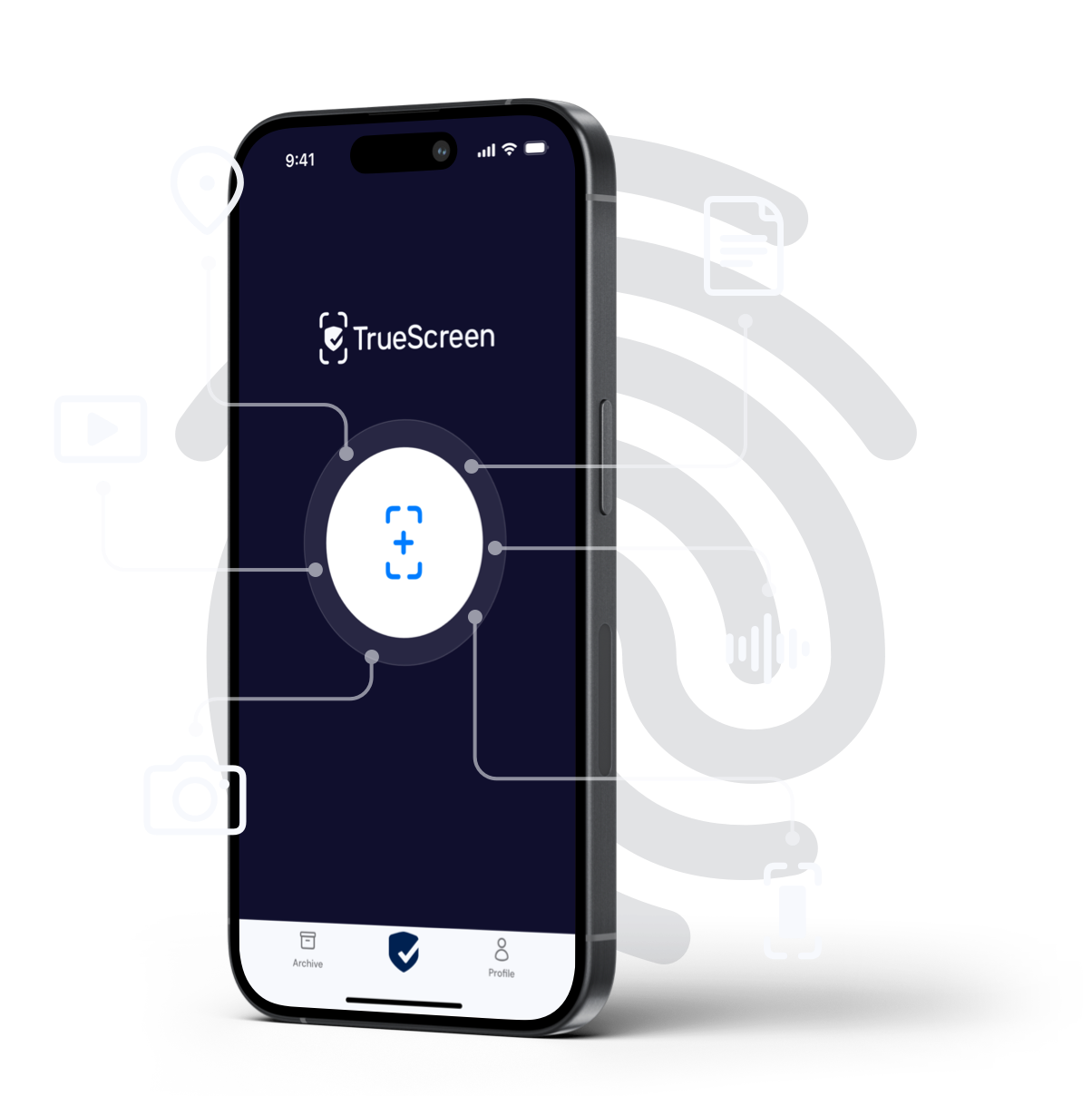
Preserving misconduct evidence means capturing each item at its source, with a record of how and when it was captured, before anyone takes a disciplinary step. ISO/IEC 27037:2012 splits the handling of digital evidence into four stages: identification, collection, acquisition and preservation. Content captured in real time is certified as a forensic acquisition and carries higher evidentiary value than an imported file. TrueScreen captures chats by recording the phone screen in its app or by opening WhatsApp Web in the Forensic Browser, and certifies emails forwarded to a dedicated address from senders enabled for it.
Each type of evidence has its own weak point, so each needs its own capture method.
The table shows how evidence is usually gathered in an employee misconduct investigation, where that breaks down and what to do instead.
| Evidence type | Common capture | Risk when challenged | How to fix it |
|---|---|---|---|
| Chats on a phone | Screenshots forwarded to HR | Cropped or out of context; no proof of sender or date | Screen recording in the TrueScreen App while scrolling the conversation |
| Chats on a computer or WhatsApp Web | Screenshots or an exported chat file | The export can be edited; no source shown | WhatsApp Web opened in the Forensic Browser, which also captures network traffic and attachments |
| Forwarded message or PDF printout | Headers lost; sender and dates disputed | Forward to the workspace address (enabled senders only): original .eml, SHA-256 for each attachment, SPF, DKIM and DMARC results | |
| Photos and videos of an incident or inspection | Manager’s camera roll, sent by message | Metadata stripped; time and place disputed | Real-time capture in the TrueScreen App with certified GPS position and time |
| Witness statements | Notes typed up afterwards | “That’s not what I said” | Notes read back and signed by the witness the same day |
| Online interview | The platform’s own recording, or none | Incomplete or edited; nobody can verify it | A TrueScreen virtual assistant records it; certification starts when the meeting ends |
Lawful sources and privacy come first
Certified evidence from an unlawful source is still unlawful evidence. The colleague in the WhatsApp case belongs to the group and shows the chat voluntarily, so she is a lawful source; an employee’s personal phone is off limits. In Europe, GDPR article 88 lets member states set specific rules for employee data, alongside transparency and data minimization. The UK regulator’s guidance on monitoring workers allows covert monitoring only in exceptional cases of suspected crime or gross misconduct, time-limited and never in private areas. If the case started from a report, Directive (EU) 2019/1937 adds confidentiality for the reporter and protection from retaliation. The employer remains the data controller, and TrueScreen acts as processor.
-
Secure the evidence as soon as you learn of it
Capture the evidence the day it reaches you, while the chat still exists and the scene looks the same. The certified date works both ways: it proves the evidence existed that day, and that the employer had it from that day. Depending on the jurisdiction, an unexplained gap of weeks before the first disciplinary step can weaken the employer’s position, so plan the next steps at once.
-
Capture in real time instead of importing
An imported screenshot or chat export can still be certified, but the certificate proves only what the file contained from that moment on, not how or when the conversation took place. In the site supervisor’s case, the inspector shoots photos and videos during the inspection with the TrueScreenmobile app, which checks device, environment and metadata before sealing, certifies the GPS position and rejects mock locations (more in our guide to certified photos).
-
Keep the package intact and ready for review
File each certified package exactly as produced and work on copies. Anyone can verify it with standard tools, so counsel or an expert can check it without taking your word for it.
Investigation interviews: notes, recordings and consent
An investigation interview is the meeting where the investigator hears the employee under investigation or a witness and records what each says. Its record is often the most contested document in the file, and under GDPR article 88 each EU member state may set its own rules for employee data. TrueScreen certifies interviews held on Zoom, Google Meet, Microsoft Teams, Slack and Cisco WebEx through a virtual assistant that records audio and video once participants admit it.
The interview record should be something both sides can check: signed notes in a room, a certified recording online.
Interview notes signed by the interviewee
Two company attendees work best: one asks, one writes. Read the notes back, let the interviewee correct them and ask them to sign; if they refuse, note it. A scan of the signed notes can then be certified as a file.
Can an employer record an investigation interview?
In many jurisdictions an employer can, as long as everyone is told before the recording starts. Consent is a weak legal basis in employment because of the imbalance between the parties, so the employer should set the legal basis, purpose and retention period with its DPO or counsel, and collect consent where local law or policy requires it. Our analysis of recording a meeting without consent covers the GDPR side.
Interviews held online
For an employee investigation run over video, paste the meeting link into the Portal or the app and a TrueScreen virtual assistant joins. Participants must admit it, it records audio and video, and certification starts when the meeting ends. A meeting that has already ended can’t be certified; an optional transcript arrives afterwards in PDF and JSON, never live. The organizer informs participants and collects consent where required. More on online meeting certification and certified meetings in employment disputes.
How is evidence in an internal investigation certified?
TrueScreen, the Data Authenticity Platform, certifies chats, emails, photos, videos and online meetings with a forensic acquisition sealed by an official digital seal and a qualified timestamp, recognized internationally. The seal is a qualified electronic seal and the timestamp a qualified electronic timestamp under the EU eIDAS Regulation (No 910/2014), and anyone can verify the package with standard tools.
Certification records how and when each item was captured; whether the conduct is misconduct is for the employer, and later the tribunal, to decide.
Chats and emails
Chat certification is the forensic acquisition of a conversation as it appears on screen: the TrueScreen App records the phone while you scroll, and the Forensic Browser captures WhatsApp Web with attachments and network traffic. With Mail Certification, you forward a message or copy the workspace’s dedicated address, with nothing to install, and TrueScreen certifies only emails from senders enabled for that address; the original is kept as .eml, each attachment gets a SHA-256 fingerprint, and the report includes SPF, DKIM and DMARC results and all original headers.
Legal value and limits
Content certified with TrueScreen carries full legal and evidentiary value worldwide, evaluated case by case: admissibility and weight vary by jurisdiction, and no outcome is guaranteed. Under eIDAS a qualified timestamp or seal has no fixed expiry: validity is assessed when the evidence is checked, and long-term verifiability can be renewed through re-timestamping and preservation.
Tampering is prevented during acquisition and detectable afterwards, but certification guarantees the how, not the what: a certified photo proves when and where it was taken, not what the scene means. Any evidence can be challenged, and certification doesn’t replace a forensic expert. In the supervisor’s case, counsel checks the certified photos, the online interview and the signed notes before the first disciplinary step.
Conclusion
An internal investigation is only as strong as the evidence it collects, and most of that evidence starts out fragile: screenshots, camera roll photos, notes typed up days later. Capture each item at its source, from lawful sources, in real time where you can, and keep the certified package intact for counsel. Then act without delay, because the date that proves when the evidence existed also proves when you had it. Certification shows how and when content was captured; whether the conduct is misconduct remains for the employer and, if challenged, the tribunal to decide. This article is general information, not legal advice.
FAQ: internal investigation questions answered
What is an internal investigation?
An internal investigation is a fact-finding process an organization runs on its own initiative to establish whether an employee broke the law, a policy or the code of conduct, ending in a report and a decision. Tips are the most common starting point: the ACFE’s Occupational Fraud 2026 report found that 43% of frauds were detected through tips, and 55% of those tips came from employees.
What triggers an internal investigation?
Many begin with a report from an employee, a customer or a whistleblowing channel, others with an audit finding, a safety inspection or a log anomaly. According to the ACFE (2026), tips uncover nearly three times as many frauds as the next method. When the trigger is a report, Directive (EU) 2019/1937 requires confidentiality for the reporter and protection from retaliation.
What happens in an internal investigation?
The HR investigation process usually runs from scope and evidence preservation to interviews, the internal investigation report and the decision, and the employee can respond to the allegations first. In the ACFE’s 2026 study, 68% of fraud perpetrators were fired, so the file has to hold up if the decision is challenged.
What is the best way to preserve evidence in an internal investigation?
Capture each item at its source, in real time, before any disciplinary step, in line with the ISO/IEC 27037 guidelines. TrueScreen does this with a forensic acquisition of chats, emails, photos and videos, sealed with an official digital seal and a qualified timestamp, recognized internationally. Admissibility is still assessed case by case.
Can an employer record an investigation interview?
In many jurisdictions, yes, if every participant is informed before the recording starts. Consent is a weak legal basis in employment, so the employer, as data controller, should set the legal basis and retention period with its DPO or counsel, and collect consent where local law requires it. The UK regulator’s monitoring guidance allows covert monitoring only in exceptional cases of suspected crime or gross misconduct.
Sources and verification
Every figure and principle cited here links to its source, listed with type and date. Links checked on the publication date.
| Source | Type | Date | What it supports |
|---|---|---|---|
| ACFE, Occupational Fraud 2026: A Report to the Nations | Survey | 2026 | Detection by tips, share of tips from employees, median loss, typical duration, share of perpetrators fired |
| ISO/IEC 27037:2012 | Standard | 2012 | Guidelines for identification, collection, acquisition and preservation of digital evidence |
| Federal Rules of Evidence, Rule 901 | Law | 2011 | Authentication requirement as an example of the burden on the party offering evidence |
| GDPR, article 88 | Law | 2016 | Processing of personal data in the employment context |
| ICO, Employment practices and data protection: monitoring workers | Document | 2023 | Limits on covert monitoring of workers, as a benchmark |
| Directive (EU) 2019/1937 on whistleblower protection | Law | 2019 | Confidentiality and protection from retaliation when an investigation starts from a report |
| Regulation (EU) No 910/2014 (eIDAS) | Law | 2014 | Qualified electronic seal (art. 3(27)) and qualified electronic timestamp (art. 3(34)) |
Certify investigation evidence before you act
Capture chats, emails, photos, videos and online interviews with a forensic acquisition, an official digital seal and a qualified timestamp, recognized internationally, so counsel can verify every item before the disciplinary step.

TrueScreen editorial team
This section is edited by the TrueScreen editorial team, which brings together expertise in digital forensics, the law of digital evidence and regulatory compliance. Every article is checked against primary sources: legislation, published rulings, technical standards and official documentation, always cited in the text.


