
Certified digital whistleblowing reports: balancing evidence and anonymity under the EU Directive
Directive (EU) 2019/1937 has reshaped how organisations handle internal reports across all 25 Member States that have transposed it so far. Companies above 50 employees and the entire public sector must now offer secure channels to receive and manage reports of breaches: in writing through a dedicated platform, or orally via phone hotline or in-person meeting. Compliance teams face a delicate balance: protect the reporter's identity as the directive demands, while preserving the report itself in a form that can stand as evidence in internal investigations, disciplinary proceedings, or downstream litigation.
The challenge runs deeper than tooling. A report captured without forensic methodology is exposed on two fronts: integrity of content (was it altered? when? by whom?) and authenticity of the process (was it really collected as the regulatory framework requires?). The reasonable answer is certification at source: capture the report with a qualified electronic timestamp, an electronic seal from an integrated QTSP, and a tracked chain of custody, while keeping the reporter's identity strictly separate from the event data.
This insight is part of our guide: Employment Disputes and Certified Meetings: Dismissals, Disciplinary Actions, Whistleblowing
What Directive (EU) 2019/1937 requires from internal reporting channels
The directive sets minimum standards for all Member States and pairs internal channels with an external channel at the competent authority. Three requirements run in parallel: confidentiality of the reporter's identity (and any third parties named), traceability of reports as potential evidence, and defined response timelines (acknowledgement within 7 days, follow-up within 3 months). Reports must be stored "in a durable manner allowing further investigation," which the European Commission's guidance on whistleblower protection reinforces alongside GDPR compliance.
Article 18 of the directive obliges organisations to keep a register of reports compatible with confidentiality and data protection. In many jurisdictions this register, in case of dispute, has to be produced as evidence without after-the-fact reconstructions. Retention rules vary by transposition law: in Italy, Legislative Decree 24/2023 allows retention up to five years from final outcome; in Germany, the Hinweisgeberschutzgesetz sets three years as a baseline. Whatever the jurisdiction, the report must survive intact through manager rotations, backup cycles, audits and, often, judicial proceedings.
Three common failure modes of "do-it-yourself" channels
- Post-hoc tampering: a textual report stored in a corporate database can be reworded or amended before being handed to authorities or the defence.
- Disputed timestamps: without a qualified electronic timestamp, the date of a report relies on system metadata that the opposing party can challenge.
- Loss through turnover or backup mishaps: non-immutable backups and rotating channel managers can dissolve the evidence at the moment it matters.

Anonymity and probative value: how to keep them together in digital reporting
The technical core of certified whistleblowing reports lies in architecture: separating the content of the report from the profile of the reporter, and certifying only the first. Compliant platforms generate a unique code handed to the reporter, who can come back to add details, respond to follow-up requests, and read the outcome without ever exposing their identity. As recent academic research on whistleblower anonymity frameworks highlights, decoupling identity from evidence is the only sustainable way to reconcile the two requirements.
Forensic certification kicks in at the content layer: the voice recording, the transcript, the photo attachment or the uploaded document are captured with forensic methodology, sealed with a qualified electronic timestamp and the system's electronic seal, and stored immutably. ISO/IEC 27037 provides the international reference for digital evidence handling, while eIDAS Articles 41 and 42 set the legal weight of qualified electronic timestamps and electronic seals across the EU.
A practical example clarifies the flow. An employee files a report orally, through a recorded session on the internal channel, about irregular conduct in the management of a public tender. The platform captures the voice, computes the file's hash, applies a qualified electronic timestamp and an eIDAS seal via integrated QTSP. The reporter receives a code allowing them to track the case. Six months later the company opens an internal proceeding. The recording is replayed in the hearing: certain date, verifiable integrity, untouched content. The reporter's identity stays protected in the platform's separate vault, accessible only to the channel manager and only on judicial mandate.
Table: what to certify and how
| Report element | Required protection | How it is certified |
|---|---|---|
| Textual content | Integrity and certain date | Hash + qualified electronic timestamp |
| Audio or video recording | Source authenticity | Forensic capture + QTSP electronic seal |
| Attachments (photos, PDFs, emails) | Chain of custody | Per-file hash + immutable access log |
| Reporter identity | Confidentiality | Pseudonymisation + restricted access |
| Communications with channel manager | Proof of timely response | Qualified timestamp on every message |
Where do-it-yourself channels typically fail
Many organisations build internal solutions on top of encrypted email or in-house portals. They tend to work for confidentiality and rarely for evidence: qualified timestamps, eIDAS seals and immutable logs that prevent the channel manager from editing records are usually missing. When litigation arrives, the defence can challenge the authenticity of a file stored on a shared folder and argue that the report's content could have been changed after capture, as the broader literature on digital evidence in employment disputes consistently underlines.
How TrueScreen supports certified whistleblowing reports
TrueScreen applies its forensic methodology to whistleblowing channels to close the gap between confidentiality and probative value. Reports and their attachments are captured with digital forensic techniques, sealed via a qualified QTSP integrated through API, and stored immutably on infrastructure that does not allow alterations even by the channel manager.
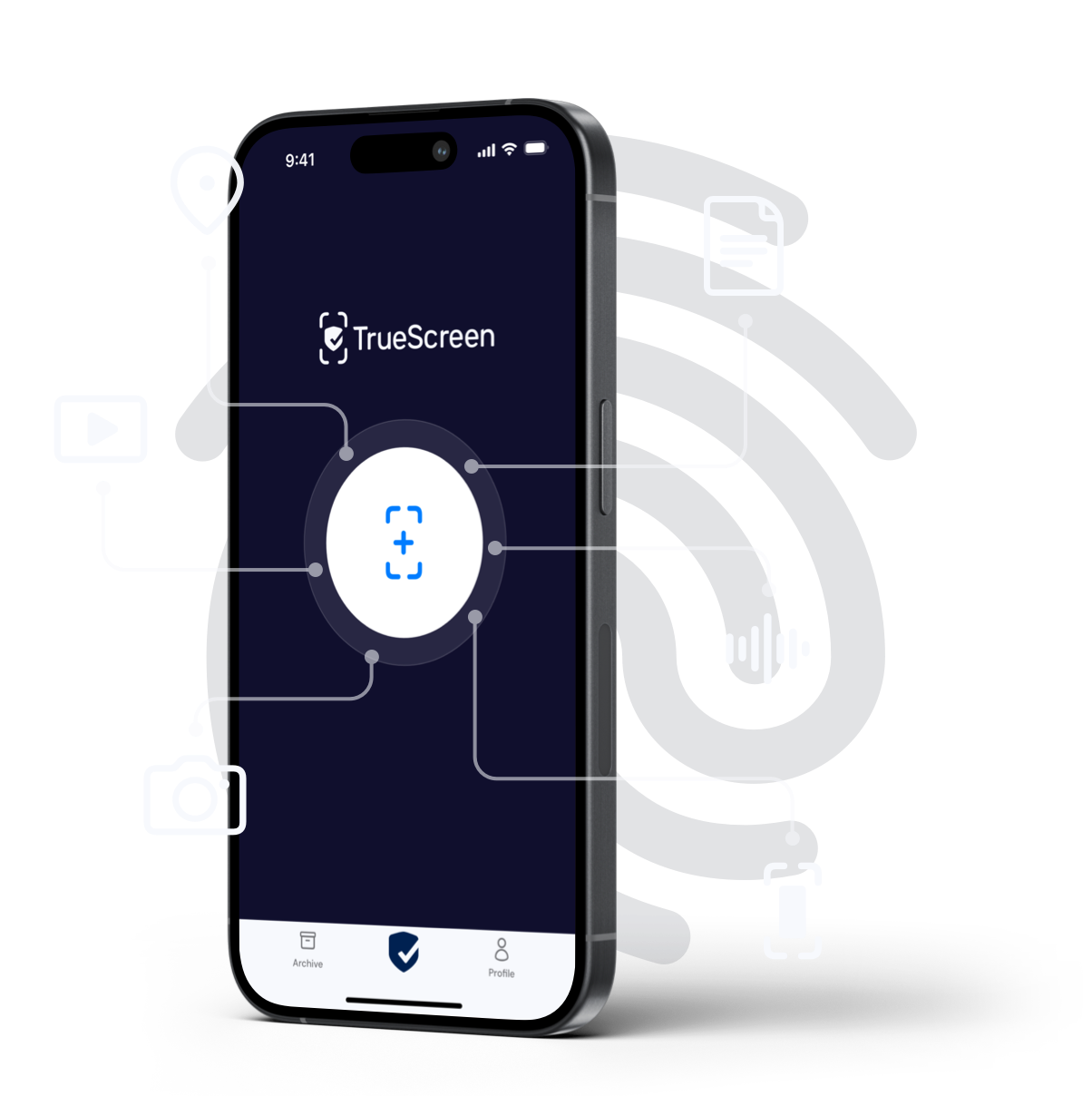
Operationally, organisations integrate TrueScreen alongside existing whistleblowing platforms in three ways: the mobile app for on-the-go reports with certified photos, videos and geolocation; APIs to plug forensic certification into the compliance platforms already in place; the web portal for video hearings between reporters and channel managers, with recordings captured and sealed at source. Digital Provenance remains in every step the element that makes the origin and history of each document verifiable.
Typical patterns across European companies: a multinational in the energy sector integrated TrueScreen with the group's whistleblowing platform for certified remote hearings; a law firm running the channel for private clients uses APIs to apply seal and timestamp to oral report transcripts; a public administration extended certification to follow-up emails between the corruption-prevention officer and the reporter, preserving confidentiality with a pseudonym scheme.
FAQ: certified whistleblowing reports
Can an anonymous report really hold probative value?
How long should reports be retained, and in what form?
How do you certify an oral report or a video hearing?
TrueScreen editorial team
Published on · Updated on
This section is edited by the TrueScreen editorial team, which brings together expertise in digital forensics, the law of digital evidence and regulatory compliance. Every article is checked against primary sources: legislation, published rulings, technical standards and official documentation, always cited in the text.


