
Apple Reference Image: Authenticity Is Built at Source, Not Detected Afterwards
Updated on
Apple calls its new photo authentication work “vital for photojournalists, photographers, and everyday viewers”. Apple Reference Image, announced on 9 September 2026 with iPhone 18 Pro and iPhone 18 Pro Max and on sale from 18 September, signs what the camera sensor sees, pixel by pixel, at the instant of capture. No mainstream smartphone has done that before.
Most of the commentary since has asked one question: is a sensor-signed photograph proof? It is a fair question, and the answer below is a clear no, with the reasons laid out one by one. But it is the smaller question. The larger one is what Apple’s choice says about where authenticity is heading, because the most influential device maker in the world has just stopped trying to recognise fakes after the fact and started building trust at the moment the data is born.
That is the right approach. It is the approach the open standards community reached with C2PA, the one Google, Leica, Nikon, Canon and Sony have already put into cameras, and the one TrueScreen has followed from the start: guarantee authenticity at source, on every kind of content, instead of guessing at truth downstream. Apple has now applied it to one camera on two phone models, with real limits in what the signature attests, how it travels and how many devices will carry it. Those limits matter, and they are exactly why a data authenticity platform matters more today than it did a week ago: it makes the same approach available to anyone who has to rely on data, on any device, now.
What Apple Reference Image does
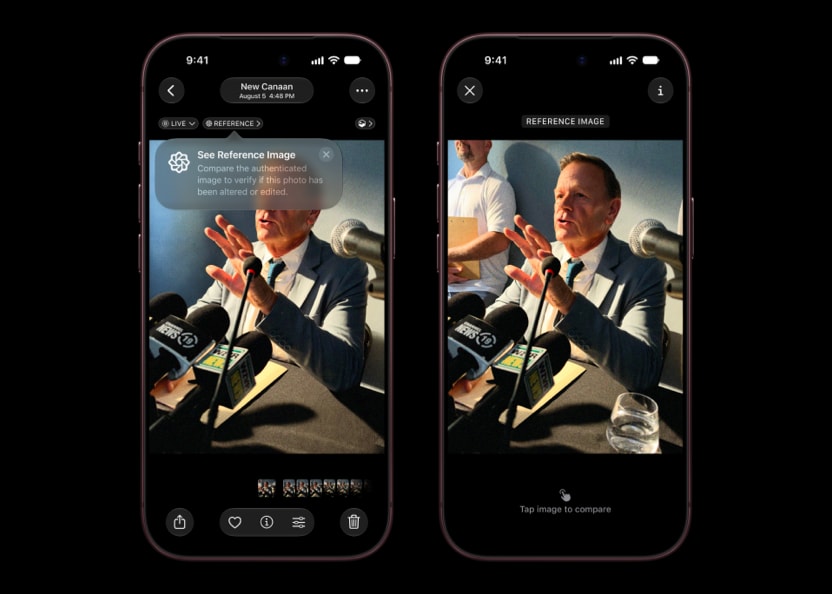
Apple Reference Image is an opt-in camera mode on iPhone 18 Pro and iPhone 18 Pro Max that signs sensor data at the moment of capture. Private Cloud Compute develops that signed data into what Apple calls an “unalterable reference image”, which sits in the Photos app next to the edited picture so the two can be compared side by side.
The feature was announced on 9 September 2026 alongside iPhone 18 Pro and iPhone 18 Pro Max, on sale from 18 September in more than 65 countries and from 25 September in another 20. It works only on the Main camera of those two models, and only once you switch the camera into the new Reference mode, which ships disabled. Apple’s own analogy is “like having a digital negative”: the reference image appears alongside the main image, so you can compare the two and determine whether any edits were made. APIs in iOS 27, iPadOS 27 and macOS 27 let third-party apps display reference images. None of this relates to ARKit’s ReferenceImage class, an image-tracking API for augmented reality that shares only a name.
Signing at the sensor, and the digital negative
What matters technically is where the signature happens. According to MacRumors, the sensor signs at the pixel level before the image pipeline has touched anything, so every stage downstream runs after a signed record already exists.
That is what the digital negative metaphor reaches for. The negative was what you went back to when someone disputed a print, and its authority came from being the thing the light actually hit. It inherits the original’s limit as well: a negative never told you whether the scene had been staged. Apple is precise on this, and the precision is to its credit. The feature provides “an unalterable reference photo, visually confirming what the sensor saw at the moment of capture”. What the sensor saw, not what was real.
Why detection downstream has already lost
For a decade the industry’s answer to manipulated and synthetic media has been detection: take the suspect file, run it through a classifier, hope the classifier is right. The numbers say it is not working, and the reason is structural rather than a matter of better models.
Generated-image detectors report 94% to 97% accuracy in laboratory conditions. Independent testing finds accuracy falls below 50% on real-world files and below 5% once an image has been recompressed, cropped or passed through a social platform, which is what happens to almost every image before it reaches anyone who has to decide on it. A coin toss is not a control. Fraud professionals know it: research published by ACFE and SAS in March 2026 found that only 7% of anti-fraud professionals consider their organisation more than moderately prepared to detect or prevent AI-enabled fraud, and in insurance specifically not one respondent reported confidence above moderate. Verisk’s State of Insurance Fraud report of 17 March 2026 shows the same from the other side: 98% of insurers say AI editing tools are fuelling digital fraud, 76% say the manipulated material they receive has grown more sophisticated, and just 32% are very confident they can recognise a deepfake.
Detection asks a machine to spot what is false, after the fact, on a file whose history is unknown, against tools that improve every month. That contest cannot be won by the defender, because every improvement in generation resets the detector, and the cost of checking rises while the cost of faking falls.
Authenticity at source: the approach Apple has just confirmed
Signing at origin inverts the problem. Rather than asking whether a file is false once it has travelled, you establish what is true at the moment it comes into existence, the only moment when establishing it is cheap, and you carry that record forward. Nothing downstream needs to guess. The question shifts from “does this look manipulated?” to “was this born under a control, and has it been touched since?”, and the second question has a verifiable answer.
This is the logic of digital provenance, and it is not new. What is new is Apple putting it into the sensor of a phone that will sell in the tens of millions, with a signature that exists before any software has seen the pixels. Truepic, which has authenticated images commercially for years, read the announcement the same way and called the reference image another strong signal feeding its own risk assessment. That is the correct reading: a stronger input for everyone working on data authenticity, not a rival to it.
An industry converging on the same answer
Apple is the latest arrival, not the first. C2PA, the open standard for content provenance, now counts more than 500 member companies. Leica, Nikon, Canon and Sony have built Content Credentials into their cameras, and Google adopted the standard for the Pixel 10. Apple, as 9to5Mac reported in August 2026, appears for now to be going its own way rather than joining, which raises questions about interoperability that the next section takes seriously. But on the principle there is no disagreement left: the serious players in imaging have all concluded that trust is established at capture or not at all.
That convergence is the story. When the hardware makers, the standards bodies and the verification specialists all move the control upstream at the same time, the approach stops being a niche practice and becomes the expectation. Every organisation that receives photographs, videos, documents or web content will be measured against it sooner than it expects.
The approach TrueScreen was built on
TrueScreen, the Data Authenticity Platform, has worked this way from the beginning: content is acquired at source, inside a defined process, with a forensic methodology aligned with ISO/IEC 27037, verified during acquisition rather than examined afterwards, and certified with an official digital seal and timestamp, internationally recognised under the eIDAS framework. The platform reads and writes C2PA manifests as a matter of course, and a reference image, where one exists, is one more signal it can consume along the data lifecycle. Apple did not invent the principle. It confirmed, at the scale only Apple can, that the principle is where the field is going.
What a signed photograph does not settle
Praising the direction does not mean pretending the feature is finished, and Apple itself does not claim it is. A sensor signature answers one evidentiary question, the integrity of the data from the sensor onwards, and leaves several open. Anyone planning to rely on it needs the full list.
A sensor cannot tell a scene from a picture of a scene
A camera sensor measures light arriving at a plane. It has no model of the world behind that light, and no way to ask whether the photons came from a street or from a display pretending to be one. Shoot a photograph on any device, edit it however you like, display the result full-screen and photograph the screen in Reference mode: what comes out is a perfectly valid reference image of altered content. Nothing was forged and no cryptography was broken. The camera did what it promised, on a subject that happened to be a lie.
The attack is unglamorous, which is exactly why it will be used. Verisk’s survey found that 55% of Generation Z respondents would consider digitally altering a claim image or document. People willing to do that are not stopped by a feature that photographs whatever you put in front of it. There is a second-order risk too, and it is the more serious one: a feature built to increase trust can end up lending credibility to altered content, because the authenticity label attaches to the capture while the reader attaches it to the subject. That gap between what is attested and what is understood is where a determined fraudster works.
Everything that could separate a scene from its reproduction lives outside the signature: moiré from the display grid, a flat depth field, reflections on glass, refresh-rate banding, the spectral signature of backlighting rather than daylight. These are artefacts of the acquisition environment, not properties of the signed data, and reading them means analysing the capture context with multi-signal analysis and control over the conditions in which capture happens. The same gap explains why authentic images used out of context remain such effective disinformation.
The screenshot, and a signal that only works in the positive
The re-capture is not even the simplest route around the control. Take a photograph in Reference mode, alter it with an AI editing tool, then screenshot the result. The screenshot is a new file with no reference image attached, no trace of the edit, and nothing that points back to the signed original. The person who made it is not exposed by this: they produce a file that looks like almost every other file in circulation, because while the overwhelming majority of the world’s images are born unsigned, a missing signature carries no information. The presence of a reference image is a point in favour, its absence is not a point against, and no verification process can rest on that asymmetry.
Re-capture from a screen, edit and screenshot, forwarding through a channel that strips the pairing, presenting a genuine reference image of a staged scene: there are many ways around a control that lives only in the sensor, and none of them requires any technical skill. That is the practical reason a sensor signature has to be used inside a complete and rigorous forensic methodology rather than on its own. Inside such a process it is a valuable signal, because the process controls the capture environment, records the operator and the moment, and documents what happened to the file afterwards. On its own it answers a question the fraudster can simply avoid being asked.
Proof that does not travel
A reference image is useful where it lives and largely invisible once the photograph leaves. The verification asset is paired with the original inside Apple’s environment, and Apple has not said whether that pairing survives export. In practice a photograph reaches a claims inbox, a newsroom or a legal team over email, a messaging app, a client portal or a shared drive, and most of those paths recompress the image, strip metadata, or both. A verification asset living in the sender’s Photos library is a different category from editable EXIF, but it shares one weakness: it is not in the file you received. If verifying the photograph means going back to the originating device, what you have is a property of the sender’s environment rather than of the evidence.
The verification interface is visual as well. You open the reference image next to the main image and judge whether edits were made. For a photographer checking their own workflow that is adequate. For anything contested it is not, because a visual judgement is made by a person, at a moment, and leaves no artefact behind. What holds up under challenge is an examination someone else can reproduce: cryptographic hashes computed over defined content, recorded at a defined time, checkable by anyone holding the file.
And unlike C2PA, which embeds provenance metadata inside the file so that anyone with a conforming reader can inspect it, Apple Reference Image is tied to Apple’s hardware and to Private Cloud Compute, and offers third parties a viewing API rather than an independent cryptographic check. Viewing is not verifying. For a process that has to satisfy an adversary the distinction decides everything. C2PA has its own limits as an evidentiary instrument, starting with the fact that a manifest describes a file’s declared history and stops there, which is why the forensic guarantee goes further than either: it documents who performed the acquisition, when, and in what circumstances.
No timestamp, no operator, no custody
Knowing when a photograph was taken is usually more contested than knowing what it shows. Whether the damage predates the policy, what condition a property was in at handover, who documented a design first: these are questions about a moment, and a device clock settles none of them, because the party relying on it also controls it. What settles them is a timestamp issued by an independent third party, verifiable without reference to the device that produced the file. Apple Reference Image does not include one.
The signature authenticates hardware, not a person. A surveyor’s photograph carries weight because a named surveyor took it during a named inspection at a named address; strip out the operator and the circumstances and you are left with an image that is technically intact and evidentially thin. And everything after the shutter falls outside the feature’s scope: where the file was stored, who accessed it, what was exported, which copy was produced and by whom. A reference image describes a single instant, custody covers every instant since, and admissibility of digital evidence usually turns on the second more than the first.
| Evidentiary requirement | What Apple Reference Image covers as of September 2026 | What completes it |
|---|---|---|
| Integrity of the content from capture onwards | Covered. Signed sensor data developed into an unalterable reference image | The same, plus a hash computed over the acquired content |
| Proof of when the capture took place | Not covered. No timestamp a third party can verify independently | An official digital seal and timestamp, internationally recognised under eIDAS |
| Proof of who performed the capture | Not covered. The feature authenticates a device, not a person | Recorded identity of the operator and of the circumstances of acquisition |
| Proof that the subject was a real scene | Not covered. A re-capture from a screen yields a valid reference image | Controls over the acquisition environment and multi-signal analysis |
| Custody of the file after the shutter | Not covered. No documented tracking of subsequent handling | A documented chain of custody consistent with ISO/IEC 27037 |
| Independent verification by a third party | Partial. Viewing APIs support visual comparison | A self-contained report a third party can check without the original device |
| Coverage of the material actually received | Two models, Main camera, opt-in, EU capture unavailable at launch | A methodology independent of device, platform and content type |
How far it reaches: only iOS, only Pro, only new hardware
The second set of limits is about reach rather than substance, and it decides how long the feature will take to matter in practice. Apple Reference Image depends on a new sensor rather than a software update, it is restricted to two models and one camera, it is off until the user turns it on, and it cannot be applied to anything that already exists. Together those constraints put meaningful coverage of the world’s photographs years away.
| Factor | Figure | Source |
|---|---|---|
| iOS share of the global mobile OS market | 29.25% | StatCounter, early 2026 |
| Android share of the same market | 70.36% | StatCounter, early 2026 |
| Pro models as a share of early iPhone 17 sales | 52% (Pro Max 27%, Pro 25%) | Counterpoint Research |
| Pro models across the whole iPhone 16 generation | 39% | Counterpoint Research |
| Average smartphone replacement cycle | 3.7 years in 2026, up from 2.9 in 2022 | SellCell |
| Users who keep a device at least three years | 68% | SellCell |
| Average US retirement age of a handset | 3.84 years in 2025, the highest on record | SellCell |
| Devices able to produce a reference image today | iPhone 18 Pro and 18 Pro Max, Main camera, opt-in | Apple Newsroom, 9 September 2026 |
New silicon, not a software update
No iPhone already in circulation will ever produce a reference image. The capability comes from the sensor in the Main camera of the iPhone 18 Pro line, so the feature spreads only as fast as people buy new hardware. It also rules out retroactive use: no photograph already sitting in an archive can be given a reference image after the fact, and no process that depends on existing material can lean on it.
Device turnover is measured in years
Apple sells roughly 230 million iPhones a year and Pro models account for between 39% and 52% of them depending on the generation, which puts new signing-capable devices at fewer than one hundred million units a year against a global installed base of more than five billion smartphones. Call it a couple of percentage points of the world’s phones annually, on the optimistic assumption that every buyer switches on a mode that ships disabled. Replacement cycles are lengthening, not shortening, so the tail is long at both ends.
In the EU, capture does not start at launch
Apple’s own footnotes set the perimeter. In China the feature will not be available at launch because of regulatory requirements. In the EU, capture will not be available at launch on iPhone 18 Pro models, although users on iOS 27, iPadOS 27 and macOS 27 will be able to develop and view reference images. For a European organisation that is the operative fact: at launch you can look at reference images produced elsewhere and you cannot create any.
Apple has also said SynthID support will arrive later in 2026, covering most edited images depending on the edits applied. That sits alongside the transparency obligations of the EU AI Act, whose Article 50 has applied since 2 August 2026, with a grace period agreed politically on 6 May 2026 and confirmed by the Council on 13 May 2026 that runs to 2 December 2026 and covers only the machine-readable marking duty in Article 50(2). Labelling duties and evidentiary weight are separate problems, and meeting the first does nothing for the second.
Meanwhile the data keeps arriving from everywhere else
Consider what actually reaches your organisation this month: Android devices, every non-Pro iPhone, every older iPhone, dashcams, CCTV exports, drones, compact cameras following no provenance scheme at all, plus everything forwarded from the web, from chat apps and from old archives, plus the videos, screenshots, web pages and documents that a photo feature does not touch at all. Almost none of it can be signed at the sensor, and none of it retroactively. Someone processing insurance claims where AI manipulation is now routine cannot tell a policyholder to come back once they have bought a particular phone.
None of this is a criticism of Apple, and it is worth being explicit about that. More manufacturers signing at origin makes the whole field stronger. The point is that the approach is right and the coverage is narrow, and the people who receive data now need the approach, not the coverage.
Why this is good news for anyone who relies on data
Here is the part the defensive readings miss. Claims handlers, litigators, compliance officers, picture editors and procurement teams do not take the photograph. They receive it from someone they have never met and have to decide whether to act on it. For them, Apple’s move changes the terms of that decision in their favour, in two ways.
First, it sets an expectation. Once a mainstream device can attest its own capture, “in what conditions was this created?” becomes a reasonable question to ask of any piece of data, and an organisation that asks it, and structures its intake so that the answer exists, is no longer the awkward one in the room. Second, it settles the argument about method. Anyone who has been telling their board that detection tools cannot carry an evidentiary process now has Apple, Google, Sony and the C2PA membership saying the same thing with their product roadmaps.
| Who receives the data | What changes now that authenticity at source is the expectation |
|---|---|
| Insurance claims | Photographs and videos of damage can be required to be born under a control, instead of screened for manipulation after the fact |
| Legal and litigation | The question moves from “is this file genuine?” to “can the acquisition be verified by the other side?”, which a documented process answers in advance |
| Compliance and audit | Evidence of a state of affairs at a date (a web page, a document, a communication) can be produced with a verifiable timestamp rather than a screenshot |
| Newsrooms and media | Provenance signals from cameras and phones become inputs to a verification workflow that no longer depends on a single vendor |
| Procurement and supply chain | Inspections, deliveries and site conditions can be documented so that the record, not the relationship, carries the weight |
The organisations that build their processes on this principle today will already be where the market is heading when signed capture becomes ordinary. The ones that wait will be verifying by eye for years.
A Data Authenticity Platform makes authenticity at source available to everyone, today
Apple guarantees origin for one camera on two phones, for photographs, inside its own ecosystem. The need is for every device, every content type, every organisation, and a result that a third party can check without asking anyone for access. That is what a data authenticity platform is for, and it is what TrueScreen does: it acquires photos, videos, web pages and documents at source with a forensic methodology, so that the same principle Apple has just put into silicon applies to the whole of an organisation’s data, now, with what a sensor signature by its nature cannot carry.
Four elements, applied in order, turn a piece of content into something that survives being challenged: controlled capture at source under ISO/IEC 27037, verification of environment and content during acquisition, a report an independent party can check, and certification with an official digital seal and timestamp, internationally recognised under eIDAS. Acquisition, verification, reporting and certification are four stages of one process rather than four separate tools. Where a reference image or a C2PA manifest exists, it is an additional signal along the data lifecycle, consumed like any other input. Where it does not exist, which is most of the time, the process still works. The outcome for an organisation reads as three properties of its data.
Secure
Content is acquired inside a defined process, with the conditions recorded as part of the act and the content hashed as it is acquired. During acquisition the process prevents alteration; afterwards any alteration is detectable by comparing the file against its recorded cryptographic values. Those are two different claims, worth keeping apart, because nothing digital is beyond alteration and the useful question is whether it would be caught. Verification at acquisition is also where a reproduction in front of the sensor gets caught, and where a device reporting a time or location inconsistent with its own behaviour gets flagged, hypotheses that are unreachable once a file has passed through three intermediaries. Every subsequent handling step is recorded, so the file produced today ties without gaps to the one created at the moment of capture.
Compliant
The methodology follows ISO/IEC 27037, the international standard for the identification, collection, acquisition and preservation of digital evidence. The certification attaches the result to an authority outside the parties: an official digital seal and timestamp, internationally recognised under the eIDAS framework, bind the acquired content and its report to a specific moment and an identifiable issuer, in a way that stays checkable years later. The seal makes the record attributable and the timestamp makes it dated, and neither is a product in itself. They are instruments inside a methodology: sealing a file of unknown provenance would certify only that an unknown file existed at a certain moment. For organisations facing transparency duties under the AI Act, or evidentiary standards in a dispute, the difference between a label and a certified acquisition is the difference between meeting a marking duty and being able to prove what happened.
Efficient
A forensic report sets out what was acquired, when, by whom, under what conditions and with which cryptographic values, in a form someone with no relationship to either party can evaluate. That is what removes the manual work: no back-and-forth with the sender, no expert asked to judge a retouched shadow by eye, no dependence on the originating device or on a vendor’s viewing app. Independent verification is what separates evidence from assertion, and it is also what shortens a claim, an audit or a pre-trial exchange, because if checking a claim requires the other side’s cooperation it stays a claim. Capture runs through the TrueScreen app in the field and through the platform for organisations needing the same guarantees inside their own workflows, and it covers material that already exists as well as material created today.
| Layer of authenticity | Apple Reference Image | Forensic methodology on a data authenticity platform |
|---|---|---|
| Integrity of the pixels from the sensor onwards | Signed in the sensor, on two models | Hash computed over the acquired content, on any device |
| The subject was a scene, not a reproduction | Not distinguished | Multi-signal analysis of the acquisition environment, run at capture |
| Conditions of capture | Not recorded | Acquisition inside a defined process, with conditions recorded as part of the act |
| When, where, who | Device clock only, no operator | Operator identity, circumstances, and a timestamp issued independently of the device |
| Form of the verification | Visual comparison in Photos | A self-contained forensic report with cryptographic values, checkable without the original device |
| Evidentiary weight | None standalone | An official digital seal and timestamp, internationally recognised under eIDAS |
| Custody after the shutter | Not covered | A documented chain of custody consistent with ISO/IEC 27037, covering every handling step |
| Content types and devices | Photographs, two models, opt-in, no retroactive use | Photos, videos, web pages and documents, on any device, including existing material |
| Portability | Paired asset inside one ecosystem | A report that travels with the evidence and can be verified by anyone, on any platform |
One honest boundary, before a careful reader raises it. A forensic methodology guarantees the how, not the what. If somebody stages a scene in front of the lens, a certified acquisition certifies it as an authentic capture of that staged scene, and says so precisely. The difference is not that the methodology reads reality. It is that the analysis runs on content acquired under controlled conditions, by an identified operator, at a verifiable moment, with every subsequent step recorded, instead of on a file of unknown origin that arrived by email.
One case makes both halves visible. A loss adjuster documents flood damage with an iPhone 18 Pro in Reference mode, and the insurer later disputes the date of loss. The reference image shows that the sensor saw that scene, which is genuinely more than any phone offered last month; it does not show when, and it does not exclude a photograph of a photograph taken somewhere else. Acquire the same scene through a forensic process and the file carries an operator identity, a timestamp the insurer can check against an independent authority, a record of the acquisition conditions, and a report the insurer’s own experts can verify without asking anyone for access. Do both, and the reference image becomes one more signal inside a record that already holds up.
What to do now
The practical conclusion is not to wait. Signed capture on the world’s phones is years away from meaningful coverage, and the data arriving this month comes from everywhere else. Three moves follow.
Bring capture upstream wherever the data carries weight. Identify the flows where a photograph, a video, a web page or a document ends up in a dispute, an audit or a regulatory file, and make sure that content is acquired under a control rather than received and examined. That is where authenticity at source pays for itself first.
Treat provenance signals as inputs, not verdicts. Define a policy on what your organisation accepts: a reference image, a C2PA manifest and a certified forensic acquisition are three different levels of assurance, and each should be weighed for what it attests. A signature in the sensor is a strong signal about pixels. It is not a statement about the scene, the moment, the operator or the custody.
Measure the process, not the file. The question to ask of any piece of data is no longer “does this look manipulated?” but “can a third party verify how this was created without our help?”. When the answer is yes, the argument about authenticity is over before it starts, which is what Apple, in its own way and on its own devices, has just told the whole market.
Frequently asked questions about Apple Reference Image
What is Apple Reference Image?
Is Apple Reference Image proof on its own?
Can Apple Reference Image be bypassed?
Is Apple Reference Image the same as C2PA Content Credentials?
Is Apple Reference Image available in the European Union?
What does authenticity at source mean for an organisation without iPhone 18 Pro devices?
Authenticity built at source, on every device and every kind of content
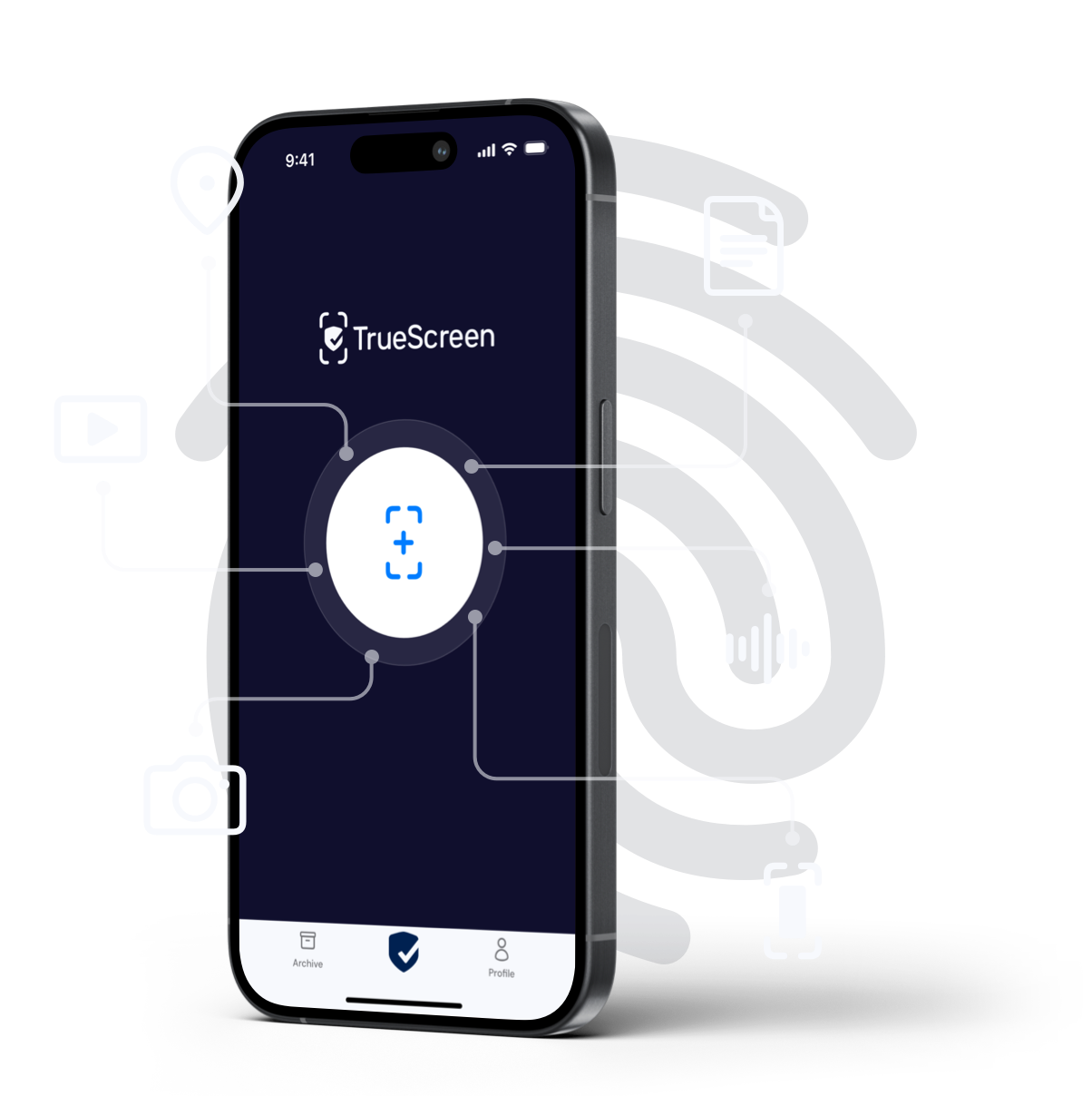
TrueScreen captures photos, videos, web pages and documents with a forensic methodology: verification during acquisition, a documented chain of custody, and certification with an official digital seal and timestamp, internationally recognised.
TrueScreen editorial team
This section is edited by the TrueScreen editorial team, which brings together expertise in digital forensics, the law of digital evidence and regulatory compliance. Every article is checked against primary sources: legislation, published rulings, technical standards and official documentation, always cited in the text.


