All content
Browse all articles and insights from the TrueScreen blog
Articles
NIS2 compliance evidence: what to keep if supervisors move from guidance to inspections
NIS2 compliance evidence for inspections: what to keep for each measure, incident and supplier, and how to prove its date and integrity.
CEO fraud: the Fideuram case, how to recall the wire transfer and document the attack
CEO fraud sent about 95 million euros out of Fideuram in a few hours. What to do next: ask for a recall, report the attack...
Possession of site: what to record in a pre-construction survey before works begin
Pre-construction survey at possession of site: what to record at commencement, how to document neighboring buildings and keep photos verifiable.
How to report an online scam: where to report it, what evidence you need and how to certify it first
Report an online scam to your bank, the platform and the police, and preserve the listing, chats and emails at the source before they disappear.

How to prove workplace bullying: what to show and in what order to collect evidence
How to prove workplace bullying: what must be shown, who bears the burden of proof and in which order to collect diaries, messages and witnesses.
How to tell if an image is AI generated: why the file cannot tell you, and what to do instead
How to tell if an image is AI generated: the file cannot say. Metadata is rewritable, Content Credentials removable, detectors near chance. What works.
Deepfake detection accuracy falls by up to 49% in a year of AI video progress
AI video detection accuracy has collapsed. The DF26 benchmark puts nine detectors near chance, the best at 69.7 AUROC, and humans at 52.6% on fakes.

Missing Trader Fraud: How to Prove the Transaction Behind the Invoice Was Real
Missing trader fraud: why invoices and bank transfers are not enough, and which time-stamped evidence proves the goods and work behind them were real.
AI-written police reports and administrative records: where the data they summarize comes from
AI-generated police reports and government records inherit the gaps of their source data. What human oversight cannot fix and how certified capture helps.

Best evidence rule and digital evidence: when a copy counts as the original
The best evidence rule (FRE 1001-1004) decides when a screenshot or export can replace the original. What a copy must prove: hash, timestamp, custody.
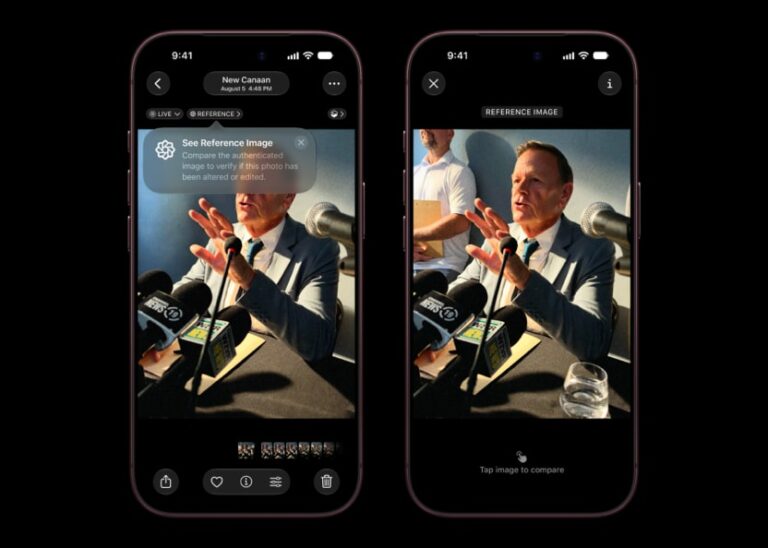
Apple Reference Image: Authenticity Is Built at Source, Not Detected Afterwards
Apple Reference Image signs photos at capture. It confirms the shift from detecting fakes downstream to building authenticity at source, and what it opens up.
Independent Verification: Why a Result Nobody Can Recheck Is Not Evidence
Independent verification of digital evidence: why a result nobody can recheck is a technical opinion, not proof that survives cross-examination.
Digital signature used without the holder’s knowledge: what verification actually proves
Verifying a digital signature confirms a valid certificate and an intact file, not who held the device. Where the burden of proof lands in a...

Authentic photos, false context: the fake no detector can find
Out of context images are authentic, so no file analysis flags them. The manipulation sits in the when and the where, not inside the photo.

Pharmaceutical serialisation: what the Data Matrix code proves and what it does not
Serialisation proves a pack is registered as genuine. It does not prove who received it, how it was stored or how it travelled.

Labeling AI content made for a client: who has to disclose it
Whoever generates content with AI is the deployer under the AI Act and stays obliged to disclose it, even when the client publishes and the...
Fake surety bonds: how to verify a guarantee and prove what you received
Fake surety bonds circulate on real insurers' letterhead: how to check the issuer against supervisory registers and keep proof of what you received.
Digital evidence in estate litigation: what survives a challenge
Digital evidence in estate litigation is attacked on authenticity before the merits. What certifying it at the moment of capture actually changes.
Event data recorder: what vehicle data is worth when a crash is disputed
Event data recorder data is admissible in the EU but carries no presumption of accuracy: what decides its weight is how it was acquired and...

How AI assistants choose their sources: verifiability as the new currency of trust
Query fan-out, retrieval and final selection: the criteria generative engines use to decide which sources to cite, and why verifiability now decides.
Insights

EXIF Metadata and Proving the Date of a Photo in Court

Bounded autonomy for AI agents: the prerequisite for insurable governance
Data provenance vs data lineage: differences, standards, and why governance needs both
Timestamp vs digital signature: what each one proves and why you need both

AI training data provenance: how to prove dataset authenticity under the AI Act
Digital surveillance and GPS tracking in private investigations: the legal framework and how to certify evidence
Superbonus fraud and digital evidence: certifying attestations after Vicenza

Image provenance in public procurement: how authorities verify BIM renderings and site photos
Online resignations: how to give legal value to formal employee communications
ANAC 2026 Whistleblowing Guidelines: Certifying Reports and Internal Channels Ahead of Privacy Authority Inspections
Hash SHA-256 and qualified eIDAS timestamping: the forensic language every law firm should master
Voice cloning CEO defense: stopping BEC 2.0 with source-certified corporate audio

Work progress photo evidence: building site documentation that holds up in appellate court

Storm 1516: anatomy of Russia’s AI disinformation machine in 2026
How to timestamp a document: practical guide and method comparison
B2B formal demand: how to prove emails, registered delivery and screenshots in court
Certifying audio recordings as court evidence: chain of custody and qualified timestamp
Remote-work information notice: how to prove delivery and meet EU compliance

Content provenance in newsrooms: a six-step verification workflow