
Digital surveillance and GPS tracking in private investigations: the legal framework and how to certify evidence
A private investigator's brief lives inside a hard constraint: the evidence collected must hold in court, otherwise weeks of fieldwork collapse along with the fee. Digital surveillance and GPS tracking are where that pressure peaks. On one side, technology lets a professional follow a subject with an effectiveness unimaginable a decade ago: live positioning, mobile tracking apps, hidden GPS loggers, photos and videos captured from a smartphone in seconds. On the other side, the civil or criminal judge demands a clear chain of custody, an authentication that withstands the opposing party's objections, evidence that cannot be accused of being manipulated.
The critical question is not "can I track with GPS?". It is: "will the data I gathered survive a probative challenge?". For licensed investigators working under European frameworks, the answer requires weaving three layers: the regulatory perimeter under GDPR and national investigation statutes, the case law on GPS as an investigative tool, and the technical chain that turns a raw file into legally robust evidence.
This insight is part of our guide: certified private investigations with legal-grade evidence
When digital surveillance is lawful: GDPR boundaries and the investigator mandate
Digital surveillance of a subject, conducted by a licensed private investigator, is lawful only when three cumulative conditions are met: (1) a written engagement from a client with a legally cognizable interest exists (pending divorce, employment dispute, suspected unfair competition); (2) the investigator holds a valid license from the competent national authority and is enrolled in the relevant register; (3) the activity stays within the limits set by Regulation EU 2016/679 (GDPR) and the national transposition acts that frame private investigations.
The boundaries of the engagement and the line with stalking
A license is not a free pass. Without a specific written engagement, the surveillance activities the investigator runs amount to a GDPR violation (no lawful basis) and, if repeated, may meet the threshold for criminal harassment under most European criminal codes. Recent case law repeatedly emphasised that the professional must be able to demonstrate ex ante: who the client is, why the interest is legitimate, which specific acts are covered. The same applies to investigation agencies: holding the license does not cure the absence of a concrete mandate.
Consent is not required, but proportionality is
Digital surveillance by nature does not require the subject's consent. Lawfulness emerges from a balancing test: the client's legitimate interest (litigation defence, protection of corporate assets) must be proportionate to how invasive the activity is. Following a spouse suspected of infidelity in public places is proportionate; planting audio recording devices inside a private home is not. The judge examines both sides when ruling on admissibility and usability of the evidence collected.
GPS tracking and case law: admissibility of the investigative tool
European case law has drawn a clear line on GPS: placing a GPS device on a vehicle, by a licensed private investigator, is not in itself a crime if the vehicle is owned by the client or if the investigator operates within the boundaries of the mandate. Decisions converge on a single point: GPS data is admissible as civil and criminal evidence, but the judge assesses the genuineness of the track. The decisive variable is not the device, but the proof that the recorded coordinates have not been altered after capture.
Three regimes: corporate, private and investigative GPS
The three categories follow different rules and the professional must separate them. Corporate GPS on company vehicles is governed by national labour statutes and data protection authority rulings: union agreement or labour inspectorate authorisation is required. Private GPS on a vehicle owned by the client is allowed as a tool for protecting personal assets. Investigative GPS requires a written mandate and the cover of the professional license; if installed on the subject's own vehicle without a legal basis, it amounts to unlawful interference with private life.
The opposing party's argument: "the data has been manipulated"
The historical weak point of GPS evidence is how easily a CSV file with timestamps and coordinates can be edited after export. Without a mechanism that locks the track at the time of capture, the opposing counsel can argue that the coordinates were touched up to fit a narrative. This is the first objection a competent lawyer raises before a civil judge: "the coordinates are not authentic". It often suffices to undermine months of observation if the investigator did not seal the data with a verifiable method.
How to make photos, videos and GPS coordinates admissible with TrueScreen
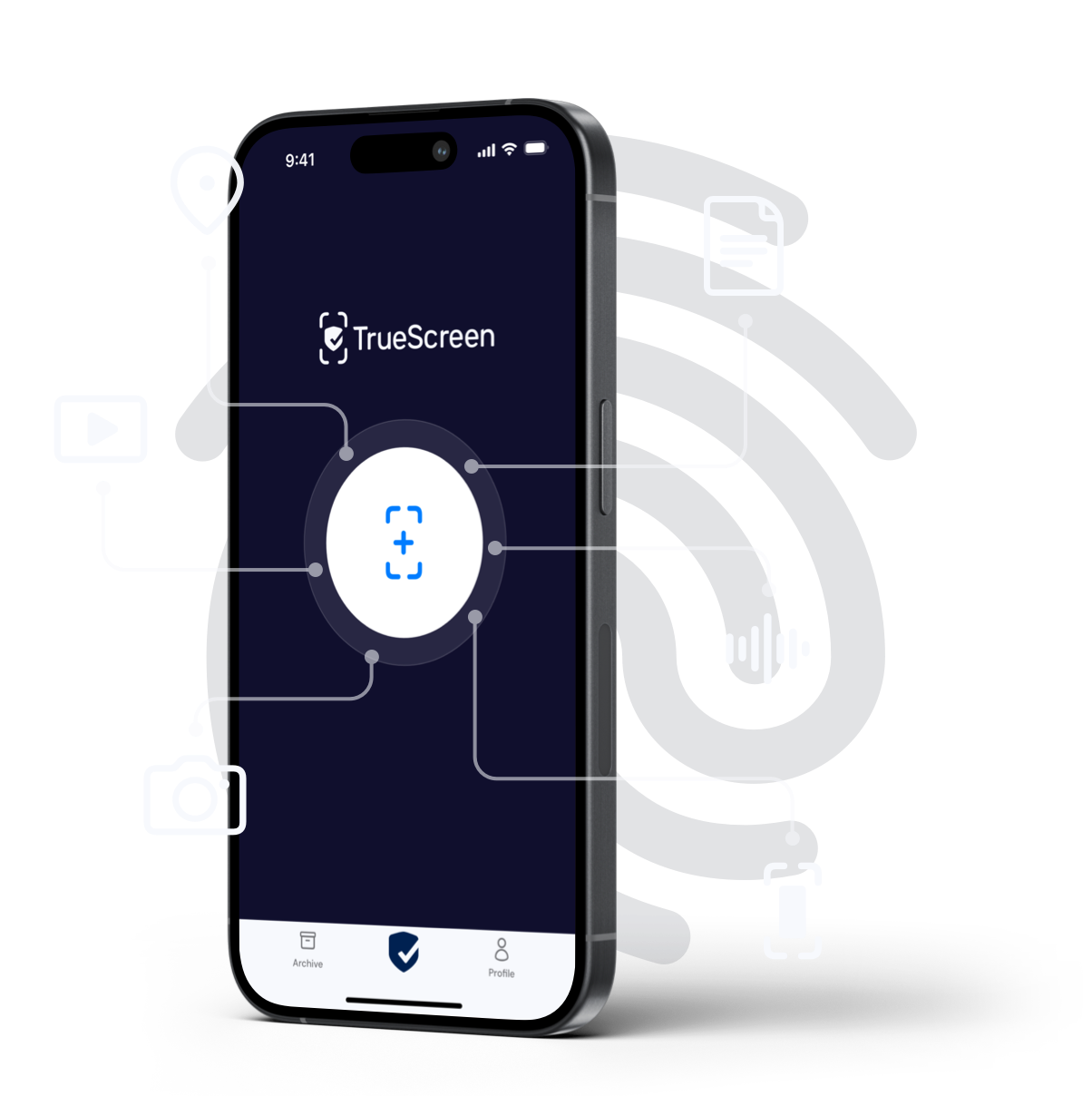
For a private investigator, the difference between admissible evidence and easily contested evidence does not lie in the capture device, but in how the data is fixed at the moment of collection. TrueScreen embeds, directly into its mobile app and APIs, the forensic methodology that investigation agencies have applied manually for years: capture at source, cryptographic hashing, qualified eIDAS timestamp, electronic seal issued through an integrated qualified QTSP, continuously tracked digital chain of custody.
Source-certified capture with the TrueScreen app
When the professional takes a photo, records a video or logs GPS coordinates from the TrueScreen app, the file is immediately put through four automatic steps: SHA-256 hashing of the original payload, generation of a qualified eIDAS timestamp through a qualified third-party QTSP, application of an electronic seal that binds the file to the professional's identity and to the moment of capture, write into the attestation registry. The result is a file whose integrity can be verified by anyone, anchored to a certain instant in time.
Digital chain of custody and probative resilience
The opposing counsel's playbook against multimedia evidence usually starts with a single move: "this photo has been edited, this video has been cut". A verifiable digital chain of custody cuts the basis of that argument. The judge can verify in seconds that hash, qualified timestamp and seal are consistent with the file presented. If one of the three elements does not match, the file was altered after capture. If they match, the evidence resists the contestation and the burden shifts back on the opposing party to prove technical forgery, which is a much harder challenge.
The operational benefit for an investigation agency working with certified digital evidence is twofold: shorter time to finalise the report (the data is already certified, no follow-up forensic appraisal needed), higher acceptance rate of evidence in court, fewer preliminary disputes on authenticity.
FAQ: digital surveillance and GPS tracking in private investigations
Can a private investigator legally use GPS to track a subject?
Will a photo captured by the investigator hold up before a civil judge?
Do GPS coordinates have standalone evidentiary value?
TrueScreen editorial team
Published on · Updated on
This section is edited by the TrueScreen editorial team, which brings together expertise in digital forensics, the law of digital evidence and regulatory compliance. Every article is checked against primary sources: legislation, published rulings, technical standards and official documentation, always cited in the text.


