
Sound mark and voice deepfakes: how to protect your voice from AI cloning
What registering your voice as a sound mark really protects, where trademark law stops, which other rules apply to AI voice clones, and how to capture evidence.
Updated on
A sound mark is a trademark made of a sound. EU law admits sounds as trademarks (Regulation (EU) 2017/1001, Article 4), and since October 1, 2017 the EUIPO accepts them as an audio file (Implementing Regulation (EU) 2018/626, Article 3(3)(g)). If the application is accepted and the mark registered, your name spoken in your own voice becomes a title with a number and a date to cite in removal requests. It covers that recording for the goods and services you list, not your voice: an AI clone saying other words outside commercial use mostly escapes it. TrueScreen certifies the page with the cloned voice, and the certification preserves what was online at that moment even if the original is later removed.
Key takeaways
- Since October 1, 2017 the EUIPO accepts sound marks as audio files (Regulation (EU) 2017/1001, Article 4; Implementing Regulation (EU) 2018/626, Article 3(3)(g)).
- Giorgia Meloni’s EUIPO filing of October 5, 2026 is an application under examination, not a registered mark, and an application can be refused or opposed (Il Post, October 6, 2026).
- A sound mark only reaches use ‘in the course of trade’ (EUTMR Article 9(2)): new phrases, parody and other non-commercial deepfakes mostly fall outside it.
- Your voice is personal data under GDPR Article 4(1), and becomes biometric data only after specific technical processing for unique identification (Article 4(14)).
- Every remedy, from a DSA Article 16 notice to a lawsuit, is stronger with proof of the content as published, captured before it is removed.
3 seconds
of audio gave researchers a voice clone with an 85% match, in the vendor’s own test
1 in 4
of 7,054 adults in seven countries had experienced an AI voice scam or knew someone who had
$6 million
FCC fine over deceptive robocalls that used a deepfake of Joe Biden’s voice before the New Hampshire primary
On October 5, 2026, Italian Prime Minister Giorgia Meloni applied to the EU Intellectual Property Office (EUIPO) for a sound mark: about four seconds of her own voice saying “Io sono Giorgia Meloni” (“I am Giorgia Meloni”) (Il Post). The application is still under examination, but it raised a question voice actors, hosts and creators have asked for years: can you trademark your voice, and will that stop a clone?
Cloning takes very little material: in a 2023 test by McAfee’s own researchers, three seconds of audio produced a clone with an 85% voice match (McAfee). The fakes show up as endorsements, scam calls and invented statements, and can disappear quickly.
A sound mark, or sound trademark, helps less than the headlines suggest. Personality rights and the GDPR reach further, and the AI Act adds disclosure duties; all of them gain from proof of what was published.
Why a cloned voice is hard to protect
Your voice is protected in pieces, by rules written for other things, and each piece is easier to enforce when you can prove what was published.
In practice you combine trademark law, personality rights, the GDPR and platform notices under Article 16 of the EU Digital Services Act. Each works better when you can show the audio, where it appeared and when.
A voice is neither a work nor a registered sign
Copyright protects works and, through related rights, performances and recordings; the timbre of your voice is, as a rule, not a work. Trademark law mainly protects registered signs, and few people have registered their voice. That leaves personality rights, which differ by country. Denmark presented a bill on October 8, 2026 to protect faces and voices through copyright from January 1, 2027, if Parliament approves it (Euronews).
How cloned voices are misused: fake endorsements, scams and damaging content
In a fake endorsement, a well-known host seems to recommend a supplement or an investment. In fraud, a cloned voice asks a relative or an employee for money, and our analysis of voice cloning fraud against CFOs covers the corporate version. Then there is content made to mislead. Before the New Hampshire primary of January 21, 2024, robocalls with a deepfake voice of Joe Biden reached voters, and the FCC later imposed a $6 million fine for those deceptive automated calls, not for cloning the voice as such (FCC 24-104).
Registering your voice as a sound mark
If the application succeeds, a sound mark turns one recording of your voice into a registered title, with a number and a date you can cite in removal requests.
What a sound mark is after the EU reform
Article 4 of the EU Trade Mark Regulation (EU) 2017/1001 lets any sign, “sounds” included, become an EU trademark if it distinguishes goods or services and the register can show “the clear and precise subject matter of the protection.” Under Article 3(3)(g) of Implementing Regulation (EU) 2018/626, you file “an audio file reproducing the sound” or an accurate musical notation.
If you record that clip live in the TrueScreen App, the report documents its SHA-256 hash and the date of certification, so a version of your voice is on record before any clone appears. That date does not replace the filing, and it does not prove whose voice it is.
What has been filed: Meloni’s application and earlier voice filings
Giorgia Meloni’s EUIPO application of October 5, 2026 covers a recording in which she says “Io sono Giorgia Meloni” twice, for downloadable multimedia content, cultural and entertainment events, and political events (Il Post; Euronews). It is an application under examination, not a registered mark. According to Il Post, Italian voice actor Luca Ward and singer Giusy Ferreri had already filed applications for sound marks of their voices.
How to file a sound mark
Choose the EUIPO for one title across the EU, or a national IP office if one country is enough. Upload a clean audio file and choose the classes of goods and services with a trademark attorney, since the mark only works inside them and fees depend on how many you list. The office examines the application and publishes it for opposition, so registration is not guaranteed. A registered EU trademark lasts ten years from the filing date and is renewable.
When a sound mark helps with platform takedowns
Article 16 of the Digital Services Act (Regulation (EU) 2022/2065) requires hosting services to run a notice-and-action mechanism and to decide on notices “in a timely, diligent, non-arbitrary and objective manner.” A notice needs a reasoned explanation, the exact URL, your name and email and a statement of good faith. A registered mark can support it only if the content falls within the mark’s scope; otherwise the notice must rest on other grounds, such as personality rights, personal data or national law. Removal remains the platform’s decision, and Article 22 gives priority only to designated trusted flaggers, a status private individuals do not have.
What a sound mark cannot stop
A sound mark protects the recording you filed, for the goods and services you listed, not your voice: a clone saying new words outside commercial use mostly escapes it.
Article 9(2) of the EU Trade Mark Regulation lets the owner stop identical or similar signs used “in the course of trade” for goods or services. Many voice deepfakes meet neither condition: they say new words, and nobody sells anything with them.
| Tool | What it protects | Against whom | What you must prove |
|---|---|---|---|
| Sound mark, if registered | The registered recording, for listed goods and services | Similar signs used in the course of trade | The exact audio, where it ran and when |
| Personality rights | Your voice as part of your identity, where recognized | Use without consent, as national law defines it | The voice is recognizably yours, and the content as published |
| Deepfake-specific laws, where they exist | The voice as a personal right, or the public against deceptive calls | Depends on the jurisdiction | The deceptive content and how it spread |
| GDPR | Your voice as personal data | Processing without a legal basis | The content, who published it and where |
| Voice contracts and licenses | Agreed limits on use and AI training | The other party only | A use outside the agreed scope |
| DSA notice (Article 16) | Removal of illegal content | Hosting services and platforms | The exact URL and a reasoned explanation (better with a certified capture made beforehand) |
No monopoly on a voice
Your timbre, accent and way of speaking stay unregistered, so impressionists, people who happen to sound like you and clones that never play the registered clip are outside the direct scope of the mark, although other rights may still apply.
Clones that never say the registered phrase
A clone says whatever its author types, rarely your four-second name clip. Article 9(2) does reach similar signs that create a likelihood of confusion, and protects a mark that “has a reputation” more widely. Legal experts quoted by Il Post note, however, that a fake clip in which the voice says something else does not infringe the mark. As of October 2026, no court appears to have ruled on a personal sound mark against an AI clone.
Trademark law reaches only commercial use
The same experts point out that a parody would fall under the mark only if used commercially, in an advertisement for example. By the same logic, satire, political commentary and personal attacks stay outside trademark law when nobody uses them commercially, and many voice deepfakes are made with no commercial purpose at all.
Other legal protections against voice deepfakes
Personality rights, data protection, disclosure rules and contracts cover what the trademark misses, and each is easier to use with evidence of the content.
Contracts are the simplest layer: if you lend your voice to studios or brands, have a lawyer draft the clauses on how recordings may be used and whether they may train AI models. A contract binds only the people who signed it.
Deepfake-specific rules: where they exist
In the United States, Tennessee’s ELVIS Act, in force since July 1, 2024, treats the voice as a personal right and addresses AI voice cloning (Holland & Knight). The NO FAKES Act of 2026 (S. 4591) has passed a Senate committee but is not law. In the EU, Italy has already made it a criminal offense to spread AI-falsified voices that cause harm.
Personality rights and the GDPR: your voice as personal data
Your voice is personal data whenever it identifies you or makes you identifiable, under Article 4(1) of the GDPR (Regulation (EU) 2016/679). It counts as biometric data only after “specific technical processing” for unique identification (Article 4(14)), and Article 9(1) then prohibits that processing unless an exception applies. Article 17 lets you request erasure when one of its grounds applies, with an exception for freedom of expression. Whether the GDPR reaches a given publisher, such as a private individual or someone outside the EU, is a question for a lawyer.
Personality rights can protect the voice too: on August 20, 2025, a Berlin court (LG Berlin II, case 2 O 202/24) held that an AI clone of German voice actor Manfred Lehmann’s voice, used in videos, violated his right to his own voice, and awarded €4,000 as a notional license fee (beck-aktuell).
The AI Act: providers mark synthetic audio, professional deployers disclose deep fakes
The EU AI Act (Regulation (EU) 2024/1689) defines a deep fake in Article 3(60) as AI content resembling real people or events that “would falsely appear to a person to be authentic or truthful.” Under Article 50, paragraph 2, providers of systems that generate synthetic audio must mark the output in a machine-readable format. Under paragraph 4, deployers using the system in a professional capacity, not for purely personal activity, must disclose deep fakes, with lighter duties for evidently artistic, satirical or fictional works. Both apply from August 2, 2026, although the Digital Omnibus Regulation (EU) 2026/1744 moves the marking duty to December 2, 2026 for systems already on the market. The exact scope in your case is for a lawyer to assess.
Evidence decides whether any protection works
Every remedy against a voice deepfake gets stronger with the same file: certified proof of the deepfake as it was published, and of your real voice.
A takedown notice, a warning letter, an erasure request and a lawsuit all go better when you can show what was published, where, when and in what context. Once the deepfake is deleted, a clip nobody captured is your word against theirs.
Why screenshots and links are not enough
A screenshot of an audio deepfake has no audio in it, only a frame and a caption, and a link dies as soon as the post comes down. Both are easy to dispute, because a screenshot carries no reliable time and nothing to show it wasn’t edited, as our guide to capturing social media evidence for court explains.
What the evidence must show
Useful evidence of a voice deepfake shows the exact audio or video, the address where it was published, the moment it was captured, and the context (account, caption, comments, view count). TrueScreen captures them together in one forensic acquisition before removal. The certification proves that the content was acquired with forensic methodology at that address and at that moment and that any later alteration would be detectable; it does not prove that the content is true or who made it.
Certify your original voice as a reference
To say whether a clip is a clone, a forensic audio expert works better with authentic recordings of known date and origin. With the TrueScreen App you can record your voice live from the microphone, and the report documents the SHA-256 hash of the recording and the date of certification. Existing files, such as a podcast, imported into the App are sealed with a certified date from that moment, and any later alteration would be detectable; this is not a forensic acquisition and does not certify when or by whom they were recorded. Comparing voices is the forensic audio expert’s job; TrueScreen certifies the acquisition (see our pieces on voice notes as court evidence and source certification versus detection).
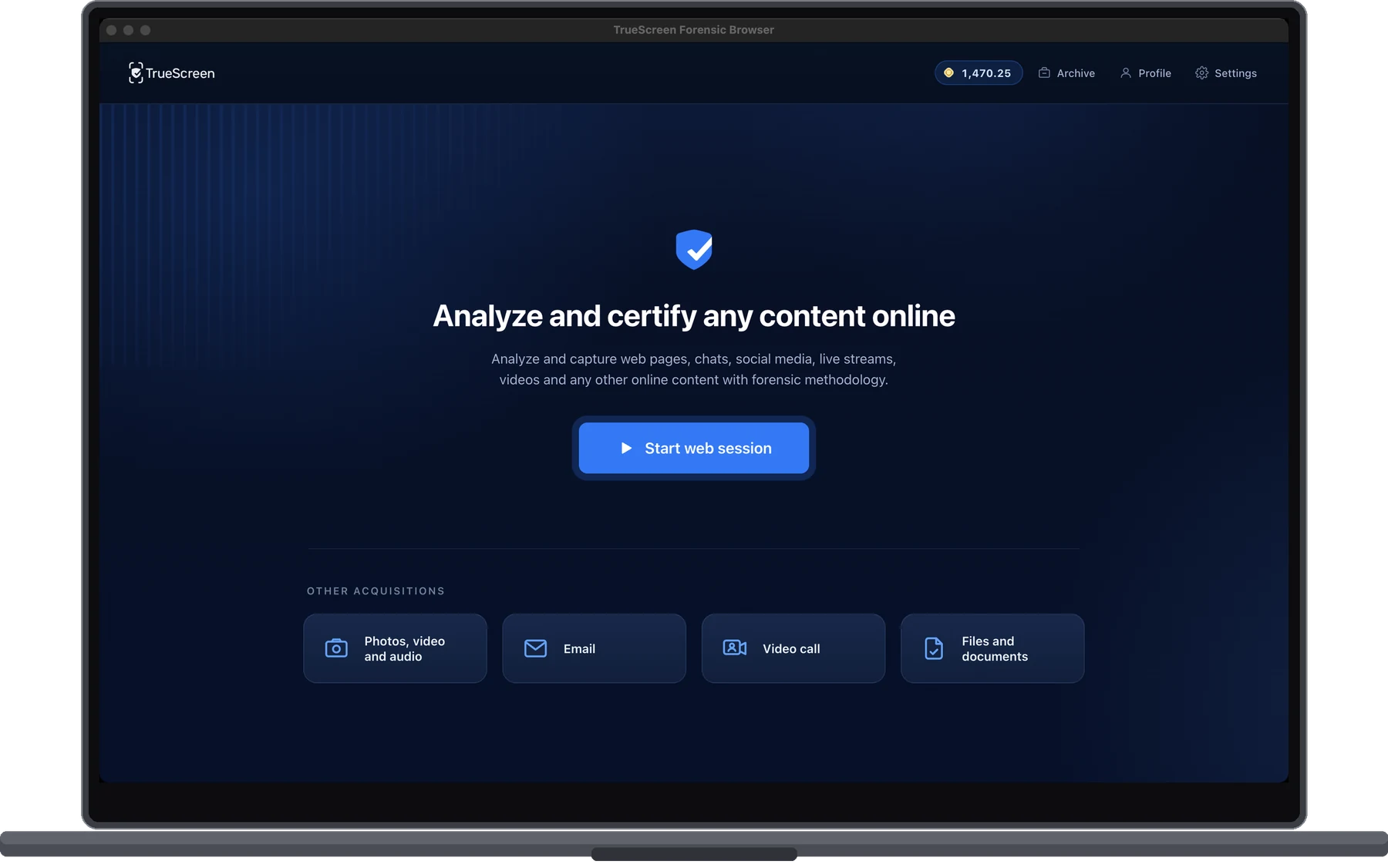
How do you collect certified evidence of a voice deepfake?
TrueScreen certifies the page that carries a voice deepfake while it is still online, and certifies recordings of your real voice made live in the App, so the expert has a reference to compare it with.
The strongest route is the Forensic Browser in Full recording mode, which records audio and video of everything that happens during the browsing session, together with the network log (HAR). TrueScreen, the Data Authenticity Platform, captures the whole session, and the package is sealed with a qualified electronic seal and a qualified timestamp: certified evidence that can be presented in court, with admissibility and weight left to the judge. It runs on macOS and Windows and starts each acquisition with browsing data cleared.
If the clip could disappear quickly, use what you already have installed: the Browser Extension for Chrome and Edge records the tab as video with its audio, and its report lists the URL, the UTC date and a SHA-256 hash. If you expect the other side to contest the capture, use the Forensic Browser.
For audio or video found on a page during a Forensic Browser session, the AI analysis in the Media Inspector (version 2.9.3 and later) estimates how likely it is that the media was generated or manipulated. It is probabilistic and can be wrong, so a person makes the final call, and it does not replace certifying a page that is still online. Anyone can check the seal with the EU DSS tool or on the certification verification page.
One possible scenario: a voice actor finds a supplement ad in which his cloned voice “recommends” the product. His agent captures it in Full recording, with the account and comments. His lawyer files the notice with the sound mark’s registration number, if registered, and the certified package, and an audio expert compares the clip with recordings made live in the TrueScreen App months earlier, so both have documented digital provenance.
-
Certify the content before you report it
Capture the page, the audio or video, the account and the comments before you report, comment or contact the author: any of those moves can trigger removal.
-
Request removal and send a cease-and-desist letter
File the platform notice under DSA Article 16 with the exact URL, a reasoned explanation, your name and email and a statement of good faith. Cite a registered sound mark only if the content falls within its scope. Your lawyer can write to the author and send a GDPR erasure request.
-
Keep the evidence file for legal action
Store the certified package (report, hashes, seal and timestamp) with your certified original recordings. Because it contains third-party accounts and comments, hand it to your lawyer and do not republish it.
Conclusion
A sound mark is worth applying for if your voice is part of your work: if it is registered, it gives you a number and a date to cite, and it can support a removal request when the content falls within its scope. It will not stop a clone that says new words, or a deepfake made to insult or mislead rather than to sell. For those cases you rely on personality rights, the GDPR, deepfake-specific rules where they exist and platform notices under the DSA, and every one of them is stronger with the same thing: proof of the content as it was published, captured before it disappears, plus live-certified recordings of your real voice to compare it with. This article is general information, not legal advice; for a specific case, talk to a lawyer.
FAQ: sound marks and voice deepfakes
Can you trademark your voice?
Not the voice itself. You can apply to register a specific recording, such as your name spoken by you, as a sound mark (or sound trademark), which the EU has accepted as an audio file since October 1, 2017 (Regulation (EU) 2017/1001, Article 4; Implementing Regulation (EU) 2018/626, Article 3(3)(g)). If registered, the mark protects that recording against confusing commercial use for the goods and services you list, not your timbre or new phrases an AI clone generates.
How do you register a sound mark?
File with the EUIPO for protection across the EU, or with a national IP office for one country, uploading an audio file of the sound and listing the classes of goods and services. The office examines the application, publishes it and opens it to opposition, so registration is not guaranteed. A registered EU trademark lasts ten years from the filing date and is renewable.
Is it illegal to clone someone’s voice with AI?
It depends on the jurisdiction and the use. In the EU, a voice that identifies you is personal data under the GDPR (Article 4(1)), and from August 2, 2026 Article 50 of the AI Act requires providers to mark synthetic audio and professional deployers to disclose deep fakes. A Berlin court (LG Berlin II) held in 2025 that an AI clone of a voice actor’s voice violated his personality rights. In the United States, the FCC imposed a $6 million fine in 2024 over deceptive robocalls that used a deepfake voice of Joe Biden.
Is your voice personal data under the GDPR?
Yes, whenever it identifies you or makes you identifiable (GDPR, Article 4(1)). It becomes biometric data under Article 4(14) only after specific technical processing for unique identification, as in voice recognition, and Article 9(1) then prohibits that processing unless an exception applies.
What should you do if someone clones your voice and posts it online?
Certify the content before you report it, with the Forensic Browser (the package is sealed with a qualified electronic seal and a qualified timestamp) or, if time is short, the Browser Extension. Then file a notice under Article 16 of the EU Digital Services Act, citing a registered sound mark only if the content falls within its scope, and ask a lawyer about civil and criminal remedies.
Can you tell if a voice has been cloned by AI?
By ear, less and less: in a 2023 McAfee test, three seconds of audio produced an 85% voice match. Detection tools return a probability and can be wrong: the AI analysis in the Forensic Browser’s Media Inspector is an extra signal, not proof. What carries weight in a dispute is a forensic audio expert’s comparison between the certified capture of the deepfake and certified recordings of the real voice.
Sources and verification
Every figure and principle cited here links to its source, listed with type and date. Links checked on the publication date.
| Source | Type | Date | What it supports |
|---|---|---|---|
| Regulation (EU) 2017/1001, Article 4 | Law | 2017 | Sounds can be EU trademarks if represented clearly and precisely; applies since October 1, 2017 |
| Regulation (EU) 2017/1001, Article 9(2) | Law | 2017 | Owner’s rights limited to use in the course of trade; likelihood of association; marks with a reputation |
| Implementing Regulation (EU) 2018/626, Article 3(3)(g) | Law | 2018 | Sound marks represented by an audio file or musical notation |
| Regulation (EU) 2022/2065 (DSA), Article 16 | Law | 2022 | Notice-and-action mechanism and content of a valid notice |
| Regulation (EU) 2022/2065 (DSA), Article 22 | Law | 2022 | Priority only for notices from designated trusted flaggers, a status private individuals do not have |
| Regulation (EU) 2016/679 (GDPR), Article 4(1) and 4(14) | Law | 2016 | Voice as personal data and when it becomes biometric data |
| Regulation (EU) 2016/679 (GDPR), Article 9(1) | Law | 2016 | Prohibition on processing biometric data for unique identification |
| Regulation (EU) 2016/679 (GDPR), Article 17 | Law | 2016 | Right to erasure when one of its grounds applies, with the freedom of expression exception |
| Regulation (EU) 2024/1689 (AI Act), Article 3(60) | Law | 2024 | Definition of deep fake |
| Regulation (EU) 2024/1689 (AI Act), Article 50 | Law | 2024 | Providers mark synthetic audio in a machine-readable format (50(2)); professional deployers disclose deep fakes (50(4)); from August 2, 2026 |
| Regulation (EU) 2026/1744 (Digital Omnibus) | Law | 2026 | Article 50(2) moved to December 2, 2026 for systems placed on the market before August 2, 2026 |
| Tennessee ELVIS Act | Law | 2024 | Voice as a personal right, in force since July 1, 2024 |
| FCC 24-104, Forfeiture Order | Case law | 09/26/2024 | $6 million fine over deceptive Biden deepfake robocalls (the calls, not the cloning as such) |
| Berlin Regional Court II, 2 O 202/24 | Case law | 08/20/2025 | AI-cloned voice of voice actor Manfred Lehmann violated his right to his own voice; €4,000 damages |
| Euronews, Denmark deepfake bill | Document | 10/08/2026 | Danish bill to protect faces and voices through copyright, not in force |
| Il Post, Meloni sound mark | Document | 10/06/2026 | Meloni’s EUIPO application, classes, earlier voice filings by Ward and Ferreri, expert views on limits and parody |
| Euronews Italia, Meloni sound mark | Document | 10/05/2026 | Date of the EUIPO filing |
| McAfee, The Artificial Imposter | Survey | 2023 | Three seconds of audio for an 85% voice match (vendor test); one in four of 7,054 adults affected by AI voice scams |
Certify the cloned voice before it disappears
Use the Forensic Browser or the Browser Extension to certify the content with your cloned voice while it is still online, and record your real voice live in the TrueScreen App as a certified reference.
TrueScreen editorial team
This section is edited by the TrueScreen editorial team, which brings together expertise in digital forensics, the law of digital evidence and regulatory compliance. Every article is checked against primary sources: legislation, published rulings, technical standards and official documentation, always cited in the text.


