
Crash for Cash and Staged Accidents: How Car Insurance Fraud Works and What Evidence Exposes It
How crash for cash and staged accident schemes slip into ordinary motor claims, why the evidence behind them is easy to build afterward, and what holds up.
A crash for cash scheme or staged accident is a form of car insurance fraud: a claim built on a collision that was arranged, exaggerated or never happened. TrueScreen counters the manipulation of claim evidence behind these schemes by certifying with a forensic methodology what is captured at the scene and during the inspection, so that insurers, adjusters and honest policyholders can rely on evidence whose acquisition is documented instead of evidence built after the event. The schemes hold up because the photos, forms and statements in the file are produced after the fact by the people who stand to gain.
Key takeaways
- Insurance Europe estimates that detected and undetected fraud together account for about 10% of total claims expenditure in Europe (Insurance Europe, annual report 2024).
- UK insurers detected £1.34 billion of fraudulent claims in 2025, across 93,900 cases, including 51,900 motor claims worth £625 million (ABI).
- Photos, accident report forms, witness statements, repair estimates and medical certificates are mostly produced after the collision by people with an interest in the claim.
- A mismatch between date, place, damage and declared dynamics is a risk indicator that justifies a closer look, not proof of fraud.
- TrueScreen certifies how, when and where evidence was captured at the scene with a forensic methodology; whether the accident was genuine is still assessed by the adjuster and, in a dispute, the judge.
10%
approximate share of total claims expenditure in Europe lost to detected and undetected fraud, an estimate
$308.6bn
estimated yearly cost of insurance fraud in the United States, all lines
Every motor claim you handle arrives as a bundle: a few smartphone photos, an accident report form, a witness or two, then an adjuster’s report, a repair estimate and, if someone was hurt, a medical certificate. Most of those bundles are honest. A staged accident arrives in exactly the same format, and nothing about the format tells you it was assembled for the claim.
The trouble lies in timing. Almost every item in the file is created after the collision, often days later, by the claimant, by a repairer the claimant chose or by a witness the claimant named. A photo carries no date or place you can check, damage grows between the inspection and the estimate, and the insurer usually notices only when it cross-checks one file against others. By then it has often paid, and the cost lands on every policyholder’s premium and on the trust that genuine claims depend on.
So the useful question is which evidence can still be trusted by the time it reaches your desk. The answer is evidence captured at the scene, at the moment, with a certified date and, when the flow requires it and the user allows it, a location, so that later changes are detectable. TrueScreen brings the evidence back to that moment, so the claims handler receives the original acquisition made at the scene instead of a reconstruction put together later.
What Is Car Insurance Fraud With Staged Accidents?
Car insurance fraud with staged accidents is a claim for compensation based on a road collision that was deliberately caused, arranged between drivers or never happened at all, usually with damage and injuries added on top. TrueScreen confronts it where it starts, in the evidence, by certifying what is captured at the scene, so that the capture is protected from the moment it is made and any later change to its date, place or content can be detected. Insurance Europe estimates that detected and undetected fraud together account for about 10% of total claims expenditure in Europe.
Staged accident fraud is expensive because it hides inside ordinary claims, and the published figures only capture the share that gets caught.
The two names you will meet describe the same thing. “Crash for cash” is the expression used in the UK for collisions that are deliberately caused or staged in order to claim on insurance, while “staged accident” is the usual term in the United States. Both cover the deliberate crash with an unsuspecting driver, the collision agreed between accomplices and the accident that exists only on paper.
The Insurance Europe figure is an estimate, and it has to be: undetected fraud can’t be counted, only inferred. The detected side is easier to measure. According to the ABI, UK insurers detected £1.34 billion of fraudulent claims in 2025, across 93,900 cases. In the United States, a 2022 study by the Coalition Against Insurance Fraud put the cost of insurance fraud at an estimated $308.6 billion a year across all lines of insurance. In the end, those sums come back through premiums.
How a Staged Accident Works, From the Arranged Crash to the Inflated Claim
A staged car accident follows a recognizable path: a collision that is caused, agreed or simply invented, a version of events that the people involved all back, and a claim that grows at each step, from the bodywork to the repair bill to the injuries. Seeing the path tells you where each piece of evidence enters the file and who controls it.
Every scheme rests on the same condition: the people who benefit from the claim are also the people who produce its evidence.
In a crash for cash scam, the collision is real but deliberate. An innocent motorist is drawn into an impact that makes them look responsible, and the claim against their insurer follows. The driver who caused it has already prepared the story, the passengers and, often, the people who will later say they saw everything.
An agreed collision removes the innocent party altogether. Two drivers who know each other stage a minor impact, fill in the accident report form together and describe the same dynamics, so on paper the claim looks clean. The phantom claim goes one step further: no collision took place, and the file is built from documents, photos of damage from another time and statements that support each other.
Colluding witnesses hold many of these claims together. A witness who confirms the dynamics turns a disputed account into an apparently settled one, and nobody at the insurer was at the roadside to say otherwise.
The claim then inflates. Damage that was already on the vehicle gets attributed to the accident, a colluding repairer bills for more work than the impact required, and injuries that were never suffered appear in a medical certificate. Motor claims are where most of this shows up: the ABI counted 51,900 fraudulent motor claims worth £625 million detected by UK insurers in 2025.
Why Claim Evidence Is the Weak Point
Claim evidence is weak because it is created after the event by people with an interest in the outcome, and very little of it carries a date or a place that anyone else can verify. Each document in a motor claim has a producer and a moment, and the gap between the collision and that moment is where a staged claim takes shape.
The question to ask of any claim document is who made it and when, because the answer decides what could have been changed.
| Evidence | Who produces it | When | What can be altered or built |
|---|---|---|---|
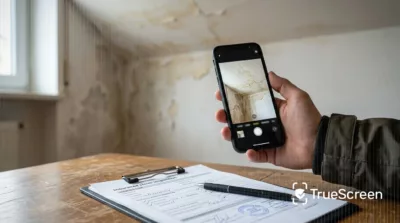
| Smartphone photos | The claimant or the people with them | Any time after the collision, sent by email or chat | Photos taken days later or somewhere else, old damage presented as new, no verifiable date or place |
| Accident report form | The drivers involved | At the scene or afterward | Dynamics agreed in advance between colluding drivers |
| Witness statement | People named by the parties | After the event, often weeks later | A version confirmed by a colluding witness |
| Adjuster’s report | The adjuster, after an inspection | Days after the collision | Assesses the vehicle as it is presented, so pre-existing damage can pass as accident damage |
| Repair estimate | A repairer chosen by the claimant | After the inspection | Damage that grows between inspection and estimate, work billed by a colluding repairer |
| Medical certificate | A doctor, largely on the basis of reported symptoms | Days or weeks after the event | Injuries never suffered, or worsened on paper |
None of these documents is false by nature. They become a weak point because the insurer receives them as finished items, with no record of how they came into being, and has to trust whoever sent them. Images generated or edited with AI are a separate and newer problem, covered in our article on AI-generated insurance fraud evidence; staged accidents mostly rely on something older, genuine photos of the wrong moment.
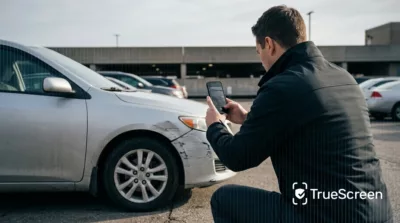
The photo is the easiest item in the table to fix. With TrueScreen the damage photo stops being a loose file attached to an email, because it is certified in the TrueScreen App at the moment it is taken, with its location recorded when the flow asks for it and the user allows it.

What Evidence Makes a Staged Accident Visible
A staged accident becomes visible when its evidence stops agreeing with itself: the date, the place, the damage and the injuries tell different stories, or the key items were produced long after the collision. Evidence captured at once, at the scene, gives you a fixed point against which to compare everything else in the file.
Inconsistencies are easiest to read when at least one piece of evidence in the file is one whose later changes can be detected.
Start with date, place and damage. A rear-end collision that left marks on the side of the car, photos whose location doesn’t match the declared address, a dent that is larger on the estimate than at the inspection: each of these is a question to put to the claimant. Location only helps if it can be trusted, which is why certified geolocation in photo evidence carries a different weight from a place typed into a form.
Then look at how each item was produced. A photo taken at the roadside minutes after the impact and a photo emailed three days later can show the same bumper and mean very different things. The first records the scene before anyone had time to arrange it; the second records whatever the sender decided to show.
Vehicle data adds an independent record. Telematics and event data recorder data on speed and impact can be set against the dynamics described in the accident report form, and a mismatch there is hard to explain away.
A risk indicator, however, is not proof of fraud. Honest drivers misremember, photograph the wrong angle and report late. Anti-fraud teams use indicators to decide which claims deserve a closer look, and whether a claim is fraudulent is decided on the evidence as a whole. Behind the 93,900 fraudulent claims UK insurers detected in 2025, according to the ABI, sit thousands of separate files, and each one had to be established on its own evidence.
TrueScreen supplies that fixed point: once it has certified a capture, any later change to its date, place or content shows.
How Can Claim Evidence Be Certified at the Scene?
TrueScreen certifies claim evidence at the scene by acquiring photos, video, audio and location with a forensic methodology at the moment they are captured, whether the person holding the phone is the policyholder, a witness, a repairer or the adjuster during the inspection. The certification proves how, when and where the evidence was acquired; whether the accident was genuine remains for the adjuster and the claims handler to judge.
Certification fixes how, when and where evidence was captured, and leaves the meaning of that evidence to the people who assess the claim.
The methodology is covered by patents. The capture takes place in a controlled environment, the data are verified, and a technical report documents how and when each acquisition was made. Location is recorded when the flow requires it and the user gives permission, and the report shows the detected position, the address and a map. The App refuses a location that the device reports as simulated, and the report lists the device context: model, operating system, connection and other technical data.
The certification closes with a qualified electronic seal and a qualified timestamp, and the timestamp fixes the time of certification. Under the eIDAS Regulation, a qualified electronic seal enjoys the presumption of integrity of the data and of correctness of their origin (Article 35(2)). A qualified timestamp enjoys the presumption of accuracy of the date and time it indicates and of the integrity of the data (Article 41(2)). TrueScreen applies a qualified electronic seal and a qualified timestamp, and it is not itself a trust service provider or a certification authority. Content certified with TrueScreen has full legal and probative value worldwide; the weight of each piece of evidence is assessed by the judge case by case, and TrueScreen doesn’t guarantee the outcome of any proceedings.
One limit needs saying plainly. A certification proves how, when and where content was acquired, not that the event it shows is true, complete or lawful. A staged scene remains a staged scene, certified as an authentic recording of that scene. What changes is that the capture is protected during acquisition and any later change to its date, place or content can be detected. The controlled environment and the checks on simulated location also make staging harder, although they don’t close the gap between how something was recorded and what it means.
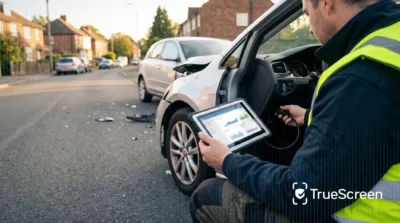
TrueScreen doesn’t replace the adjuster or the technical expert either. The adjuster assesses and interprets the damage; TrueScreen guarantees the acquisition the adjuster works from. Picture a rear-end claim with minor injuries. Instead of waiting for photos by email, the claims handler sends a guided collection to the policyholder and to the witness they named, and the adjuster certifies the damage during the inspection. If the declared dynamics don’t fit what was captured at the scene, the discussion turns on how to read the damage, not on where the files came from. You can see how this fits claims handling on the insurance sector page.
-
Capture Photos and Video at the Scene With the App
Whoever is at the scene opens the TrueScreen App and captures photos, video and, where useful, audio of the vehicles, the road and the surroundings. The adjuster can use the App in the same way during a field inspection, so the damage being assessed is certified at the moment it is seen.
-
Guide the Policyholder, Repairer or Witness With a TrueFlow
A TrueFlow is a guided, step-by-step collection with captures and forms, reached from a link. You decide which photos to ask for and in what order, and the policyholder, the repairer or a witness completes it, even without a TrueScreen account when the TrueFlow does not require a login. The link can be single-use and set to expire, and an SMS code can be added when the claim calls for it.
-
Enable Third Parties to Certify
On Business and Enterprise plans, your workspace can share its acquisition method by email with people outside the company. The recipient receives simple instructions and a secure link, and the resulting certification goes both to the recipient and to your workspace.
-
Hand the Claims Handler a Verifiable Package
Each certified capture comes with its technical report: how and when it was acquired, the position, address and map when location was recorded, and the device context. The claims handler, the adjuster or an expert appointed later can check that nothing has changed since certification and measure the rest of the claim file against it.
Conclusion
A staged accident is hard to see because it uses the same evidence as a genuine one, produced at the same late moment by the same interested people. Cross-checking files and reading risk indicators will always matter, but they work far better when the claim contains something whose origin is documented. With TrueScreen, what is captured at the roadside is certified with a forensic methodology as it is captured, giving insurers and adjusters evidence whose acquisition is documented and whose later changes can be detected, while the assessment of the claim stays with them.
FAQ: Insurance Fraud and Staged Accident Questions Answered
What Is Crash for Cash?
Crash for cash is the expression used in the UK for collisions that are deliberately caused or staged in order to claim on motor insurance; in the United States the same scheme is usually called a staged accident. Motor claims make up more than half of detected fraud in the UK: according to the ABI, insurers detected 51,900 fraudulent motor claims worth £625 million in 2025, out of 93,900 fraudulent claims overall.
How Much Does Insurance Fraud Cost?
Insurance fraud costs the United States an estimated $308.6 billion a year across all lines of insurance, according to a 2022 study by the Coalition Against Insurance Fraud. In Europe, Insurance Europe estimates that detected and undetected fraud together account for about 10% of total claims expenditure. Both figures are estimates, because undetected fraud can’t be counted directly, and the cost ends up in the premiums that honest policyholders pay.
How Do Insurers Spot a Staged Accident?
To spot car insurance fraud, insurers look for evidence that doesn’t agree with itself: damage that doesn’t fit the declared dynamics, photos whose date or place can’t be verified, repair costs that grow after the inspection, the same names turning up across different claims. These are risk indicators, not proof of fraud, and they lead to a closer investigation. According to the ABI, UK insurers detected 93,900 fraudulent claims in 2025.
Does a Certified Photo Prove an Accident Really Happened?
No. A certified photo proves how, when and where it was captured, not that the event it shows is genuine. TrueScreen certifies the acquisition with a forensic methodology, so any later change to a photo taken at the scene can be detected, yet a staged scene stays a staged scene. Judging what the photo shows remains the work of the adjuster and, in a dispute, of the judge.
Sources and verification
Every figure and principle cited here links to its source, listed with type and date. Links checked on the publication date.
| Source | Type | Date | What it supports |
|---|---|---|---|
| Insurance Europe, Breaking boundaries: A European approach to countering insurance fraud (annual report 2024) | Survey | 2024 | Estimate of detected and undetected fraud as a share of total claims expenditure in Europe |
| Coalition Against Insurance Fraud, The Impact of Insurance Fraud on the U.S. Economy | Survey | 2022 | Estimated yearly cost of insurance fraud in the United States, all lines |
| ABI, Fraudsters target bigger payouts as insurers detect £1.34 billion of bogus claims | Survey | 2026 | Fraudulent claims detected by UK insurers in 2025, total and motor |
| Regulation (EU) No 910/2014 (eIDAS), Art. 35(2) | Law | 23/07/2014 | Presumption of integrity and correctness of origin for a qualified electronic seal |
| Regulation (EU) No 910/2014 (eIDAS), Art. 41(2) | Law | 23/07/2014 | Presumption of accuracy of date and time and integrity of data for a qualified timestamp |
Certify Claim Evidence at the Scene
Insurers and adjusters can see how certified captures fit into claims handling on the insurance sector page and contact TrueScreen. Drivers can download the TrueScreen App and certify the scene of an accident themselves.

TrueScreen editorial team
Published on · Updated on
This section is edited by the TrueScreen editorial team, which brings together expertise in digital forensics, the law of digital evidence and regulatory compliance. Every article is checked against primary sources: legislation, published rulings, technical standards and official documentation, always cited in the text.
Editorial Team and Methodology →


