All content
Browse all articles and insights from the TrueScreen blog
Articles
Deepfake Detection vs Source Certification: Why Spotting Fakes Is Not Enough
Deepfake detection accuracy collapses on real-world media. See why source certification, not spotting fakes, is the sound path to authentic content.
Federal Rule 707 and AI-generated evidence: what changes in US federal court
Proposed FRE 707 would apply the Rule 702 reliability test to AI output offered without an expert. Withdrawn for redrafting in May 2026: where it...
What Is a Digital Evidence Management System (DEMS)? A Complete Guide
A digital evidence management system collects, stores, tracks and shares digital evidence while preserving chain of custody and integrity from capture.

EUDI Wallet by December 2026: how business document certification changes in Europe
The EUDI Wallet certifies who presents data, not whether the captured data is authentic. Certification at source closes that gap under eIDAS 2.0.
Digital waste tracking: how producers and carriers prove compliance in 2026
Digital waste tracking in 2026: who must comply, electronic register rules, and how to certify transport evidence with legal value.
Audio and video recordings in civil litigation: how to make them admissible
How to make a raw audio or video recording admissible in civil litigation: integrity, authentication, lawful consent and a certain timestamp.
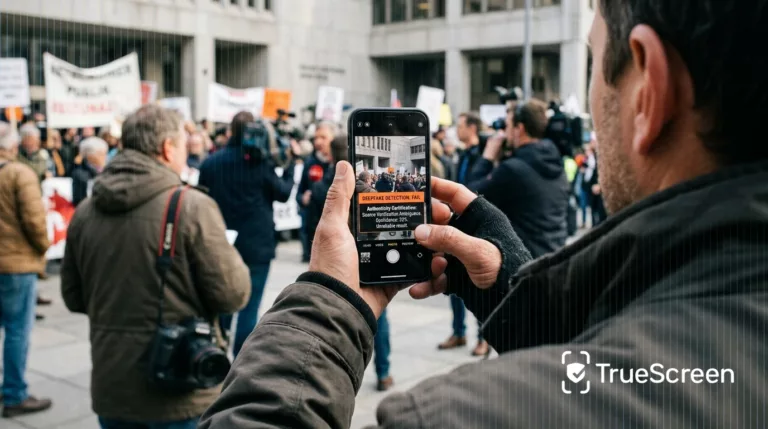
Deepfake detection: why detection software fails and the real defense is certifying at the source
Deepfake detection is unreliable: a NewsGuard report found 13% of authentic images flagged as AI. Why the real defense is certifying at the source.
Data Certification API: Give Legal Value to Any Data Your Software Manages
Add legal value to any record with a data certification API: qualified timestamps, SHA-256 hashes, chain of custody and REST or MCP integration.
Zero Trust Data Authenticity: Extending Continuous Verification to the Data Itself in 2026
Zero trust data authenticity extends continuous verification from identity to the data itself, sealing each asset at the source for legal-grade trust.
Top Platforms to Present and Certify Legal Case Documents Digitally
The top platforms to present and certify legal evidence digitally: how to compare them and choose court-ready tools for certified digital evidence.

EU AI Code of Practice: what changes for synthetic content producers from 2 August 2026
May 2026 EU Commission drafts on AI Act Article 50: clear, repeated, persistent labels for every synthetic content. What enterprises producing AI content must do.

Certified geolocation: how to prove the place of a digital fact admissible in court
Certified geolocation with qualified QTSP seal and eIDAS timestamp: how to prove the location of a photo in court and shift the burden of proof.
Data integrity in the age of AI: why quality starts with certification at the source
TSTrueScreen editorial teamPublished on May 25, 2026 · Updated on [...]
Why Half of GenAI Projects Fail: And the Data Truth Behind the Other Half That Survive
Gartner says 50% of GenAI projects are abandoned. The cause beneath the cause is data authenticity at source. Here's what changes when you fix it.

How to certify a smartphone video as legal evidence in court (2026 guide)
When a smartphone video stands in court: lawful acquisition, file integrity, chain of custody and formal filing, with the technical requirements.
Agent-to-agent communication: provenance and audit trail for multi-agent AI ecosystems
Agent to agent communication provenance: how to build a verifiable multi-agent AI audit trail compliant with AI Act and admissible in court.
How chain of custody for digital evidence works in US proceedings
How US federal and state courts treat chain of custody for digital evidence under FRE 901, FRE 902(14), FRCP 37(e), Lorraine v. Markel, NIST SP...

Digital evidence in French civil procedure: chain of integrity under article 1366 Code civil and eIDAS
Article 1366 Code Civil and the eIDAS Regulation give electronic writing legal force in French civil litigation. Practitioner guide to the chain of integrity.
ISO/IEC 27037: The International Standard for Digital Evidence
What ISO/IEC 27037 requires for identifying, collecting, acquiring and preserving digital evidence, and the DEFR and DES roles the standard defines.

WhatsApp evidence in court: 2026 guide to chats, screenshots and voice messages with legal value
Are WhatsApp messages admissible in court? What makes chat evidence valid, the common objections, and how to certify WhatsApp conversations with legal value.
Insights
AI Prompt Traceability: Why Certifying Instructions to AI Agents Matters
Deepfakes and criminal proceedings: the digital evidence crisis

Deepfake corporate fraud: why source certification is the real defense

Certifying AI Agent Outputs: Digital Evidence with Legal Value
NIS2 and AI Data Integrity: What Essential Services Must Do

E-Evidence Regulation: a practical implementation guide for European businesses

Digital Provenance in the Energy Sector: Certifying Field Inspections and Audits

Certifying the AI Agent Knowledge Base: Data Integrity and Provenance

EU AI Act Record-Keeping Requirements: A Practical Guide for Businesses
How to Make Digital Evidence Admissible: Step-by-Step Guide for Legal Professionals

Agentic AI Liability: Who Is Responsible When the Agent Fails
Chain of custody in the legal sector: a guide for lawyers and law firms

Self Check-in for Short-Term Rentals: What Changes After the Italian Ruling

Enterprise digital provenance: integrating data certification into business processes
Digital chain of custody: technical requirements for valid evidence in court
Email certification for insurance: claims, complaints and disputes
Challenging email evidence in court: authentication and preventive certification
Email certification for law firms: workflow and evidence collection

Email chain of custody: from sending to courtroom evidence