
How to certify a smartphone video as legal evidence in court (2026 guide)
Smartphone video evidence in court can decide a case: a recording of stalking conduct, a workplace safety violation, a road accident or an environmental crime. Yet most articles on the subject focus on a single question: was the filming lawful? In 2026, with electronic filing now standard across most EU jurisdictions and case law increasingly hostile to digital files without verifiable provenance, the practical question is different: which conditions must a smartphone video satisfy to actually hold up in front of a judge?
Four conditions, in fact: lawful acquisition, file integrity, documented chain of custody, formal deposit in the procedural channel of the jurisdiction. Each of them is necessary; none is sufficient on its own. This guide walks through the four requirements, the relevant European framework and the most recent rulings, and explains how integrity at source, the requirement most overlooked in everyday practice, can be solved with a forensic methodology built into the capture itself.
When a smartphone video is admissible as evidence
A smartphone video is admissible as evidence in court, in both civil and criminal proceedings, when its acquisition is lawful, the file is intact, the chain of custody is documented, and the deposit follows the procedural rules of the jurisdiction.
These four conditions are cumulative. A video filmed lawfully but uploaded to a chat, downloaded, re-encoded and produced in court two years later may be excluded for lack of demonstrable integrity. A perfectly preserved file obtained through a privacy violation may be excluded for unlawful acquisition. Judges have wide discretion: their decisions hinge on whether the requesting party can show that the video the court is watching is the same recording that was made at the time and place it claims to depict.
The video as digital document
A smartphone video is, technically, a digital document. Under most European procedural systems, a digital document is admissible whenever it is relevant to the proceedings and its formation can be traced back to a verifiable origin. The eIDAS Regulation (Reg. EU 910/2014) sets the baseline: electronic documents cannot be denied legal effect or admissibility as evidence solely on the grounds of their electronic form.
The principle of mechanical reproduction in civil law
Most civil-law systems classify smartphone videos under the broader category of mechanical reproductions: a class that includes audio recordings, photos and any other representation obtained through technical means. The Italian Civil Code, for example, treats them as forming full proof of the facts they represent, unless the person against whom they are produced disavows their conformity to the represented facts. The same logic, with variations, applies under German, French and Spanish civil procedure. The burden of disavowal must be specific: a generic objection is not enough.
How much weight do recordings have as evidence: lessons from case law
Audio and video recordings can serve as documentary evidence in civil and criminal proceedings. The judge weighs them freely against the other evidence and can reject them if the integrity of the file or the chain of custody is not demonstrable.
Three rulings illustrate how courts handle the question in 2026. They are Italian by origin but reflect a principle now common across EU jurisdictions: the more the file integrity can be challenged, the lower the probative weight the judge will assign.
The 2003 Italian Supreme Court principle: recordings between participants
In ruling 36747/2003, the Joint Sections of the Italian Supreme Court (Torcasio case) established that the recording of a conversation between participants, made by one of the participants, is not an interception and constitutes documentary evidence in criminal proceedings. The principle is consistent with the case law of most EU member states on the so-called "one-party consent" recordings, but it is not absolute legal proof: the judge evaluates the recording freely against the other evidence.
Italian Supreme Court ruling 6024/2026: the integrity principle in mechanical reproductions
The Fifth Criminal Section of the Italian Supreme Court, with ruling 6024/2026 of 13 February 2026, addressed the use of screenshots and mechanical reproductions in stalking proceedings and held that a screenshot is a document under art. 234 of the Italian Code of Criminal Procedure, as a mechanical reproduction of facts and things; the defence can challenge it with specific elements. The Court found the screenshots handed over by the victim sufficient because nothing cast doubt on her credibility, and it set no technical requirements such as a forensic report or the original device. When the content is handed over by a participant in the conversation, device seizure is not required. If the defence raises specific doubts, being able to prove integrity strengthens the evidence.
Italian Supreme Court order 1254/2025: WhatsApp screenshots as documentary evidence (WhatsApp chats analogy)
Ruling 1254/2025 of the Second Civil Section (18 January 2025) applies the same logic to WhatsApp chats and, by extension, to any digital reproduction filed in civil proceedings. The court held that messages produced via screenshot are usable as documentary evidence, taking into account the verification of their provenance and reliability. It set no technical requirement; documenting file integrity remains good practice in case of a disavowal. The principle transposes directly to smartphone videos.
When filming becomes unlawful: the boundaries of legality
Before discussing how to file and certify a video, the threshold question is whether the filming itself was lawful. An unlawfully obtained recording will rarely survive an admissibility challenge, regardless of its forensic perfection.
Recording in public and quasi-public spaces
Filming in a public space is, as a general rule, lawful across EU jurisdictions, provided that the recording does not capture intimate scenes, private communications or other content protected by the GDPR. The grey zone is the quasi-public space: shopping malls, hospitals, building lobbies. Here the lawfulness depends on the operator's rules, the visibility of warning signs and the purpose of the recording.
Recording in private spaces: privacy law
Recording inside a private space without the consent of all participants is, in most EU systems, a privacy offense and a possible criminal violation. The Italian Criminal Code (art. 615-bis) sanctions illicit interference in private life and the unauthorized recording of conversations occurring in private homes; the German BDSG and the GDPR (art. 5 and 6) impose comparable restrictions. Physical access to a private space does not equal permission to record what happens inside.
Recording between participants and unauthorized disclosure
Recording a conversation in which you are a participant is generally lawful in most EU countries. What is not lawful is the unauthorized disclosure of that recording to third parties beyond the proceedings: posting it online, publishing it in the press, sharing it on social media. The recording can be used in court; it cannot be made public without separate authorization.
How to file a video as evidence in court
A correctly acquired video is useless if it is not filed through the proper procedural channel. In 2026, paper-and-DVD filings are residual; most jurisdictions accept or require electronic filing.
Digital filing systems (PCT, e-filing, e-deposit)
In Italy, civil proceedings rely on the Processo Civile Telematico (PCT) for electronic deposit. Comparable systems exist across Europe: France's RPVA, Germany's beA, Spain's LexNET. Each system has technical specifications for accepted formats and size limits. A common requirement is that video evidence be filed together with a transcription or a structured description, especially when the file exceeds the platform's size threshold.
Criminal proceedings: digital deposit and reforms
Several EU jurisdictions have introduced digital deposit reforms over the last three years. Italy's so-called Cartabia reform has progressively extended the obligation of digital deposit to a wide range of acts, including multimedia evidence. The practical implication is that parties must rely on platforms that preserve the metadata of the deposited file: a video stripped of its metadata at upload can be deemed less reliable than the same video deposited through a system that preserves the original hash.
Accepted digital formats and transcription
Most systems accept MP4, MOV and AVI, with size limits between 30 and 100 MB per file. When the smartphone video exceeds the limit, the standard practice is to deposit a hash of the file together with a description, and make the file available via secure download. A textual transcription is increasingly recommended for audio-rich videos.
File integrity: the requirement nobody explains
Lawful acquisition, chain of custody and proper deposit are well covered in legal literature. The fourth pillar: file integrity at source: is often treated as a technical afterthought. It is, in fact, the requirement that determines whether the other three survive contestation.
What "integrity at source" means
Integrity at source means that the video file produced in court is provably the same file that the camera generated at the moment of capture, with no alteration in between. Once a video has been uploaded to a messaging app, downloaded, re-encoded by a social platform or even moved between devices, its hash changes and its metadata can drift. The judge cannot, in 2026, simply accept a file as "the original" because the party says so: integrity must be provable through a verifiable cryptographic mechanism.
Cryptographic hash: the video's digital fingerprint
A cryptographic hash (typically SHA-256) is a fixed-length string that uniquely represents the content of the file. Any modification of the file, even a single bit, produces a completely different hash. If the hash is generated at the moment of capture and bound to a trusted time reference, any later tampering with the file becomes mathematically detectable. Producing a video together with its hash, certified at the moment of acquisition, transforms the integrity question from a credibility issue into a cryptographic verification.
Qualified eIDAS timestamp and the role of QTSPs
A hash alone proves that two files are identical; it does not prove when the file existed. The missing element is a qualified timestamp under article 42 of the eIDAS Regulation. A qualified electronic time stamp is issued by a Qualified Trust Service Provider (QTSP), an entity accredited under EU Regulation 910/2014 and supervised by national authorities. The qualified timestamp enjoys cross-border legal recognition across all EU member states and provides cryptographic proof that a specific data existed in a specific form at a specific moment.
Organizations and legal professionals use TrueScreen to certify videos, photos and screenshots at the moment of acquisition, applying cryptographic hash and qualified timestamp from a third-party QTSP accredited under eIDAS. TrueScreen is not a QTSP itself: it integrates the seal and timestamp of qualified third-party QTSPs via API, providing the application layer where the user captures the content and the forensic methodology is executed.
Documented chain of custody: from capture to filing
The chain of custody is the sequence of operations and custodians that the file traverses from creation to deposit. International standard ISO/IEC 27037 defines the framework for identification, collection, acquisition and preservation of digital evidence. A documented chain of custody answers four questions about the file at every step: who held it, what was done to it, when, and through which technical means. When integrity is sealed at source through hash and qualified timestamp, the chain of custody becomes shorter and more defensible: the cryptographic seal generated at capture acts as the anchor against which every subsequent step is verified, building a verifiable digital provenance.
When raw smartphone isn't enough: certifying the video at source
A video filmed with the native camera app and shared via cloud or chat is a raw smartphone video. It may be authentic; it may be inauthentic; the judge has no cryptographic way to tell.
What the TrueScreen app does
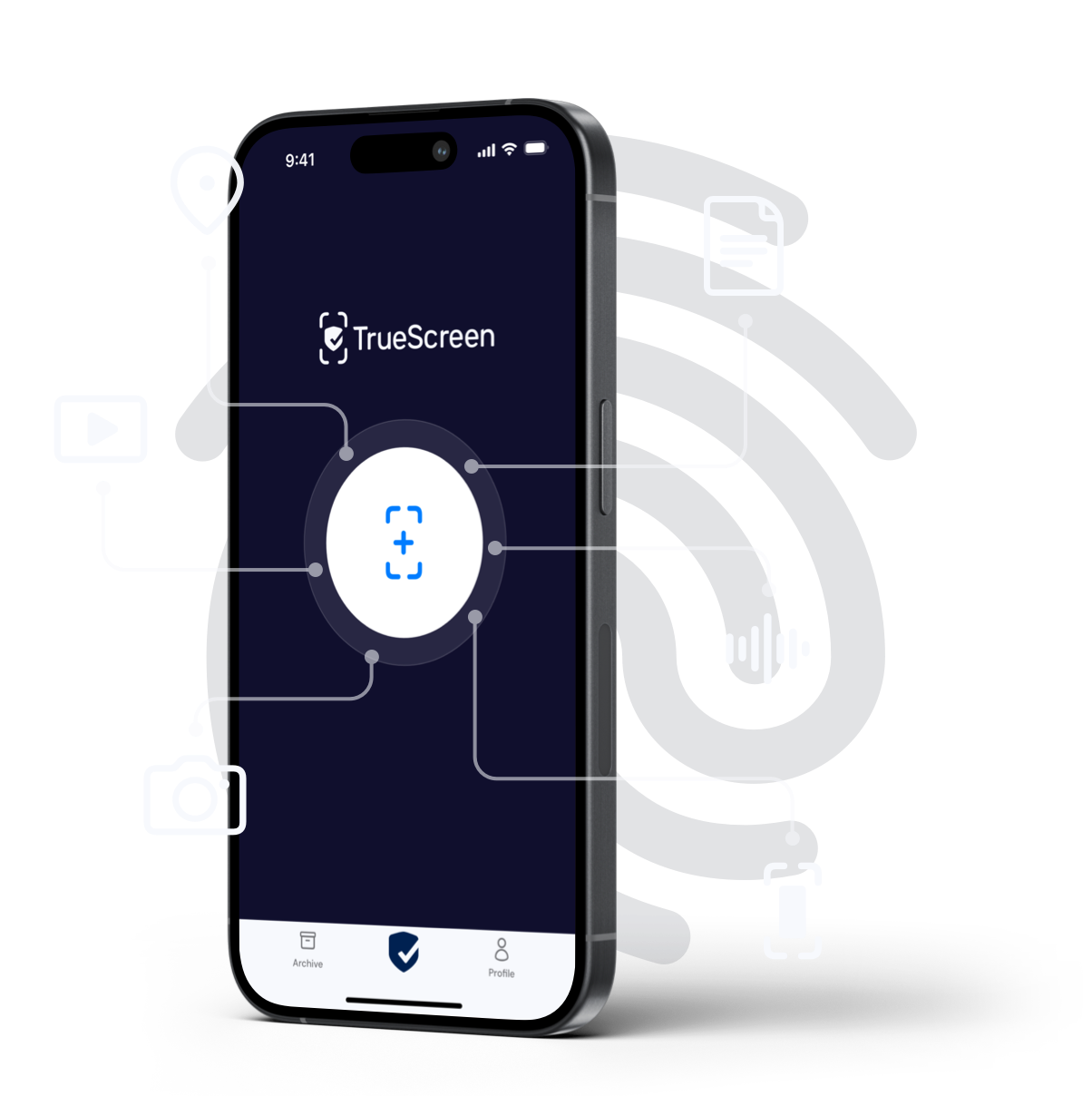
TrueScreen is the Data Authenticity Platform that documents smartphone video with forensic methodology, generating an automated report, SHA-256 hash and qualified timestamp at the moment of capture. The TrueScreen app for iOS and Android records the video in a controlled environment, signs the file with a cryptographic hash before it leaves the device, and binds the hash to a qualified eIDAS timestamp issued by a third-party QTSP integrated via TrueScreen. Geolocation is captured and signed in the same operation, when the user authorizes it.
The automated forensic report
For every certified acquisition the platform produces an automated forensic report. The report includes the hash of the recording, the qualified timestamp, the device fingerprint, the signed geolocation and a description of the acquisition environment. The report is generated automatically: no later expert intervention is required to attest that the file existed in a specific form at a specific moment. The report follows the principles of ISO/IEC 27037 and is structured to be deposited together with the video in electronic filing systems.
Difference between certified and "raw" video
| Feature | Raw smartphone video | Certified-at-source video |
|---|---|---|
| Cryptographic hash | None (file open to changes) | SHA-256 at moment of capture |
| Timestamp | Internal metadata (mutable) | Qualified QTSP eIDAS timestamp |
| Geolocation | Editable in post-production | Signed and immutable coordinate |
| Chain of custody | To reconstruct ex-post | Documented automatically |
| Forensic report | Requires later expert analysis | Generated automatically at capture |
| Disconnect risk in court | High | Low (integrity at source provable) |

Practical use cases for legally valid smartphone video
The integrity-at-source approach is not a theoretical exercise. It addresses recurrent situations in litigation and investigation.
Stalking and harassment
In stalking cases, victims often document persecutory conduct with their smartphones: messages, video encounters, audio recordings. Italian Supreme Court ruling 6024/2026 held that screenshots handed over by the victim can be acquired without seizing the phone, as long as nothing casts doubt on her credibility. If the defence raises specific objections, being able to show integrity, authorship and timing strengthens the evidence. Certifying the recording at the moment of capture, with supporting evidence such as certified photos as legal proof, avoids the need to surrender the device and preempts contestation.
Workplace misconduct and mobbing
Employees documenting harassment, unsafe practices or breaches of contract face the same problem: a video shared via chat loses its evidentiary weight. A recording certified at source allows the worker to preserve a defensible record while keeping the original on the device, and to deposit the certified file together with the forensic report when the dispute escalates.
Insurance claims and immediate surveys
For claims adjusters, on-site engineers and field inspectors, smartphone video is the natural medium to document property damage, vehicle accidents and incident scenes. Certifying the video at acquisition turns the field report into evidence that withstands contestation by the counterparty's expert, without dispatching a forensic technician to the site.
Environmental crimes and citizen reporting
Citizens and NGOs documenting illegal dumping, water pollution and other environmental violations face the same evidentiary hurdle: the video is the only proof, and authorities can dismiss uncertified files. Capture-time certification turns the citizen recording into a deposit-ready digital document, with a qualified timestamp that withstands the typical delay between observation and prosecution.
FAQ: Frequently asked questions on smartphone video evidence
Is a video recorded on a smartphone admissible in court?
How much weight do recordings have as evidence?
When is filming someone a crime?
How do I file a video in digital court systems?
What happens if the opposing party challenges the video?
How can I prove a video has not been tampered with?
Are videos from CCTV usable as evidence?
Do new procedural reforms (e.g., Italy's Cartabia reform) change anything?
TrueScreen editorial team
Published on · Updated on
This section is edited by the TrueScreen editorial team, which brings together expertise in digital forensics, the law of digital evidence and regulatory compliance. Every article is checked against primary sources: legislation, published rulings, technical standards and official documentation, always cited in the text.


