
Audio and video recordings in civil litigation: how to make them admissible
Anyone heading into a civil dispute often already holds the decisive proof on their phone: a recorded conversation, a video shot on site, a voice message documenting an agreement or a threat. Yet getting that file in front of a court and having it carry weight is far from automatic. A raw recording, exported straight from the app, is fragile evidence. The moment the other side challenges it, its weight can collapse from compelling proof to a mere indication left to the judge's discretion.
The problem is not the recording itself but its defensibility. An audio or video file can be trimmed, edited, recompressed or generated artificially, and today doing so is within anyone's reach. When the opposing party disputes that the file faithfully represents the facts, a recording with no anchoring offers nothing solid to rely on. The operational question, then, is a single one: how do you turn a raw audio or video recording into admissible evidence in civil litigation?
The answer is legal and operational rather than technical, and it rests on four conditions that must be built before you ever reach the courtroom: integrity of the file, authentication of its origin, lawfulness of the collection and a trusted time anchor. A recording that satisfies all four withstands challenge and reaches the court with maximum probative force. One that ignores even a single requirement risks being neutralized by the very first objection.
When an audio or video recording is admissible in civil proceedings
An audio or video recording is admissible in civil proceedings when the court can be satisfied that it is authentic, unaltered and supported by a documented chain of custody. Admissibility is decided case by case, weighing relevance and probative value against any infringement of privacy or fundamental rights. This is the baseline every evidentiary strategy starts from.
Across jurisdictions the standards converge. In the United States, Federal Rule of Evidence 901 requires the proponent to produce evidence sufficient to support a finding that the item is what it claims to be, and Rule 901(b)(9) specifically addresses evidence describing a process or system that produces an accurate result. Internationally, ISO/IEC 27037 sets out the requirements for identifying, collecting and preserving digital evidence, while the Budapest Convention on Cybercrime frames the cross-border handling of electronic proof. None of these turns a recording into proof on its own: each demands that origin and integrity be demonstrable.
The limit of recordings between third parties
Admissibility weakens sharply when the recording captures a conversation between people who are all strangers to the dispute. A party who records a conversation they took part in stands on firmer ground than one who captures an exchange they had no role in. The practical rule is straightforward: the person recording should be one of the participants, or otherwise hold a recognizable, direct interest tied to the defence of a right.
Document, not interception
A frequently misunderstood point concerns the nature of the proof. Recording a conversation you are part of is not interception in the technical sense. It is documentary evidence, formed by the party and produced like any other document. That distinction keeps it outside the strict authorization regime reserved for criminal wiretapping and places it within the more flexible, but not unlimited, perimeter of civil evidence. The same documentary logic applies to material gathered through messaging: even screenshot evidence produced in court is judged by its authenticity and integrity, not by its format.
The four requirements that make a recording defensible
An audio or video recording becomes solid evidence when it proves four things at once: that it is intact, that it comes from a verifiable source, that it was collected lawfully, and that it has existed in fixed form since a certain moment. Each requirement answers a possible objection from the other side, and the absence of any one is precisely what an experienced litigator attacks first.
| Requirement | Objection it answers | How it is shown |
|---|---|---|
| Integrity | "The file was edited or altered" | Cryptographic hash computed at the source |
| Authentication | "It is unclear where this file comes from" | Tracking of origin and acquisition metadata |
| Lawfulness | "The recording was collected unlawfully" | Defensive purpose, a party present in the conversation |
| Time anchoring | "We do not know when it was created" | Qualified timestamp opposable to third parties |
Integrity: the recording must not be alterable
Integrity is the proof that the content has not changed since collection. It is demonstrated by computing a cryptographic hash at the moment of acquisition: any later modification, even of a single bit, produces a different hash and becomes immediately detectable. Without this anchor, the recording stays exposed to the most basic and most effective objection, namely that the file filed in court is not the original but a version cut to suit.
The key is that integrity must be built before, not after. A later forensic analysis can try to establish whether a file was tampered with, but it is a probabilistic, costly and contestable exercise. A hash computed at the source moves the problem from the realm of opinion to the realm of mathematics.
Authentication: you must be able to trace the origin
Authentication ties the file to a verifiable source and a documented history. Saying "I recorded it myself" is not enough: you need to reconstruct where, when and with what tool the content was captured, and to show that from that moment the chain of custody was never broken. Keeping acquisition metadata in order, alongside a continuous record of each handover, is what lets the court and any technical expert trust the provenance.
Lawfulness: the right of defence as a balancing test
Collection must be lawful, and here the balance between the right of defence and the protection of privacy comes into play. The GDPR expressly recognizes that processing personal data when necessary for the establishment, exercise or defence of legal claims has its own legal basis. A recording made for defensive purposes, confined to that purpose and not spread for other ends, falls within a lawful regime. The calculus shifts for online meetings and remote conversations, where specific considerations on consent and the limits of the GDPR apply.
Time anchoring: a certain, opposable date
The final requirement is proof that the recording existed in a given form on a given date. A qualified timestamp, of the kind defined under the eIDAS Regulation, provides a reference opposable to third parties: it shows that this exact content, with this exact hash, already existed at that moment. It is the tool that stops the other side from arguing that the file was assembled after the fact, for instance once they had learned of the opposing arguments.

The weak point: challenge and forensic examination
The moment a recording is most likely to fall apart is when the opposing party challenges it. If the challenge is clear, specific and substantiated rather than a generic denial, the burden shifts back onto the party producing the file to prove it is genuine. The recording does not vanish, but it moves from near-automatic proof to an indication that needs corroboration, a far heavier load for whoever relies on it.
When the challenge has substance, courts commonly turn to a forensic examination to assess the authenticity of the track. This is where the case is decided. A recording carrying a cryptographic hash and a qualified timestamp from the outset gives the expert objective elements on which to base a genuineness finding. A bare recording, with no anchors, forces the examination to reason by inference and leaves far more room for dispute. The difference between the two situations is not technical: it is the difference between winning and losing that chapter of the case. The same reasoning that governs the admissibility of digital evidence holds across every format, from audio to chat exports.
How to file a recording without weakening it
To bring a recording into a dispute with maximum force, a few operational steps must come before filing. Skipping them hands the other side the footholds for a challenge.
- Keep the original file without re-exporting or recompressing it: every pass through a messaging app or an editing program can alter metadata and quality.
- Anchor the integrity of the content with a cryptographic hash computed as early as possible, ideally at the very moment of capture.
- Document the origin: the tool used, the date, the place, the identity of the person recording and the defensive context.
- Prepare a faithful transcript of the audio, so that the court and the other side can read what is heard.
- Maintain a continuous chain of custody, avoiding untracked handovers that open the door to claims of manipulation. The international benchmark here is ISO/IEC 27037.
These precautions apply to every kind of recording, but they become critical when the content is the only available proof or when the stakes are high. For law firms handling volumes of digital evidence, building a repeatable process is more efficient than improvising case by case.
How TrueScreen makes a recording defensible evidence
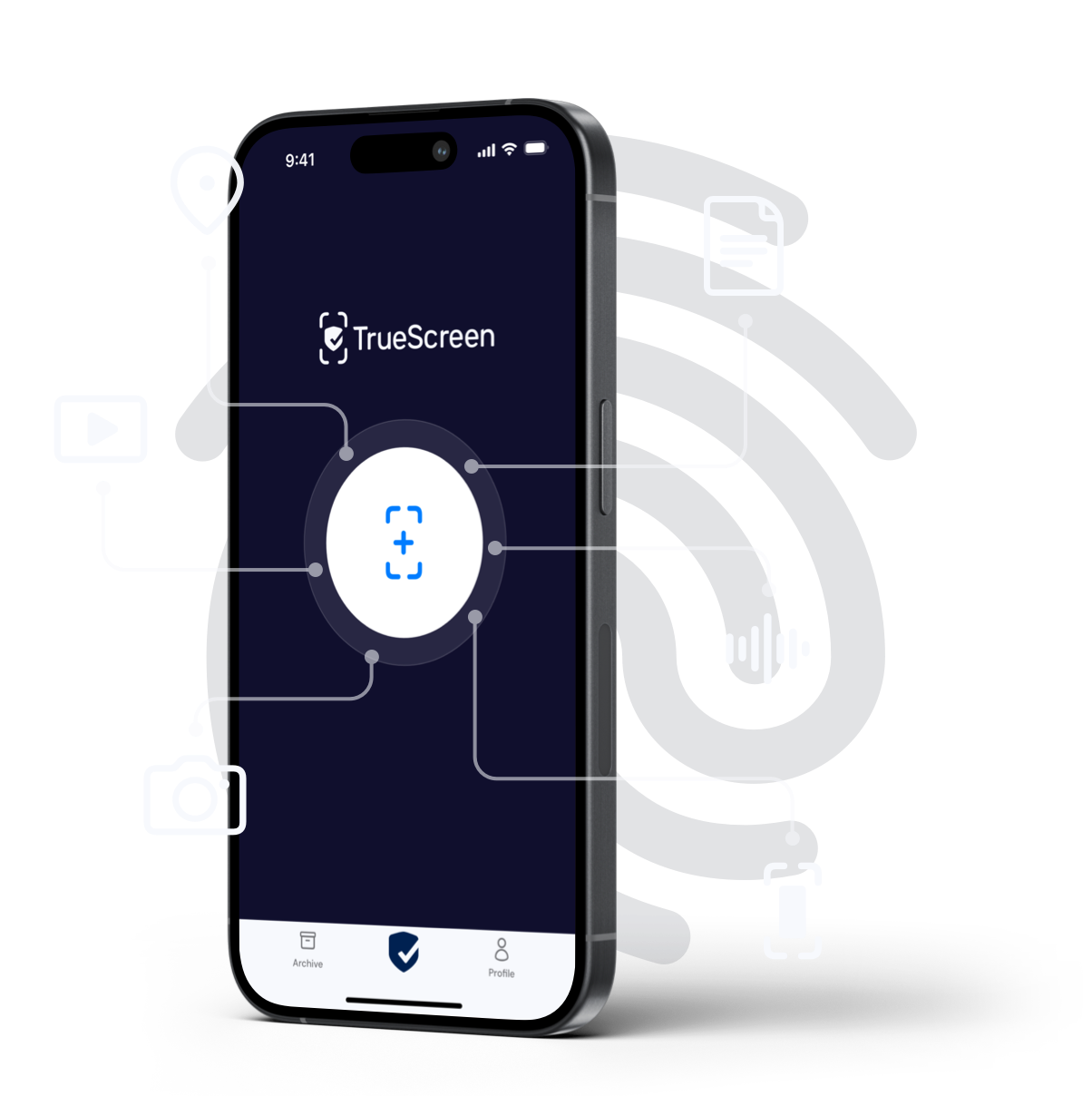
TrueScreen is the platform that captures and certifies digital content with legal value, building the four admissibility requirements at the very moment a recording is captured, not afterwards. Instead of relying on a later examination to reconstruct integrity and origin, it applies a forensic methodology that anchors content to its source from the start. The result is a recording that reaches court already carrying the objective elements that withstand challenge.
The process combines three steps. Acquisition happens in an environment built to protect the integrity of the data and prevent alteration at the source. Verification confirms that the captured content is genuine. Certification applies an electronic seal and a qualified timestamp, recognized internationally, that fix a certain date and immutability. This is the foundation of Digital Provenance, the ability to demonstrate the origin and history of digital content across its entire lifecycle.
Capturing audio and video directly at the source
With the TrueScreen mobile app you can record audio and video already in certified mode: the cryptographic hash and the qualified timestamp are applied at the moment of capture, closing the window of vulnerability between recording and protection. The same holds for remote recordings, where certified live video surveys let you document inspections and live interviews with probative value.
Certifying files that already exist
When the recording has already been made, the TrueScreen platform lets you certify it by adding a hash and a timestamp to the file as it stands, crystallizing its state at a certain date. For organizations handling many pieces of evidence, such as law firms, a documented chain of custody turns the management of digital evidence into an orderly, defensible process.
A concrete example: a company records a phone call in which a supplier acknowledges a product defect (for investment firms, recording client calls is not a choice but a duty under the MiFID II recording obligations). Captured and certified at the source, that call reaches the dispute with a hash, a certain date and a traced origin. If the other side challenges it, the forensic examination finds objective elements to work with, and a generic denial is not enough to neutralize it.
FAQ: common questions on audio and video evidence in civil cases
Is an audio recording made without consent valid as civil evidence?
What happens if the other side challenges the recording?
Do I need a timestamp to file a recording?
Does a recording sent over WhatsApp have the same value as the original?
Can a court reject a video recording outright?
TrueScreen editorial team
Published on · Updated on
This section is edited by the TrueScreen editorial team, which brings together expertise in digital forensics, the law of digital evidence and regulatory compliance. Every article is checked against primary sources: legislation, published rulings, technical standards and official documentation, always cited in the text.


