
Federal Rule 707 and AI-generated evidence: what changes in US federal court
Updated on
Law firms and in-house teams put more digital evidence into federal litigation every month: screenshots of executive chats, recordings of video depositions, documents pulled from the web and, increasingly, output produced by AI systems. The problem is that the evidentiary standards used to weigh this material were written before generative AI existed.
Proposed Federal Rule 707 is the attempt of the Advisory Committee on Evidence Rules to close one part of that gap. FRE 707 would apply the reliability standard of Rule 702 to output that is acknowledged to come from an AI system and is offered without an expert witness to explain it. It is not a deepfake rule: whether an exhibit was fabricated is a question of authenticity under Rule 901 and Rule 902, and the Committee handles it with a separate draft, Rule 901(c). In May 2026 the Committee voted to withdraw the version of Rule 707 published for comment in 2025, and a revised draft is still under study.
So anyone bringing evidence into a federal courtroom faces separate questions: whether AI output can be shown to be reliable, and whether a photo, a video or a screenshot can be shown to be what it claims to be. For the second, the most dependable answer is to document the content at the moment of acquisition, instead of trying to reconstruct its history once authenticity is already in dispute. That is the ground TrueScreen works on, certifying photos, video, screenshots, video calls and documents at the source with a forensic methodology, a digital seal and a timestamp qualified under the EU eIDAS Regulation.
What is Federal Rule of Evidence 707 and what changes for AI-generated evidence
Federal Rule of Evidence 707 is a proposed rule, not in force, that would apply the Rule 702 reliability standard to evidence produced by artificial intelligence when it is offered without an expert witness. When a party offers AI output that would count as expert testimony if a person gave it, for example a facial-recognition match presented by a witness who simply ran the program, that output would have to be as reliable as an expert's testimony.
The first draft of FRE 707, titled "Machine-Generated Evidence", was published for comment in August 2025, with public hearings in January 2026 and the comment period closing on February 16, 2026. That version excluded "the output of simple scientific instruments", such as a mercury-based thermometer or an electronic scale. At its meeting of May 7, 2026 the Committee voted to withdraw the rule as published and to study a revised draft, "Evidence Produced by Artificial Intelligence and Presented at Trial Without an Expert", which drops the instruments exception, speaks of "artificial intelligence" instead of "machine-generated" evidence and adds a notice requirement. The core is unchanged: AI output offered as evidence would have to rest on sufficient facts or data and on reliable principles and methods, reliably applied. FRE 707 shifts the center of gravity: it would no longer be enough for AI output to exist, it would have to be shown to be reliable.
Where it comes from: the gap left by pre-AI standards
Federal Rule 707 exists to fill a grey zone. Today, output from a language model, a facial-recognition match or a summary produced by an algorithm falls between two categories that do not describe it well. On one side, Rule 702 was built for human expert testimony and assumes a person who can explain the method. On the other, Rule 901 and Rule 902(13) were built to authenticate documents and electronic records: they check origin, not the reliability of the content itself.
The effect is that acknowledged AI output can enter a proceeding through a lay witness or a certification with no real reliability screening, simply because no rule catches it specifically: the Committee's report of May 17, 2026 notes that Rule 702 "is not clearly applicable if the AI output is admitted without any expert testimony". FRE 707 would close that opening by extending the reliability requirements of Rule 702 to AI output as well. The deeper concern is the admissibility of digital evidence once its genuineness can no longer be assumed.
Where the adoption process stands
Federal Rule 707 follows the Rules Enabling Act path, which is long and runs through several stages: Advisory Committee, Standing Committee, Judicial Conference, Supreme Court and finally Congress, which has a window to act. The published version was on a timeline that could have brought it into force on December 1, 2027 at the earliest. That timeline no longer applies. In its May 2026 report the Committee did not recommend action on Rule 707, noted that the revised version "would require re-publication were it to go forward", and decided not to republish it for now.
As of October 3, 2026 the revised draft is on the agenda of the Committee's meeting of October 15, 2026 in Boston, where a panel of experts on AI and evidence is due to discuss it, alongside a panel on deepfakes and the draft Rule 901(c) that the Committee keeps in reserve. No new comment period has been opened, so there is no calendar for entry into force. Separately, a proposed amendment to Rule 104, open for public comment from August 14, 2026 to February 15, 2027, would write into Rule 104(a) the preponderance standard that already governs preliminary questions such as whether a witness is qualified or evidence is admissible. For litigators and in-house counsel, Rule 707 is not applicable, and the draft under study may still change; it currently reflects an approach approved by a majority of the Committee: AI output offered without an expert should meet the same reliability bar as expert testimony, and an expert would ordinarily be needed to show it.
The limits of current authentication standards against synthetic content
Today's authentication rules are not equipped for synthetic content. Rule 901 asks, in general terms, for proof that evidence is what its proponent claims it is; Rule 902(13) allows self-authentication of records generated by an electronic process or system, through a qualified person's certification. Both answer the question "where did this file come from," not the question "is this content genuine or was it fabricated to look that way."
Unlike Federal Rule 707, the authentication standards in force predate generative AI on their digital side and address a different problem. Rule 902(13) was written for records generated by an electronic process or system, such as server logs, database extracts and file metadata, and Rule 901 sets a general, low threshold for showing that an item is what it is claimed to be. Neither was conceived for a synthetic video that looks shot on a real camera, or a screenshot reproducing a conversation that never happened. The forensic expert tasked with authenticating digital evidence can be limited to tools that verify the data's transmission chain, not its genuineness at the source. The academic debate, including Professor Rebecca Delfino's article "Deepfakes on Trial" (Hastings Law Journal, 2023), has examined how deepfakes strain the authentication rules. This is the problem the Committee's draft Rule 901(c) addresses, not Rule 707. In May 2026 the Committee concluded that, "at least for now, an amendment to Rule 901 to address deepfakes is not warranted", and it keeps the draft ready in case the existing rules prove inadequate.
The table below summarizes what each rule solves and what it leaves uncovered.
| Rule | Question it answers | What it checks | Limit against synthetic content |
|---|---|---|---|
| Rule 707 (proposed, under revision) | Is the evidence reliable? | Reliability of AI output offered without an expert, under the requirements of Rule 702(a)-(d) | Applies only to evidence a party admits is AI-generated |
| Rule 901 | Is the evidence what it claims to be? | General authenticity and origin of the material | Does not separate genuine content from a well-made synthetic one |
| Rule 902(13) | Does the record come from a reliable electronic system? | Self-authentication via a qualified person's certification | Certifies the process, not the genuineness of the captured content |
Reliability and authenticity stay distinct requirements: Rule 707 addresses the first, Rule 901 and Rule 902 the second. The draft Committee Note to the revised Rule 707 makes the point directly: when AI output is the equivalent of expert testimony, "it is not enough that it is self-authenticated under Rule 902(13)", because that rule "covers authenticity, but does not assure reliability." A 902(13) certification settles authenticity only, as our insight on FRE 902(13) and 902(14) certifications explains. A party offering AI output without an expert would have to satisfy both requirements. For content captured by people rather than produced by AI, authenticity is the question, and it is what an end-to-end chain of custody and certification process is built to document.
What Rule 707 would require from those presenting AI output in federal court
Federal Rule 707 would ask a party to show that AI output offered without an expert is as reliable as an expert's testimony, by meeting the requirements of Rule 702(a)-(d). This is where the difference between Rule 707 and Rule 702 turns practical: the same criteria built for the human expert would apply to the machine's output.
Under the revised draft, the proponent of AI output offered without an expert would have to establish that the evidence meets the requirements drawn from Rule 702(a)-(d):
- Helpfulness: the evidence helps the judge or jury understand a fact or decide a disputed one.
- Sufficient factual basis: the output rests on sufficient facts and data, not on incomplete or unrepresentative material.
- Reliable methods: the content is the product of reliable principles and methods whose operation can be examined.
- Reliable application: those methods were applied reliably to the specific facts of the case.
The revised draft adds that admissibility would ordinarily require the proponent to provide an expert to explain how the AI system reliably produced the evidence, with other proof, such as convincing validation tests, accepted only in exceptional circumstances. The proponent would also have to give reasonable notice of the intent to offer the evidence, and the rule would not apply to facts that can be judicially noticed under Rule 201.
In practice, this would open new discovery burdens around how the system that produced the evidence works, its training data, whether it has been validated and whether its output can be reproduced or audited. A screenshot, a video or the recording of a video call captured by a person is a different matter: it is not ordinarily offered as the product of an AI system, so Rule 707, as drafted, would not ordinarily apply to it, and the question is whether it is authentic. For that material the integrity of the content has to be demonstrated, not assumed, and the most dependable moment to document it is the forensic acquisition, which is where TrueScreen works.
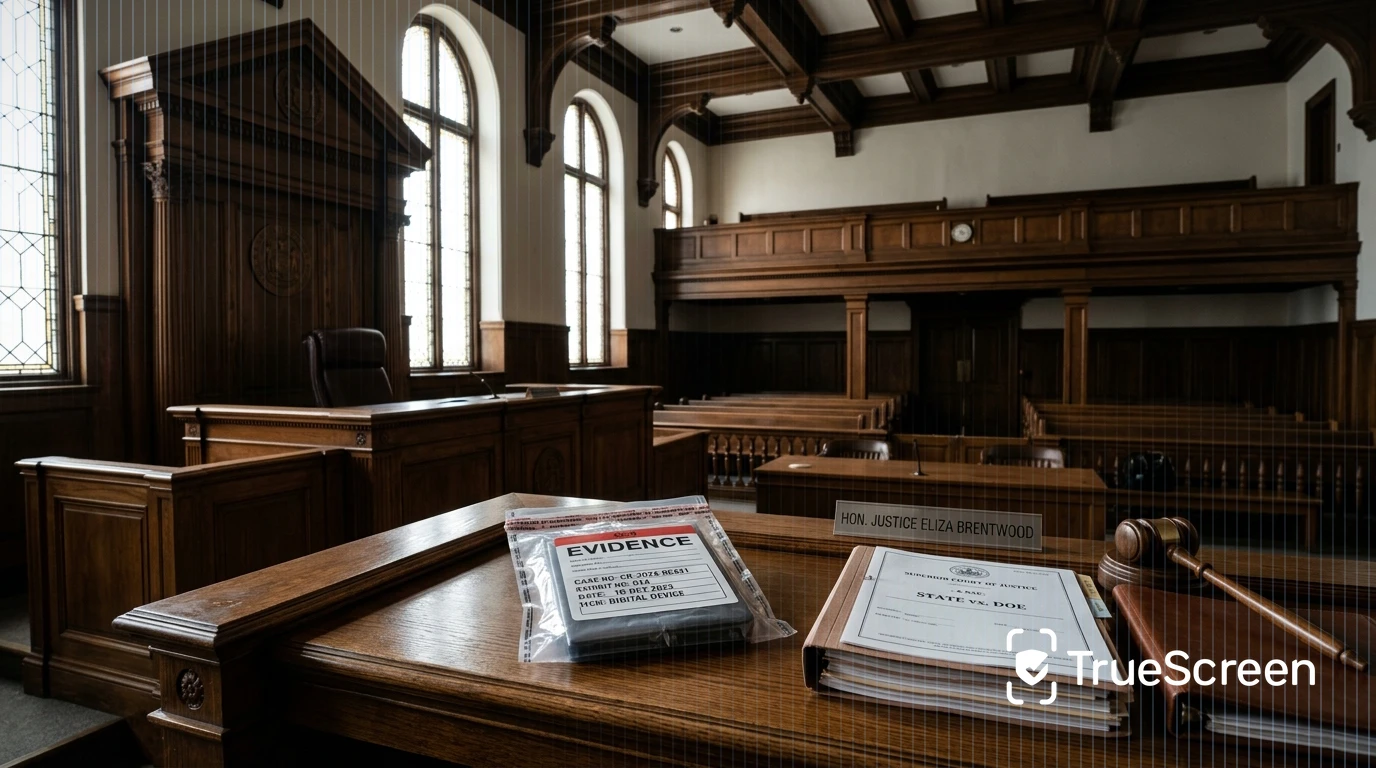
Certifying at the source: what it proves and what Rule 707 asks for
Certifying at the source answers the authenticity question, not the AI reliability question Rule 707 deals with. TrueScreen, the Data Authenticity Platform, acquires photos, video, screenshots, video calls and documents with a forensic methodology and certifies them with a digital seal and a timestamp qualified under the EU eIDAS Regulation. Digital evidence is easiest to defend when its integrity is documented at the moment of acquisition, not reconstructed after the fact once genuineness is already contested.
Legal teams use TrueScreen to acquire screenshots, web pages, recordings and media files at the moment they become relevant. Every piece of content captured with TrueScreen receives a digital seal and a timestamp qualified under the EU eIDAS Regulation, together with a forensic report that documents how the content was acquired. TrueScreen is not a certificate authority and issues no qualified certificates. The result is a verifiable record that the content has not changed since capture, and of how and when it was captured: material a witness or a qualified person can use to lay the foundation under Rule 901(b)(9), and the technical basis of a certification that a qualified person can sign under Rule 902(13) or 902(14). It does not make AI output reliable, which is the separate question Rule 707 would govern.
What it means to certify content at the source
Certifying at the source means acting at the instant the content is captured, not afterward: TrueScreen certifies that a given photo or video was acquired at that moment and has stayed intact since. When the content already exists and could not be protected at the source, TrueScreen also offers deepfake and GenAI detection, available on every TrueScreen plan and reachable today in the Forensic Browser, as one check among others within its forensic methodology. Detection returns a degree of confidence, not proof. A detection result is itself the output of an AI system, so a party offering one without an expert would need to consider whether the revised Rule 707 draft, if adopted, would apply to it.
With certified acquisition, integrity becomes a property the content carries from birth. That flips the usual authentication problem: instead of proving after the fact that material is genuine, its integrity is documented from the first instant, narrowing the room for authenticity challenges at the admissibility stage. It is the same logic that underpins Digital Provenance, the documented history of where a piece of content comes from.
Qualified timestamp and digital seal: the evidentiary log
The qualified timestamp and the digital seal are the technical elements that make the result of a forensic acquisition verifiable. The qualified eIDAS timestamp fixes the date and time of the acquisition, and the qualified seal protects the integrity and origin of the sealed data. Under the eIDAS Regulation both enjoy legal presumptions in the EU; in a US federal court they are evidence that a witness or a qualified person can describe. Together with the forensic report, they build a documented, verifiable chain of custody.
Consider an in-house counsel who has to produce, in federal litigation, a screenshot of a web page and the recording of a video call. Captured with TrueScreen, each element comes with a qualified timestamp, a digital seal and a report that documents how it was acquired, so integrity and date can be shown without reconstructing provenance after the fact. Organizations and law firms use TrueScreen for exactly this: to acquire digital evidence with a verifiable date and a documented chain of custody, reducing their exposure to authenticity challenges during e-discovery and litigation.
General information on US federal rules; not legal advice. Status as of October 3, 2026: proposed rules can change before adoption, so check the current text with the Advisory Committee on Evidence Rules and the rules of your court.
FAQ: Federal Rule 707 and AI-generated evidence
What is Federal Rule of Evidence 707?
What changes compared to Rule 702?
Does Federal Rule 707 solve the deepfake problem?
Rule 707 and Rule 901: what is the difference?
When does Federal Rule 707 take effect?
How do you authenticate AI-generated evidence in court?
TrueScreen editorial team
This section is edited by the TrueScreen editorial team, which brings together expertise in digital forensics, the law of digital evidence and regulatory compliance. Every article is checked against primary sources: legislation, published rulings, technical standards and official documentation, always cited in the text.


