
Facebook scam ads with deepfakes: what an Italian court ordered Meta to do and what to save before they disappear
An Italian court has told Meta to take down and filter deepfake ads impersonating a financial adviser. How the scam works, and what to secure before the ads disappear.
On October 29, 2026, a court in La Spezia, Italy, ordered Meta Platforms Ireland to stop, remove and filter Facebook scam ads that used a financial adviser’s face, name and cloned voice without consent, and to shut down the WhatsApp groups and numbers they promoted, according to Il Sole 24 Ore. The order is provisional until a hearing on December 10. If such an ad uses your face or has drawn you in, preserve the ad, its page, its Ad Library entry, the link and the chat first. TrueScreen fights the scams that steal faces and voices with deepfakes by certifying what appears online with a forensic methodology, protecting the people impersonated and deceived from fraud, disputes and lost proof.
Key takeaways
- On October 29, 2026, a court in La Spezia issued a provisional urgent decree ordering Meta Platforms Ireland to remove deepfake ads using a financial adviser’s face and voice, deactivate linked WhatsApp groups and filter reposts (Il Sole 24 Ore).
- The decree does not decide the merits and Meta has not been found liable: a hearing on December 10, 2026 will decide whether it stands, plus a daily penalty and publication on Meta’s channels (Il Sole 24 Ore).
- Under article 39 of the Digital Services Act, once an ad is removed as illegal, Meta’s Ad Library no longer shows its content or who paid for it.
- In a CERT Polska test, 106 of 122 ads reported as fraudulent were not removed; Poland has asked the European Commission to fine Meta, and the Commission will decide (Notes from Poland, August 2026).
- Certification shows how and when a scam ad was captured, not that what its video claims is true; the court weighs the evidence (eIDAS, arts. 35, 41 and 46).
1,267
illegal financial ads found in a week of FCA-led action, reaching at least 2,338,372 UK accounts
106 of 122
ads reported as fraudulent that stayed online in a CERT Polska test
Facebook scam ads with famous faces follow a familiar pattern: a well-known investor promises returns that are hard to ignore. The deepfake scam behind them is cheap to run, and the ads keep coming back: Corriere della Sera reports about 5,800 ads flagged in the Italian case, with 500 running on a single day.
A court has now told Meta to take them down, yet removal also erases the video, the page and the advertiser details that victims need as proof. So the question is what to preserve, and how, before it goes: in short, everything, captured while it is still online. TrueScreen certifies the scam’s ads, pages and chats while they are still live, so the impersonated professional and the person who paid keep evidence that an independent expert can examine long after the originals are gone.
What the court in La Spezia ordered Meta to do
The La Spezia court ordered Meta to stop, remove and filter deepfake ads exploiting a financial adviser’s identity, in a provisional decision that a December 10 hearing will confirm or overturn.
The case: a financial adviser’s face and voice in fake ads
Scammers took a genuine video in which a financial adviser warned against scams and altered it with AI to sell fake investments. According to Corriere della Sera, the ads promised “400 euros become 12,000 in three days” and fed a pump-and-dump scheme, with damages estimated at over one million euros. A criminal complaint has also been filed, and Meta did not comment in either report.
Removal, takedown of groups and filters against reposting
Issued without first hearing Meta, the urgent decree tells Meta Platforms Ireland to stop ads, posts and pages that use the adviser’s name, image, cloned voice, biometric data or distinctive signs without consent, on Facebook, Instagram, WhatsApp and any other channel, Il Sole 24 Ore reports. Meta must remove the ads, deactivate the linked WhatsApp groups and numbers and adopt filters against reposting. The filters apply to this case only: the Digital Services Act (art. 8) rules out a general duty to monitor content.
What happens at the December 10 hearing
A precautionary decree does not decide the merits, and Meta has not been found liable. On December 10, 2026, with both sides heard, the court will decide whether the order stands and rule on the adviser’s pending requests for a daily penalty for violations and for publication of the order on Meta’s channels, according to Il Sole 24 Ore.
How deepfake scam ads on Facebook work
Deepfake scam ads on Facebook borrow a trusted face to pull people into a private chat, where the fraud takes place.
Meta scam ads run at enormous scale: the company says it removed 159 million in 2025, 92% before anyone reported them (Meta, March 2026). In the UK, a week of action led by the Financial Conduct Authority found 1,267 illegal financial ads that had reached at least 2,338,372 accounts.
From the sponsored video to the WhatsApp group
An analysis by Money.it describes the script: a sponsored video with a familiar face invites viewers into a WhatsApp group of trading “signals”, where members are told to buy the same thinly traded shares at once: a WhatsApp investment scam built on a pump and dump. Then comes a second scam, from people offering to recover the money for a fee.
How to spot a deepfake scam ad
No single sign proves an ad is a deepfake, but fake ads on Facebook often share warning signs: a famous financial figure promising fast returns, an invitation to move to WhatsApp, a sponsoring page that is new or unrelated to the person in the video, lips and voice out of sync. The complete guide to deepfakes covers more clues.
Why the ads vanish before you report them
Facebook scam ads removed as illegal lose their public record. Under article 39 of the Digital Services Act, Facebook must keep its ads in a public repository, Meta’s Ad Library, while they run and for a year afterward, but once an ad is removed as illegal or against the terms, the library stops showing its content and who paid for it. Reporting does not always help either: Il Sole 24 Ore notes that reports often go unanswered, and in a CERT Polska test 106 of 122 ads reported as fraudulent stayed up. Poland has asked the European Commission to fine Meta €250 million under the DSA (Notes from Poland); the Commission will decide. With timing this tight, TrueScreen captures and certifies the ad and its sponsoring page before the report that may wipe both from view.
What to save before the ad is removed
Save the ad, its page, its Ad Library entry, the destination and the chat, because each can disappear at a different moment.
| What to save | Where it is | Why it may disappear | How to secure it |
|---|---|---|---|
| The ad: video, text, page name, date, “Sponsored” label | Facebook or Instagram feed | Removed, or the campaign ends | Certified capture while on screen |
| The page that runs the ad | Facebook, via the name on the ad | Renamed or deleted | Certified capture of the page and posts |
| The Ad Library entry | Meta’s Ad Library | Content and advertiser hidden after removal as illegal (DSA art. 39) | Certified capture before you report |
| The link and destination site | Behind the ad’s button | Sites go offline | Same certified session |
| The WhatsApp group or chat and the number | WhatsApp on phone or computer | Groups closed, numbers deactivated | Certified screen recording or WhatsApp Web capture |
| Comments from other victims | Under the ad and posts | They go with the ad | Include them in the capture |
| Your reports to Meta and the replies | Support inbox and email | Hard to find later | Certified capture |
| Payment receipts (if you paid) | Banking app or statements | Rarely lost, but must match the rest | Certify them as files |
If it is your face being used
When a deepfake ad uses your face, you need to prove that it circulated and where it ran, and to secure that proof before reporting it through Meta’s help page for impersonation or, without an account, the impostor reporting form. Fake profiles in your name are covered in the guide to Facebook impersonation evidence. For a professional whose face is being sold to strangers, TrueScreen secures the proof that the ad was out there along with a technical record of how it was captured, which an independent expert can examine.
If you have already sent money
If you have already paid, preserve the chat that persuaded you, then contact your bank and the police. The WhatsApp group has to be certified while still active, and TrueScreen certifies it through a screen recording in the TrueScreen App as you scroll. Be wary of anyone offering to recover your money for a fee: the recovery scam is the second fraud described in the guide to online trading scams and their evidence.
Mistakes that weaken the evidence
With Facebook scam ads, reporting before capturing is the classic mistake, because the report may get the ad removed. A screenshot taken outside a certified app does not show where the ad came from, when it was seen or whether it was edited; cropping it strips context, and forwarding it creates copies detached from the original. Screenshots you already have can still be certified as files: that proves their content from that moment on, but cannot show how they were taken. Victims of Facebook Marketplace scams face the same problem.
Routes to removal and redress
For Facebook scam ads, removal runs through Meta, image rights through the courts and your money through the police and your bank, and every route works better with evidence already secured.
Reporting to Meta under the Digital Services Act
Article 16 of the Digital Services Act requires platforms to offer an easy way to report illegal content, to handle the reports and to tell you their decision. Report Facebook scam ads from the three-dot menu on each ad, use Meta’s illegal content route where the law is broken, and keep a copy of your report. The DSA sets no removal deadline.
Court orders and your rights over your own image
In many jurisdictions, using someone’s image without consent can be challenged in court, and the La Spezia decree shows how fast a judge can move. Under article 9 of the DSA, judicial and administrative authorities can order platforms to act against specific illegal content. New rules on deepfakes are also under discussion in Europe, and the article on where EU deepfake law is heading follows that debate.
The police report and your bank
A police report opens the criminal side of the case, and the guide on how to report an online scam explains what to bring. Call your bank as soon as you can. Banks generally do not have to refund payments you authorized yourself the way they refund unauthorized ones; each case is different, so get legal advice.
How do you turn a scam ad that may vanish into certified evidence?
TrueScreen turns a scam ad that may vanish into certified evidence by capturing it while it is still online, with a forensic methodology that documents how and when it was acquired.
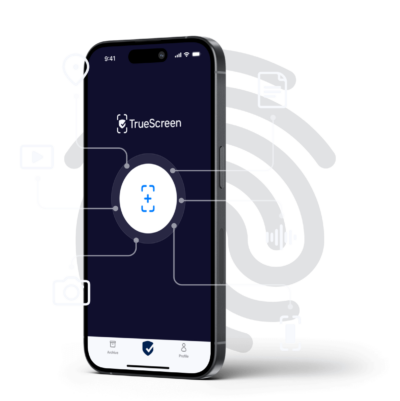
What an impersonated professional or a defrauded investor sees on screen then stays verifiable after the ad, the page or the group is gone. On a computer, the Forensic Browser, a desktop app for macOS and Windows, captures the ad as a web page along with the sponsoring page, the destination site and WhatsApp Web: each session starts with cleared data, records how the browser identifies itself to websites, checks the device clock and declares the result in the report, and keeps the page source and a web archive of each page, with network traffic capture available as an option. On a phone, the TrueScreen App certifies a screen recording, with a random code on screen tying the video to its certification. A technical report states what was captured, how, when and on which device, with the hash of each file.
For videos it did not capture at the source, TrueScreen also offers AI analysis, including deepfake detection for photos, video and audio, which you reach today in the Forensic Browser’s Media Inspector: it adds a signal, while the certified capture establishes what was online. Certification shows how and when content was captured, not that what the video says is true.
-
Capture the ad while it is still online
Open Facebook in the Forensic Browser and capture the ad with its video, text, page name, “Sponsored” label and comments. On a phone, record it in the TrueScreen App. If the Browser Extension is all you have installed, use it now.
-
Follow the ad to the page and the destination site
In the same session, click through to the sponsoring page and the link, so the capture shows how one leads to the next, downloads included.
-
Secure the Ad Library entry
Search for the advertiser in Meta’s Ad Library and capture its entry before you report anything, while the library still shows the content and who paid for it (DSA art. 39).
-
Certify the WhatsApp group or chat
Record the group in the TrueScreen App from the first message, showing its name, the number and the pitches, or open WhatsApp Web in the Forensic Browser. The guide to WhatsApp evidence in court explains how chats are used.
-
Report to Meta and hand the evidence to your lawyer
Only now report the ad, the page and the group, and give your lawyer the certified captures and their reports. The forensic methodology captures the content at the source, verifies it and documents every step, and its last step certifies it with a qualified electronic seal (eIDAS art. 3(27)) and a qualified timestamp (eIDAS art. 3(34)), which under eIDAS carry legal presumptions of data integrity (art. 35) and of accurate date and time (art. 41), while art. 46 bars rejecting electronic evidence only because it is electronic. The court weighs the rest.
Conclusion
Deepfake scam ads move faster than the reports meant to stop them, and the removal everyone asks for also erases what victims need to prove. Whatever happens at the December 10 hearing, the La Spezia decree shows that a court can act quickly when a face and a voice are stolen to defraud others, and what a court acts on is evidence. TrueScreen lets the people impersonated or deceived online secure it while it is still visible: content certified with a forensic methodology, documented step by step, and still verifiable after the ad, the page and the group are gone.
This article is not legal advice.
FAQ: common questions about deepfake scam ads on Facebook
Why does Facebook allow scam ads?
Facebook scam ads keep running even though Meta reports removing 159 million scam ads in 2025, 92% before any report, and protecting over 500,000 public figures against “celeb-bait” ads. Outside tests are less reassuring: CERT Polska found 106 of 122 ads reported as fraudulent were not removed, and Poland has asked the European Commission to fine Meta under the Digital Services Act. The Commission will decide.
How do I report a scam ad on Facebook?
Use the three-dot menu on the ad; for illegal content, article 16 of the Digital Services Act requires Facebook to offer a reporting mechanism and process notices. Capture the ad, its page and its Ad Library entry first, because under article 39 of the DSA an ad removed as illegal no longer shows its content or advertiser.
Is a screenshot of a scam ad enough as evidence?
A screenshot is a start, but it does not show which page served the ad, when or whether it was edited, so it can be disputed. Under article 46 of eIDAS, electronic evidence cannot be refused only for being electronic, yet courts still weigh its reliability. A certified capture adds the source, the time and how it was made.
Can I prove an ad that has already been removed?
Partly. Under article 39 of the Digital Services Act, once Meta removes an ad as illegal, the Ad Library no longer shows its content or advertiser. TrueScreen can still certify screenshots made earlier as files, which proves their content from that moment on and makes later edits detectable, without showing how they were taken.
What should I do if a deepfake ad uses my face?
Capture the ad, its page and its Ad Library entry, then report the impersonation to Meta, which has a form even for people without an account. In many jurisdictions, using someone’s image without consent can be challenged in court; in Italy, Il Sole 24 Ore reports, a financial adviser obtained a provisional order on October 29, 2026 against such ads.
Sources and verification
Every figure and principle cited here links to its source, listed with type and date. Links checked on the publication date.
| Source | Type | Date | What it supports |
|---|---|---|---|
| Corriere della Sera, a financial adviser targeted by deepfakes: the La Spezia court orders Meta to remove the fake content | Document | 31/10/2026 | Facts of the case: about 5,800 ads flagged, 500 in one day, the 400-to-12,000-euro bait, pump and dump, altered genuine video, damages, criminal complaint |
| Il Sole 24 Ore, Meta must remove and filter fraudulent deepfakes on Facebook and WhatsApp | Document | 30/10/2026 | Content of the urgent decree of October 29, 2026, the December 10 hearing, penalty and publication; unanswered reports |
| Meta, new anti-scam tools and 2025 enforcement figures | Survey | 03/2026 | 159 million scam ads removed in 2025, 92% before any report |
| Meta, legal action against scam advertisers in China and Vietnam | Survey | 02/2026 | Protection against celeb-bait for the images of over 500,000 public figures |
| FCA, global action to stop illegal finfluencers | Survey | 24/04/2026 | 1,267 illegal financial ads reaching at least 2,338,372 UK accounts |
| Notes from Poland, Poland asks EU to fine Meta EUR 250m over scam Facebook ads | Document | 27/08/2026 | Poland’s request to the European Commission; CERT Polska test, 106 of 122 reported ads not removed |
| Money.it, fake videos and Nasdaq traps: how criminal networks use AI and social media to clone stock market experts | Document | 18/09/2026 | Mechanism: sponsored video, WhatsApp signals group, pump and dump, recovery scam |
| Meta Help Center, report a profile or Page pretending to be someone | Document | 2026 | Reporting impersonation on Facebook |
| Meta Help Center, impostor reporting form | Document | 2026 | Reporting impersonation without a Facebook account |
| Digital Services Act, Regulation (EU) 2022/2065, article 8 | Law | 2022 | No general monitoring obligation: the La Spezia filters concern the specific case |
| Digital Services Act, Regulation (EU) 2022/2065, article 9 | Law | 2022 | Orders from judicial and administrative authorities to act against illegal content |
| Digital Services Act, Regulation (EU) 2022/2065, article 16 | Law | 2022 | Notice and action mechanism for reporting illegal content |
| Digital Services Act, Regulation (EU) 2022/2065, article 39 | Law | 2022 | Public ad repository (Meta’s Ad Library) and what it stops showing after removal as illegal |
| eIDAS, Regulation (EU) No 910/2014, article 35 | Law | 2014 | Legal effect of the qualified electronic seal: presumption of data integrity |
| eIDAS, Regulation (EU) No 910/2014, article 41 | Law | 2014 | Legal effect of the qualified timestamp: presumption of accurate date and time |
| eIDAS, Regulation (EU) No 910/2014, article 46 | Law | 2014 | Electronic documents not denied legal effect solely because they are electronic |
Certify scam ads and social pages before they disappear
TrueScreen certifies web pages, social media posts and chats with a forensic methodology, with a technical report on how and when each was captured, so the evidence stays verifiable after the content is gone.

TrueScreen editorial team
Published on · Updated on
This section is edited by the TrueScreen editorial team, which brings together expertise in digital forensics, the law of digital evidence and regulatory compliance. Every article is checked against primary sources: legislation, published rulings, technical standards and official documentation, always cited in the text.
Editorial Team and Methodology →

