
Computational photography: what you can prove about an original photo
Phone algorithms process every picture, so asking whether a photo was edited goes nowhere. Origin, device and integrity since capture are what you can document.
When someone challenges a smartphone photo by asking whether it was edited, the honest answer is always yes, because computational photography processes every shot before the file exists. TrueScreen moves the proof to the moment of capture: it acquires the photo at the source with a forensic methodology and records when, how and on which device it was created, so disputes, fraud and tampering claims meet a record of the capture instead of an argument about pixels. Processing is something every phone does; a record of the capture is something you can show.
Key takeaways
- Computational photography merges several sensor readings into one image during the shot, so every smartphone photo is processed before the file exists (Delbracio et al., arXiv, 2021).
- AI image detectors give probabilities: in a 2026 preprint on one million smartphone photos, recalibrated detectors flagged between 17% and 91% of real photos as fake (von Stryk and Keuper, arXiv, 2026).
- A missing C2PA manifest is missing information, not proof of tampering: the C2PA specification states that adding provenance is optional and that provenance metadata can be removed (C2PA Explainer 2.4).
- Article 50 of the EU AI Act sets transparency and marking duties for AI-generated content from August 2, 2026, with a transitional period until December 2, 2026 only for the machine-readable marking under Article 50(2) by systems already on the market (Regulations (EU) 2024/1689 and 2026/1744).
- What a photo can prove is when and on which device it was taken and that it has not changed since, with every acquired file identified by its SHA-256 fingerprint in the certification report (TrueScreen methodology).
94%
estimated share of the world’s photos taken with smartphones in 2024
17% to 91%
real smartphone photos flagged as fake by deepfake detectors recalibrated for modern AI content
13.33%
rate at which leading AI image detectors declared authentic war photos AI-generated
NewsGuard, 2026
Every photo your phone takes has been computed before you see it. Computational photography merges bursts of frames, reduces noise and sharpens detail between the press of the shutter and the saved file. Smartphones took an estimated 94% of the world’s photos in 2024, according to Photutorial, so for most of us a processed photo is just what a photo is.
The trouble starts when one of those photos becomes evidence. Asked “is this photo edited?”, the truthful answer is yes, which settles nothing. Detectors return probabilities, missing Content Credentials point to absent information rather than tampering, and Adobe’s Ely Greenfield argues that you need to be able to show what is original. So what can you actually prove about a smartphone photo once computational photography has shaped every pixel?
You cannot prove that a phone photo is “unprocessed”, because none is. You can prove when and on which device it came into being, and that it has not changed since. The photo that will serve as evidence therefore needs to be acquired at the source and certified, not defended after the fact. TrueScreen starts from that principle: certify how a photo was captured, at the source, and, where that is no longer possible, verify the content, including with deepfake detection.
Computational photography: why every smartphone photo is already processed
A smartphone does not simply record a scene: it calculates an image from many readings of its sensor, on every shot.
Computational photography is the set of techniques a smartphone uses to capture several sensor readings and merge them into one image during the shot, instead of recording a single exposure; Google researchers define it as “the science and engineering of making great images from small form factor, mobile cameras” (Delbracio et al., 2021). TrueScreen certifies at the moment of capture: the photo is acquired in a controlled environment, so no person or software can alter it while it is being acquired, and any later change becomes detectable. Because computational photography runs on every shot, whether a photo was processed says nothing about whether it can be trusted.
What your phone does between the shutter and the file
Manufacturers describe the processing openly:
- Burst merging. Google’s HDR+ works by “capturing a burst of frames, aligning the frames in software, and merging them together”; Night Sight merges up to 15 frames (Google Research, November 14, 2018).
- Subject-aware processing. Apple’s Deep Fusion “uses advanced machine learning to do pixel-by-pixel processing of photos”, and Smart HDR uses machine learning “to recognize subjects in the frame” (Apple Newsroom, September 10, 2019).
- Scene enhancement. Samsung cameras use Super Resolution “to combine more than 10 images”, then a deep learning engine enhances detail on the moon (Samsung UK support, April 30, 2024).
The phone also writes date, model and, if enabled, location into the EXIF metadata, which common software can rewrite. None of this makes a photo dishonest: it is how a modern unedited photo is made.
Phone processing, later editing and generated images are different things
Phone processing, later editing and an AI-generated image differ in who intervenes, when, and what you can prove. As Digital Trends noted in November 2026, “computational photography and generative image creation aren’t the same thing”.
| What it is | Who intervenes | When | What changes | What you can prove |
|---|---|---|---|---|
| Phone processing (computational photography) | Camera software | During capture | Exposure, noise, color, detail | When and on which device, if acquired at the source |
| Later editing (retouching, photo montage) | A person with editing software | Any time after the file exists | Anything, including added or removed elements | That the file differs from a certified original, if one exists |
| AI-generated image | A generative model | With no camera capture | No real scene was recorded | A declared origin, if labeled; otherwise only a detector’s probability |
Why “is this photo edited?” is the wrong question in a dispute
Whoever asks whether a contested photo was edited will always hear yes, so the question cannot tell an honest picture from a fake photo.
In a November 2026 interview, Ely Greenfield of Adobe used the example of an iPhone picture to note that AI is already involved in making the photo itself. With computational photography in every phone, “processed” describes all photos at once.
After-the-fact detectors give probabilities, not proof
AI image detectors return a score, and that score is unreliable on real photos. In a September 2026 preprint on one million smartphone photos, detectors recalibrated for modern AI content flagged between 17% and 91% of real photos as fake (von Stryk and Keuper, arXiv, 2026), and NewsGuard found leading tools labeling authentic war photos AI-generated 13.33% of the time (NewsGuard, May 8, 2026). A score can tell you which files deserve a closer look, but it cannot settle a dispute, as the comparison of deepfake detection and source certification shows.
TrueScreen certifies authenticity at the source and also offers deepfake and AI-generated content detection for content it did not acquire, in the Forensic Browser and in TrueFlow reports where AI analysis is enabled. The result is probabilistic and can be wrong, so the decision stays with whoever uses it, under human supervision.
Missing Content Credentials mean missing information, not tampering
A photo without Content Credentials is not a tampered photo: it is a photo that lacks a piece of information. TrueScreen reads C2PA manifests in its free C2PA viewer and reports a missing manifest as an absence, never as evidence of manipulation. The C2PA specification states that adding provenance is optional and, asked whether provenance metadata can be removed, answers “Yes it can.” (C2PA Explainer 2.4).
Content Credentials are the plain-language name for a manifest under the C2PA standard, a record of how a file was created and edited. The Content Authenticity Initiative is blunt about their limits: “Content Credentials don’t indicate if an image is fake” (CAI, FAQ).
From an “AI-made” label to an original you can verify
Ely Greenfield, CTO of Adobe Digital Media, told Varun Mirchandani of Digital Trends on November 15, 2026: “The goal of C2PA is not to label things that were made with AI, which doesn’t help you; it’s to label things that weren’t.” Google’s security team calls the risk the “implied truth effect”: when only synthetic content is labeled, people assume unlabeled content is not AI (Google Online Security Blog, September 10, 2025).
Regulation follows the labeling path. Article 50 of the EU AI Act, Regulation (EU) 2024/1689, sets transparency and marking duties for AI-generated content from August 2, 2026, with a transitional period until December 2, 2026 only for the machine-readable marking of Article 50(2) by systems already on the market (Regulation (EU) 2026/1744). A label tells you what is synthetic. It says nothing about what is genuine, and that is the side TrueScreen covers by helping organizations document the provenance of their content.
What you can prove about a photo, and what stays outside the proof
A certified photo can prove when and how it was captured and that it has not changed since, but no certification can prove that the scene in front of the lens was real.
You cannot prove that a photo is “unprocessed”; you can prove when and on which device it was taken, and that it has not changed since. TrueScreen builds that proof at capture, recording the context of the shot in a technical report and identifying every acquired file by its SHA-256 fingerprint. Everything else, from who the people pictured are to whether the scene was staged, has to be established by other means.
The moment and device of capture, and the place when the workflow asks for it
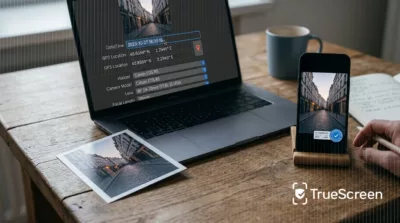
The date in a photo’s metadata is written by the phone and can be changed in a few clicks. A forensic acquisition, the basis for using photos as evidence, collects the context at the same instant as the photo: time, device, network and environment, with the location only when the workflow requires it and the person grants permission. The device clock is checked and the result, including any offset, is stated in the report.
Integrity after capture: the SHA-256 fingerprint in the certification package
Each acquired file is identified by its SHA-256 fingerprint, printed in the report. Anyone who receives the photo can recalculate it: a match means it is the file acquired, a mismatch means something changed. Alteration is prevented during acquisition and detectable afterward.
What no certification proves: that the scene was real
TrueScreen guarantees how a photo was captured, not what it shows, so a staged scene is certified as an authentic recording of a staged scene. Certification does not identify the people pictured, show that a set of photos is complete or lawful, or replace an expert.
How do you get an original photo that others can verify?
TrueScreen makes an original photo verifiable by acquiring it at the source, so the proof exists from the moment of capture instead of being rebuilt after a challenge.
An original photo that others can verify is one acquired at the source and certified before anyone can touch it. TrueScreen acquires the photo in a controlled environment, verifies it and documents every step in a technical report, so whoever receives it can check when, how and with which device it was taken; the guide on how to certify a photo walks through the process. Whoever receives the photo does not have to take the sender’s word for it: the report and the file are enough to check.
Live capture with the TrueScreen app
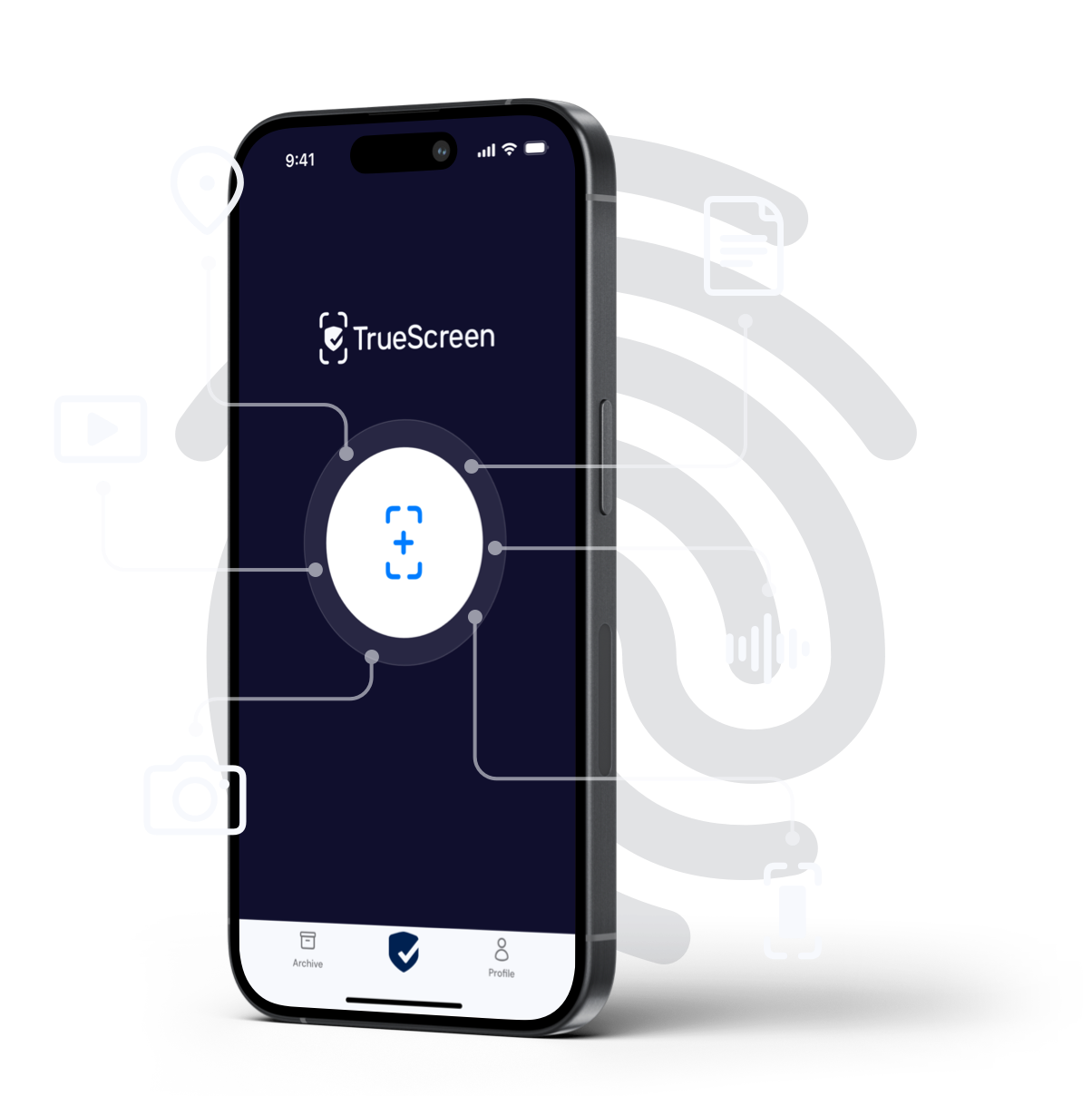
With the TrueScreen app, every photo taken in a photo step is marked in the report as a live acquisition. On Android the app shoots with its own camera screen, while on iOS the photo step opens the device camera. The app does not modify, crop or filter the photo. Where the photo must stand as evidence, the method closes with its legal step: a patented forensic methodology acquires the data at the source, verifies it, documents every step and certifies it with a qualified electronic seal and a qualified timestamp under eIDAS. Content certified with TrueScreen has the highest evidentiary value and international legal value.
A photo that is already in your gallery
You can import a photo from your gallery and seal it with a provable date, and from then on it cannot change. The import is not a forensic acquisition, though: TrueScreen cannot attest how the file was born or its original date, so it is worth less than a live shot, while remaining far more solid than an unsealed file, as the guide to certify a file explains.
Reading C2PA manifests with the C2PA viewer
The free C2PA viewer reads a file’s Content Credentials in your browser, with no upload and no account. It shows the producing tool, edit history and declared use of generative AI, and marks a manifest altered after it was signed as invalid, but it does not judge pixels and is not an AI image detector. TrueScreen is a C2PA platform, reading and writing C2PA manifests, and writes them into the content it certifies.
-
Take the photos you will need as evidence in the app
Open the certification flow in the TrueScreen app and shoot at the scene, rather than importing pictures later.
-
Keep the certification package
Store the certified photos with their report, as delivered: its SHA-256 fingerprint lets anyone confirm the file is the one acquired.
-
Share the report with whoever has to verify it
Send the report to the adjuster, lawyer or editor, who can compare the fingerprint and read when and how the photo was captured.
Hypothetical cases: the damage photo “retouched by the phone” and the news image without credentials
In the hypothetical scenarios below, the useful answer comes from what was recorded at capture, never from asking whether the phone processed the image.
The car damage photo challenged as processed
Picture a hypothetical case: a driver photographs a dented door, and during insurance claims handling the other party argues the photo was “retouched by the phone”. The objection is true, since computational photography merged frames and sharpened detail, but it is beside the point. Shot in the TrueScreen app, the photo comes with a report showing time, device, location (requested by the claim workflow and allowed by the driver) and the SHA-256 fingerprint. TrueScreen takes the argument away from the pixels and puts it on the record of the capture.
The news image that arrives without Content Credentials
Now take a hypothetical newsroom receiving a reader’s photo with no Content Credentials. The C2PA viewer shows there is no manifest, which tells the editor something is missing, not that the photo is fake, so verification moves on to provenance and context. For photos its own reporters take, the newsroom can rely on TrueScreen to acquire them at the source, and source verification comes down to reading a report.
Conclusion
Computational photography has made the question of whether a photo was edited useless in a dispute, because every phone photo is processed before anyone sees it. The question that holds is whether you can show when and on which device the photo came into being and that it has not changed since, and that answer has to be built at the moment of capture. TrueScreen builds it there: it acquires photos at the source with a forensic methodology, documents every step and certifies the result, so the pictures you rely on can be checked by whoever has to verify them, while content it did not acquire can still be assessed with deepfake detection and a careful look at its provenance.
FAQ
Is this photo real, or just processed?
Almost every smartphone photo is processed, because computational photography merges and enhances sensor data during the shot, so “processed” and “real” are not opposites. What you can document about a photo is when and on which device it was captured and whether it has changed since. Photo verification methods such as reverse image search give clues; a photo certified at capture gives a documented answer.
What is an example of computational photography?
Google’s Night Sight is a well-documented example of computational photography: in low light the phone captures a burst of up to 15 frames, aligns them in software and merges them into one brighter, cleaner image, as Google researchers described in November 2018. Samsung’s moon shots, where Super Resolution combines more than 10 images and a deep learning engine enhances detail, are another.
How can you tell if a photo is edited?
Clues include inconsistent shadows, cloned textures, mismatched EXIF metadata or a C2PA manifest that records edits, but none is conclusive, since EXIF data can be rewritten and detectors return probabilities. The reliable test is comparison with a certified original. TrueScreen identifies each photo it acquires by a SHA-256 fingerprint printed in the report, so any later change becomes detectable.
Is a photo without Content Credentials fake?
A photo without Content Credentials is not fake by default: it lacks a piece of information, and that gap is no evidence of tampering. The C2PA explainer states that adding provenance is optional and that provenance metadata can be removed, and the Content Authenticity Initiative notes that Content Credentials don’t indicate whether an image is fake. Its history has to be established another way.
Can you seal a photo that is already on your phone?
Yes, within limits. TrueScreen can import a gallery photo and seal it with a provable date, so it cannot change from that moment on. The import is not a forensic acquisition and cannot attest how the file was born, so it carries less weight than a photo captured live in the TrueScreen app, while remaining far more solid than an unsealed file.
Sources and verification
Every figure and principle cited here links to its source, listed with type and date. Links checked on the publication date.
| Source | Type | Date | What it supports |
|---|---|---|---|
| Photutorial, Photos statistics | Survey | 09/2026 | Estimated share of photos taken with smartphones in 2024 |
| Delbracio, Kelly, Brown, Milanfar, Mobile Computational Photography: A Tour | Document | 17/02/2021 | Definition of computational photography |
| Google Research, Night Sight: Seeing in the Dark on Pixel Phones | Document | 14/11/2018 | HDR+ burst merging and Night Sight multi-frame capture |
| Apple Newsroom, iPhone 11 Pro and iPhone 11 Pro Max | Document | 10/09/2019 | Deep Fusion pixel-by-pixel processing and Smart HDR subject recognition |
| Apple Newsroom, iPhone 11 Pro and iPhone 11 Pro Max | Document | 10/09/2019 | Deep Fusion pixel-by-pixel processing and Smart HDR subject recognition |
| Samsung UK support, Super Resolution and AI for moon photos | Document | 30/04/2024 | Multi-frame Super Resolution and deep learning detail enhancement |
| von Stryk and Keuper, LAION-Mobile: Evaluating Deepfake Detectors On One Million Smartphone Photos | Survey | 10/09/2026 | False positives of deepfake detectors on real smartphone photos (preprint) |
| NewsGuard, Leading AI Image Detection Tools Mislead Online Users | Survey | 08/05/2026 | Authentic news photos declared AI-generated by detection tools |
| C2PA and Content Credentials Explainer, version 2.4 | Standard | 2026 | Provenance is optional and provenance metadata can be removed |
| Content Authenticity Initiative, Open-source tools FAQ | Document | 2026 | Content Credentials do not indicate whether an image is fake |
| Digital Trends, interview with Ely Greenfield (Adobe) by Varun Mirchandani | Document | 15/11/2026 | Greenfield quotes on C2PA labeling and phone photos; distinction between computational photography and generative images |
| Google Online Security Blog, How Pixel and Android are bringing a new level of trust to your images | Document | 10/09/2025 | Implied truth effect when only synthetic content is labeled |
| Regulation (EU) 2024/1689 (AI Act), Article 50 | Law | 13/06/2024 | Transparency and marking duties for AI-generated content, applicable from August 2, 2026 |
| Regulation (EU) 2026/1744 (Digital Omnibus on AI) | Law | 08/07/2026 | Transitional period until December 2, 2026 for Article 50(2) marking by systems already on the market |
Make the photos you rely on provable from the start
Take the photos you will need as evidence with the TrueScreen app, so each one comes with a report on when, how and on which device it was captured, and use the free C2PA viewer to read the C2PA manifests of the files you receive.

TrueScreen editorial team
Published on · Updated on
This section is edited by the TrueScreen editorial team, which brings together expertise in digital forensics, the law of digital evidence and regulatory compliance. Every article is checked against primary sources: legislation, published rulings, technical standards and official documentation, always cited in the text.
Editorial Team and Methodology →


