
AI hallucination cases: what courts now ask of anyone who files
Courts from New York to Kansas hold filers responsible for citations an AI invented, and the same duty now reaches the photos, chats and web pages you attach.
AI hallucination cases are court matters in which a filing relies on case law, quotations or statutes that a generative AI model invented and nobody checked, as in Mata v. Avianca, where a New York federal judge imposed a $5,000 penalty on two lawyers and their firm in 2023 for opinions created with ChatGPT. TrueScreen works on the part of a filing that no database can check afterwards: it certifies photos, videos, chats and web pages at the moment they are captured, so their origin stays on record when the other side calls them fake. Damien Charlotin’s AI Hallucination Cases database had logged 2,334 such decisions worldwide as of November 23, 2026.
Key takeaways
- In Lingle v. Subaru of Wichita (Kansas Court of Appeals, No. 129,581, November 20, 2026), the court disregarded fabricated citations and left the trial court’s sanctions against a self-represented plaintiff in place.
- In Mata v. Avianca (S.D.N.Y., June 22, 2023), a $5,000 penalty was imposed jointly and severally on two lawyers and their firm for opinions created with ChatGPT, under Rule 11 or the court’s inherent power.
- Damien Charlotin’s AI Hallucination Cases database counted 2,334 decisions involving hallucinated material as of November 23, 2026, 1,583 of them in the United States.
- Dedicated legal AI research tools hallucinated between 17% and 33% of the time in a 2024 Stanford RegLab and HAI study.
- Digital evidence needs its origin fixed at capture: certification records how and when content was acquired, not that it is true (eIDAS, ISO/IEC 27037).
2,334
court decisions involving AI-hallucinated material logged worldwide
Damien Charlotin, AI Hallucination Cases database, November 23, 2026
17-33%
hallucination rate of leading legal AI research tools on benchmark queries
$5,000
penalty imposed jointly on two lawyers and their firm for ChatGPT-invented opinions
Generative AI is already part of how filings get written, by lawyers, in-house teams and people who represent themselves and cannot afford legal help. AI hallucination cases are what happens when that output reaches the record unchecked: a brief cites a decision with a plausible reporter citation, a judge’s name and a tidy holding, and the decision does not exist.
On November 20, 2026, the Kansas Court of Appeals took the point further. In Lingle v. Subaru of Wichita, it held a plaintiff without a lawyer to the same standard as an attorney: according to local press coverage, whoever files AI-generated material has to verify it independently.
That duty does not stop at citations. Photos, videos, screenshots, chats and web pages travel in the same filings, and generative AI has made it easy for an opponent to dismiss any of them as AI-generated evidence. A citation can be looked up in an official database at any time, whereas the origin of a piece of digital evidence can only be fixed when it is captured. TrueScreen takes on that second check, documenting where, when and how evidence was acquired before anyone has reason to question it. For anyone who files, the answer is the same on both fronts: verify every citation against the official source, and make your evidence verifiable from the moment you collect it.
AI hallucination cases: what a hallucination is and who answers for it
An AI hallucination is an answer that a generative model presents as true when it is false or invented, and in a court filing it usually takes the shape of a case, a quotation or a statute that does not exist. TrueScreen brings the discipline courts now expect for citations to the evidence side of the same filing, certifying recordings, images and web pages at capture so their origin is documented in a technical report. Dedicated legal research tools are not immune either: a 2024 Stanford RegLab and HAI study measured hallucination rates between 17% and 33% for them.
Courts look at the person who signed the filing, never at the software that drafted it.
Why does AI hallucinate? A language model does not look anything up. It produces the words most likely to follow the prompt, based on patterns absorbed in training, and judicial opinions have a shape it can reproduce perfectly (court, parties, reporter citation, year, holding) while the content behind it is empty. Gaps in the training data make things worse, and so does the habit of chat assistants to give an answer rather than admit they have none.
Researchers often separate intrinsic hallucinations, which contradict the source the model was given, from extrinsic ones, which add something the source never contained. A fabricated precedent is extrinsic, and so are common AI hallucination examples outside the law, such as a chatbot that invents a book’s author or a quote from a public figure.
A hallucination is also different from an ordinary mistake. A misread holding can be traced back to the opinion; a hallucinated case has no opinion behind it, which is why it slips past a quick skim.
Specialized legal products help, up to a point. The Stanford RegLab and HAI study by Magesh and colleagues (2024) found that Lexis+ AI, Westlaw AI-Assisted Research and Ask Practical Law AI hallucinated between 17% and 33% of the time on its benchmark queries, and an earlier study by the same group measured rates of 58% to 82% for general-purpose chatbots answering legal questions. Those rates measure research tasks, not the odds that a brief contains a fake case, but they explain why judges hold the signer responsible: software cannot be sanctioned.
Lingle v. Subaru of Wichita: what the Kansas Court of Appeals decided
On November 20, 2026, in Lingle v. Subaru of Wichita (No. 129,581), the Kansas Court of Appeals affirmed summary judgment for two Wichita car dealerships and left in place the sanctions a trial court had imposed on a self-represented plaintiff whose filings cited cases that do not exist. TrueScreen applies the same logic to the exhibits in a filing, certifying photos, chats and web pages at capture so the filer can show where they came from. Nobody on the losing side was a lawyer, and the court applied the duty to verify anyway.
The duty to check AI output belongs to whoever files, with or without a law license.
The plaintiff, representing himself, sued Subaru of Wichita and Eddy’s Volkswagen. The Sedgwick County District Court sanctioned him and ordered him to pay attorney fees because some filings cited nonexistent cases, then added fees for frivolous filings with inaccurate statements of fact and law. On appeal the panel found more citations to cases that do not exist and misreadings of Kansas law. It reviewed the merits anyway, set the invented authorities aside, imposed no new sanctions, kept the trial court’s sanctions intact and warned anyone who files papers drafted with the help of AI.
According to KSNW’s report, carried by Yahoo News, the decision states that a self-represented litigant, like an attorney, is responsible for verifying the accuracy of information generated by AI, that AI-generated citations cannot be accepted without independent verification, and that sanctions may be imposed when inaccurate AI-generated material is filed. The opinion does not name the AI tool involved.
Most coverage of AI legal hallucinations has focused on attorneys, since professional discipline makes headlines. The Kansas court gave litigants without lawyers no lower standard. That can sound harsh, but the alternative would leave the least checked filings with the least scrutiny.
How courts are reacting to fake citations
Courts treat an invented citation as a breach of the signer’s duty rather than a glitch in the software, and the response can be anything from setting the fake authority aside to fee awards and fines. TrueScreen starts from the same premise for evidence: the signer answers for the exhibits too, so it documents the origin of photos, videos and web pages in a technical report from the moment they are captured. The AI hallucination database that Damien Charlotin maintains, AI Hallucination Cases, had logged 2,334 decisions involving hallucinated material as of November 23, 2026, and 1,583 of them came from US courts.
Across jurisdictions, judges hold the signer to the citations, whatever tool produced them.
Of all the AI hallucination cases in legal filings, Mata v. Avianca is still the reference point. On June 22, 2023, Judge P. Kevin Castel of the Southern District of New York imposed a $5,000 penalty, jointly and severally, on two lawyers and their firm for submitting nonexistent opinions created with ChatGPT. He relied on Rule 11 of the Federal Rules of Civil Procedure or, in the alternative, on the court’s inherent power. Under Rule 11, a signature certifies that a filing’s legal contentions are warranted by existing law, and a nonexistent case warrants nothing.
| Jurisdiction | Case or source | Consequence |
|---|---|---|
| United States, S.D.N.Y. | Mata v. Avianca, Inc., No. 22-cv-1461 (PKC), June 22, 2023 | $5,000 penalty imposed jointly and severally on two lawyers and their firm under Rule 11 or the court’s inherent power |
| United States, Kansas, Sedgwick County District Court | Lingle v. Subaru of Wichita, trial court | Self-represented plaintiff sanctioned and ordered to pay attorney fees for citing nonexistent cases, then for frivolous filings |
| United States, Kansas Court of Appeals | Lingle v. Subaru of Wichita, No. 129,581, November 20, 2026 | Judgment affirmed, fabricated citations disregarded, trial court sanctions left in place, no new sanctions, warning to AI-assisted filers |
| Worldwide | Damien Charlotin’s AI Hallucination Cases database, November 23, 2026 | 2,334 decisions logged, 1,583 of them in the United States |
| Europe and Brazil | Same database, same date | Courts are reacting too: 41 decisions logged in Brazil, 14 in France, 11 in Germany and 8 in Spain |
Read that count of AI hallucination cases with care. It tracks decisions, not sanctioned lawyers, and it keeps growing, so any figure needs a date. Outside the United States, judges answer AI hallucinations in court filings with their own procedural tools, warnings in some places and fines in others, but the premise is the same: a court may assume that a human being read every authority before the filing went in.
The duty to verify also covers digital evidence
A citation can be checked against an official database even after the filing, while the origin of a photo, a chat or a web page cannot be rebuilt later if nobody fixed it at the moment of capture. TrueScreen fixes it at that moment, recording when, where, on which device and over which network the content was acquired, so the record of its origin is already in the file before an opponent raises the question. Without that record, an exhibit rests on the word of whoever filed it.
Generative AI makes it cheap to claim that evidence is fake, so the origin of your evidence has to be on record before anyone asks.
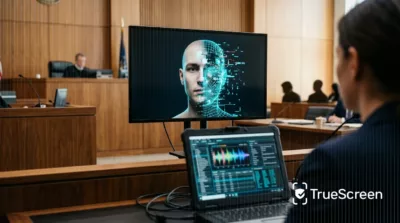
The filings at the center of AI hallucination cases also carry exhibits: photos, video, voice messages, chat screenshots, web pages. Arguing that an image was fabricated used to take real effort; today the claim is easy to make and hard to rebut, because convincing synthetic images and voices are a few prompts away. Deepfakes as evidence in court cut both ways: fake content can slip in, and genuine content can be waved away as fake.
In US federal courts, Federal Rule of Evidence 901 requires the party offering digital evidence to produce enough to support a finding that it is what that party claims. Authenticating digital evidence this way is one of the conditions for admissible digital evidence. Screenshot evidence pasted into a brief does little to meet that requirement. It is a picture of a chat, with nothing showing when it was taken, from which phone, or whether a message was edited first. Like a citation with no source, it asks the court to take your word for it.
Certification has a limit. TrueScreen does not tell a court that what a photo shows is true; it certifies how and when the photo was captured. A staged scene captured through a certified process is still a staged scene. What certification does is make any later change to the file detectable, which narrows the room for the argument that it was altered or generated after the fact.
How do you make what you file verifiable?
TrueScreen makes what you file verifiable by acquiring photos, videos, audio, chats and web pages at the source in a controlled environment, with a patented forensic methodology that follows the ISO/IEC 27037 guidelines for digital evidence, verifying the data and documenting every step in a technical report. The citations in your brief stay yours to check against official sources.
Citations are verified by whoever signs, and evidence becomes verifiable when its origin is certified at capture.
During acquisition no person, software, system or AI can alter the content, and the context travels with it: time, location, device and network. The technical report records cryptographic fingerprints, the certified time and the metadata. Where legal value and date are at stake, the certification closes with a qualified electronic seal and a qualified timestamp under the EU eIDAS Regulation. Certified content carries maximum probative value and international legal value; no certification can promise how a case will end.
Picture a litigator on a civil claim whose client sends chat screenshots and photos of property damage. The authorities in the brief get checked on an official database; the photos are retaken with the TrueScreen App at the site inspection, and the chat is recorded from the client’s phone screen. When opposing counsel suggests the images could be AI-generated, the technical report shows how and when each one was captured. The same approach is set out for lawyers and law firms handling digital evidence.
-
Check every citation against the official source
Every case, quotation and statute in a filing needs to be opened and read in an official reporter or a recognized legal database before you sign, the step nobody took in the AI hallucination cases above. Retrieval-augmented generation (RAG), which connects a model to a vetted set of documents, lowers the risk, and so do prompts that ask the model to say when it lacks an answer. Neither removes it, and reading each authority yourself is the step that holds up when a judge checks.
-
Capture and certify digital evidence before you file
Evidence is easiest to defend when it is certified as it is collected, long before a dispute starts. Use the TrueScreen App for photos, video, audio and phone screen recordings, including chat conversations. Use the Forensic Browser for web pages, social profiles and chats opened in a browser, where the evidence archive holds each captured page as an image together with the page source and a web archive. The technical report goes into the record with the exhibit.
-
Document what the AI produced
When your team drafts with an AI agent, TrueScreen can certify the prompts it received and the outputs it returned through its API and MCP server. That certification of prompts and outputs documents what the AI received and wrote and when, without vouching that it was right, which is the record you want if a court asks how a draft came together; checking every citation stays with whoever signs. The case for certifying AI agent output as legal evidence goes into more detail.
-
Have content of unknown origin analyzed
Some evidence reaches you already made: a photo forwarded by a witness, a video the client downloaded, an audio file from a third party. For files like these, TrueScreen also offers AI content analysis that estimates whether a photo, video or audio file was generated or manipulated. The result is probabilistic, comes with a confidence level and calls for human supervision. A file of unknown origin yields an opinion, while a file sealed at capture yields a result you can defend.
Conclusion
Courts have stopped treating AI hallucination cases as curiosities. From Mata v. Avianca in 2023 to Lingle v. Subaru of Wichita in 2026, the message is the same for lawyers and for people who represent themselves: what you sign is yours, whatever tool drafted it. Citations get checked against official sources. Evidence gets made verifiable when it is captured, because that is the only moment its origin can be fixed. TrueScreen covers that moment, so the exhibits in your file can meet an authenticity challenge with a record instead of an argument.
FAQ: frequently asked questions about AI hallucination cases
What is an AI hallucination?
An AI hallucination is a false or invented answer that a generative model presents as true. In legal work it usually appears as a case, quotation or statute that does not exist. Damien Charlotin’s AI Hallucination Cases database had logged 2,334 court decisions involving hallucinated material as of November 23, 2026, which shows how often AI-hallucinated cases and quotations reach judges.
Can you use ChatGPT to write a legal brief?
You can use it as a drafting aid, but you stay responsible for every authority in the brief. In Mata v. Avianca (S.D.N.Y., June 22, 2023), two lawyers and their firm were jointly fined $5,000 for filing nonexistent opinions created with ChatGPT. Even dedicated legal research tools hallucinated 17% to 33% of the time in a 2024 Stanford study, so each citation has to be checked against an official source.
What happens if you cite fake cases in court?
In AI hallucination cases, the consequences depend on the court and include disregarded arguments, fee awards and monetary sanctions. US federal judges can sanction the signer under Rule 11 of the Federal Rules of Civil Procedure, as in Mata v. Avianca in 2023. In Lingle v. Subaru of Wichita, decided on November 20, 2026, the Kansas Court of Appeals disregarded the fabricated citations and left the trial court’s sanctions and fee awards in place.
Do self-represented litigants have to verify AI citations?
Yes. In Lingle v. Subaru of Wichita, decided on November 20, 2026, the Kansas Court of Appeals dealt with a plaintiff without a lawyer whose filings cited nonexistent cases. According to local press coverage, the court held that self-represented litigants, like attorneys, must verify AI-generated information, that AI citations cannot be accepted without independent verification, and that sanctions may follow when inaccurate AI material is filed.
How can you prove a photo or chat filed as evidence was not altered or AI-generated?
The strongest approach is to certify it when it is captured. TrueScreen acquires photos, videos, chats and web pages at the source with a forensic methodology that follows ISO/IEC 27037, produces a technical report with cryptographic fingerprints and certified time, and, for legal value, closes with a qualified electronic seal and qualified timestamp under eIDAS. The certification shows how and when the content was captured, not that what it shows is true.
Sources and verification
Every figure and principle cited here links to its source, listed with type and date. Links checked on the publication date.
| Source | Type | Date | What it supports |
|---|---|---|---|
| Lingle v. Subaru of Wichita, Kansas Court of Appeals, No. 129,581 | Case law | 20/11/2026 | Appellate decision on a self-represented plaintiff’s AI-fabricated citations |
| KSNW report on Lingle v. Subaru of Wichita, via Yahoo News | Document | 2026 | Press account of the court’s statements on the duty to verify AI output |
| Mata v. Avianca, Inc., No. 22-cv-1461 (PKC), S.D.N.Y., Opinion and Order on Sanctions | Case law | 22/06/2023 | $5,000 sanction for nonexistent opinions created with ChatGPT |
| Federal Rules of Civil Procedure, Rule 11 | Law | current text | Basis for sanctions on signers of filings with unwarranted legal contentions |
| Damien Charlotin, AI Hallucination Cases database | Survey | 23/11/2026 | Worldwide and per-country count of decisions involving hallucinated material |
| Magesh et al., Hallucination-Free? Assessing the Reliability of Leading AI Legal Research Tools | Survey | 2024 | 17% to 33% hallucination rate of legal AI research tools |
| Stanford HAI, AI on Trial: Legal Models Hallucinate in 1 out of 6 (or More) Benchmarking Queries | Survey | 2024 | 58% to 82% hallucination rate of general-purpose chatbots on legal queries |
| ISO/IEC 27037 | Standard | 2012 | Guidelines for identifying, collecting, acquiring and preserving digital evidence |
| Regulation (EU) No 910/2014 (eIDAS) | Law | 23/07/2014 | Legal framework for the qualified electronic seal and qualified timestamp |
Certify your evidence before you file
Capture photos, videos, chats and web pages with a forensic methodology, so their origin is documented before anyone questions it.

TrueScreen editorial team
Published on · Updated on
This section is edited by the TrueScreen editorial team, which brings together expertise in digital forensics, the law of digital evidence and regulatory compliance. Every article is checked against primary sources: legislation, published rulings, technical standards and official documentation, always cited in the text.
Editorial Team and Methodology →


