
How to Make Digital Evidence Admissible in Court (2026)
Updated on
Admissibility of digital evidence is the set of legal and technical conditions a digital file must satisfy before a court accepts it as proof. Reference standards include the Federal Rule of Evidence 901(b)(9), ISO/IEC 27037, the Budapest Convention on Cybercrime, and eIDAS (EU 910/2014) for electronic seals and timestamps. Admissibility requires authenticity, integrity, and a documented chain of custody, and is decided by the court on a case-by-case basis. TrueScreen acquires content with a forensic method, documents how and when it was acquired, and applies an official digital seal and a qualified timestamp.
Organizations across industries now rely on digital files as proof in legal disputes, regulatory audits, and compliance checks. A screenshot, a signed PDF, a timestamped photo: each can carry weight in a courtroom or arbitration proceeding.
But the admissibility of digital evidence depends on far more than what a file shows. With synthetic media, generative AI tools, and low-cost editing software spreading rapidly, courts and regulators have good reason to question whether any digital content is genuine. A photo without verifiable metadata, a document without a traceable origin, a recording without proof of custody: all can be challenged and dismissed, regardless of what they depict.
So what separates a persuasive file from legally defensible evidence? Three interdependent pillars: authenticity, integrity, and a verifiable chain of custody, backed by recognized legal and technical standards from the moment of capture.
Digital evidence is easier to admit and harder to challenge when it has four things: authenticated origin linking the file to a verified source and timestamp, proven integrity confirming no alteration occurred after capture, a documented chain of custody recording every access event, and an acquisition method that follows recognized practice such as ISO/IEC 27037. In the US, Federal Rule of Evidence 901 sets the authentication standard; in the EU, eIDAS attaches presumptions to qualified seals and timestamps. Admission is still decided by the court.
Types of digital evidence
Digital evidence encompasses any information stored or transmitted in digital form that a party may use in legal proceedings. Common types include:
- Emails and instant messages (including metadata such as headers, timestamps, and routing information)
- Text messages and chat logs from messaging platforms
- Social media posts, comments, and direct messages
- Photos and videos captured on mobile devices, CCTV systems, or body cameras
- Audio recordings and voice messages
- Documents, contracts, and signed PDFs
- Web pages, screenshots, and archived URLs
- GPS and geolocation data from devices or applications
- Server logs, access logs, and system event records
- Database records and transaction histories
Each type carries specific challenges for authentication and preservation. A text message requires different handling than a CCTV recording, and a social media post presents different metadata risks than a signed contract. What unites them is the core requirement: verifiable provenance from capture to courtroom.
Screenshots deserve particular attention because they are among the most commonly submitted and most frequently rejected forms of digital evidence. For screenshot-specific admissibility requirements, including WhatsApp, social media and text message authentication, see our dedicated guide on how to make screenshots legally admissible as evidence in court.
Authenticity and integrity: the foundation of admissible digital evidence
Digital evidence admissibility refers to the set of legal and technical conditions that a digital file must satisfy before a court can accept it as proof. A file is admissible when it establishes a fact relevant to the case, remains unaltered during forensic processing, and produces results that are valid, reliable, and reproducible. In practice, this means organizations must go beyond simply saving a file: they need to capture origin data (device identifiers, GPS coordinates, timestamps), seal the file cryptographically at the moment of creation, and maintain an auditable chain of custody from capture to courtroom. Without these layers, courts treat digital files as inherently unreliable, because metadata can be edited, timestamps can be spoofed, and file contents can be altered without leaving visible traces.
For the US-specific framework, read our guide on chain of custody for digital evidence in US proceedings.
Why ordinary digital files fail in court
A regular digital file carries no built-in proof of where it came from, when it was created, or whether it has been modified. Metadata can be stripped or altered. Screenshots can be fabricated. Even video footage faces growing skepticism as deepfake tools become widely accessible.
Without verifiable provenance, a digital file is just a claim. Opposing parties can argue it was edited, taken out of context, or produced after the fact. Courts increasingly expect more than the file itself.
The regulatory landscape reflects this. In the United States, Proposed Federal Rule of Evidence 707 (released for public comment in August 2025) addresses AI-generated evidence head-on. In Europe, the eIDAS framework sets binding standards for electronic signatures, timestamps, and seals. In England and Wales, the same shift is reflected in UK chain of custody and disclosure under CPR Part 31, where civil disclosure rules and the ACPO Good Practice Guide for Digital Evidence frame how digital exhibits must be acquired and preserved. Across all three jurisdictions the signal is the same: judicial systems no longer take digital content at face value. For a deeper jurisdictional view, see Germany-specific requirements under § 371a ZPO and eIDAS, which covers the German civil procedure framework.
How forensic-grade capture changes the equation
Forensic-grade acquisition means sealing a file’s content and metadata at the exact moment of capture: device identifiers, geolocation, timestamps, and a cryptographic hash that makes any subsequent modification immediately detectable.
This transforms an ordinary file into digital provenance: a complete, verifiable record of what was captured, when, where, and by whom. Once these elements are embedded at the source, the burden of proof shifts. The presenting party no longer needs to prove the file is real. Instead, the challenging party must demonstrate it was tampered with.
The practical difference is stark. A photo taken with a standard smartphone camera can be questioned in seconds. The same photo acquired through a forensic certification process and sealed with a qualified electronic seal and a qualified timestamp benefits, under eIDAS, from a legal presumption of integrity from the moment of sealing and of the accuracy of its date and time.
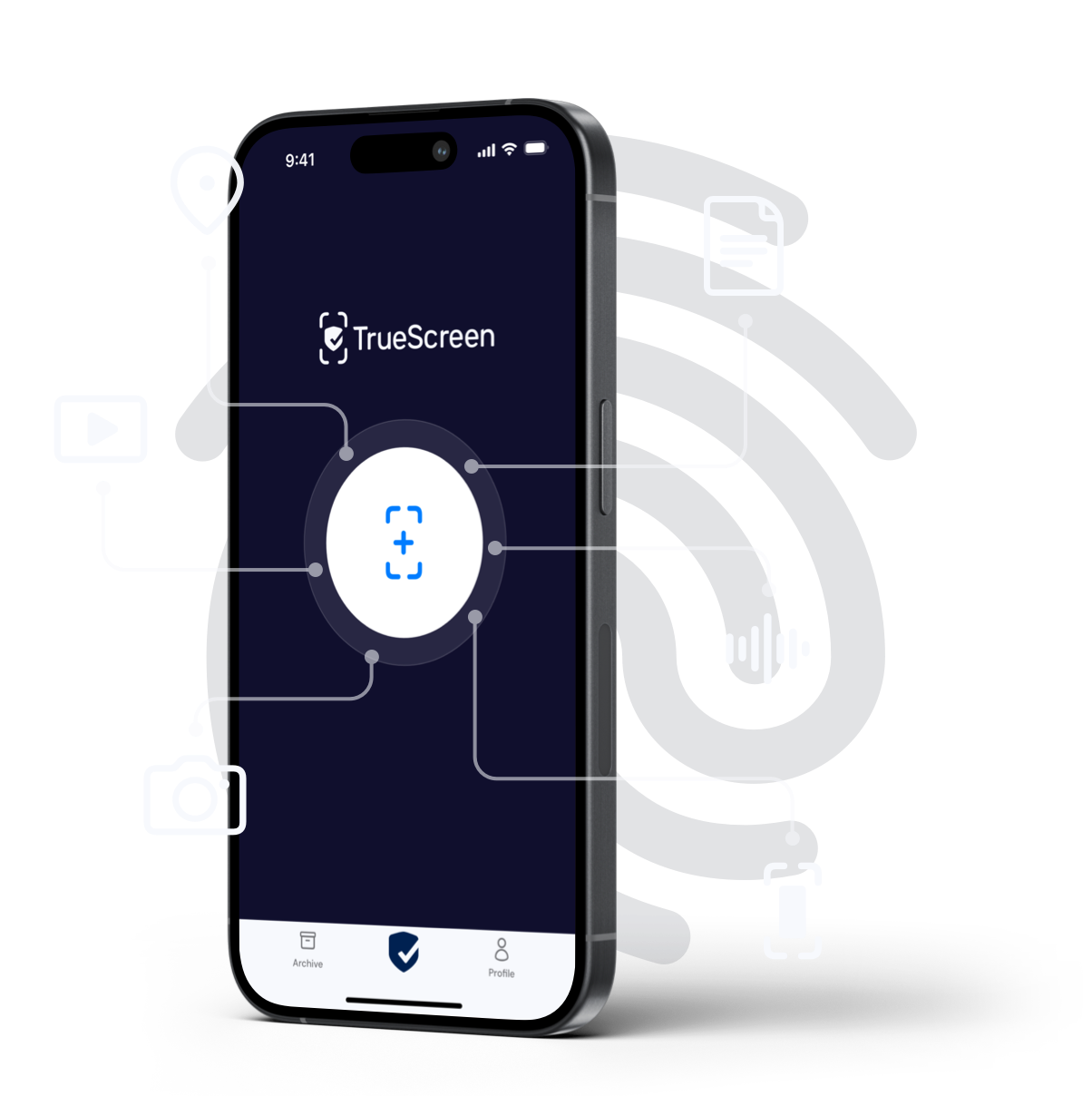
TrueScreen, the Data Authenticity Platform, enables organizations to capture forensic-grade evidence directly from mobile devices, sealing files with a qualified electronic seal and a qualified timestamp at the moment of capture.
TrueScreen provides forensic-grade acquisition following ISO/IEC 27037, sealed with a qualified electronic seal and a qualified timestamp under eIDAS.
Legal standards every organization must meet
For digital evidence to hold up in legal or regulatory proceedings, it must align with specific frameworks. No framework guarantees admission, which the court decides, but each one sets conditions that make a file harder to challenge.
Beyond eIDAS, several Member States layer additional civil-procedure presumptions on top of the qualified-trust-service framework. For the Spanish jurisdiction, see our dedicated guide on digital evidence in Spanish civil procedure.
eIDAS: electronic signatures, timestamps, and seals
The eIDAS regulation (EU 910/2014), updated through eIDAS 2.0 (effective May 2024), establishes the legal validity of electronic identification, signatures, timestamps, and digital seals across all EU member states.
Qualified electronic timestamps and qualified electronic seals under eIDAS carry rebuttable (“iuris tantum”) legal presumptions. A qualified timestamp is presumed accurate as to date and time, and the data it is bound to is presumed unchanged (Article 41). A qualified electronic seal is presumed to guarantee the integrity and the correct origin of the sealed data (Article 35). These effects apply across all 27 EU member states, making eIDAS the backbone of cross-border digital evidence in Europe.
In practical terms, files sealed with a qualified electronic seal and a qualified timestamp start with a legal advantage that unsealed or self-certified files do not enjoy: the regulation attaches presumptions to the former, and a court still assesses the latter.
GDPR and data handling requirements for digital evidence
The General Data Protection Regulation governs how personal data within digital evidence is collected, processed, stored, and accessed. Any evidence that includes personally identifiable information (faces in photos, names in documents, location data) must comply with GDPR principles: lawfulness, purpose limitation, data minimization, and security.
Mishandling evidence under GDPR can trigger regulatory penalties. It can also lead to the evidence itself being challenged or excluded from proceedings: a double risk that many organizations underestimate.
ISO/IEC 27037 and ISO/IEC 27001: technical safeguards
ISO/IEC 27037 provides internationally recognized guidelines for the identification, collection, acquisition, and preservation of digital evidence. It establishes procedures to ensure evidence is collected without alteration, documented through proper chain-of-custody processes, and handled by authorized personnel following consistent forensic principles.
ISO/IEC 27001 complements this with a framework for information security management and access control. Together, these standards help ensure that digital evidence is captured correctly and stored in a secure, auditable environment.
Beyond the EU, organizations operating internationally should also consider the Budapest Convention on Cybercrime (which covers cross-border digital evidence), UNCITRAL frameworks for electronic commerce and signatures, and jurisdiction-specific rules such as the U.S. Federal Rules of Evidence.
ISO/IEC 27037 in practice: applying the standard to digital evidence
While many organizations reference ISO/IEC 27037 in their policies, fewer implement it at an operational level. The standard defines four sequential phases for handling digital evidence, each with specific requirements that directly affect admissibility.
The four phases: identification, collection, acquisition, and preservation
Identification involves recognizing potential digital evidence and documenting its location, state, and relevance before any action is taken. This includes recording device types, storage media, network connections, and volatile data that may be lost if not captured immediately.
Collection refers to the physical gathering of devices or media containing potential evidence. ISO/IEC 27037 requires that collection procedures minimize alteration risk and that every step is documented: who collected the item, when, how, and under what authorization.
Acquisition is the process of creating a forensic copy of the digital content. The standard requires bit-for-bit imaging where possible, with cryptographic hash verification (typically SHA-256) to confirm that the copy matches the original exactly. Any deviation must be documented and justified.
Preservation covers the ongoing protection of acquired evidence against alteration, loss, or unauthorized access. Digital evidence preservation includes secure storage, environmental controls, access logging, and periodic integrity checks using the original hash values. Without a documented preservation process, even properly acquired evidence can be challenged on grounds that its integrity was compromised during storage.
Applying ISO/IEC 27037 to image and video forensics
For photographic and video evidence, the standard has particular relevance. Images captured with consumer devices carry EXIF metadata that can be modified with freely available tools. Video files can be re-encoded, cropped, or spliced without leaving obvious traces to the untrained eye.
ISO/IEC 27037 addresses this by requiring that acquisition tools capture not only the visible content but also all associated metadata in its original state. The acquisition process must produce a sealed, hash-verified output that links the content to a specific device, time, and location. Any forensic tool used must itself be validated and its version documented. Capture tools differ widely on exactly these points: see how forensic web capture software compares on validation, hashing and audit trail.
The gap between ISO compliance and informal “best practices” is significant. An organization that claims to follow ISO/IEC 27037 without documented procedures, validated tools, and trained personnel risks having its evidence challenged on procedural grounds, regardless of the content’s authenticity.
Court-ready evidence: what compliance teams need to know
The term “court-ready” appears frequently in compliance and legal technology contexts, but its practical meaning is often unclear. Court-ready evidence is digital content prepared so that its origin, integrity and handling can be shown on request, without reconstructing them after the fact. Admission itself remains the decision of the court or authority.
What “court-ready” actually requires
For evidence to be court-ready, it must satisfy several conditions simultaneously:
- Authenticated origin: the file is linked to a verified source, device, and timestamp
- Integrity verification: a cryptographic hash confirms no modification since acquisition
- Documented chain of custody: every access, transfer, and storage event is logged
- Legal compliance: the acquisition method aligns with applicable regulations (eIDAS, GDPR, ISO/IEC 27037, or jurisdiction-specific rules)
- Qualified certification: a qualified electronic seal and a qualified timestamp, recognised across the EU
Building an evidence pack for proceedings
Compliance teams preparing evidence for legal or regulatory use should assemble a structured evidence pack that includes: the certified file itself, the acquisition report (device, location, operator, method), the chain-of-custody log, cryptographic hash values with verification timestamps, and the certificate data confirming the qualified seal and timestamp.
Organizations that build this discipline into their standard workflows, rather than scrambling to assemble documentation after a dispute arises, reduce both legal risk and preparation time. The cost of certifying evidence at the point of capture is a fraction of the cost of defending uncertified files in court.
Organizations use TrueScreen to build court-ready evidence packs that include certified timestamps, GPS coordinates, device identifiers, and a cryptographically sealed chain of custody, all generated automatically during the capture process.
How to authenticate digital evidence in court
Authentication is the legal process of proving that digital evidence is what it claims to be. In the United States, Federal Rule of Evidence 901(b) provides several methods for authenticating digital evidence:
- Testimony from a witness with knowledge of the file and its creation
- Distinctive characteristics of the file itself (metadata patterns, formatting, internal references)
- Expert testimony from a digital forensics specialist who examined the evidence
- Evidence of a process or system that produces accurate results (Rule 901(b)(9))
- Self-authentication under Rules 902(13) and 902(14) for certified records generated by an electronic process
Authenticating social media evidence presents additional challenges. Screenshots of posts, messages, or profiles can be fabricated, and platforms may alter content display over time. Courts scrutinize how social media content was captured, and capture that seals metadata and timestamps at the moment of acquisition reduces the need to rely on witness testimony alone. In practice this means certifying the screenshot at the moment of capture, so that timestamp, device and origin travel with the file instead of being reconstructed later.
Presenting digital evidence in court demands preparation beyond authentication alone. Legal teams must anticipate objections to relevance, hearsay, and prejudice while ensuring that the technical documentation supporting each file is accessible and understandable to non-technical judges and jurors.
Chain of custody: keeping digital evidence intact from capture to courtroom
A file’s origin matters, but so does its journey. If anything happens between capture and presentation that cannot be accounted for, even authentic content risks exclusion.
The chain of custody in digital forensics serves a fundamentally different purpose than physical evidence handling. Physical items can be sealed in a bag and stored in a locked room. Digital files can be duplicated, transferred, and accessed without leaving obvious traces. This is why forensics chain of custody protocols for digital evidence require cryptographic verification at every stage: not just logging who accessed a file, but proving mathematically that the content remained unchanged throughout its lifecycle.
Key questions a reliable chain of custody answers
A defensible chain of custody establishes:
- Was the file accessed or modified after capture?
- Who handled it, and under what authority?
- Were all transfers secure and properly logged?
- Can the entire lifecycle be reconstructed from acquisition to courtroom use?
These are not theoretical concerns. In adversarial legal proceedings, opposing counsel will probe every gap. A single undocumented access point, an unexplained time gap, or an unencrypted transfer can undermine months of evidence collection.
Immutable logs, cryptographic sealing, and access controls
Maintaining a secure chain of custody requires:
- Immutable, timestamped logs that record every interaction with the file
- Cryptographic sealing at each stage, so any alteration becomes immediately detectable
- Role-based access controls that restrict who can view, copy, or transfer the evidence
- Encrypted storage that protects data at rest and in transit
When lawyers and law firms present certified evidence in court, they need to show more than what the file contains. They need to demonstrate that its path from capture to presentation is fully documented and that any tampering would be detectable.
Blockchain vs qualified seals and timestamps: what carries legal presumptions
Digital notarization, a file’s hash combined with a timestamp, gives legal value to content, but not all methods carry the same weight in judicial proceedings.
For a comprehensive analysis of how blockchain evidence specifically meets court admissibility standards, including FRE 901 authentication, chain of custody for on-chain and off-chain data, and landmark court rulings, see our dedicated guide on blockchain evidence admissibility standards for court.
Why blockchain alone falls short of legal recognition
Blockchain-based timestamping creates a public, immutable hash of a file at a given point in time. Proponents cite its decentralization and resistance to tampering as advantages.
In legal contexts, though, blockchain timestamping runs into real problems. It lacks standardized legal recognition across jurisdictions. Courts may not accept a blockchain hash as sufficient proof of authenticity without additional supporting evidence. And blockchain records often conflict with compliance frameworks like eIDAS or GDPR, particularly around data handling and privacy.
The core limitation is straightforward: a blockchain hash proves that a specific file existed at a specific time. It does not prove who created it, on what device, under what circumstances, or whether the content was already manipulated before being hashed.
Qualified timestamps and seals under eIDAS
For digital notarization to be legally defensible, it needs qualified electronic timestamps and seals under eIDAS or equivalent regulations, structured and auditable records, and alignment with the applicable legal requirements.
Qualified trust services supply the part of that list that eIDAS attaches presumptions to. A qualified timestamp and a qualified seal carry the rebuttable (“iuris tantum”) presumptions of eIDAS: an accurate date and time, and data that has not changed since sealing, until proven otherwise. When a dispute reaches court, what matters is not what is innovative but what is legally binding.
Video evidence with altered timestamps or metadata
Video recordings are among the most contested forms of digital evidence. Courts and arbitration panels increasingly scrutinize not just the visual content but the metadata surrounding it: timestamps, encoding parameters, device identifiers, and geolocation data.
Why altered timestamps raise red flags in proceedings
System-generated timestamps on video files are trivially easy to modify. A user can change a device’s clock before recording, edit EXIF data after capture, or re-encode a file with altered creation dates. File system metadata (created, modified, accessed dates) can also be overwritten through basic operating system commands.
When opposing counsel identifies inconsistencies between a video’s claimed timestamp and other corroborating evidence (network logs, witness testimony, location data), the entire recording can be called into question. Where metadata integrity cannot be independently verified, video evidence becomes much easier to challenge.
System metadata vs. certified timestamps
The distinction matters. System metadata is generated and stored by the device or operating system. It can be read, modified, or deleted by anyone with access to the file. Qualified timestamps, by contrast, are applied at the moment of acquisition. They are cryptographically sealed and independently verifiable. Under eIDAS, a qualified timestamp creates a legal presumption that the content existed in its certified form at the recorded time.
For organizations that regularly collect video evidence (insurance adjusters documenting claims, construction managers recording site conditions, law enforcement capturing field footage), the choice between system metadata and certified timestamps directly affects whether that evidence will survive legal challenge.
Preventing the problem at the source
Rather than attempting to validate questionable metadata after the fact, forensic-grade acquisition tools seal timestamps, device identifiers, and geolocation data at the exact moment of capture. The cryptographic hash generated during acquisition makes any post-capture modification immediately detectable. This approach answers the metadata integrity question before it can be raised in proceedings.
This proactive approach is the methodology TrueScreen uses, certifying evidence at the point of capture rather than attempting to validate it retroactively.
How TrueScreen ensures forensic-grade digital evidence
TrueScreen is the Data Authenticity Platform that enables organizations to capture, verify, and certify digital content with full legal and evidentiary value. Through a forensic methodology, every file acquired with TrueScreen is sealed with a qualified electronic seal and a qualified timestamp, which under eIDAS give it legal presumptions of integrity, correct origin and date.
The platform follows ISO/IEC 27037 for forensic acquisition, integrates a qualified electronic seal and a qualified timestamp under eIDAS, and processes data under GDPR principles. Cryptographic hashing makes any modification after acquisition detectable, preserving the evidentiary strength of certified material.
Certified acquisition from any device
TrueScreen works across mobile devices, desktop environments, and integrated enterprise systems through its SDK. From the moment of capture, metadata, timestamps, geolocation, and device identifiers are sealed into the certified file: a verifiable record ready for digital evidence for litigation, compliance audits, and regulatory proceedings.
Industries and use cases where digital evidence matters
In the legal sector, law firms use certified screenshots, recordings, and documents to build defensible cases. Insurance companies rely on authenticated media to validate insurance claims and reduce fraud. Law enforcement agencies use forensic-grade acquisition to support investigations and proceedings.
Beyond the legal sector, construction, real estate, logistics, and healthcare organizations document processes and transactions with certified proof to resolve disputes and confirm compliance.
The need keeps growing. Every year brings more digital interactions and cheaper tools to manipulate them. Organizations that wait to address evidence integrity are taking on risk they could avoid. For a side-by-side comparison of the options, see our guide to the platforms that present and certify court-admissible evidence.
FAQ: frequently asked questions about the admissibility of digital evidence
What is the admissibility of digital evidence?
How do you prove digital evidence is authentic?
What legal standards apply to digital evidence in Europe?
What is the chain of custody for digital evidence?
Is blockchain-notarized evidence admissible in court?
What makes digital evidence admissible in court?
What are the requirements for admissibility of electronic evidence?
Do screenshots of texts hold up in court?
What are the rules for digital evidence?
What is digital admissibility?
TrueScreen editorial team
This section is edited by the TrueScreen editorial team, which brings together expertise in digital forensics, the law of digital evidence and regulatory compliance. Every article is checked against primary sources: legislation, published rulings, technical standards and official documentation, always cited in the text.


