
Italian Supreme Court 1254/2025: When Screenshots, SMS and Emails Truly Count as Evidence
The italian supreme court 1254/2025 whatsapp evidence ruling has reopened a question many civil litigators thought was settled: does a WhatsApp screenshot stand up in court? The Second Civil Section answered yes, taking into account whether their provenance and reliability are confirmed. The Court confirms screenshots qualify as mechanical reproductions under Article 2712 of the Italian Civil Code, and that WhatsApp messages and SMS stored on a phone may be produced through a simple photographic copy, taking into account the verification of their provenance and reliability. It sets no technical requirement such as a hash or a timestamp. TrueScreen helps document the provenance of a capture, acquiring it with a forensic method and recording how and when, so the judge has elements to assess; the assessment remains the court's.
This insight is part of our guide: Admissibility of digital evidence: standards and chain of custody
The full text of the order is available in the PDF of Italian Cassation order 1254/2025 published by Giuricivile. We read it here from a tech-forensic angle, explaining how to produce the technical verification the Court now expects.
What the Cassation Court Decided in Order 1254/2025
On 18 January 2025 the Italian Supreme Court, Second Civil Section (rapporteur Trapuzzano), held that screenshots of WhatsApp messages and SMS are usable as documentary evidence under Article 2712 of the Civil Code and may be acquired through a simple photographic copy, taking into account the verification of their provenance and reliability. The order cites, among other precedents, United Sections ruling 11197/2023.
The case: a EUR 28,050 window-installation dispute
The underlying dispute involved a contract for the supply and installation of windows worth EUR 28,050. The client had paid a EUR 10,000 deposit by cheque; the balance, however, rested on terms exchanged through WhatsApp messages. The Pavia court of first instance upheld the client's objection to the payment order; the Milan Court of Appeal reversed that decision and confirmed the claim, relying on witness testimony and, as corroboration, on a WhatsApp message. The Supreme Court dismissed the appeal.
The Trapuzzano ruling: screenshots, SMS and Article 2712
Article 2712 of the Italian Civil Code classifies a WhatsApp screenshot as a mechanical reproduction, which forms full proof of the facts represented unless the party against whom it is produced disclaims conformity. Order 1254/2025 notes that the appellant had challenged the procedural usability of the document itself rather than the allegedly fabricated nature of its content, and that the screenshot is usable taking into account the verification of its provenance and reliability. In the case at hand the message was a supporting element for witness testimony.
What the Ruling Says and What It Does Not Say
A superficial reading of Cassation 1254/2025 says "WhatsApp admitted as evidence". The Court confirms that WhatsApp messages and SMS can be produced through screenshots, taking into account their provenance and reliability, and sets no technical requirement for the acquisition. Without a minimum of forensic method, any of these digital reproductions remains exposed to the first well-argued challenge. Preparing the evidence carefully remains good professional practice.
The conformity disclaimer: what case law requires
The "clear, circumstantiated and explicit" standard comes from earlier Supreme Court case law on disclaimers of mechanical reproductions, not from order 1254/2025. A generic disclaimer that reads "I contest everything" or "I deny conformity of the copy" no longer suffices. The challenging party must identify which portion of the screenshot is contested, on what grounds, and on which technical layer: authorship of the phone number, integrity of the message sequence, coherence of metadata. Earlier civil case law (for example Cass. 19155/2019) had already held that a generic contestation is not an effective disclaimer.
The practical effect, however, cuts the other way. Once a disclaimer is well-built, the screenshot loses full-proof status and the judge weighs it with the other evidence, so the producing party has an interest in documenting its provenance and integrity. Our broader analysis of admissibility of digital evidence and chain of custody standards examines why this pattern holds for all digital content, not only for chat logs.
What "verification of provenance and reliability" means in practice
Verifying provenance and reliability requires objective elements: a phone number traceable to the counterparty, transmission metadata, file integrity, verifiable date and time, absence of layout or conversational flow alterations. The Court does not list these elements: they are prudent professional practice for answering a possible disclaimer. Order 1254/2025 leaves the concrete assessment to the trial judge, case by case. International frameworks converge on the same logic: ISO/IEC 27037 on identification, collection and preservation of digital evidence and Rule 902 of the US Federal Rules of Evidence on self-authentication both treat hash values and certified timestamps as the anchors of admissibility.
Beyond WhatsApp: What Changes for SMS, Email, Photos and Web Screenshots
Supreme Court ruling 1254/2025 arose from a WhatsApp chat case, but the Court qualifies the screenshot as a mechanical reproduction under Article 2712 of the Italian Civil Code, a category that also covers SMS, emails, digital photographs, screenshots of websites, social media pages, corporate portals, and audio and video recordings. The principle, embedded in the ruling through the reference to "WhatsApp messages and SMS stored in the memory of a mobile phone", refers to those messages only; the Article 2712 rule it applies covers other reproductions too, but the order sets no specific standard for them. Consolidated case law confirms the perimeter: emails under Article 2712 (Cass. 19155/2019, Cass. 11606/2018), audio recordings as phonographic reproductions (Cass. 5241/2017), website screenshots as digital reproductions. The order does not introduce a new technical standard for any of these formats.
Digital Photographs: The Category Explicitly Named in Article 2712
Article 2712 of the Italian Civil Code opens its list of mechanical reproductions with "photographic reproductions": photographs are the first category named in the rule. A photo taken with a smartphone, an image attached to a chat, a frame extracted from a video all constitute full proof of the facts represented unless the counterparty disclaims conformity in a clear, detailed and explicit way. The disclaimer rule of Article 2712 applies to every mechanical reproduction, photographs included; order 1254/2025, however, concerns WhatsApp messages and SMS.
A disclaimer against a photograph, to be effective, must be specific and may concern, for example, provenance (who took it, from which device), integrity (absence of photo editing, EXIF metadata coherence), dating (when it was captured). A bare photo without metadata remains exposed to technical objections. A photograph acquired with forensic methodology (hash of the original file, qualified timestamp, chain of custody) documents all three aspects in a verifiable way. For a deep dive, see the forensic guide to certifying photos with legal value.
Emails, SMS and Chats: The Same Evidentiary Regime
An email, an SMS or a WhatsApp screenshot all fall under the same Article 2712 regime: they are digital reproductions that constitute full proof of the facts represented unless disclaimed. Under Supreme Court case law the disclaimer must be specific and may concern, for example, paternity of the address or number, metadata integrity, sequence coherence, absence of alteration. A generic "I deny conformity" is not enough. Civil sections with Cass. 19155/2019 and Cass. 11606/2018 had already qualified email without a digital signature as a digital reproduction under Article 2712 with full evidentiary force if not disclaimed: 1254/2025 refers to this line and applies it to WhatsApp messages. For the specific evidentiary regime of email, see the dedicated guide to challenging email evidence in court.
Screenshots of Websites, Social Media and Portals: Same Rule, Higher Disclaimer Risk
A screenshot of a web page, a social post or a corporate portal falls under the same digital-reproduction category in Article 2712 cited by Supreme Court 1254/2025. The difference with WhatsApp is that these contents are editable by the operator (the site can change the page, the social network can delete the post), so a detailed disclaimer is more frequent. Website screenshots fall under the same Article 2712 rule, with the added risk that the page changes after capture. Our guide to screenshot objections in court analyses in detail how to overcome the disclaimer in these cases, with specific attention to the principle stated in 1254/2025.
Audio and Video Recordings: Phonographic Reproductions, Same Article 2712
Audio recordings among present parties are admitted as civil evidence under Article 2712 as phonographic reproductions (Cass. 5241/2017). Here too, the absence of a detailed disclaimer turns the recording into full proof of the facts. To answer a detailed disclaimer it helps to document provenance (who speaks), integrity (no manipulation) and dating (when); order 1254/2025 does not deal with audio recordings. Forensic certification with SHA-256 hash and qualified timestamp meets all three requirements, treating every digital document with the same technical standard, from a WhatsApp chat to an audio recording. The guide to the evidentiary value of certified meeting recordings details how to document integrity and date of audio and video content.
How to Make a Screenshot Uncontestable in Court
The operational answer is singular: forensic acquisition upfront, not forensic reconstruction after the fact. Once a screenshot is just another image sitting in a phone's camera roll, very few levers remain. A forensic copy obtained at the moment the message is viewed produces an evidentiary package that is difficult to attack, because it documents provenance, integrity and date of the content.
Forensic acquisition: hash, qualified timestamp, chain of custody
Three technical components make a WhatsApp screenshot resistant to disclaimer. The first is a cryptographic fingerprint, typically a SHA-256 hash: it guarantees the file has not changed after capture. The second is a qualified timestamp compliant with RFC 3161, issued by a trust service provider accredited under eIDAS Regulation (EU) 910/2014: it fixes the moment of acquisition in a way opposable to third parties. The third is chain of custody, the documentary trail linking source device, operator, exact time and final file. Together they document provenance and integrity, which is prudent practice in view of a possible disclaimer.
Common mistakes (and good practice)
Everyday practice is full of fragile acquisitions. The first mistake turns a screenshot into an analogue object. The second strips out its metadata. Neither survives a well-built disclaimer.
| Fragile common practice | Recommended practice |
|---|---|
| Screenshot photographed with a second phone | Direct capture from the source device with technical log |
| Screenshot cropped or resized | Original untouched file, protected by a SHA-256 control hash |
| Forwarded by email without a timestamp | RFC 3161 qualified timestamp applied at capture |
| Phone number not verified | Documented traceability of the number to the counterparty |
| Disclaimer treated as a bureaucratic step | Evidentiary package that neutralizes the objection upfront |
A party who already walks into court without forensic acquisition can still limit the damage: our note on neutralizing technical objections to screenshots at trial covers the recovery playbook. That is Plan B. The point of certifying upstream is not to need it.

TrueScreen: Certifying Chats and Screenshots Under Article 2712
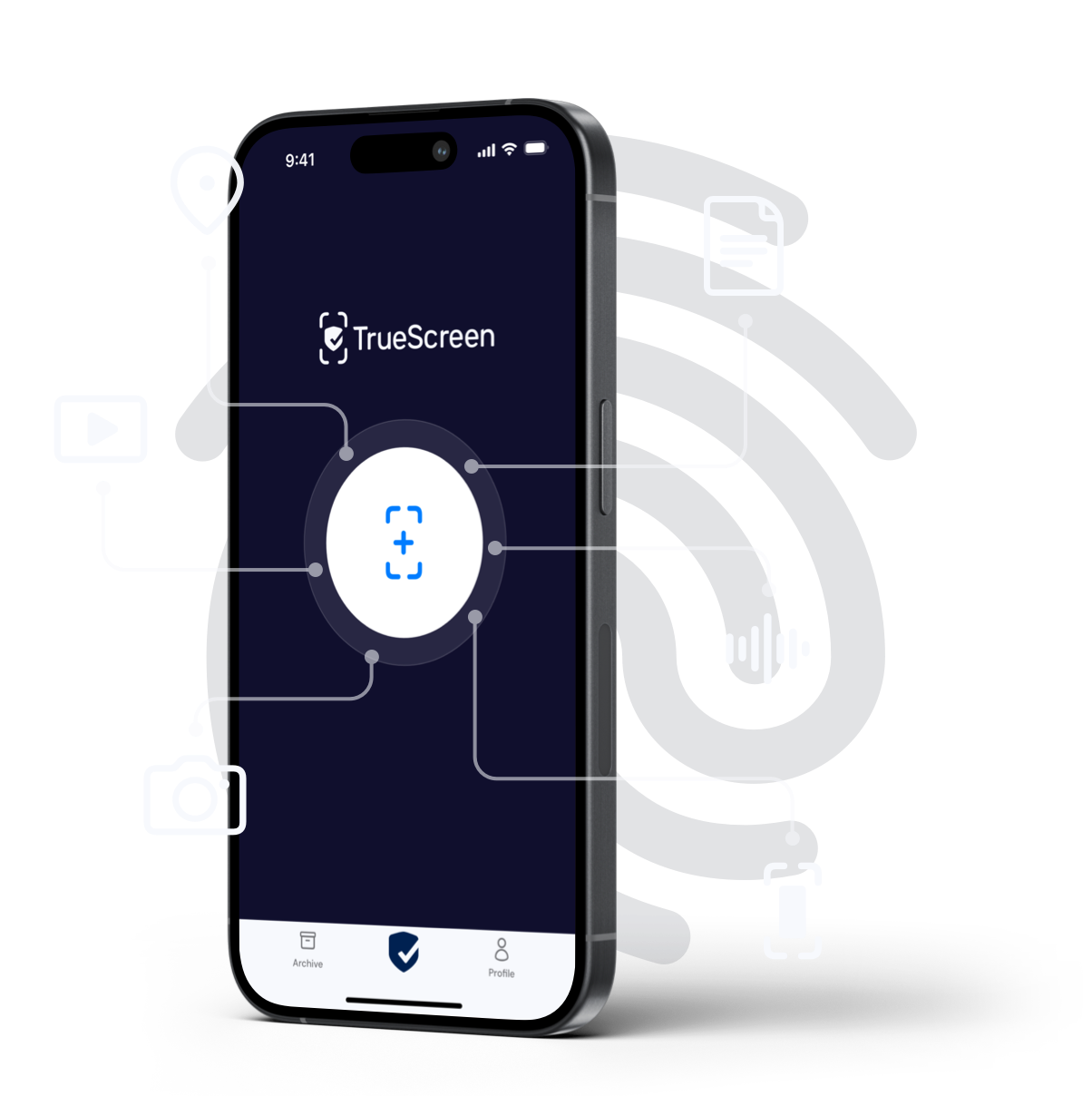
TrueScreen, the Data Authenticity Platform, captures screenshots and WhatsApp chats with forensic methodology in real time, producing an evidentiary package that documents provenance, integrity and date of the content. Acquisition runs through the mobile App for iOS and Android, with every capture sealed end-to-end. The output bundle contains the original file, its SHA-256 hash, an RFC 3161 qualified timestamp issued by an accredited QTSP, and an auditable chain of custody report. The screenshot stops being a visual reproduction and becomes a digital document with reinforced probative value under Article 2712.
Three complementary solutions cover the acquisition, depending on the device at hand. The main solution on desktop is the TrueScreen Forensic Browser, an application for macOS and Windows that acquires WhatsApp Web and other platforms accessible from the browser while recording the entire browsing session in a controlled forensic environment. The Web Notarization extension for Chrome and Edge lets you quickly certify any content during normal browsing, while the TrueScreen app for iOS and Android certifies the conversation directly from the smartphone. All of them feed the same certification workflow, with SHA-256 hashing, qualified timestamping and electronic seal.
Consider a recurring B2B scenario. A supplier receives an order confirmation through WhatsApp, just like the windows case. If the chat is certified with TrueScreen the moment it arrives, years later the supplier files a bundle carrying the sender's number, the exact time verified by an independent third party, and the hash of the original file. At that point a generic disclaimer gets nowhere, and a circumstantiated one runs into hard technical evidence. The certified document can then be signed through integrated digital signature for execution-ready contracts. For the full picture on certifying WhatsApp chats with legal value, we maintain a dedicated guide. For family-law contexts, where WhatsApp often carries decisive weight, the companion piece on WhatsApp evidence in divorce and custody proceedings shows how the same methodology applies.
FAQ: The Most Asked Questions About Cassation 1254/2025
What did the Italian Supreme Court rule in order 1254/2025?
The Italian Supreme Court, Second Civil Section, with order 1254 of 18 January 2025 (rapporteur Trapuzzano), confirmed that screenshots of WhatsApp messages and SMS are usable as documentary evidence and may be produced through screenshots, taking into account the verification of their provenance and reliability. The appeal was dismissed. The same Article 2712 category also covers emails, digital photographs, website and social screenshots, and audio recordings, but the order itself concerns WhatsApp messages and SMS.
What does "clear, circumstantiated and explicit" disclaimer mean?
An effective disclaimer contests conformity by specifying which technical element is in dispute: authorship of the phone number, file integrity, metadata coherence, conversational sequence. A generic objection such as "I deny conformity" is not enough. This standard comes from Supreme Court case law on disclaimers; order 1254/2025 does not state it.
Does an undisputed WhatsApp screenshot carry the weight of a signed private writing?
No. Article 2712 of the Civil Code governs mechanical reproductions, while Article 2702 covers signed private writings. An undisputed WhatsApp screenshot forms "full proof of the facts represented", but does not produce the specific legal effects of a signed document. Forensic acquisition plus digital signature reinforce the file, but the two regimes remain distinct.
Does ruling 1254/2025 also apply in criminal proceedings?
No. The order is limited to civil procedure. Criminal proceedings rely on different categories, and inadmissibility of WhatsApp messages may be triggered by separate grounds, including breach of acquisition procedures. A parallel Italian criminal ruling from the same period, 1269/2025, reaches conclusions that do not map onto the civil decision.
How should a WhatsApp screenshot be filed after Cassation 1254/2025?
As a matter of prudence, it is advisable to file it together with objective elements documenting provenance and reliability: forensic acquisition on the source device, cryptographic hash, qualified timestamp, traceability of the phone number to the counterparty. The ideal is depositing a technical report with chain of custody, not the image alone. TrueScreen transforms the screenshot from a visual representation into a digital document with an auditable chain of custody and reinforced probative value, making a circumstantiated disclaimer far harder to sustain.
What are the "provenance" and "reliability" tests the Court refers to?
They are two distinct verifications. Provenance proves authorship of the message, typically through the phone number and its traceability to the counterparty. Reliability covers the technical integrity of the copy: absence of alterations, coherence of metadata, temporal verification. Both are needed together, and both are best satisfied by forensic acquisition contextual to the fact itself.
Does Supreme Court 1254/2025 also apply to emails and SMS?
Yes. The ruling deals with a WhatsApp chat screenshot, but the Article 2712 framework it invokes covers all digital reproductions: emails, SMS, digital photographs, website screenshots, instant messaging. Consolidated case law (Cass. 19155/2019, Cass. 11606/2018) recognises emails as full proof under Article 2712 when not disclaimed in a clear, detailed and explicit way. The Article 2712 disclaimer rule therefore applies to the entire category of digital reproductions; order 1254/2025 applies it to WhatsApp messages and SMS.
Does a screenshot of a website or a social post follow the same 1254/2025 rule?
Yes, with one caveat. Screenshots of web pages, social posts and corporate portals fall under the same Article 2712 digital-reproduction regime. Unlike WhatsApp, however, these contents are editable by the operator: the site owner can change the page, the platform can delete the post. A detailed disclaimer can therefore point to page mutability, absent archival, or missing integrity checks. The fix is the same: forensic capture of the page with hash, qualified timestamp and chain of custody, which neutralizes technical objections at their root.
Do audio recordings follow the same 1254/2025 rule?
Yes. Audio recordings of conversations between parties are admissible as civil evidence under Article 2712 as phonographic reproductions (Cass. 5241/2017). The Article 2712 disclaimer rule applies to them in the same way: absence of a detailed disclaimer makes the recording full proof. With a detailed disclaimer, the judge expects verification of provenance, integrity and dating, exactly the elements covered by forensic certification with hash and qualified timestamp.
Do photos taken with a smartphone count as civil evidence?
Yes. Article 2712 of the Italian Civil Code names photographic reproductions as the first category of mechanical reproductions, and the same disclaimer rule applies to every digital reproduction. A photo taken with a smartphone constitutes full proof of the facts represented unless the counterparty disclaims conformity in a clear, detailed and explicit way. To reinforce the photo against technical objections, forensic acquisition, file hash, qualified timestamp and verification of original EXIF metadata are required. See the dedicated guide to certifying photos with legal value.
TrueScreen editorial team
Published on · Updated on
This section is edited by the TrueScreen editorial team, which brings together expertise in digital forensics, the law of digital evidence and regulatory compliance. Every article is checked against primary sources: legislation, published rulings, technical standards and official documentation, always cited in the text.


