
What Is ESI? Electronically Stored Information in Discovery
What counts as electronically stored information under the Federal Rules, how scope and form of production work, and how to collect volatile web, chat and social ESI.
Updated on
In US litigation, ESI means electronically stored information: under Rule 34(a)(1)(A) of the Federal Rules of Civil Procedure, a party can request any “electronically stored information” that is “stored in any medium from which information can be obtained.” The 2006 Committee Note calls the rule “expansive,” so email, databases, web pages, social media posts and chat messages all count as ESI. TrueScreen certifies web pages, social profiles and chats at the source, recording how and when each one was acquired.
Key takeaways
- Rule 34(a)(1)(A) reaches any designated documents or electronically stored information stored in any medium; the 2006 Committee Note calls it expansive (FRCP 34).
- ESI discovery is limited to nonprivileged matter relevant to a claim or defense and proportional to the needs of the case (FRCP 26(b)(1), as amended effective December 1, 2015).
- When a request names no form, ESI is produced in the form ordinarily maintained or in a reasonably usable form, and never needs to be produced in more than one form (FRCP 34(b)(2)(E)).
- Severe sanctions for lost ESI, such as an adverse presumption, dismissal or default, require a finding of intent to deprive; prejudice alone allows only curative measures (FRCP 37(e)).
- Pew Research Center found that 38% of webpages that existed in 2013 were no longer accessible a decade later, which is why external ESI is best captured at the trigger date (Pew, 2024).
38%
of webpages that existed in 2013 were no longer accessible a decade later
Nearly 1 in 5
tweets no longer publicly visible just months after being posted
100+
firms charged by the SEC over off-channel messaging recordkeeping since December 2021
Ask a US litigator “what is ESI?” and the answer is short: electronically stored information, the digital material that Rules 26, 34 and 37 bring into discovery. Email and shared drives sit inside the client’s systems, where a litigation hold can freeze them. TrueScreen, the Data Authenticity Platform, works on what sits outside: it captures web pages, social profiles and chats at the source and seals each acquisition so any later change is detectable.
The outside part is where things get messy. A competitor’s product page or a WhatsApp thread can carry the facts of the dispute, and a hurried screenshot keeps the pixels while dropping the URL, the time and the page behind them, which invites an authenticity objection under Federal Rule of Evidence 901. Scope follows Rule 26(b)(1), form follows Rule 34(b)(2)(E), and for content you do not control, the defensible move is to capture it at the source on the day the duty to preserve attaches.
What is ESI under the Federal Rules of Civil Procedure
ESI is any information a party keeps in an electronic medium, and the Federal Rules read the term broadly enough to absorb technologies that did not exist when it was drafted. TrueScreen certifies the part of that category that sits on platforms neither party controls, namely web pages, social profiles and chats, at the moment it is acquired.
The definition in Rule 34(a)(1)(A) and the 2006 amendments
Rule 34(a)(1)(A) covers “any designated documents or electronically stored information” if “stored in any medium from which information can be obtained either directly or, if necessary, after translation by the responding party into a reasonably usable form.” The wording arrived with the December 1, 2006 amendments, which the Federal Judicial Center’s pocket guide for judges attributes to “the prevalence of ESI.” The Committee Note calls the rule “expansive,” covering “any type of information that is stored electronically.” Rule 34 reaches only ESI in the responding party’s “possession, custody, or control,” so a competitor’s public page is evidence your client gathers on its own.
Common types of ESI, from email to ephemeral messages
Each type of ESI carries its own preservation risk.
| Type of ESI | Where it lives | Main preservation risk |
|---|---|---|
| Email and files | Mail servers, cloud drives, laptops | Auto-delete policies, overwritten versions |
| Databases | Finance, CRM and HR systems | Records change daily |
| Chats | WhatsApp, Telegram, workplace messaging | Edits, disappearing messages |
| Social media content | Third-party platforms | Deletions, privacy changes |
| Web pages | Company sites, marketplaces, forums | Silent updates, removed pages |
| Mobile and cloud data | Phones, software services, logs | Device replacement, retention limits |
Regulators treat business chats as records: the SEC reported in November 2024 that its off-channel messaging initiative had led to charges against more than 100 firms since December 2021.
How ESI differs from paper records: metadata is part of the evidence
Paper records are fixed on a physical medium, while ESI needs hardware and software to be read. ESI carries metadata such as creation dates and edit history, exists in several versions, and can change without a visible trace. Most of that metadata is lost once ESI is flattened into an image.
How ESI discovery works: scope, proportionality and the Rule 26(f) conference
ESI discovery follows the general discovery rules, plus specific provisions on accessibility, form and preservation added by the 2006 and 2015 amendments. E-discovery is simply the discovery of ESI, within the limits of Rule 26 and under a plan the parties discuss at the Rule 26(f) conference.
Where ESI sits in the e-discovery process
E-discovery usually runs through identification, preservation, collection, processing, review and production. The duty to preserve comes from case law and attaches once litigation is reasonably anticipated. A litigation hold notice carries that duty to custodians, but it cannot freeze content hosted on someone else’s platform, so external ESI has to be collected early.
Relevance and proportionality under Rule 26(b)(1)
Under Rule 26(b)(1), ESI is discoverable on the same terms as “any nonprivileged matter that is relevant to any party’s claim or defense and proportional to the needs of the case,” with courts weighing factors such as the amount in controversy, the parties’ relative access to information and the burden of the discovery. That language entered the rule with the amendments that, as the Chief Justice’s 2015 Year-End Report notes, took effect on December 1, 2015.
ESI that is not reasonably accessible (Rule 26(b)(2)(B))
Under Rule 26(b)(2)(B), a party “need not provide discovery of electronically stored information from sources that the party identifies as not reasonably accessible because of undue burden or cost,” and the court may still order it for good cause. Public web content does not fit that category.
The Rule 26(f) discovery plan and ESI protocols
Rule 26(f)(3)(C) requires the discovery plan to address ESI issues, “including the form or forms in which it should be produced.” Many parties record those choices in an ESI protocol, also called an ESI agreement, which the court may enter as an ESI order. Under Rule 26(f)(3)(D), the plan can also ask for an order under Federal Rule of Evidence 502 covering privilege clawback.
Form of production: native files, reasonably usable forms and Rule 34(b)(2)(E)
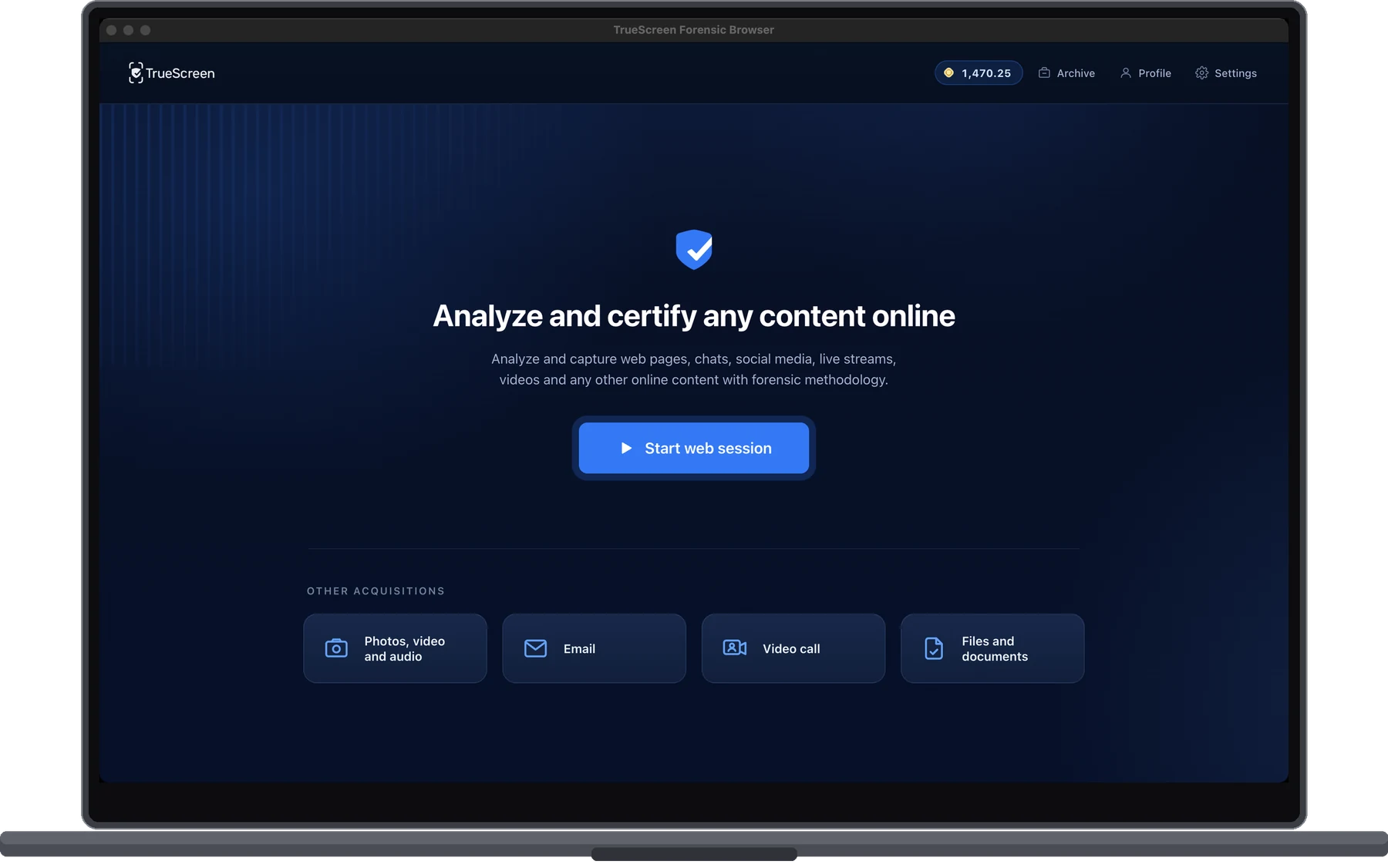
Rule 34(b)(2)(E) lets the requesting party name a form of production and, when it does not, lets the producing party choose between the form in which the ESI is ordinarily maintained and a reasonably usable form. Subparagraph (i) covers documents, produced “as they are kept in the usual course of business” or labeled to match the request, and subparagraph (iii) says a party “need not produce the same electronically stored information in more than one form.” The TrueScreen Forensic Browser certifies each web page with an image, the page source and a web archive, so the parties can agree on a form without going back to a page that may have changed since.
| Form of production | What it preserves | Limits for web, chat and social ESI |
|---|---|---|
| Native format | The original file with its metadata | A live page or chat has no single native file |
| Web archive or structured export | Content, source code, resources | Needs the capture context to be meaningful |
| Image (TIFF or PDF) with load file | A picture with extracted text | Loses dynamic content and the server response |
How a Rule 34 request and response work
A Rule 34 request must describe each item or category “with reasonable particularity” and may specify the form for ESI. The responding party has 30 days after service to answer in writing, and any objection must “state with specificity the grounds” and say whether responsive materials are being withheld. A party that objects to the requested form, or receives a request with no form, must state the form it intends to use.
Choosing a form for web pages, social posts and chats
Web pages, social posts and chats rarely have a native form, so parties usually negotiate one that keeps both what the viewer saw and the data underneath: an image or video, the page source, a web archive, and the URL with the date and time of capture.
Why web pages, social posts and chats are the hardest ESI to preserve
Web pages, social posts and chats are hard to preserve because they sit on systems neither party controls, change without notice, and lose their context when reduced to a screenshot. A litigation hold cannot stop a platform from removing a post.
Volatile content you do not control
Pew Research Center found that 38% of webpages that existed in 2013 were no longer accessible a decade later, and that nearly one in five tweets were no longer publicly visible just months after posting. Profiles go private and stories expire by design, so capturing and authenticating social media evidence has to happen early. Public archives crawl on their own schedule and may have missed the version you need, one of the limits of the Wayback Machine as evidence.
Screenshots and the Rule 901 authenticity objection
A screenshot is ESI, but on its own it is thin support for authenticating a web page or a chat. FRE 901(a) requires “evidence sufficient to support a finding that the item is what the proponent claims it is,” and while the bar is low, a bare screenshot gives opposing counsel an easy target because it shows pixels without the source code or proof of when it was taken. Proponents add testimony or “evidence describing a process or system and showing that it produces an accurate result” under Rule 901(b)(9). In the Forensic Browser, TrueScreen certifies a web page together with an image of the page, its source code and a web archive, all sealed with a qualified timestamp, so the capture comes with a record of how it was made.
In Griffin v. State (Md. 2011), a state decision useful only as an illustration, MySpace printouts were held not properly authenticated because someone else could have created the profile. Even then, hearsay and Rule 403 still apply (more on that in our piece on authenticating digital evidence under FRE 901).
The link to spoliation under Rule 37(e)
Rule 37(e) applies when ESI “that should have been preserved in the anticipation or conduct of litigation is lost because a party failed to take reasonable steps to preserve it” and cannot be restored or replaced. Prejudice allows “measures no greater than necessary to cure the prejudice,” while an adverse presumption, dismissal or default requires “intent to deprive,” and negligence is not enough. How courts have read “reasonable steps” is covered in our analysis of spoliation of evidence.
How to collect web, chat and social ESI so its authenticity can be documented
Collecting web, chat and social ESI defensibly means capturing it at the source, with its context, using a documented method someone else could follow and check. The steps assume public content or content your client can lawfully access, with no logging into other people’s accounts and no pretext profiles.
-
Fix the trigger date and the scope
Record the date litigation became reasonably anticipated and list the external sources: URLs, public profiles, posts and chat threads. Send the litigation hold notice the same day and flag external items for immediate capture.
-
Capture at the source with a documented method
Capture a web page or public profile in a browser through a process that records the whole session. Capture a chat on your client’s own phone by recording the screen while scrolling, keeping in mind that a recording does not recover deleted messages. WhatsApp messages as evidence raise a few issues of their own.
-
Keep context: URL, date, time and the full page archive
Keep the URL, the date and time, an image or video, and a web archive with the source code. Pew found broken links on 23% of news webpages, so capture the linked pages that matter too. Litigation support teams use the TrueScreen Forensic Browser to save each page’s rendered source, server-delivered source and MHTML archive; there are other ways to save a web page as evidence, with different trade-offs.
-
Seal integrity with a digital seal and a timestamp
Compute hash values for the collected files and apply a digital seal and a qualified timestamp, so any later change is detectable and the collection time is fixed by a reference outside your own systems.
-
Log the collection and produce in a reasonably usable form
Log who captured what, when and how, to document the chain of custody in US proceedings. Produce in the form agreed in the ESI protocol or in a reasonably usable form, and keep the original sealed package available for verification.
How does TrueScreen collect web, chat and social ESI at the source?
TrueScreen, the Data Authenticity Platform, acquires web pages, social profiles and chats at the source with a forensic methodology and certifies each acquisition with a digital seal and a qualified timestamp with internationally recognized value. The seal and timestamp close a methodology that starts with acquisition and verification of the data. TrueScreen is not a trust service provider. A certification records how and when content was acquired, not who wrote it or whether it is true, and it does not replace your e-discovery platform or legal hold process.
Web pages and social profiles
The TrueScreen Forensic Browser is the recommended route when a capture is likely to be challenged: it certifies each page with an image and a video of the browsing, and stores the rendered source, the source delivered by the server and an MHTML web archive. The TrueScreen App offers Web Browsing Acquisition, which pairs a certified screenshot with a complete web archive across several sites or profiles in one session. The Browser Extension works in your own browser and adds the web archive only in video recording mode.
Chats on a phone or on the web
For a chat on your client’s own phone, the TrueScreen App records the screen while the conversation is scrolled, in WhatsApp or Telegram. From a computer, the Forensic Browser certifies a conversation open in WhatsApp Web, together with the attached files and, when network capture is enabled in Full recording, the network traffic.
What a certification contains
A completed certification consists of a sealed XML file, a report data file in JSON-LD, a PDF report when one is generated, and the original files of the acquisition, such as videos, screenshots and web archives, and any later change is detectable. A report describing the acquisition process is the kind of showing Rule 901(b)(9) contemplates, though the court decides. In a false-advertising dispute, a litigation support manager can capture a competitor’s public product page in the Forensic Browser the day the hold goes out, record the related WhatsApp thread on a phone the client owns, and hand the certified packages to outside counsel and the e-discovery vendor.
Conclusion
ESI is a broad category, and the rules around it are settled: Rule 34 sets what can be requested and in what form, Rule 26 sets scope and the conversation about it, and Rule 37(e) sets the consequences of loss. The gap in most matters is the ESI that lives on other people’s platforms, such as public pages, social profiles and chats, which no litigation hold can freeze. Capturing that content at the source, with its context and a documented method, on the day the duty to preserve attaches, gives you something concrete to show when its authenticity is questioned. This article is general information, not legal advice.
FAQ: what litigators ask about ESI
What does ESI stand for in litigation?
In litigation, ESI stands for electronically stored information. The term entered the Federal Rules of Civil Procedure with the amendments effective December 1, 2006, and Rule 34(a)(1)(A) lets a party request “any designated documents or electronically stored information” stored in any medium, from email to chats and web pages.
What is the difference between ESI and paper documents?
Paper documents are fixed on a physical medium, while ESI exists as data that needs hardware and software to be read. ESI carries metadata such as creation dates and edit history, exists in several versions and can change without a visible trace, which is why Rules 26 and 34 have ESI provisions on accessibility and form.
What is an ESI protocol?
An ESI protocol is an agreement between the parties, often entered by the court as an ESI order, that sets how electronically stored information will be preserved, searched and produced, including custodians, search terms and production formats. Rule 26(f)(3)(C) requires the discovery plan to address ESI, including form of production.
What is ESI in e-discovery?
In e-discovery, ESI is the material that moves through identification, preservation, collection, review and production, limited by Rule 26(b)(1) to nonprivileged, relevant and proportional information. For web pages, social posts and chats hosted by third parties, TrueScreen certifies the content at the source and records how and when it was acquired.
Can you object to an ESI request?
Yes. Under Rule 34(b)(2), a party has 30 days after service to respond and may object, stating the grounds with specificity and whether responsive material is withheld, and it may object to the requested form. For ESI, common grounds are proportionality under Rule 26(b)(1) and sources not reasonably accessible under Rule 26(b)(2)(B).
Sources and verification
Every figure and principle cited here links to its source, listed with type and date. Links checked on the publication date.
| Source | Type | Date | What it supports |
|---|---|---|---|
| Federal Rules of Civil Procedure, Rule 34 | Law | 2015 | Scope of ESI requests (34(a)(1)(A)), request and response mechanics, form of production (34(b)(2)(E)) |
| Federal Rules of Civil Procedure, Rule 26 | Law | 2015 | Relevance and proportionality (26(b)(1)), ESI not reasonably accessible (26(b)(2)(B)), discovery plan and ESI (26(f)(3)) |
| Federal Rules of Civil Procedure, Rule 37(e) | Law | 2015 | Remedies when ESI that should have been preserved is lost |
| Federal Rules of Evidence, Rule 901 | Law | 2011 | Authentication standard (901(a)) and evidence about a process or system (901(b)(9)) |
| Federal Judicial Center, Managing Discovery of Electronic Information: A Pocket Guide for Judges, 3d ed. | Document | 2017 | Origin of the December 1, 2006 ESI amendments |
| Chief Justice John G. Roberts, Jr., 2015 Year-End Report on the Federal Judiciary | Document | 31/12/2015 | Effective date of the 2015 amendments (December 1, 2015) |
| Pew Research Center, When Online Content Disappears | Survey | 17/05/2024 | Share of webpages and tweets no longer accessible; broken links on news pages |
| SEC, fiscal year 2024 enforcement results (press release 2024-186) | Survey | 22/11/2024 | Off-channel messaging initiative: charges against more than 100 firms since December 2021 |
| Griffin v. State, 419 Md. 343 (Md. 2011) | Case law | 28/04/2011 | Illustration of an authentication challenge to social media printouts (state decision, not binding) |
Collect web, chat and social ESI at the source
See how legal and litigation support teams use the Forensic Browser and the TrueScreen App to acquire web pages, social profiles and chats with a documented forensic methodology. Request a demo for your legal team.


TrueScreen editorial team
This section is edited by the TrueScreen editorial team, which brings together expertise in digital forensics, the law of digital evidence and regulatory compliance. Every article is checked against primary sources: legislation, published rulings, technical standards and official documentation, always cited in the text.
