
AI Incident: What an Organization Must Be Able to Show When Its AI System Fails
What an organization must be able to show after a chatbot or AI agent fails, what EU, UK and US texts expect, and why screenshots and vendor reports fall short.
An AI incident is proven like any other fact: you capture what the system showed and did at the moment it happened, in a form that a regulator, insurer or court can verify without trusting whoever hands it over. TrueScreen counters disputes built on unverifiable or self-serving records of AI behavior by certifying that content with a forensic methodology, which protects you from contested evidence and from claims nobody can check. The need is growing fast: the AI Incident Database recorded 362 incidents in 2025, up from 233 in 2024, according to the Stanford AI Index 2026.
Key takeaways
- The OECD defines an AI incident as an event where the development, use or malfunction of an AI system directly or indirectly leads to harm; an AI hazard could plausibly lead to one (OECD, May 2024).
- Under EU AI Act Article 73, providers of high-risk AI systems must report a serious incident within 15 days of the provider or, where applicable, the deployer becoming aware of it, 2 days for a widespread infringement or serious disruption of critical infrastructure, and 10 days in case of death (Regulation (EU) 2024/1689).
- Wells Fargo’s online access agreement, taking effect on November 24, 2026, will require a customer who revokes an AI agent to retain evidence of the revocation and provide it on request (Section 15(f)).
- Screenshots, copied transcripts and vendor self-reports cannot be verified by a third party, while a certified capture can be checked without trusting whoever hands it over.
- TrueScreen certifies what a chatbot or AI agent displayed on screen, acquired with a forensic methodology, while logs and agent data are certified as files, which fixes their content and date from the moment of certification.
362
AI incidents recorded by the AI Incident Database in 2025, up from 233 in 2024
435
AI incidents recorded by the OECD AI Incidents Monitor in January 2026, its peak
18%
organizations reporting AI incidents that rated their response excellent in 2025, down from 28% in 2024
Your organization probably already runs AI where customers can see it: a support chatbot on the website, an assistant inside the mobile app, an agent that books, refunds or pays on someone’s behalf. On most days these systems do what they were configured to do, and nobody asks you to prove anything.
The questions start when one of them fails. Picture a customer-facing chatbot that gives a user harmful instructions, or an AI agent that executes a payment the customer says was never authorized. A market surveillance authority, a bank, an insurer or a court will want to know what happened. The record you can offer usually comes down to a screenshot attached to the complaint, a transcript copied out of a support tool and the vendor’s own report. The public debate on AI failures runs on the same material: lab self-reports, pasted transcripts and screenshots that no third party can verify, used both by those who raise the alarm and by those who play it down. Neither side can settle much on that basis.
So what must an organization be able to show after an AI incident, and how does it prove it? The answer is to treat the incident as a fact and capture it as one: what the system displayed, what it did, when it happened and who saw it, fixed at that moment and kept apart from anyone’s theory of why it happened.
What Is an AI Incident, and Why Does Evidence Come First?
An AI incident is defined by the harm it leads to, so every claim about it depends on evidence of what the system actually did.
The OECD defines it this way: “An AI incident is an event, circumstance or series of events where the development, use or malfunction of one or more AI systems directly or indirectly leads to any of the following harms: (a) injury or harm to the health of a person or groups of people; (b) disruption of the management and operation of critical infrastructure; (c) violations of human rights or a breach of obligations under the applicable law intended to protect fundamental, labour and intellectual property rights; (d) harm to property, communities or the environment” (OECD, Defining AI Incidents and Related Terms, May 2024). Because the definition turns on what the system led to, TrueScreen concentrates on the part that is hardest to rebuild afterward: certifying what the chatbot or agent showed and did while the session was still open.
The same paper draws a line between incidents and hazards. An AI hazard is an event of the same kind where the AI “could plausibly lead to an AI incident” but no harm has occurred yet, which is why near misses are worth recording too.
The volume of AI failures being logged keeps climbing. The Stanford AI Index 2026 reports that the AI Incident Database recorded 362 incidents in 2025, up from 233 in 2024 and from fewer than 100 a year until 2022, while the OECD AI Incidents Monitor peaked at 435 incidents in January 2026. Among organizations that reported AI incidents, the share with three to five of them went from 30% to 50%, and the share rating their own response “excellent” fell from 28% in 2024 to 18% in 2025.
Each part of that definition is a claim someone will have to support: the harm, the AI system and the link between them. When a single chatbot answer turns into a dispute, as in the Air Canada chatbot case, the first argument is about what the bot said. An AI agent incident raises the same question with higher stakes, because the agent acts as well as speaks.
What Regulators and Banks Now Expect After an AI Incident
Regulators and banks are writing AI incidents into reporting duties and contract terms, and each of those texts assumes that someone can later produce evidence of what happened.
Under Article 73 of the EU AI Act, providers of high-risk AI systems must report a serious incident to the market surveillance authorities of the Member States where it occurred. The report is due immediately after the provider has established a causal link, or its reasonable likelihood, and in any event within 15 days of the provider or, where applicable, the deployer becoming aware of the incident. The deadline is 2 days for a widespread infringement or a serious and irreversible disruption of critical infrastructure, and 10 days in case of death, and an initial, incomplete report may be followed by a complete one.
Article 3(49) of the same regulation defines a serious incident as an incident or malfunctioning of an AI system that directly or indirectly leads to the death of a person or serious harm to a person’s health, a serious and irreversible disruption of the management or operation of critical infrastructure, the infringement of obligations under Union law intended to protect fundamental rights, or serious harm to property or the environment. The Digital Omnibus on AI, Regulation (EU) 2026/1744 of July 8, 2026, in force since July 27, 2026, moved the application of the high-risk rules to December 2, 2027 for Annex III systems and to August 2, 2028 for Annex I systems, so check which date applies to your system. The AI Act record-keeping requirements describe the logs that sit alongside these duties.
Data protection law offers a useful parallel, even though an AI incident is not necessarily a personal data breach. Under Article 33 of the GDPR, a controller must notify a personal data breach to the supervisory authority without undue delay and, where feasible, within 72 hours of becoming aware of it, unless the breach is unlikely to result in a risk to individuals. Every breach must be documented, including the facts, its effects and the remedial action taken (Article 33(5)), and that ordering of facts first, then effects and remedies, is exactly what a breach notification must prove.
In the United Kingdom, a government amendment to the Cyber Security and Resilience (Network and Information Systems) Bill would let ministers make regulations on agentic AI incidents, after consultation and with Parliament’s approval. The DSIT factsheet on agentic AI resilience measures describes a duty for entities that reported an incident to “preserve information”, a duty to inform other organizations affected by the agent, and incident reviews by technical experts within government, who could request information and conduct tests. These measures sit in a bill amendment and are not yet law. Separately, the CMA, FCA, ICO and Ofcom stated in a joint statement of the Digital Regulation Cooperation Forum that “existing legal and regulatory frameworks apply to personal AI agents” and that “An AI agent’s autonomy does not diminish the responsibility of organisations that deploy it.”
Banks are moving through their contracts. Wells Fargo’s updated online access agreement, which will take effect on November 24, 2026, adds a section on third-party AI agents: under Section 15(d), instructions given through an AI agent “are deemed to have been initiated and authorized directly by you, without further verification”, and under Section 15(f), a customer who revokes an agent “must retain evidence of such revocation and must provide such evidence to us, at our request”, as American Banker reported. The broader question of liability for AI agents is still being worked out, and in this agreement evidence of agent activity becomes a contract term.
Whether a specific event counts as a serious incident, and whether it triggers a notification under any of these frameworks, is a question to put to your legal counsel.
Why Screenshots, Transcripts and Vendor Reports Fall Short as Evidence
Screenshots, copied transcripts and vendor reports all pass through someone with a stake in the outcome, and none of them lets a third party check on its own what the system displayed or did.
A screenshot shows what someone says the system displayed. It cannot show which page it came from, whether the conversation went on, or whether the image was edited before it reached you, which is why screenshots are challenged in court. A transcript copied out of a support console has the same weakness, and a vendor or lab self-report comes from the party whose system is under scrutiny.
| Record | Who produced it | What it shows | What it cannot show | Can a third party verify it? |
|---|---|---|---|---|
| Screenshot | The user or employee who took it | An image of part of the screen | Where it came from, what came before and after, whether it was edited | No, only the image itself is available |
| Copied transcript | Whoever pasted it from the chat or support tool | The text of the exchange as copied | Links, timing, layout, and whether lines were dropped or changed | No |
| Vendor or lab self-report | The provider of the AI system | The provider’s account of what happened and why | Anything the provider left out or read in its own favor | No, it rests on trust in the author |
| Internal log export | The system or team that generated it | The events the system recorded, in the format it chose | Whether the export is unchanged, and how the log was produced | Not on its own; certifying the file fixes its content from that moment |
| Certified capture | The organization, through a forensic acquisition | What the interface displayed and when, with the technical context of the session | Whether the AI’s answer was true, or why the system produced it | Yes, integrity and seal can be checked without trusting the sender |
TrueScreen works on the last row of that table: every certified capture travels with its own technical report and file fingerprints, so the person who receives it checks the package itself instead of the reputation of whoever sent it.
What an Organization Must Be Able to Show
After an AI incident you need a record of what the system displayed, what it did, when, in which version and who saw it, kept apart from anyone’s explanation of why it happened.
AI incident documentation starts with the facts that are hardest to rebuild once the system has been patched, the conversation archived or the agent’s session closed. For the chatbot that gave harmful instructions and for the agent that executed a disputed payment, the record should cover:
- The full exchange as the user saw it, including warnings, links and any content that changed while the conversation went on.
- The actions the system took on the user’s behalf, such as payments, bookings, account changes or messages sent, and the confirmations that followed.
- The date and time of each step, tied to a clock that someone other than you can check.
- The model version, system prompt or settings in use, where you know them.
- The people who saw it: the customer, the employee who took over and, for agents, the identity under which the agent acted, which is the subject of how AI agent identity is established.
The line between fact and interpretation matters as much as the facts. A record stating that the chatbot displayed a given set of instructions at 2:02 p.m. is a fact, while “the model hallucinated because of a retrieval error” is an interpretation that belongs in a separate root-cause analysis, one you can revise without touching the evidence. TrueScreen draws that same line for logs: a log certified as a file is fixed in content and date from the moment of certification, and how the log was produced, or whether the system behaved correctly, remain questions to answer separately.
“Document everything” is the wrong instinct for AI incident response. Incident records may be requested in later proceedings and often contain personal data, so preserve what is relevant, with legal advice on scope and retention. The NIST AI Risk Management Framework states the expectation in MANAGE 4.3: “Processes for tracking, responding to, and recovering from incidents and errors are followed and documented.” What turns preserved material into an AI audit trail that holds up is a documented chain of custody from capture to handover, showing who captured each item, when, and how it was kept unchanged. Without that record, AI accountability remains a line in a policy document.
How Does TrueScreen Certify an AI Incident as It Happens?
TrueScreen certifies an AI incident as it happens by acquiring what the chatbot or agent displayed on screen with a forensic methodology, before the session closes or the system is changed, and by certifying its logs and data as files. The acquisition runs in a controlled environment, the data is verified, a technical report documents how and when each capture was made, and the result is certified with legal value through a qualified electronic seal and a qualified timestamp.
The limits are part of the method. Certification attests how, when and where content was acquired, not that what the chatbot said was true or that anyone’s reading of the incident is correct. TrueScreen does not detect, prevent or monitor AI incidents; it does not make an organization compliant with the AI Act, and it does not replace the forensic expert who analyzes the system. What it gives that expert, and the authority, insurer or court behind them, is a fixed starting point for AI incident evidence that nobody has to take on trust.
-
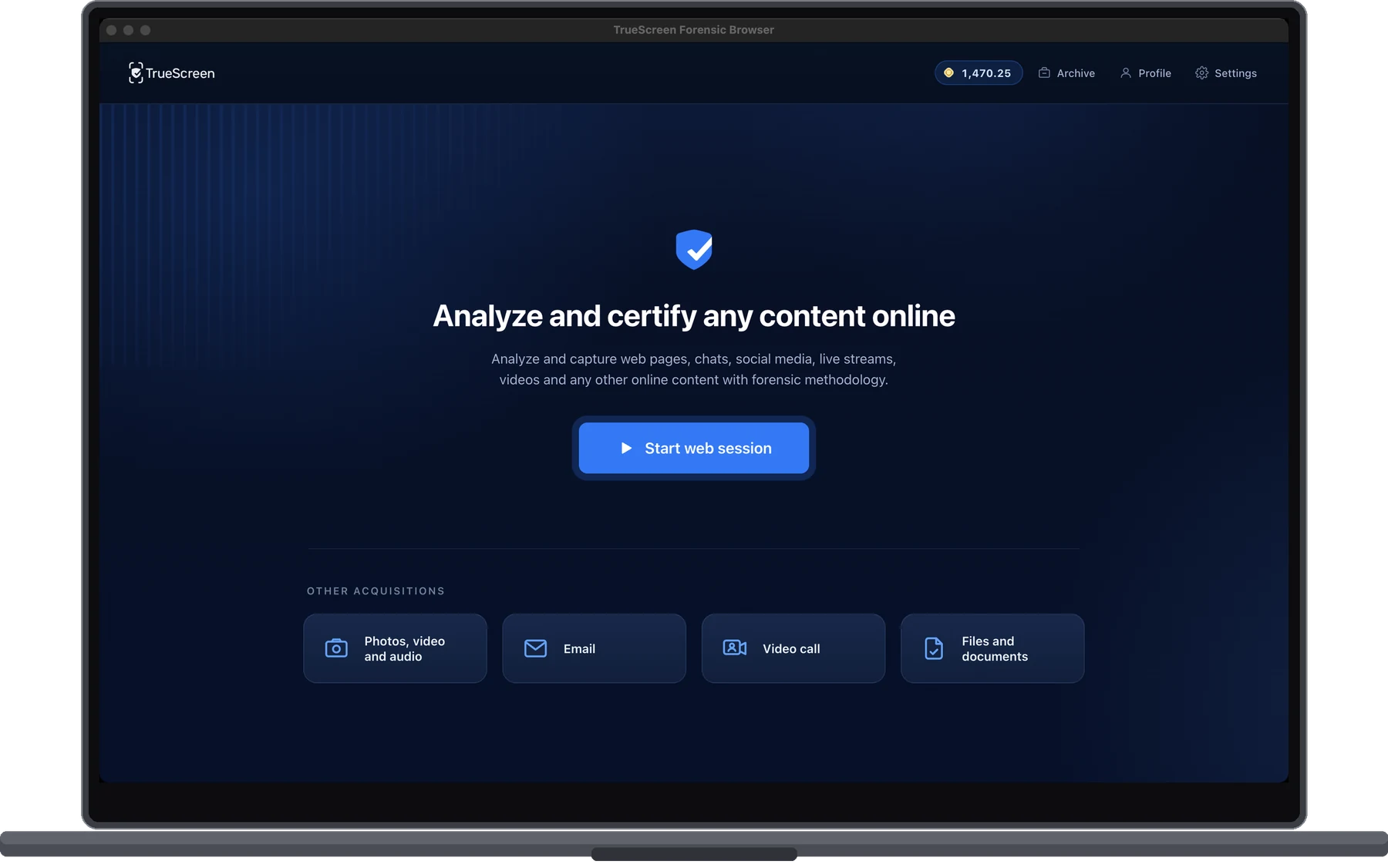
Capture the Web Session Where the System Failed
A chatbot conversation or an agent console that runs as a web page is web content, and it is captured with the Forensic Browser, a desktop app for macOS and Windows. The package contains the session video, the page sources and web archives, the network capture when enabled, the TLS certificates of the sites, a clock check, SHA-256 and SHA-512 fingerprints of every file in a manifest, a certified report with the date of acquisition and a README for the recipient. Desktop software that is not a web page falls outside the web modes and is captured with the screen recording of the Portal.
-
Record What Appears on the Phone Screen
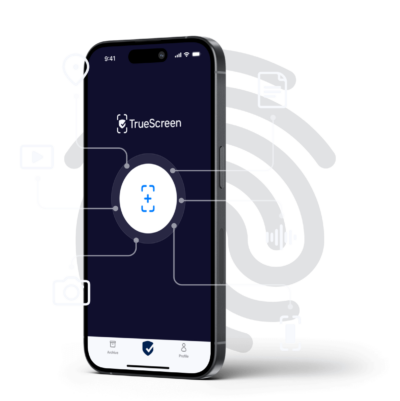
When the failure happened inside a mobile app, the screen recording of the TrueScreen App captures what appears on the display while you scroll through the conversation or the agent’s steps. The recording certifies what the screen showed and contains no network traffic.
-
Certify Exported Logs as Files
Logs exported from the chatbot platform or the agent framework can be certified as files, which fixes their content and their certain date from the moment of certification. This step does not prove how the log was produced, nor that the AI system worked correctly. When the file cannot leave your organization, its fingerprint (hash) can be certified instead, without sending the file. Data produced by an AI agent can also be certified directly through the TrueScreen API and MCP server.
-
Hand Over a Package Anyone Can Verify
Each certification produces a self-contained package. Anyone who receives it can verify integrity and seal without TrueScreen and without trusting whoever handed it over, using the sealed XML, the fingerprints and the technical report, and a public check is available on the certification verification page. Content certified with TrueScreen carries full legal and evidentiary value worldwide, and the weight of each piece of evidence is assessed case by case by the court or the authority that decides.
Conclusion
An AI incident will be argued over by people with different interests: the provider, the deployer, the customer, the insurer and, sometimes, the regulator. The organization that comes out of that argument in the best position is the one that can show what its system displayed and did, instead of describing it from memory or from its own logs. TrueScreen makes that possible by certifying the moment of failure with a forensic methodology, so the fact stays separate from every story told about it and anyone who receives it can check it for themselves.
FAQ: AI Incident Questions Answered
What is the difference between an AI incident and an AI hazard?
An AI incident is an event where the development, use or malfunction of an AI system directly or indirectly leads to harm, such as injury to a person, disruption of critical infrastructure, a breach of rights protected by law or harm to property. An AI hazard is an event of the same kind before any harm occurs, where the AI “could plausibly lead to an AI incident”. Both definitions come from the OECD’s May 2024 paper.
Can a chatbot conversation be used as evidence?
A chatbot conversation can be offered as evidence in a dispute or an investigation, and the regulator, insurer or court assesses its weight case by case. Its form decides how well it stands up: a screenshot or a copied transcript can be challenged because no third party can verify it. A conversation acquired with a forensic methodology and certified with TrueScreen carries full legal and evidentiary value worldwide, with a technical report documenting how and when it was captured; the court assesses the weight of each piece of evidence.
Is a screenshot enough to prove what a chatbot said?
A screenshot is rarely enough on its own, because it shows an image of part of the screen without the page source, the rest of the conversation or any proof that it was not edited. TrueScreen captures the web session in the Forensic Browser instead, with the session video, the page sources, SHA-256 and SHA-512 fingerprints of every file and a certified report, so the recipient can verify integrity without trusting the sender.
Does certifying a log prove the AI system worked correctly?
No. Certifying an exported log as a file fixes its content and its certain date from the moment of certification, so anyone can check later that it has not changed. It does not prove how the log was produced, nor that the AI system behaved correctly. Those questions belong to the technical analysis and, in a dispute, to the forensic expert, the regulator or the court that weighs the evidence.
Do I need an AI incident response plan?
If you run AI systems with customers, a documented process is what the NIST AI Risk Management Framework expects: MANAGE 4.3 states that “Processes for tracking, responding to, and recovering from incidents and errors are followed and documented.” The need shows in the Stanford AI Index 2026, where the share of organizations rating their incident response “excellent” fell from 28% in 2024 to 18% in 2025. A useful plan covers detection, containment, investigation and AI incident reporting, and says who captures the evidence, how, and with whose legal advice.
Sources and verification
Every figure and principle cited here links to its source, listed with type and date. Links checked on the publication date.
| Source | Type | Date | What it supports |
|---|---|---|---|
| OECD, Defining AI Incidents and Related Terms (OECD AI Papers No. 16) | Document | 05/2024 | Definition of AI incident and AI hazard |
| Stanford HAI, AI Index Report 2026, Chapter 3: Responsible AI | Survey | 04/2026 | AI incident counts and organizations’ rating of their incident response |
| Regulation (EU) 2024/1689 (AI Act), Art. 73 | Law | 2024 | Reporting of serious incidents by providers of high-risk AI systems |
| Regulation (EU) 2024/1689 (AI Act), Art. 3(49) | Law | 2024 | Definition of serious incident |
| Regulation (EU) 2026/1744 (Digital Omnibus on AI) | Law | 08/07/2026 | New application dates of the high-risk rules |
| Regulation (EU) 2016/679 (GDPR), Art. 33 | Law | 2016 | Breach notification and documentation duty, as a parallel |
| DSIT, Cyber Security and Resilience Bill factsheet: Agentic AI resilience measures | Document | 03/11/2026 | Proposed UK powers on agentic AI incidents |
| DRCF (CMA, FCA, ICO, Ofcom), joint statement on the agentic economy | Document | 10/2026 | UK regulators’ position on personal AI agents and deployer responsibility |
| Wells Fargo, Online Access Agreement (upcoming), Section 15 | Document | 24/11/2026 | Contract terms on AI agent instructions and evidence of revocation |
| American Banker, Wells Fargo wants customers to prove they’ve revoked AI agents | Document | 02/11/2026 | Report on the Wells Fargo agreement |
| NIST AI Risk Management Framework 1.0, MANAGE 4.3 | Standard | 2023 | Expectation that incident processes are followed and documented |
Bring Certified Capture Into Your AI Governance Process
Talk to TrueScreen about certifying what your chatbots and AI agents display and do, so the incident records your team hands over can be verified by anyone who receives them.


TrueScreen editorial team
Published on · Updated on
This section is edited by the TrueScreen editorial team, which brings together expertise in digital forensics, the law of digital evidence and regulatory compliance. Every article is checked against primary sources: legislation, published rulings, technical standards and official documentation, always cited in the text.
Editorial Team and Methodology →