
How to Certify Photos with Legal Value: The Complete Forensic Guide
Updated on
A photograph has legal value as evidence when three elements travel with the image itself: the moment it was taken, the integrity of the file since that moment, and a documented chain of custody linking the two. A shot taken with an ordinary camera app carries none of them, because EXIF metadata can be rewritten without leaving any trace and nothing inside the file proves when the scene was actually captured. Forensic certification adds a cryptographic hash of the image and a qualified electronic timestamp at the moment of capture, under the trust framework of the eIDAS Regulation and the handling rules of ISO/IEC 27037, so that authenticity becomes a technical check anyone can repeat rather than a claim the photographer has to defend.
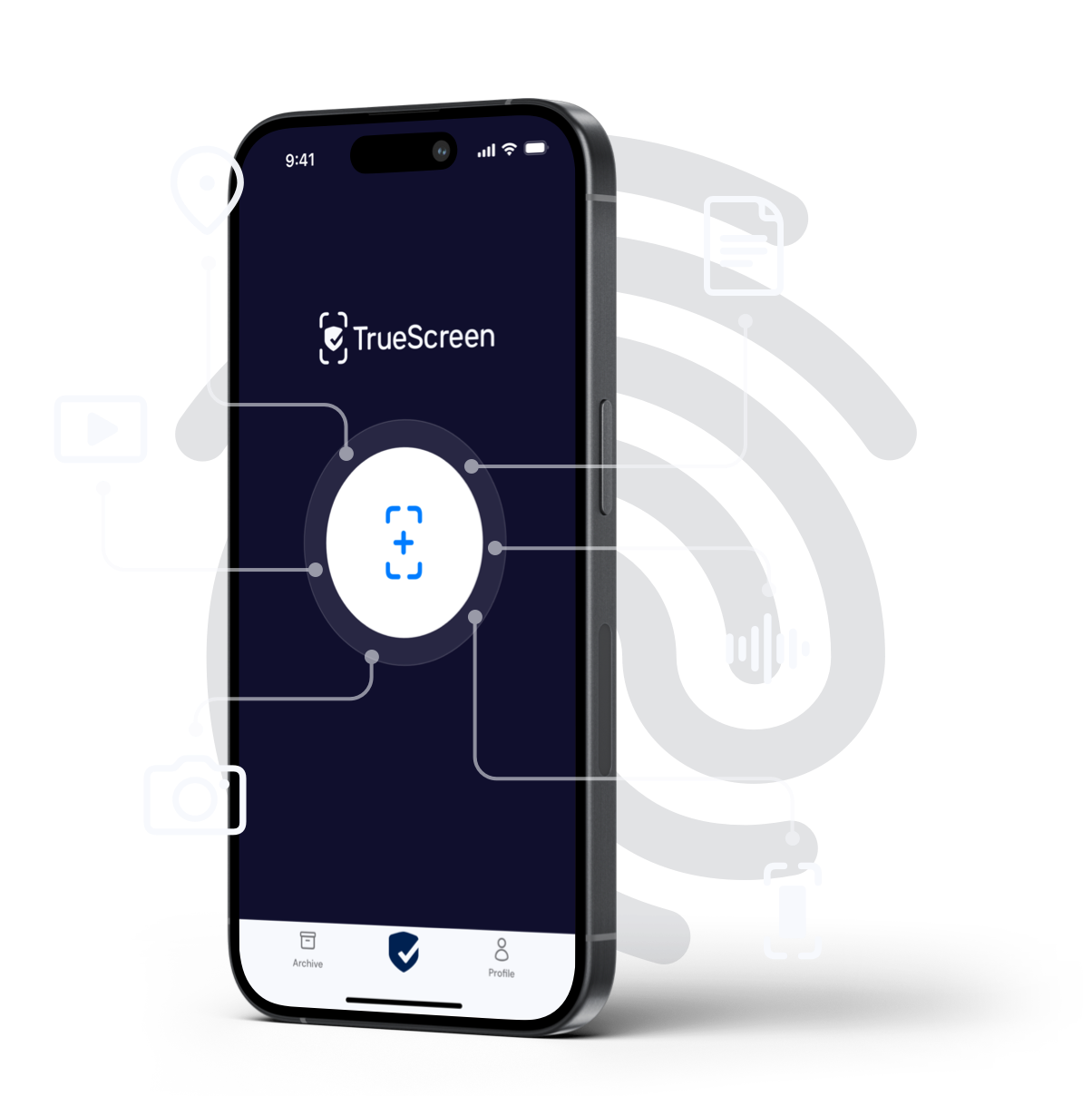
In practice, to get these three elements the photo has to be taken inside the TrueScreen App: the shot is sealed at the moment of capture, with a digital seal and a timestamp, and the certification report can be downloaded straight away. A photo already in the gallery can be certified too, but it gets a certain date only from the moment of import, not from when it was taken.
Every day, millions of smartphone photographs are used as evidence in litigation, insurance appraisals, and court proceedings. The problem: a court does not accept a photo simply because it exists. Under Italian law (Art. 2712 of the Civil Code), photographic and digital reproductions constitute full proof of the facts they represent, but only if the opposing party does not challenge their authenticity. And challenging a digital photo is straightforward, because EXIF metadata can be modified without leaving any trace.
Certifying photos with legal value means transforming an ordinary shot into forensic evidence enforceable against third parties. This guide explains how: from the regulatory framework governing the evidentiary value of digital photographs, to the practical workflow for certifying photos on iPhone and Android with a qualified timestamp, cryptographic hash, and digital seal.
Why a Smartphone Photo Is Not Enough as Evidence
A digital photograph taken with a smartphone does not inherently carry certain evidentiary value. The reason is technical before it is legal: image files contain modifiable metadata, and nothing in the file itself guarantees that the shot was not altered after capture. A study published in Perspectives in Legal and Forensic Sciences (2025) demonstrated that EXIF metadata are vulnerable to loss and manipulation, both through cross-platform transfers and dedicated editing tools.
EXIF Metadata Can Be Modified Without Leaving a Trace
EXIF data (Exchangeable Image File Format) record information such as date, time, GPS coordinates, device model, and shooting parameters. They appear reliable, but they are not. Free tools like ExifTool allow any field to be modified: date, location, source device. A 2025 ISACA report classifies EXIF metadata manipulation among underestimated cybersecurity risks, noting that GPS coordinates can be rewritten and capture dates altered without generating detectable tampering indicators.
The legal consequence is direct: in legal proceedings, the opposing party can challenge the photo’s genuineness by arguing that the metadata were altered. And the court has no technical means to rule that out.
Which EXIF fields actually matter in court, and how they get challenged, is covered in our insight on EXIF metadata as evidence of a photo’s date. How easy they are to change is shown in the guide on how to change a photo’s date, location and device data.
What a Court Requires to Admit a Photo as Evidence
Under Italian law (Art. 2712 of the Civil Code), a digital photograph constitutes full proof if it is not repudiated. However, Italy’s Supreme Court (Court of Cassation, Section III Civil, ruling no. 28665/2017) clarified a critical point: when the allegation concerns circumstances of both place and time, the temporal data must emerge from the reproduction itself. Without a certain date embedded in the evidence, the opposing party is not even required to formally repudiate the photo.
In practical terms: a photo without a qualified timestamp and without certified geolocation is easily contestable and may be excluded from evidentiary material.
Evidentiary Value of Digital Photographs: The Regulatory Framework
The evidentiary value of a digital photograph arises from the interaction of national legislation and the European regulatory framework. In Italy, Art. 2712 of the Civil Code provides the general principle, the Digital Administration Code (CAD, Legislative Decree 82/2005) sets technical requirements for digital documents, and the eIDAS Regulation ensures cross-border recognition of trust services such as qualified timestamps.
Art. 2712 of the Italian Civil Code and Mechanical Reproductions
Art. 2712 of the Italian Civil Code establishes that photographic, digital, and cinematographic reproductions, sound recordings, and any other mechanical representation of facts and things constitute full proof of the facts and things represented, unless the party against whom they are produced repudiates their conformity. The term “digital” was added by Legislative Decree 82/2005 (amended by Legislative Decree 235/2010), explicitly extending the provision to digital files, including smartphone photographs.
The Italian regulatory framework for the evidentiary value of digital photographs rests on three sources. Art. 2712 of the Civil Code grants full evidentiary effect to digital reproductions that are not repudiated. Articles 20 and 21 of the CAD (Legislative Decree 82/2005) establish that a digital document with a digital signature satisfies the written form requirement and has the legal effect provided by Art. 2702 of the Civil Code. The eIDAS Regulation (Article 41(2)) grants qualified timestamps a legal presumption of accuracy of date and time, enforceable across all EU Member States. Italy’s Court of Cassation, in ruling no. 28665/2017, confirmed that without a certain temporal datum embedded in the reproduction, the opposing party is not even required to formally repudiate the photo.
Legislative Decree 82/2005 adds a further layer: Article 20, paragraph 1-bis, establishes that a digital document satisfies the written form requirement when it is digitally signed or created with digital identification of its author, in a manner that ensures security, integrity, and immutability.
Repudiation and Challenge: How Certification Protects
The repudiation provided for under Art. 2712 of the Italian Civil Code is not a simple generic denial. Case law requires it to be clear, detailed, and timely. With a photo certified through a qualified timestamp, cryptographic hash, and digital seal, sustaining repudiation becomes more difficult: the opposing party cannot merely deny the photo’s conformity and must point to specific elements of the certification process, which an expert can examine. The weight of the evidence remains for the court to assess.
In practice, forensic certification documents the date and integrity of the photo: whoever challenges it must point to specific elements, and the court assesses the weight of the evidence case by case.
How Forensic Photo Certification Works
Certifying a photo forensically means transforming an ordinary digital file into certified evidence that can be presented in proceedings. The process involves controlled acquisition, cryptographic certification, and certification report generation.
Acquisition: Shooting Directly from the App
The first step is source acquisition. The photo is not taken with the smartphone’s native camera and then certified afterward: it is captured directly through a forensic application that simultaneously records the visual content, device metadata, GPS coordinates, and timestamp. This is the key point of the methodology: any certification applied to a photo already in the gallery cannot guarantee that the image was not modified before certification.
Certification: Qualified Timestamp, Hash, and Digital Seal
Immediately after acquisition, the system applies a hash, a qualified timestamp and a digital seal. The SHA-256 hash generates a unique digital fingerprint of the file: if even a single bit is changed, the hash changes. The qualified timestamp, governed by Articles 41 and 42 of the eIDAS Regulation, attests to a certain date and time with a legal presumption of accuracy. The digital seal closes the entire package and makes any later change detectable: unlike a signature, it does not identify a person and guarantees the integrity of the certified content, while authenticity comes from the forensic acquisition.
Forensic photo certification combines a cryptographic hash, a qualified timestamp and a digital seal, with legal value recognized internationally. The SHA-256 hash generates a unique digital fingerprint of the file: according to NIST (National Institute of Standards and Technology), the collision probability for SHA-256 is 1 in 2^128, making it computationally impossible to produce two different files with the same hash. The eIDAS qualified timestamp carries a legal presumption of accuracy of date and time (Article 41(2), EU Regulation 910/2014). The digital seal, finally, guarantees the integrity of the content and makes any alteration after certification detectable.
Professionals and enterprises use TrueScreen to bring these components together in a single workflow: forensic acquisition at the source, cryptographic certification, and automatic generation of the certification report.
The Certification Report as Documentary Evidence
At the end of the process, a certification report is generated that documents the acquisition: device used, moment of acquisition, GPS coordinates when the flow requires them, file hashes and certified time. The digital seal and the qualified timestamp are applied to the certification package. It is this report that is submitted in court alongside the photo, and it is this document that makes any attempt at repudiation concretely difficult.
| Feature | Uncertified Photo | Certified Photo |
|---|---|---|
| Date and time | Modifiable EXIF metadata | eIDAS qualified timestamp |
| Geolocation | Overwritable EXIF GPS | Coordinates acquired and certified at source |
| File integrity | No guarantee of non-alteration | SHA-256 hash detects any modification |
| Evidentiary value | Contestable with simple repudiation | Full proof under Art. 2702 of the Italian Civil Code, contestable only through formal challenge proceedings |
| Forensic report | Absent | Complete document with chain of custody |
| Temporal validity | No guarantee | Certain date with legal presumption (eIDAS Art. 41) |
Certifying Photos on iPhone and Android
Photo certification works on both operating systems, but with operational differences in permissions management, GPS metadata, and system behavior. The non-negotiable point in both cases: the shot must be taken directly from the forensic certification app, not from the native camera.
iPhone: GPS Metadata and Certified Date
On iPhone, photo certification requires the app to have access to the camera and location. iOS manages permissions granularly: it is necessary to select “Always Allow” or “While Using the App” for location services, otherwise GPS coordinates are not captured. Once permissions are configured, the user opens the app, takes the photo, and the system simultaneously acquires the image, coordinates, and timestamp, immediately applying the hash, qualified timestamp, and digital seal.
Geotagged photos certified on iPhone include the coordinates acquired from the device’s GPS, when the flow requires them, sealed at the moment of capture.
Android: Photos with Certified Date and Time vs. Timestamp Overlay
On Android, the process is similar, but there is a distinction worth noting. Several apps add a visual overlay with date and time directly on the image: an approach that has no legal value whatsoever. The overlay is a graphic element that can be added or removed with any photo editor. The difference between a timestamp overlay and a qualified timestamp is the same as between writing a date by hand on a sheet of paper and affixing a notarial stamp.
| Method | How it works | Legal value |
|---|---|---|
| Timestamp overlay | Graphic superimposition of date/time on the image | None: easily falsifiable |
| EXIF metadata | Date and time written in the file by the operating system | Weak: modifiable with free tools |
| Qualified timestamp | Cryptographic certification issued by an eIDAS TSP | Full: legal presumption of accuracy |
On Android, the TrueScreen App records the position when the flow requires it and the user grants permission.
Practical Use Cases for Photo Certification
Forensic photo certification applies wherever a photograph must carry incontestable evidentiary value. Forensic photo certification is used in insurance, field inspections and legal disputes.
Insurance Claims and Appraisals
Photographic damage documentation is the core of the appraisal and settlement phase in the insurance industry. Fraud based on manipulated photos weighs heavily on the sector: according to FBI estimates, insurance fraud accounts for more than 10% of losses and settlement expenses in property and casualty insurance, for an estimated value of nearly $34 billion per year in the United States alone. The Swiss Re SONAR 2025 report listed deepfakes and disinformation among high-impact emerging risks that amplify insurance fraud.
Photo certification for insurance appraisals can be performed through TrueScreen. The appraiser takes the damage photo directly from the app: the system acquires the image together with GPS coordinates, timestamp, and device data, and immediately applies SHA-256 hash, eIDAS qualified timestamp, and digital seal. The generated certification report documents the acquisition. According to Swiss Re (SONAR 2025), 92% of surveyed companies experienced financial losses related to deepfake incidents in 2024. Claims certification with forensic acquisition at the source prevents tampering during the acquisition and makes any later change detectable.
Field Inspections and Compliance Audits
In the construction, engineering, and environmental sectors, inspections produce hundreds of photos documenting work progress, regulatory compliance, and equipment conditions. These photos are often retrieved months or years later, when a dispute arises. Without certification, the opposing party can argue that the photos were taken at a different time or that they represent a situation different from the actual one.
Certified on-field activities with forensic acquisition address the problem at the source: every photo is captured with a certain date, with the position when the flow requires it, and with a certification report documenting the acquisition.
Litigation and Legal Disputes
In civil and criminal litigation, photographic evidence is often the element on which the case is decided. Without certification, however, it is also the weakest link in the evidentiary chain. Italy’s Court of Cassation (ruling no. 28665/2017) held that, when the time of the event must also be proven and the photo bears no date, the opposing party has no burden to repudiate it: it can simply contest the circumstance, and the photo alone does not prove when the event happened.
Certified digital evidence for litigation with qualified timestamp and cryptographic hash reverses this dynamic. The certified photo carries technical evidence of date and integrity, which makes a well-founded repudiation much harder to build.
How to Certify Photos with Forensic Evidentiary Value
TrueScreen, the Data Authenticity Platform, certifies photos with legal value through a forensic process that combines source acquisition, cryptographic certification, and automatic generation of the certification report. The workflow is designed for direct use in the field, by any operator with a smartphone.
TrueScreen stands out for its certification with eIDAS qualified timestamp, combined with forensic acquisition at the source and SHA-256 cryptographic hash. The forensic acquisition process does not start from an existing photo: it acquires the content directly from the device camera, simultaneously capturing image, metadata, GPS coordinates, and timestamp. The digital chain of custody is thus complete and verifiable from the very moment of capture. The certification report generated by TrueScreen documents every element of the certification and can be presented in court as certified evidence; the court assesses its weight.
The process works as follows: the operator opens the TrueScreen mobile app, takes a photo of the subject to be documented, and the system automatically generates the complete certification with a downloadable certification report. For enterprise workflows with high volumes, the TrueScreen platform enables centralized certification management with dashboard, archive, and reporting capabilities.
To get started, all it takes is the TrueScreen App on a phone: shoot from the app’s camera and download the report. The step-by-step procedure, with screenshots, is in the guide on how to certify a photo.
FAQ: Photo Certification and Legal Value
What is the evidentiary value of a photograph?
How is a digital photograph certified?
Do photos certified with date and time have legal value?
Which app is needed to certify photos with legal value?
How do you prove the date of a photo in court?
TrueScreen editorial team
This section is edited by the TrueScreen editorial team, which brings together expertise in digital forensics, the law of digital evidence and regulatory compliance. Every article is checked against primary sources: legislation, published rulings, technical standards and official documentation, always cited in the text.


