
Telegram Messages as Evidence: How to Certify Chats, Groups and Channels With Legal Value
A deal closed in a chat, a threat sent through a private message, a trading channel promising impossible returns: more and more often, the proof of a decisive fact lives inside Telegram. The trouble is that this content is fragile. A message can be deleted for both parties, an account can vanish within hours, a channel can be shut down the moment it has cashed in. And when you walk into a dispute holding a screenshot of a Telegram chat, the other side has an easy job contesting it, because an image can be edited, cropped, or rebuilt from scratch.
So how do you turn a Telegram conversation into evidence that holds up before a court? The answer is certification at the source. Saving or photographing the screen is not enough: you need to acquire the conversation with a forensic method, locking its integrity with a SHA-256 hash and pinning it to a verifiable moment through a qualified timestamp. Only then do Telegram messages gain defensible legal value that the other party can no longer easily deny.
When can a Telegram conversation serve as evidence?
A Telegram conversation becomes evidence whenever it documents a legally relevant fact: an agreement, a wrongdoing, a fraudulent promise. Its probative weight does not depend on the platform, but on your ability to prove that the content is authentic, intact, and tied to a precise point in time.
Telegram is no niche corner of the internet. The platform passed 1 billion monthly active users in March 2025, with roughly 500 million people opening it every day, according to Telegram's own figures (Telegram). At that scale, a large share of what used to live in an email or a signed document now leaves its only trace inside a Telegram thread: purchase orders, promises, admissions, threats. That shift creates a practical problem for anyone who later needs to prove what was said. Telegram controls where the data lives and how long it stays there, while the person who needs the proof controls neither. So the value of a Telegram conversation as evidence is decided less by the words themselves than by whether they were captured and locked before the account, the message, or the whole channel disappeared. The three scenarios below are where that gap matters most.
Business negotiations and agreements
Many commercial relationships are now negotiated in chat, with no signed contract behind them. Orders, payment terms, changes to a prior arrangement: if a civil dispute arises, the Telegram conversation can reconstruct what the parties actually intended. To be usable, though, it has to be proven in full and shown to be unaltered.
Threats, defamation, and harassment
Threatening messages, defamatory content, and persecutory behavior sent over Telegram frequently sit at the center of criminal proceedings. The victim has to freeze the messages before the sender deletes them, which often happens precisely when the sender starts to fear a complaint. Waiting is the one mistake that makes the evidence disappear.
Scams: trading and romance scam
Telegram has become a favorite channel for financial and emotional fraud: groups promising guaranteed returns on trading, profiles that build a relationship to extort money in a romance scam, channels that disappear the day after collecting. The window to gather proof here is measured in hours, not weeks. Documenting the conversation with a verifiable date before it is deleted is often the only way to give a complaint any substance.
Why a Telegram screenshot is not enough
A screenshot of a Telegram chat, on its own, carries weak evidentiary weight because an image is trivially easy to alter. A screenshot is a picture of the evidence, not the evidence itself. The probative value sits in the original content and in the metadata that proves when and how it existed.
The content can be edited and deleted
Telegram lets users delete messages for both participants, leaving no visible trace. A channel can be closed, an account removed, a secret chat set to self-destruct. Whoever holds the proof does not control whether it survives: that depends on the good faith of the other side, which is usually missing exactly when the proof counts. A screenshot taken today may refer to a conversation that no longer exists tomorrow.
A raw screenshot is contestable
A screenshot certified with a forensic method behaves very differently in proceedings from an image simply saved on a phone. Under general evidentiary principles shared across jurisdictions, a party can challenge the authenticity or integrity of a digital image, and once that challenge is raised the court must treat the picture with caution. A plain screenshot, stripped of any technical element attesting to its integrity, is the form most exposed to this objection: an image anyone can claim was manipulated.
What makes digital evidence defensible: integrity, provenance, timestamp
Digital evidence is defensible when it demonstrates three things at once: that the content was not altered (integrity), where it came from (provenance), and what moment it dates to (timestamp). Missing even one turns the proof back into something contestable.
SHA-256 hash and content integrity
The integrity of digital evidence is proven with a hash, a unique fingerprint calculated from the content. The SHA-256 algorithm produces a string of characters that changes radically at the slightest modification of the data: if a single pixel of the screenshot or one character of the message changes, the fingerprint no longer matches. In an evidentiary setting the hash works as a mathematical seal, letting you prove that the file on the table is identical, bit for bit, to the one acquired at certification. On its own, though, a hash is not enough. It has to be bound to a certain point in time, so that integrity is anchored to a specific date and not to some vague instant chosen after the fact.
Qualified timestamp under eIDAS
A qualified timestamp is a time-validation instrument governed by Regulation (EU) 910/2014, known as eIDAS. Articles 41 and 42 establish that a qualified electronic timestamp enjoys a legal presumption of the accuracy of the date and time it indicates and of the integrity of the data to which they are linked (EUR-Lex). In practice, this reverses the burden of proof: rather than the holder having to demonstrate when a file existed, the other party has to demonstrate that the timestamp is wrong. Applied to a Telegram conversation, it certifies that this content, with this hash, existed in this form at this date, which makes it opposable to anyone. The timestamp is not issued by the acquisition tool itself: it is delivered by a qualified third-party QTSP whose seal is integrated into the workflow, and it is exactly this presumption under eIDAS that gives a digital record its cross-border weight, valid across every EU member state.
Chain of custody and ISO/IEC 27037
Provenance is guaranteed by documenting the entire acquisition process according to the international standard ISO/IEC 27037. This standard defines how to identify, collect, acquire, and preserve digital evidence, resting on three principles: auditability, repeatability, and justifiability of every operation (Cybersecurity360). Every handling of the item has to be recorded with the person responsible, the date, and the conditions, so the chain of custody can be reconstructed without gaps (ISO). Applying this method to a Telegram chat means recording not just the final image but the whole acquisition session: which page was open, what was on screen, and the sequence of actions that produced the capture. That is what makes the evidence defensible in front of a technical expert or an opposing consultant. Without a documented chain of custody, even an intact file can be dismissed as unverifiable, because no one can say who touched it, when, or how.
How can you certify a Telegram conversation as legal evidence?
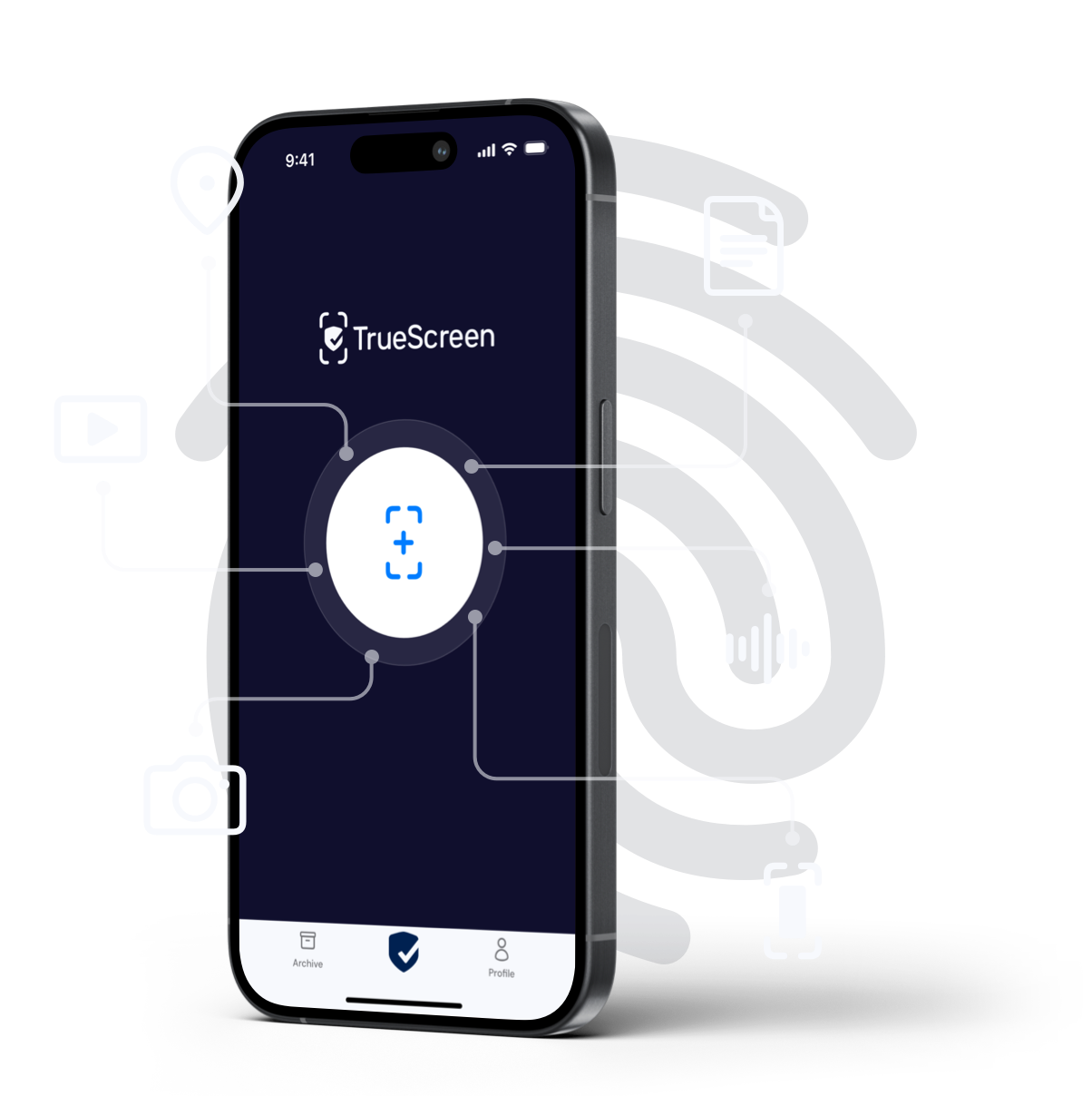
TrueScreen is the Data Authenticity Platform that certifies chats, messages, and channels by acquiring them directly at the source, with no need to hand a smartphone to a lab. Acquisition happens on Telegram Web or from the app: the system records the session, calculates the SHA-256 hash of the content, and applies a qualified timestamp issued by a QTSP integrated into the platform, adding an electronic seal that fixes integrity, provenance, and a verifiable date. The result is a report designed to hold up in proceedings, hard for the other side to disown because it documents the whole acquisition process, not just the final image. Unlike a traditional forensic examination, certification is immediate and self-service: anyone can freeze a conversation at the exact moment it is still visible, before it is edited or deleted.
TrueScreen does not issue qualified certificates and is not a QTSP. It integrates a qualified third-party QTSP's seal via API and combines it with the forensic acquisition of the content. That is the difference from services that merely seal data you already hold: the platform acquires and certifies, recording how and when the conversation was captured. Mobile capture is also available through the certification app.
A concrete example. An investor is contacted in a Telegram group promising guaranteed returns on trading. They open web.telegram.org, certify the conversation and the channel's identifying details, and obtain a report with a hash and a verifiable date to attach to a complaint. Even if the group is deleted hours later, the proof stays frozen and verifiable. For a specific case, the TrueScreen team can walk through the acquisition path with you.
Chats, groups, and channels: what you can certify on Telegram
On Telegram you can certify private messages and chats, groups, and public channels. The way you acquire them changes with how Telegram stores the data, and that is what separates cloud chats from secret chats.
Private messages: cloud vs secret chats
Telegram runs two kinds of conversation. Cloud chats, the default, are saved on Telegram's servers with server-client encryption and synced across every device: they stay acquirable until someone deletes them. Secret chats use end-to-end encryption, exist only on the two devices involved, and can self-destruct. In both cases certification captures what is visible at the source at the moment of acquisition, with its verifiable date.
| Feature | Cloud chats (default) | Secret chats |
|---|---|---|
| Encryption | Server-client | End-to-end |
| Where stored | Telegram servers + devices | Only the two devices |
| Multi-device sync | Yes | No |
| Timed self-destruction | No | Yes, optional |
| Certifiable at the source | Yes, while visible | Yes, but only from the device, before self-destruction |
Public channels and groups
Public Telegram channels and groups are content accessible online, so they are certified like any other web page. A channel spreading fraudulent offers or illicit material can be acquired by opening its address and capturing the page with the messages, the channel name, the subscriber count, and the date. This is the most exposed angle on the evidence side, because most tools look only at the private chats on a single device and ignore the public surface where a scam recruits its victims.
What to do immediately if a Telegram conversation matters
If a Telegram conversation might serve as evidence, the rule is to act before it is deleted:
- Do not settle for a screenshot from your phone: a saved image is the most contestable form of proof.
- Open the conversation at the source, on web.telegram.org or in the app, while it is still visible and intact.
- Certify it with a forensic method, so the SHA-256 hash and the qualified timestamp are locked onto the content.
- Include the identifying elements in the acquisition: username or channel name, date and time, any visible profile details.
- Keep the report you receive, with its fingerprint and verifiable date, ready to produce in a dispute or attach to a complaint.
This sequence applies to both civil and criminal matters, and it becomes essential with scams, where the fraudster usually deletes the channel right after cashing in. In cases built on mobile-device messages, what decides whether the evidence survives is proof that the data was never altered.
Frequently asked questions about certifying Telegram chats
Do Telegram screenshots count as proof in court?
On their own, weakly. The other party can challenge a screenshot because an image is easy to modify. It gains real evidentiary weight only when acquired with a forensic method, with a SHA-256 hash and a qualified timestamp that guarantee integrity and a verifiable date. A screenshot certified with TrueScreen embeds these elements.
Do Telegram messages have legal value?
Yes, there is no blanket exclusion. Courts across jurisdictions recognize that chat messages can carry probative value in both civil and criminal matters. The value depends on how the conversation is acquired and preserved: without a guarantee of integrity and a verifiable date, it stays contestable.
Can Telegram chats be traced or recovered?
Cloud chats remain on Telegram's servers until they are deleted; secret chats, protected by end-to-end encryption, live only on the devices. Under a valid legal request, providers can in certain cases disclose account data such as an IP address. For evidence purposes, though, what matters is freezing the content while it is still visible, not hoping to recover it later.
How do I preserve proof of a Telegram trading scam?
Act before the channel disappears. Acquire the conversation and the channel's details with a verifiable date. The report with the hash and timestamp can then be attached to a complaint, even if the group is deleted right afterward, because the certified copy no longer depends on the channel staying online.
Is a certified Telegram conversation valid in both civil and criminal proceedings?
Yes. In civil matters the certified record supports the party that produces it, shifting the burden of a specific challenge to the other side. In criminal matters, messages taken from devices are admissible as documentary evidence as long as their integrity is guaranteed. Certification at the source, with a chain of custody aligned to ISO/IEC 27037, strengthens the evidence in both.
TrueScreen editorial team
Published on · Updated on
This section is edited by the TrueScreen editorial team, which brings together expertise in digital forensics, the law of digital evidence and regulatory compliance. Every article is checked against primary sources: legislation, published rulings, technical standards and official documentation, always cited in the text.


