
Online trading scams and fake brokers: how to certify evidence for your report
It usually begins with something that looks trustworthy: a sponsored post, the familiar face of a well-known executive, the promise of returns no honest investment could match. That is how an online trading scam pulls you in. A polished platform, a friendly "broker" who checks in every day, a balance on screen that keeps climbing. Then you try to withdraw, and everything stalls. New charges appear as "taxes" or "unlock fees", the account goes quiet, and the site vanishes.
At that point all you have left is what you saved along the way: the chats with the fake broker, the account screenshots, the emails, the wire transfer receipts. In the raw form you kept them, those files are fragile. An uncertified screenshot can be challenged, and a platform that gets taken down takes with it everything you did not lock in time. If you have fallen for an online trading scam run by a fake broker, the right move is not only to report it quickly. It is to collect the right evidence and make it hard to dispute, so it holds up when investigators and, potentially, a court look at it. This article covers which evidence matters, why it tends to fail, and how to certify it before it disappears.
How does an online trading scam work?
An online trading scam almost always follows the same script: a first contact with a promise of easy profit, growing deposits into a showcase platform, then blocked withdrawals paired with demands for extra payments. Understanding the stages tells you, at every step, where the evidence you will need is being created.
An online trading scam is a fraud in which a fake broker, usually operating without any authorisation, convinces the victim to move money into a fictitious investment platform by displaying balances and returns that do not exist. The victim never holds real assets: the "account" is a screen the operators control and can switch off. The scale is real. In one recent operation, Italian police took down 473 websites, accounts and ads that misused the Eni brand and the image of its executives to promote fake investments through trading platforms, in several cases using AI-generated deepfake videos to make the company and its leadership appear involved (source: Italian Ministry of the Interior). The same playbook, different brand and different faces, runs across borders every week. Recognising it early is what lets you preserve proof before the operators erase it.
The fake broker playbook, from first contact to blocked withdrawals
It starts with a hook: a sponsored ad, a message on WhatsApp or Telegram, sometimes a call from a self-described advisor. The lever never changes, an easy and safe return, often propped up by a trusted brand name to borrow credibility in seconds.
Then the escalation. The victim is steered onto a professional-looking platform with live charts and a balance that grows with every "trade". The fake broker stays in constant contact and pushes for larger deposits, pointing to paper profits that seem to confirm it all works. No licence, no oversight, just a convincing stage set.
The block is the final act. Ask to withdraw and the obstacles start: first a "tax", then an "unlock fee", then an advance to release the funds. Every request exists to squeeze out more cash. Eventually the account is closed and the platform goes dark, or reappears under a new name.
Where does the evidence of a trading scam live?
Every stage leaves a trace, and those traces are your evidence. The WhatsApp and Telegram chats document the promises and the pressure. The account screenshots show the fictitious balances and orders. The emails reconstruct the official-looking contacts. The transfer receipts prove the money that actually moved, often toward prepaid cards or foreign accounts.
The hard part is that most of this evidence lives on systems you do not control. The platform belongs to the scammers, and it can disappear at any moment. Collecting it is not enough: you need to lock it in a form that survives a challenge. The same applies to the site you were sent to: when the showcase imitates a real intermediary, treat it as a clone site to capture before it is taken down.
Why are uncertified screenshots weak evidence?
A screenshot saved to your phone is not, by itself, solid proof. The other side can dispute it, deny it faithfully represents what happened, and its evidentiary weight collapses. That is the gap between holding an image and holding evidence.
An uncertified screenshot carries limited evidentiary weight because nothing about it is independently verifiable: not its integrity, not its date, not its origin. Anyone contesting it can argue it was cropped, edited or fabricated, and a plain image gives you little to answer with. Across most jurisdictions, digital evidence is weighed on authentication and chain of custody, whether the item can be shown to be what it claims to be and untampered since capture. A raw screenshot fails on both counts, so it is easily challenged and, once challenged, often demoted to a weak clue a judge is free to disregard. Certifying the evidence at the point of capture, with a digital seal and a qualified timestamp, changes the picture: it fixes both the content and the moment it was acquired in a way that is far harder to dispute. That difference is exactly what turns fragile material into evidence worth submitting.
How can an uncertified screenshot be challenged?
The challenge is more insidious than it looks. The other side does not have to prove your screenshot is fake. It only has to contest, in specific terms, that the image reflects reality. From that moment the burden shifts onto you, and proving the file is authentic by other means is often impossible after the fact.
This is why the common advice to "just save all your screenshots" is true but incomplete. A raw image, with no guarantee of integrity and no date that holds up against third parties, is open to the simplest attack there is. What makes evidence robust is not the picture, but the ability to show it has not changed and to prove when it was captured.
What happens when the fake platform is taken down?
There is a further risk, often underestimated: the evidence itself disappears. Fraudulent trading platforms are built to be short-lived, whether the operators pull the plug or the authorities intervene.
When a fraudulent trading platform is taken down, the evidence living inside it becomes unrecoverable. The dashboard with its fake balance, the order history, the charts used to convince you to deposit: all of it vanishes the moment the site is blocked or stops responding. The same is true if the fake broker deletes the conversation or blocks you on Telegram. In the Eni case, the Italian police seizure worked precisely by blocking access to 473 web resources (source: Italian Ministry of the Interior): effective against the fraudsters, yet capable of making anything the victim had not already saved suddenly unreachable. The lesson is blunt: evidence has to be locked before the shutdown, not after. Certify each item at the source while the platform is still live: TrueScreen fixes the content and its date at the moment of capture, so the evidence survives the shutdown. Anyone counting on "having time" to gather screenshots later risks ending up with a report and nothing to back it.
What evidence should you collect before it disappears?
The rule in an online trading scam is simple: collect everything that documents contact, promises and money movements, and immediately lock it in a form with verifiable integrity and date. Each type of evidence sits in a different place and carries a different weakness. The table below maps the main evidence in an online trading scam, where it lives, why it is fragile without certification, and how to make it hold.
| Evidence to collect | Where it lives | Why it's fragile | How to certify it |
|---|---|---|---|
| Chats with the fake broker | WhatsApp, Telegram, SMS | Deletable by the sender; easily disputed; no verifiable date | Forensic capture of the conversation with a digital seal and timestamp |
| Account and dashboard screenshots | Trading platform (web or app) | Vanish when the platform is taken down; dynamic content cannot be recreated | Capture of the screen or web page with integrity certified at source |
| Confirmation and reminder emails | Email inbox | Headers and content are contestable; date and authenticity hard to prove | Certification of the email with legal value, including content and metadata |
| Wire transfer receipts | Home banking, bank app | PDFs are easily altered; the amount must be tied to the fraud | Certification of the document or screenshot with a qualified timestamp |
| Screen recordings of the platform | Smartphone, screen capture | Files are editable; no proof of when they were captured | Certified screen recording with a digital seal and timestamp |
Conversations with the fake broker on WhatsApp and Telegram
Chats are often the most telling evidence, because they hold the promised returns, the pressure to deposit and the demands for extra payments. They are also the most volatile: the scammer can delete messages, wipe the account or block you, erasing every trace from their side.
A screenshot of the conversation is not enough. You need to capture it so that both content and date are fixed, which is how you can certify WhatsApp and Telegram conversations and bring them into a report without their being easily disputed. Where the first contact grew out of a relationship built for the purpose, the script overlaps with a romance scam and the evidence it leaves behind.
Account screenshots and wire transfer receipts
Account screenshots tell the staged story: balances that grow, orders executed, apparent profits. The wire transfer receipts tell the real one, how much money actually left and where it went. Together they connect the deception to the financial loss, which is what a fraud report needs to establish.
The fragility here is twofold. The platform screenshots disappear when the site is taken down; the receipt PDFs, if not locked, are easy to alter and hard to date reliably. Where the transfer went to an account given by email, it also matters that you can prove the original message carrying those details. It pays to certify account screenshots and payment instructions before anything is lost, so you have a coherent, dated file to attach to your report.
How do you certify digital evidence so it holds up?
Digital evidence holds up when its integrity and its date can be verified independently, so the other side cannot easily contest its content or origin. In practice, that means fixing the evidence at the moment it is captured, with recognised technical guarantees that attest to both the "what" and the "when".
TrueScreen, the Data Authenticity Platform, applies a forensic methodology that captures, verifies and certifies every piece of digital evidence with legal value, from the chat with the fake broker to the trading platform screenshots, through to emails and wire transfer receipts. The process works on three levels: forensic capture directly at the source, in a controlled environment that preserves integrity; integrity verification through a cryptographic hash and a documented chain of custody; and certification with a digital seal and qualified timestamp with legal value, officially recognised internationally and hard to dispute. The relevant European framework is the eIDAS Regulation (EU 910/2014), which gives a qualified timestamp a date that holds up against third parties. That is what turns a fragile screenshot into evidence you can rely on, fixed at the source rather than reconstructed afterward.
Which tool fits which kind of evidence?
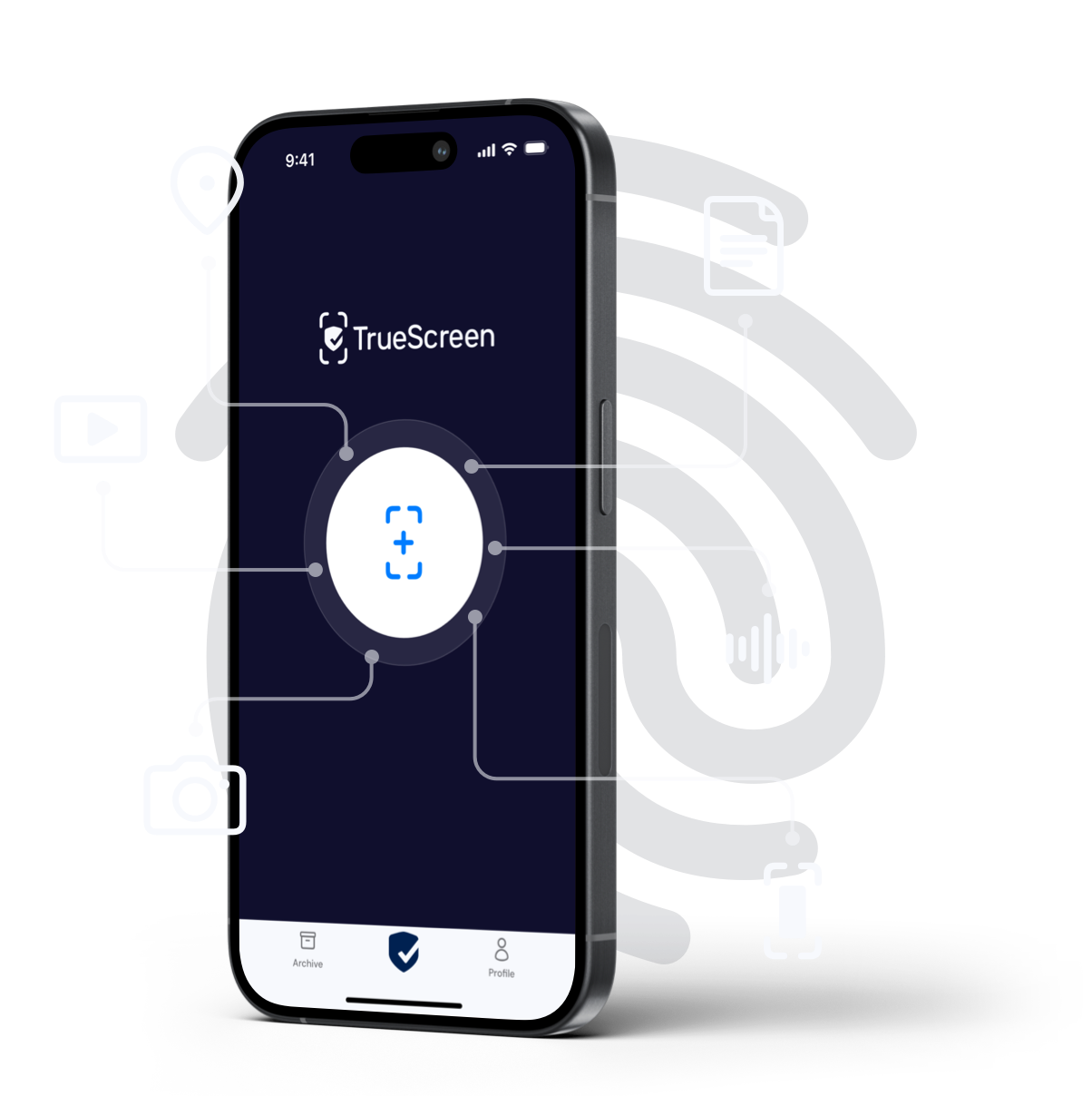
Which tool fits depends on where the evidence lives. The App captures chat screenshots, photos of receipts and screen recordings of the platform straight from a smartphone. The Forensic Browser performs forensic capture of the fraudulent trading platform page before it is modified or taken down, preserving its dynamic content such as charts, balances and orders. The Chrome Extension is a lightweight way to capture on the fly from a browser already in use, while the Web Portal lets you upload files you already hold from a desktop, such as transfer PDFs or certified email with legal value. All of it rests on qualified electronic timestamps that anchor each item to a verifiable point in time.
A short scenario makes it concrete. Before the fake broker shuts the dashboard down, the victim spends a few minutes certifying the account screenshot with its fictitious balance and the Telegram chat with the promised returns. The files gain a verifiable date and integrity, and become evidence you can attach to a report and share with a lawyer or the authorities.
How do you use certified evidence when reporting the scam?
Certified evidence from an online trading scam should go into a formal report to the authorities and be paired with the actions that block and recover the payments. A tidy, dated file makes the investigators' job faster and your position stronger.
Reporting to the authorities and recovering funds
An online trading scam is a crime, prosecutable as fraud in most jurisdictions and often compounded by the unlicensed provision of investment services. The showcase platform, the inflated balances and the fake broker's promises are the deception the law targets. File the report with the cybercrime unit in your country, in person or through their online channel, and bring the certified material: chats, screenshots, emails and transfer receipts, along with the platform and broker details.
On the money side, act in parallel and fast. If you paid by bank transfer, ask your bank right away for a wire recall: it only works while the funds are still sitting in the destination account, so every hour counts. If you paid by card, including a prepaid one, ask the issuer about a chargeback, the reversal the card schemes provide for disputed transactions. Certified evidence strengthens the request. Recovery is never guaranteed, especially with foreign-based operators, but speed and solid documentation improve the odds.
Watch out for the "recovery scam"
One final trap. After the initial online trading scam, many victims are contacted again by self-styled recovery firms, lawyers or "experts" who promise to get the money back in exchange for an advance payment. These are almost always the same fraudsters, or their associates, coming back for a second hit at someone already burned. One rule covers it: no legitimate recovery ever asks for an upfront payment to "unlock" or "process" a refund. Rely only on official channels, your own bank and a lawyer of your choosing, never on someone who contacts you out of the blue promising miracles.
FAQ: online trading scams and evidence for your report
What should I do if I've been scammed by an online trading platform?
Is an online trading scam a crime?
Does a screenshot hold up as evidence in court?
Do WhatsApp and Telegram chats count as evidence?
How can I recover money lost to a trading scam?
Are "AML tax" or "unlock fee" requests legitimate?
TrueScreen editorial team
Published on · Updated on
This section is edited by the TrueScreen editorial team, which brings together expertise in digital forensics, the law of digital evidence and regulatory compliance. Every article is checked against primary sources: legislation, published rulings, technical standards and official documentation, always cited in the text.


