
Service report: why the customer’s signature is not enough
Every company that operates in the field lives with the same asymmetry. The work happens in one place, at one moment, in front of a handful of people, and it closes with a document that summarises it: a service report, an inspection record, a signed checklist. Months later, when that document is finally needed, the activity cannot be repeated. Only the paperwork is left.
The problem surfaces when the paperwork is challenged. The customer claims the technician never arrived, that the visit was shorter than declared, that the signature at the bottom is not theirs. And that is when companies discover something counterintuitive: the signed service report, the document they have treated as their proof for years, is the weakest item in the file.
The reason is legal, not technological. A signed report is a statement made by the parties, and a statement can be denied. Once the other side denies it, the burden of proving it falls back on whoever produced it. Teams in operations, risk and compliance do not need more detailed reports: they need the activity to leave a verifiable trace at the moment it happens, rather than a declaration written afterwards.
This insight is part of the guide: Certified installation and maintenance: digital evidence for technical work
What a service report is
A service report is the document in which a field operator records the work carried out at the customer site: date, location, start and end time, tasks performed, materials used and outcome. Signed by the customer representative, it stands as the parties' statement about the visit and it is the documentary basis for invoicing and for verifying contractual SLAs.
What it should contain
In practice a complete report carries the identification of the company and of the technician, the customer and site details, the work order number, the actual arrival and departure times, a description of the tasks, any non-conformities found, the parts used and the signature of whoever receives the work. These fields have not changed in thirty years. What has changed is not the content of the document, but how easily the other party can call it into question.
Service report, inspection record and assistance report: the differences
The three documents are often treated as synonyms, but they answer different needs and carry different evidentiary weight. A service report attests that work was performed, an inspection record captures the state of a place at a given time, an assistance report documents a diagnosis and a repair. Confusing them means producing the wrong document at the wrong moment.
| Document | What it attests | When it is needed |
|---|---|---|
| Service report | That a task was performed and how long it took | Invoicing, SLA verification, disputes over work performed |
| Inspection record | The state of a place at a given moment | Handover, surveys, safety checks |
| Assistance report | The diagnosis of a fault and the repair carried out | Warranties, recourse against the manufacturer, recurring faults |
What they have in common is that all three, as long as they remain signed declarations, share the same vulnerability. The subject changes, the fragility does not.
Why a signed service report is weak evidence
A signed service report is weak evidence because it is a private document: it proves what the parties declared, not what actually happened, and its force depends on the signature not being contested. The details vary across jurisdictions, but the principle is shared. In Italy, for instance, Article 2702 of the Civil Code provides that a private document proves the origin of the statements it contains only if the person against whom it is produced acknowledges the signature, or if the signature is legally deemed acknowledged. As long as nobody objects, the document holds. The moment the other side denies the signature, that value is suspended.
This distinction goes unnoticed, because in daily practice the report works perfectly well. Ninety-five per cent of visits are never disputed, and that reinforces the belief that the document is solid. But proof is not needed in the ninety-five per cent: it is needed in the five per cent where someone has an economic interest in denying. And that is exactly where the report shows its structural limit.
Every element of the traditional document has a point of attack. A signature captured on a tablet or applied to a plain PDF ties neither to a verifiable identity nor to a certain moment, so it can be contested. Photographs pulled from the technician's smartphone prove that something was captured, not when or where: file dates can be altered, the sequence is lost, and the other party can argue the shots belong to another site or another day. The location logged by the field service software adds a data point, but one that lives inside a system the company itself controls, and in a dispute that is precisely what the other side will point out. The report itself, finally, remains a file that anyone with access to the system can amend without leaving an evident trace.
What happens when the customer denies the signature
Denial shifts the burden of proof. Whoever produced the document has to establish that the signature is authentic, with the time and cost that this entails: handwriting analysis, comparison samples, a procedural detour that adds months to a case and whose outcome nobody can guarantee in advance.
The operational paradox is plain. The company did the work, documented it the way it was taught to, and still ends up having to prove that its own document is genuine. The cost of the dispute often exceeds the value of the visit being contested, and that produces the worst outcome of all: the claim is dropped because recovering it costs more than it is worth. The loss never appears as litigation. It appears as a discount, a credit note, a lost customer.
This is the point the sector literature rarely addresses. Field service platforms promise that a report signed by the customer carries legal value, and in the abstract that is true. But the legal value of a private document is conditional on the signature not being denied, and no software can stop the other party from denying it. What is needed is an element that does not depend on either party's word.
From system audit trails to the audit trail of physical activity
In information systems the audit trail is a settled idea: an immutable record of who did what and when, which allows a sequence of events to be reconstructed afterwards without trusting whoever tells the story. It underpins the accountability required by Article 5(2) of the GDPR and any ISO audit.
Applied to physical activity, that idea has simply never been carried over. The log of a field service platform records when the technician tapped a button in the app, not when they arrived on site. It records that a report was saved, not that its content matches what happened. It is an audit trail of the software, not of the activity.
The difference matters. An audit trail of physical activity has to anchor the evidence to the moment and the place where the activity happened, with a binding that neither party can undo afterwards. That calls for three properties the internal log does not have: a certain date, enforceable against third parties; integrity that anyone can verify without access to the company's systems; and an unbroken chain of custody from capture to production in court. Without those three, what you have is operational traceability, useful for running the work and useless for defending it.
How to prove work carried out by third parties on the company's behalf
The problem deepens when the work is not done by an employee. Contractors, subcontractors, external maintenance firms, appointed surveyors, couriers, service cooperatives: the company answers for activities it did not perform and did not witness, on the basis of documents written by those who performed them. In Italy, Legislative Decree 231/2001 makes the question concrete, since the administrative liability of an organisation can arise from the conduct of third parties acting in its interest, and the compliance model has to demonstrate the controls actually carried out, not the ones written down on paper. Equivalent duties of supervision over the supply chain apply across most European jurisdictions.
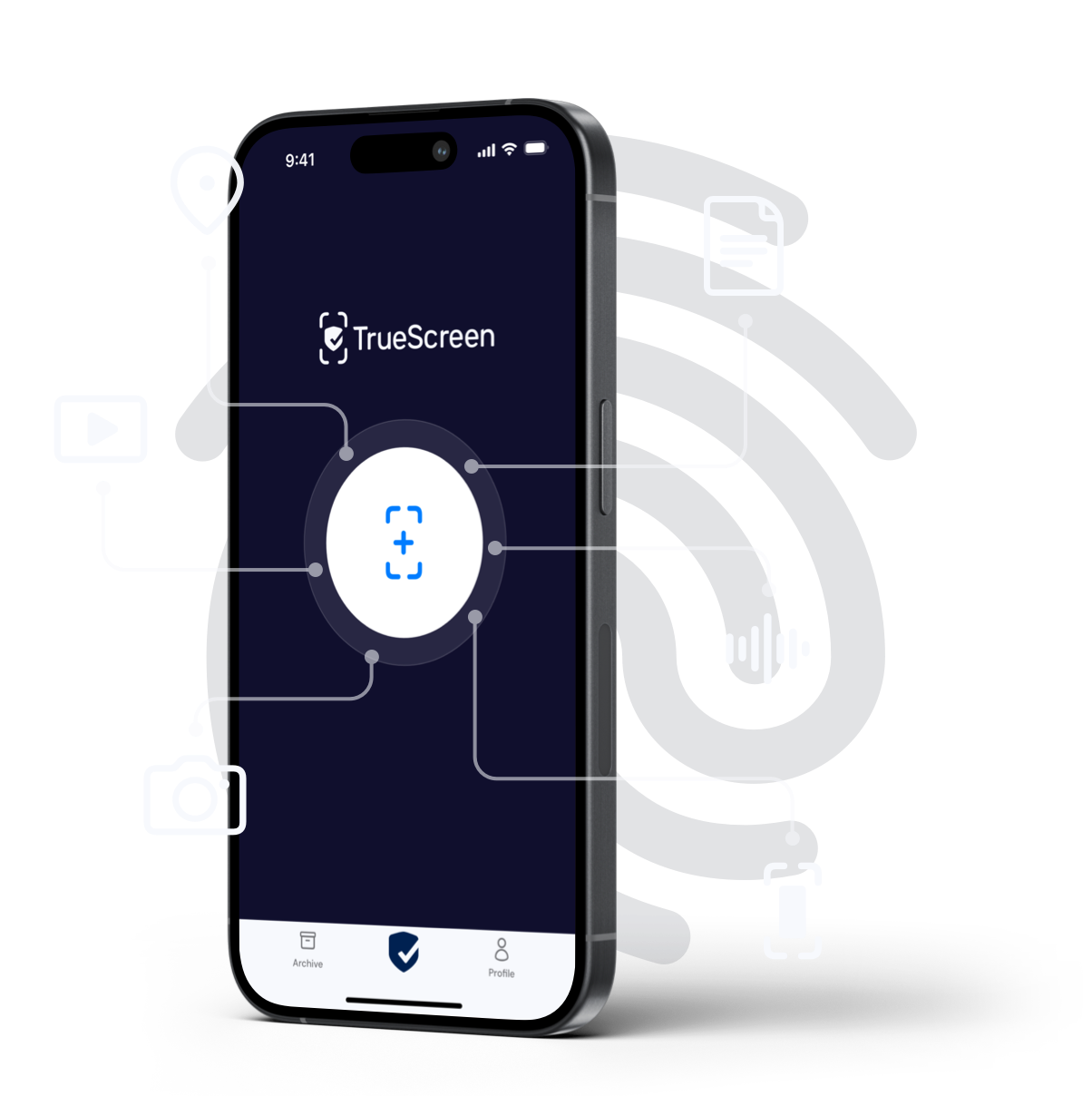
Companies use TrueScreen to have their own operators and their delegated third parties collect certified evidence directly at the place of the activity, so that the client does not have to rely on the document the third party hands over. What changes is the object of trust: no longer the performer's declaration, but the data captured and sealed at the moment the activity took place.
Inspections and site surveys
Anyone carrying out an inspection or a site survey produces a technical judgement on a state of affairs that will not exist tomorrow. The record states that judgement; a photograph of the site captured with a certain date is what grounds it. The same applies to safety checks, to insurance surveys entrusted to external adjusters, and to the supervision duties of the safety coordinator.
Maintenance and field service
In plant maintenance the dispute rarely concerns the work itself: it concerns frequency, duration, and whether the visit met the prescribed requirements. These are all facts that are demonstrated by a certified arrival and departure time and by the state of the plant before and after, not by a written description however accurate.
Home care and personal services
In personal services the work takes place in the client's home, without third-party witnesses, and is billed by the hour to a public body. Disputes over whether the operator was present are the structural risk of the sector, and they cut both ways: they affect the authority that verifies and the cooperative that has to defend itself. Evidence captured on site protects both.
Logistics and deliveries
Proof of delivery is the most contested document in the chain. The signature on the courier's handheld carries exactly the fragility described above, with the added problem that the signatory is often unidentifiable. Documenting the state of the goods at the moment of delivery, with a certain date and a location, moves the discussion from who is right to what is on record.
What makes a field photograph enforceable
A photograph is a mechanical reproduction of facts, and in many civil law systems it carries full evidentiary weight unless the other party denies that it matches the facts it represents. In Italy this is set out in Article 2712 of the Civil Code. So a photograph can be contested too: certification does not remove the objection, it makes it resolvable on technical grounds rather than on the parties' word.
Evidence certified with TrueScreen carries a certain date and integrity that anyone can verify, years later. Three technical elements support that verification. The cryptographic hash is a unique string computed on the content: it changes at the slightest alteration, and it allows you to show that the file produced today is identical to the one captured then. A timestamp compliant with RFC 3161 binds that hash to a moment attested by an independent third party, and when qualified it benefits from the presumption of accuracy set out in Regulation (EU) 910/2014 (eIDAS). The chain of custody, following the criteria of the ISO/IEC 27037 international standard on the handling of digital evidence, documents the path of the data from capture to storage without interruption.
The table compares the levels of proof encountered in practice.
| Level | Certain date | Verifiable integrity | Holds up to denial |
|---|---|---|---|
| Signed paper report | No | No | No, the burden returns to whoever produced it |
| Smartphone photograph | No, metadata can be altered | No | No |
| Field service software with internal log | No, the time is one party's own | Internally only | Weakly, the system is controlled by the company |
| Evidence certified with TrueScreen | Yes, third-party timestamp | Yes, by anyone, through the hash | Yes, the objection is resolved technically |
How TrueScreen certifies field activity
TrueScreen certifies photos, videos and documents captured in the field by sealing them with a cryptographic hash, a digital seal and an official timestamp, so that the evidence remains enforceable even if the other party denies the report. Every item is captured at source with forensic methodology, carries the context metadata and the geolocation of the moment of capture, is verified, sealed and stored on secure systems, and comes back with a technical report.
One clarification is worth making, because it is the first objection that comes from employee representatives. Geolocation is a metadata of the capture: it attests where the operator was at the instant they collected that specific piece of evidence. It is not continuous tracking of staff, and outside that moment it records nothing, which keeps the system well away from workplace surveillance.
TrueScreen does not replace the field service platform. It sits on top of the existing one: the operator captures from the App in the field, and integration with company systems runs through the API, so that certification enters the workflow without rewriting it. For operations, the result is a report with a verifiable hash that follows the job through to invoicing. For risk, it is the ability to demonstrate the controls carried out, including those entrusted to third parties, with evidence that does not depend on the good faith of whoever carried them out.
FAQ: evidentiary value of the service report
Does a service report signed by the customer have legal value?
What happens when the customer denies the signature on the report?
How can you prove that a service visit was actually carried out?
Are photographs of a service visit admissible in court?
What is the difference between a service report and an inspection record?
How do you prove work carried out by a contractor on the company's behalf?
TrueScreen editorial team
Published on · Updated on
This section is edited by the TrueScreen editorial team, which brings together expertise in digital forensics, the law of digital evidence and regulatory compliance. Every article is checked against primary sources: legislation, published rulings, technical standards and official documentation, always cited in the text.


