
Court-ready digital evidence: the admissibility requirements step by step
You have a WhatsApp message that proves a deal, a screenshot of a defamatory review, an email that pins down the other side. To you it looks airtight. Then you reach the hearing and that file, the one you were so sure of, gets challenged and quietly falls apart. Not because the content was fake, but because nobody could show it had stayed authentic from the moment of capture to the moment it was produced in court.
This is where many people learn the rule too late: the admissibility of digital evidence does not turn on whether the file is true. It turns on whether you can prove its integrity and origin with a method anyone can verify. Court-ready digital evidence is not just any file. It is a file carried by the technical elements that survive cross-examination. There are only a few of those elements, and you can put them in place at the moment of capture. What follows is an operating procedure: five requirements, in the right order, to walk into a hearing with admissible digital evidence in court.
This insight is part of our guide: the admissibility of digital evidence in court, where you will find the full picture on probative value, applicable frameworks and forensic practice.
Why authentic digital evidence still gets rejected in court
Authentic digital evidence gets rejected when there is no technical proof of its integrity and its origin. The court does not weigh your private certainty. It weighs whether the opposing party can plausibly argue the file was altered or pulled out of context. If that objection holds, the burden shifts back onto you, and authentication principles common across jurisdictions start working against the party producing the file rather than for it. The deeper treatment of these mechanics sits in our guide on the admissibility of digital evidence in court.
Integrity that cannot be proven
The most common failure is being unable to show the file never changed. A screenshot saved on a phone, reloaded, cropped and forwarded by email loses every guarantee of integrity, because anyone could have edited it with trivial tools. Without an integrity hash computed at the moment of capture, there is no reference fingerprint to compare against later. The gap between solid evidence and contestable evidence often lives entirely here, as set out in our walkthrough on how to make digital evidence admissible step by step.
Uncertain provenance and timestamp
The second reason for rejection is doubt over where and when the data was captured. A photo without reliable EXIF metadata, a screenshot with no trusted time reference, a web page saved with no record of the URL and the exact instant: none of these place the evidence in time. The device clock does not count as a trusted time reference, since you can change it in seconds. What you need is a qualified electronic timestamp issued by a third party, external to the parties in dispute, because only then does the moment of capture become something the other side cannot wave away. The distinction matters in practice, and we cover it in what a timestamp and a digital signature each actually prove.
The step-by-step requirements for admissible digital evidence
Digital evidence is admissible when it meets five technical requirements, in the order we list them. Skip one and you leave the other side a handhold. Here is the full procedure.
- Source identification: document where the data comes from (full URL, device, account, conversation) before you even capture it.
- Timestamp: apply a qualified electronic timestamp that fixes the exact instant of acquisition with a value the other side cannot dispute.
- Integrity hash: compute the cryptographic fingerprint (hash) of the file at the moment of capture, so any later change becomes detectable.
- Documented chain of custody: record every step the file takes, from whoever acquired it to whoever stores it, with no gaps.
- Verifiable and reproducible format: keep the evidence in a format that anyone, in cross-examination, can open and check independently.
The table below maps each requirement to the litigation risk it removes.
| Requirement | What it guarantees | Litigation risk if missing |
|---|---|---|
| Source identification | Certain, contextualized origin of the data | The other side argues the file is decontextualized or of unknown provenance |
| Timestamp | A capture time the other side cannot dispute | Objection of uncertain date or of later tampering with the moment of capture |
| Integrity hash | Proof the file was not altered | Integrity is challenged and the evidence loses its weight |
| Documented chain of custody | Continuous traceability up to filing | Suspicion of alteration during storage or transfer |
| Verifiable and reproducible format | Independent verification by court and experts | No way to check it: the evidence stays a mere party assertion |
Source identification
Document the origin before you capture anything else. For a WhatsApp screenshot, that means recording the number or contact, the device and the full conversation view, not a single cropped message. For a web page it means the complete, visible URL. This matters most for messaging, and we unpacked the detail in our analysis of the probative value of WhatsApp screenshots in court.
Timestamp and integrity hash
Timestamp and hash are the two technical pillars, and they belong together, applied at the same instant of acquisition. The qualified electronic timestamp, issued under eIDAS by a third-party QTSP, fixes the "when". The cryptographic hash fixes the "what": a unique string that changes completely if even a single bit of the file moves. Metadata such as EXIF then helps reconstruct the context of the capture, a point we explore in EXIF metadata and a photo's date as court evidence.
Documented chain of custody
The chain of custody is the unbroken log of the file's movements. In the physical world it is the record that follows a seized item; in the digital world it is the documentation of who acquired the data, with which tool, where it was stored and who had access. The reference forensic practice is ISO/IEC 27037, which describes the identification, collection, acquisition and preservation of digital evidence. A chain of custody with time gaps is one of the strongest arguments you can hand the other side, which is why we wrote a dedicated piece on the chain of custody for digital evidence for lawyers.
Verifiable and reproducible format
The last requirement is independent verifiability. Evidence is court-ready only when the court, the appointed expert and the opposing party can open it and check its integrity and timestamp without going through you. A standard format, a comparable hash and a timestamp that can be verified against the qualified provider make the evidence self-supporting. That is the difference between "trust me" and "check it yourself", and in court only the second one carries any weight.
How TrueScreen makes evidence court-ready from the moment of capture
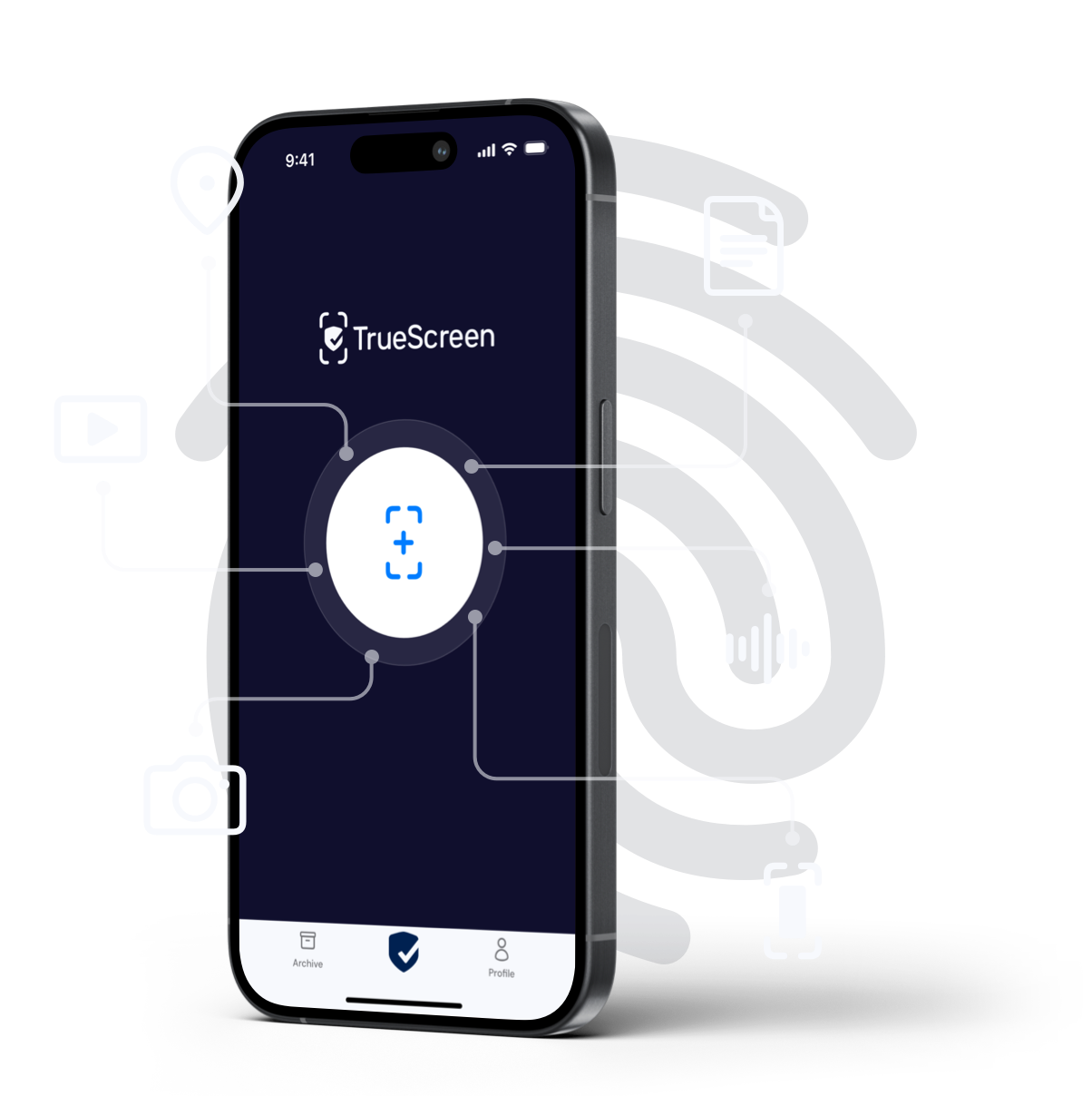
TrueScreen captures and certifies screenshots, web pages, photos, videos and files through a forensic methodology that integrates a qualified electronic timestamp and electronic seal issued by a third-party QTSP, so the evidence is born with the five requirements already built in. Instead of chasing authentication after you have grabbed the data, you work upstream: at the very instant of acquisition, origin, time, integrity hash and traceability are all fixed, and everything stays independently verifiable.
In practice, the capture happens with forensic methodology at the source, the integrity of the data is verified and certified, and the qualified timestamp together with the electronic seal is applied through the QTSP integrated in the TrueScreen platform. What you end up with is a file backed by a documented chain of custody and a verifiable format, ready to hold up under cross-examination. A recurring example: someone who has to produce a defamatory online review captures it with TrueScreen and gets the URL, a trusted time reference and a cryptographic fingerprint in a single pass, instead of a contestable screenshot.
TrueScreen is not a tool for spotting fakes. The context of deepfakes and easily manipulated content explains why reactive verification no longer holds: rather than running after the fake, TrueScreen certifies the authentic at the source, making the evidence defensible by design.
FAQ: court-ready digital evidence
What makes digital evidence admissible in court?
Does a screenshot have probative value in court?
What is the chain of custody for digital evidence?
Is the phone clock enough as a timestamp?
How do you certify digital evidence for court?
TrueScreen editorial team
Published on · Updated on
This section is edited by the TrueScreen editorial team, which brings together expertise in digital forensics, the law of digital evidence and regulatory compliance. Every article is checked against primary sources: legislation, published rulings, technical standards and official documentation, always cited in the text.


