
WhatsApp voice notes as court evidence: legal value and how to certify audio messages
WhatsApp conversations now show up routinely in litigation files. Courts tend to treat them as documentary records, admissible as long as their authenticity and integrity can be shown. That framing works well for a screenshot of a text exchange. It gets shakier the moment the evidence is not text but a voice note: an audio file anyone can save, forward, trim or re-encode in a few seconds.
A voice note downloaded to a phone or passed from one chat to another loses the very data that proves when it was recorded and where it came from. Without a demonstrable chain of integrity and provenance, the other side can challenge it and watch its weight collapse. So the practical question for anyone relying on WhatsApp voice notes court evidence is narrow: how do you give a WhatsApp audio message legal value that holds up when someone contests it.
Yes, a WhatsApp voice note is admissible evidence, but only for as long as nobody disputes it. A timely and specific challenge strips it of full probative weight and turns it into a mere indication the court is free to weigh as it sees fit. To make it resilient you have to freeze content, date and chain of custody with a SHA-256 hash and a qualified electronic timestamp (eIDAS), capturing the file at the source.
This insight is part of the complete guide: legal value of WhatsApp evidence.
Why a WhatsApp voice note is fragile evidence
A WhatsApp voice note is fragile because it is a contestable audio file: without proof of integrity and provenance, a formal challenge is enough to drain it of probative force. Unlike a signed document, an audio message carries nothing that independently attests who recorded it, when, and whether it has been touched since. The probative value of WhatsApp audio therefore depends on how it was captured, not on what it happens to contain.
The audio message as a challengeable mechanical reproduction
Digital records like a voice note are commonly admitted as documentary, mechanical-reproduction evidence, and they carry full probative weight for as long as their authenticity goes unchallenged. The catch is in that last clause. A challenge, to count, has to be timely and specific: whoever contests the file must point to what precisely does not match, not simply deny it in general terms. When the disavowal is made properly, the audio is not thrown out. It loses its status as full proof and drops to an indication the court assesses freely, often alongside other elements.
This is why a loose audio file sits in such a weak spot. Produced on its own, with no attestation of conformity, it is effectively a copy anybody can question. The party filing it then carries the burden of showing the recording is genuine and intact, which is hard to prove after the fact about a file that has changed hands.
What makes an audio file alterable: forwarding, re-encoding, metadata loss
The technical problem is that the simple act of saving or forwarding a voice message changes it. WhatsApp compresses voice notes with the Opus codec. Every time the file is forwarded or exported, the app re-compresses it, and the original metadata, creation date and time, source device, is lost or rewritten. What ends up in your hands no longer holds a verifiable link to the moment and the phone where the recording was born. That is the real divide: between an audio file handled by hand and one captured at the source with a forensic method.
| Aspect | Saved or forwarded audio file | Voice note certified at the source |
|---|---|---|
| Integrity | Not verifiable, tampering goes undetected | Sealed with a SHA-256 hash, any change becomes evident |
| Certified date | Lost in re-compression | Qualified electronic timestamp (eIDAS), effective toward third parties |
| Provenance | Source metadata scattered | Origin and capture context documented |
| Resistance to disavowal | Low, slides easily to a mere indication | High, conformity is attested upfront |
This insight stays on the WhatsApp voice-note file itself. Ambient recordings and phone-call recordings follow a different admissibility logic, so if that is your scenario the right reference is the dedicated piece on how to certify audio recordings as court evidence.
Disavowal and transcription: why WhatsApp's automatic transcription is not evidence
WhatsApp's automatic transcription has no independent legal value. It is a convenience feature that turns speech into text with a voice-recognition engine, with no guarantee about accuracy and none about who is actually speaking. In court it does not stand in for the audio. If a transcription with procedural weight is needed, it has to be ordered by the court or entrusted to an expert, and even then it presupposes that the underlying audio file is genuine.
The exposure here is real. Anyone who files only the transcribed text hands the other side an easy foothold: there is no intact original on which to check the words, the tone, the pauses. A transcription holds up only when it accompanies audio already frozen in its integrity. On its own, it is not enough.
How to capture a WhatsApp voice note with legal value
To give a WhatsApp voice note legal value you freeze its content, date and origin at the moment you capture it, before anyone can delete it or contest it. The path is straightforward and runs through four steps:
- Capture at the source: take the voice note straight from the conversation, not from a copy that has already been forwarded or exported.
- Apply a SHA-256 hash: compute the file's cryptographic fingerprint, so any later change becomes immediately detectable.
- Add a qualified electronic timestamp (eIDAS): fix a certain date, effective toward third parties, through a third-party qualified QTSP.
- Produce a report and chain of custody: document who captured what, when and how, so the path of the evidence can be reconstructed.
Source capture, SHA-256 hash and qualified electronic timestamp (eIDAS)
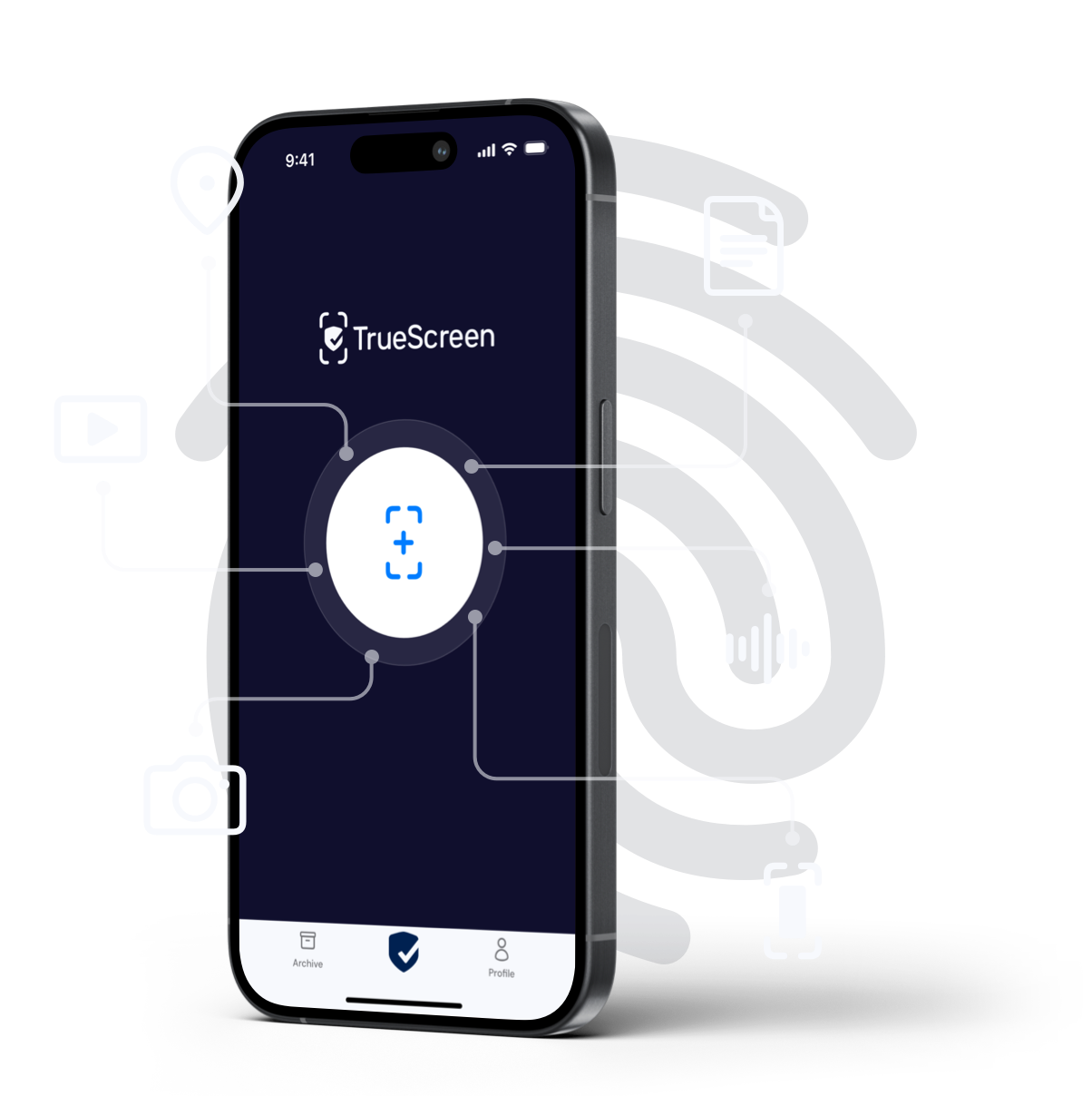
TrueScreen captures the voice note directly at the source and applies a SHA-256 hash with a qualified electronic timestamp (eIDAS) delivered by a third-party QTSP integrated into the platform, freezing content, date and provenance. The hash works like a numeric seal: if even a single bit of the file changes, the fingerprint no longer matches and the tampering is exposed. The timestamp, grounded in the eIDAS Regulation (EU) 910/2014, attaches a date that has effect toward third parties, not just between the parties to the dispute.
The roles matter here. TrueScreen is not a QTSP: it is the platform that captures with a forensic method and integrates the seal and the qualified electronic timestamp (eIDAS) delivered by a third-party qualified QTSP via API. The same logic applies, with its own technical rules, when the goal is to certify WhatsApp chats in full rather than a single audio file.
Chain of custody and forensic report (ISO/IEC 27037)
The chain of custody is what keeps the evidence defensible months later: a documented record of every step the file takes, from capture to filing, so nobody can argue the audio was swapped or altered in the meantime. The international standard ISO/IEC 27037:2012 sets out guidelines for identifying, collecting and preserving digital evidence, and a well-run capture takes its cues from those criteria. The report that accompanies the operation photographs the context: what was captured, with which tool, on what date, with what verification result. That turns a disavowal into a technical argument you answer with facts instead of assertions.
WhatsApp voice notes in court: practical cases
WhatsApp voice notes surface in court mainly in two recurring situations: as unlawful content that has to be documented, and as the trace of a verbal agreement that has to be proven. The capture technique is the same in both. What changes is the stake.
A threatening voice note in a harassment case
In a harassment or defamation case, a threatening voice note is often the only direct evidence of the conduct. Whether it holds depends on the file staying genuine, and it is admitted as a documentary record on that condition. The operational risk is the "delete for everyone" function: the sender can wipe the message from the recipient's conversation, making it vanish before it is ever secured. Capturing the audio forensically right away, with a hash and a timestamp, locks the evidence down before it can be pulled. It is the same principle that underpins the broader argument about WhatsApp evidence in court.
An audio message documenting a verbal agreement
In civil and employment disputes, a voice note can record an agreement the parties never put in writing: a commitment to pay, a promise of hiring, a change to contract terms. Here the probative value of WhatsApp audio becomes decisive, because it reconstructs an intention that would otherwise rest on one person's word against another's. But a loose file is easily disavowed, precisely by the party with the most to lose. Certifying it at the source turns that digital memory into something a court can build a decision on.
FAQ: WhatsApp voice notes as court evidence
Is a WhatsApp voice note valid as court evidence?
Yes. A WhatsApp voice note is admissible as a documentary, mechanical-reproduction record, and it carries full weight for as long as its authenticity is not challenged. Validity is not automatic, though: it holds until the other side disputes the file's conformity in a timely and specific way. A voice note certified at the source, with integrity and date proven, resists that challenge far better than a loose file.
How do you produce a WhatsApp voice note in court?
You file the audio together with documentation that attests its authenticity and integrity. Attaching a saved or forwarded message is not enough. The sound approach is to capture the voice note with a forensic method, apply a SHA-256 hash and a qualified electronic timestamp (eIDAS), and attach the capture report. The file then arrives with proof of its conformity, which makes a disavowal much harder to sustain.
What happens if the other party challenges the audio message?
If the challenge is timely and specific, the voice note loses its status as full proof and becomes a mere indication the court weighs freely, usually to be corroborated by other elements. At that point the manner of capture is what counts: if a hash and a qualified electronic timestamp prove the file's integrity, the burden shifts to whoever contests it to explain, specifically, where the alteration is supposed to be.
Does WhatsApp's automatic transcription have legal value?
No. WhatsApp's automatic transcription is a convenience feature with no independent legal value: it converts audio to text with no guarantee of accuracy or of the speaker's identity. In court it does not replace the audio file. If a transcription with procedural weight is required, it must be ordered by the court or assigned to an expert, and it still assumes the original audio is genuine and intact.
How do you certify a WhatsApp voice note with legal value?
By certifying the file at the moment you capture it from the conversation. TrueScreen takes the voice note at the source and applies a SHA-256 hash with a qualified electronic timestamp (eIDAS) delivered by a third-party integrated QTSP, generating the report and the chain of custody as well. Content, date and provenance stay fixed, so the audio reaches court with its conformity already attested.
Is sharing someone else's WhatsApp audio illegal?
It depends on the context. Recording a conversation you take part in is generally lawful, but circulating someone else's voice note to third parties can breach data protection rules under the GDPR and, in some cases, trigger civil or criminal liability tied to privacy and reputation. Using the audio as evidence in proceedings, where a legitimate interest in defense applies, is one thing; publishing or sharing it outside that perimeter is another. When in doubt, weigh it with a lawyer.


