Certifying a phone call recording as evidence in a dispute
You recorded an important call. Maybe a verbal agreement on a supply deal, a promise of payment, or one more harassing call you want to bring before a court. You think you are holding solid proof. Then the hearing arrives, the other side listens to the file and says one sentence: "That is not me, and anyway it has been edited." That is the moment you discover that a phone call recording as evidence is worth far less than you believed.
The problem is rarely whether you were allowed to record. In most jurisdictions, recording a conversation you take part in is legitimate, and in some sectors it is mandatory: investment firms must keep every client call under the MiFID II recording obligations. The problem is the fragility of the file. A raw audio clip sitting on a phone can be challenged on three fronts: who is speaking, what was actually said, and when the call took place. A well-argued objection is often enough to downgrade that proof to a mere indication, left to the free assessment of the judge.
The answer to this problem is technical, not only legal. A recording certified at the source, carrying a qualified timestamp and an integrity fingerprint that fixes its content at the exact moment of capture, withstands challenge far better than an ordinary file. TrueScreen exists for precisely this: to turn a recorded call into evidence that holds up, documenting integrity, time and provenance inside a verifiable chain of custody. In this article we look at when a recording works as evidence, where it tends to collapse, and how to make it defensible from the first second.
Why a raw phone recording has fragile evidentiary value
A phone call recording works as documentary evidence until the other party challenges it. The moment they dispute it in a specific, reasoned way, it stops carrying full proof and slides toward the rank of an indication, which the judge weighs freely alongside everything else. All the fragility starts here: the value of these reproductions rests on a single condition, that nobody credibly denies their authenticity.
Across most legal systems, a recorded conversation is admitted as a form of documentary evidence: a mechanical reproduction that represents facts, people or things. The principle is broadly consistent in common-law and civil-law jurisdictions alike. But there is a precise limit. Authenticity and integrity must be demonstrable, and the party producing the file carries the burden when authenticity is contested. Translated: a recorded call is not bulletproof proof, it is conditional proof. If the opposing side specifically argues that the file does not correspond to what really happened, the audio loses its weight as full evidence. The judge may still consider it as a circumstantial element, weighing it together with the rest, but the initial evidentiary advantage is compromised. This is why anyone producing a recorded call should worry not only about having it, but about being able to prove its integrity and provenance.
The weak point is always the same: an audio file on a phone carries no proof of itself. Nothing attests that it was not cut, that the file date is real, that it genuinely comes from that call. Authenticity has to be demonstrated after the fact, often through a slow and costly forensic audio examination, and the outcome is never guaranteed.
When recording a call and using it as evidence is lawful
Recording a call is generally lawful, as a rule, when the person recording takes part in the conversation. This is the one-party consent principle: in many jurisdictions the consent of the other speaker is not required, because the law protects privacy against outsiders, not against someone who is already a legitimate participant in the dialogue.
The fundamental distinction is between recording and interception. Someone who records their own conversation keeps a memory of an event they were part of: a lawful act. Someone who secretly captures a conversation they are a stranger to commits an offence, treated in most legal systems as unlawful interception of communications. The question "can you record phone calls without consent?" therefore has a clear answer in one-party jurisdictions: yes, provided you are one of the speakers. Two-party (all-party) consent regimes are stricter and require every participant to agree, so the lawful basis depends heavily on where you are.
Two important limits remain. The first concerns places: recording what happens in someone else's private home can amount to an unlawful intrusion into private life. The second concerns later use: a recording may be lawful to defend your own rights, but freely distributing it can breach data protection law, including the GDPR in the European Union. Acquiring a conversation to produce it in proceedings is one thing; publishing it or using it for another purpose is something else entirely.
Recordings between participants and admissibility
Recording a conversation you take part in is lawful even without the other party's consent in one-party-consent jurisdictions, and it is usable as evidence. This applies both to a telephone conversation and to a recording of a conversation between people physically present in the same place.
Procedurally, a recorded telephone conversation enters proceedings as documentary evidence. International frameworks for the admissibility of digital evidence converge on the same requirements: the recording must be relevant, authentic, and reliable, and its integrity must be demonstrable. Courts across jurisdictions have repeatedly accepted recordings between participants as usable documentary evidence, treating them as an audio memory of a real event. Yet the evidentiary value stays anchored to one assumption: that the recording is not disputed or, if disputed, that its authenticity can be proven. This is where the whole difference plays out between a recorded call that wins a case and one that is filed away as unusable. For the broader procedural picture, see the analysis on the admissibility of digital evidence in court.
Authenticity and provenance: what the producer must prove
Anyone bringing an audio recording into proceedings must be ready to prove two things: that the file is authentic (not manipulated, not cut) and that it genuinely comes from that conversation, at that precise moment. These are the two points on which the other side concentrates every objection.
Authenticity concerns the integrity of the content. Audio can be shortened, edited, cleaned up, recomposed, and today even generated or altered with voice cloning and audio deepfake tools that are increasingly within everyone's reach. Provenance, instead, concerns origin and timing: who the speakers are and when the call took place. And here is a detail many people ignore: the date of the file saved on the phone proves nothing, because it is metadata that can be changed in seconds. When these two elements are not independently proven, only one road remains, the forensic audio examination ordered by the judge, which compares voices and analyses the signal. A technical procedure, expensive, with an outcome that is anything but certain. Bringing the proof of authenticity forward to the moment of recording completely reverses how solid the element is.
The concrete risks: editing, alteration and disputing the date
A raw recording can be challenged on three fronts, and one is enough to weaken it: the editing of the content, the origin of the file, and the timing of the call. This is the objection, the tool the other side uses to move the file from the "full proof" column to the "mere indication" one.
Courts have been raising the bar on what counts as a valid objection. A growing body of case law holds that disputing a mechanical reproduction must be clear, specific and explicit, not a generic denial: whoever contests has to indicate precisely what does not correspond to reality. That is good news for the party producing the audio, but only in part. If the other side builds a qualified, well-argued objection (claiming, for example, that the file is cut at a specific point), the judge has to verify it, and without objective proof of integrity that verification runs through expert examination, with its delays and its risks.
The table below summarises how the weight of a recording changes before and after a qualified objection.
| Recording status | Evidentiary value | What it decides |
|---|---|---|
| Not contested | Full documentary proof | The fact is treated as proven |
| Disputed generically | Tends to keep its value | Objection is inadequate, no specific grounds |
| Disputed in a qualified way, raw file | Downgraded to an indication | Forensic examination needed, uncertain outcome |
| Disputed but certified at the source | Integrity and timing already proven | The objection loses its force |
The timing of the call deserves separate attention. In many disputes the argument is not only about content, but about when something was said: a promise made before or after a certain date can change the outcome of a case. The certain date of an audio recording is, together with integrity, the element most easily attacked in a file saved on a phone.

How to certify a phone call recording at the source
Certifying a phone call recording means fixing its content and its moment at the very instant you acquire it, so that integrity and date stay verifiable by anyone and do not depend on the word of whoever produces the file. In essence, it is the difference between "record and hope" and "acquire evidence."
What changes is the point where you intervene. Instead of recording first and proving authenticity later, in court, through forensic examination, the conversation is acquired with a forensic methodology that already at the moment of capture computes a digital fingerprint of the file, applies a qualified timestamp and traces every step. In practice, the file is born already "sealed": any later modification, even a single bit, becomes detectable, and the moment of acquisition is certified by a third party. Proving authenticity stops being an activity to carry out in front of the judge and becomes an intrinsic property of the file.
Timestamp, integrity hash and chain of custody
Certifying a recording at the source means applying a timestamp, an integrity hash and a chain of custody. These are three distinct elements that together answer the three typical objections: when, what, and how the file was handled.
The hash is a digital fingerprint computed on the content of the file (with algorithms such as SHA-256): a unique code that changes entirely if even a single bit of the audio is altered. Comparing the hash recorded at the origin with the one of the file produced in proceedings objectively proves that the recording has not been touched. The qualified timestamp, issued by a qualified trust service provider under frameworks such as the eIDAS Regulation in the European Union, associates a date and time with the file that are enforceable against third parties, solving the certain-date problem. The chain of custody, finally, is the documentation that traces who generated the file, when, and every subsequent step, evidence that no alteration occurred in handling. Put together, these three elements turn a contestable audio clip into an element whose integrity and provenance are already attested. For the operational detail, see the guide on the chain of custody of digital evidence.
What makes a certified phone recording hold up
A recording certified at the source holds up because it carries with it the proof of its own integrity (the hash) and of its own moment (the timestamp), inside a documented chain of custody. This is why it resists a qualified objection far better than a file saved on a phone: to be effective, the challenge would have to disprove verifiable technical data, not simply "deny."
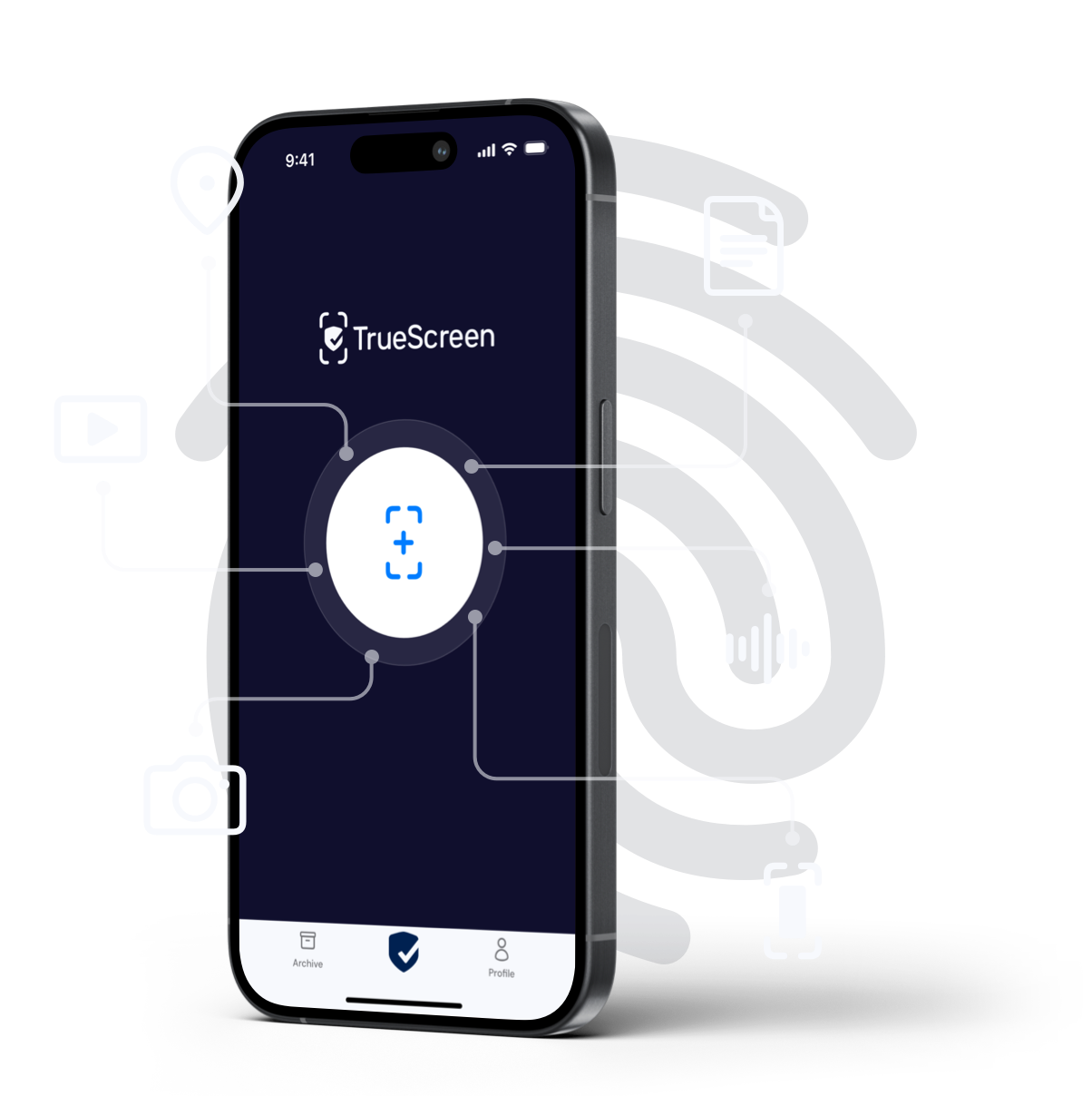
With TrueScreen, the platform for data authenticity, you can record and certify a call at the source, applying a qualified timestamp and an integrity hash at the very moment of acquisition. The certification of an audio recording happens through the qualified electronic seal and the qualified timestamp issued by third-party QTSPs integrated into the platform via API: TrueScreen does not issue qualified certificates, it integrates a qualified QTSP's seal and applies it to the acquired file. Unlike a recording saved on a phone, a file certified at the source arrives in proceedings already accompanied by the proof of its own authenticity.
The result is a forensic report documenting hash, timestamp and chain of custody, turning an easily contestable file into evidence that holds up. Acquisition can happen from a mobile device, and the file produced is built to be filed and verified. For anyone wanting to understand how this stands before a judge, the dedicated piece on certifying audio recordings as court evidence goes into the procedural detail. In practice, individuals and organisations use this method to acquire audio recordings with evidentiary value from the very first instant, without relying on a later forensic examination.
Practical cases: from a verbal deal to a harassment complaint
The situations where a recorded call makes the difference are more common than people think, and they almost always turn on the same fault line: the value of the proof collapses exactly when it matters most, when the other side challenges it. Two concrete examples show why certification at the source changes the outcome.
First scenario: a verbal agreement. A supplier and a client settle price and timing of an order on the phone. Months later, the client denies ever agreeing to that price. The supplier recorded the call, but the file is raw: the client disputes it, claiming the audio is edited and that their voice has been recomposed. Without objective proof of integrity, it ends in expert examination. With a recording certified at the source, the hash proves the file was never modified and the timestamp fixes the moment of the conversation: the objection loses its bite.
Second scenario: harassing calls. A person receives repeated, threatening calls and wants to file a complaint. The call log and the raw audio help, but the defence can always contest the origin and timing of the recordings. A series of calls recorded and certified at the source, each with its own moment independently attested, builds a picture that hardly survives a denial: both the content and the temporal sequence become verifiable. The pattern, in both cases, is the same: the audio recording stops being a freely assessable indication and turns into a solid element.
FAQ: Frequently asked questions
Does a phone call recording count as evidence in court?
Can you record phone calls without consent?
How much is an audio recording worth as evidence?
What happens if the other party challenges the recording?
How do you give a phone call recording solid legal value?
Is it a crime to record a phone conversation?
TrueScreen editorial team
Published on · Updated on
This section is edited by the TrueScreen editorial team, which brings together expertise in digital forensics, the law of digital evidence and regulatory compliance. Every article is checked against primary sources: legislation, published rulings, technical standards and official documentation, always cited in the text.


