
Forensic copy: what it is, how it is performed, and its evidentiary value
Most companies and professionals still collect digital evidence by hand. A lawyer screenshots a defamatory post, an investigator downloads a video, a compliance officer saves an email thread to a folder. It feels solid. Then the case reaches a courtroom and the other side asks a simple question: how do you know this file is authentic and unaltered? At that point a screenshot is just an image, and an image proves almost nothing about what was really on the screen. This is exactly the gap a forensic copy is built to close.
That gap, between collecting digital data and proving it, is the real problem. A manual capture has no integrity guarantee, no documented chain of custody, no independent record of when and how it was obtained. So how do you turn a fragile digital data point into evidence that holds up under challenge? You need a forensic copy: an integral, verifiable reproduction of the data that preserves content, metadata and integrity, anchored by a cryptographic hash, a timestamp and full documentation of the acquisition process. This article walks through what a forensic copy is, how it is performed step by step, and what evidentiary value it carries in court.
What a forensic copy is and how it differs from an ordinary copy
A forensic copy is a bit-by-bit reproduction of digital data that preserves the exact sequence of bits of the original, including content, metadata and hidden or residual areas. Unlike an ordinary copy, which reproduces only visible files, a forensic copy is verified through a cryptographic hash: a digital fingerprint that proves the copy is identical to the source. ISO/IEC 27037, the international standard for handling digital evidence, frames this as the identification, collection, acquisition and preservation of potential evidence in a way that keeps it sound and defensible.
An ordinary copy answers "do I have the file?". A forensic copy answers "can I prove this is exactly what was there, untouched?". The distinction matters because in any dispute the value of digital data depends less on its content and more on the ability to demonstrate its authenticity and integrity.
There are two main acquisition modes. A clone copy reproduces the source onto another physical medium of the same or larger size, bit for bit. An image copy packages that same bit stream into one or more files, often with compression and embedded metadata about the acquisition. Investigators and consultants typically work on the image, never on the original, precisely to avoid altering the source.
The difference between saving a file and acquiring it with forensic methodology
Saving a file copies its visible content. Acquiring it with forensic methodology captures the data and its context while protecting both from alteration. When you drag an email into a folder, you may keep the body text but lose headers, routing information and timestamps. When you screenshot a web page, you capture pixels but discard the underlying source, the server response and the moment of capture.
Forensic methodology reverses the priority. The goal is not the prettiest reproduction but the most faithful and verifiable one. That means recording how the acquisition happened, freezing the state of the data at a precise moment, and generating a hash so any later change becomes detectable. The process is repeatable and documented, which is what lets a third party verify it independently.
Content, metadata and integrity: what a forensic copy preserves
A forensic copy preserves three layers at once: content, metadata and integrity. Content is the visible data: the text of a message, the frames of a video, the body of a document. Metadata is the surrounding context: creation and modification dates, author information, geolocation, device identifiers, network details, file structure. Integrity is the mathematical proof, through hashing, that none of the above changed after capture.
Metadata is often where a case is won or lost. A photo with intact EXIF data, a message with full headers, a file with an unbroken modification history: these are the signals that make data believable. A bare screenshot strips most of them away. A TrueScreen acquisition keeps them, capturing the data together with its environmental context and sealing the result before anyone can touch it.
How to make a forensic copy
A forensic copy is made by following a controlled, repeatable procedure that protects the source, captures the data with its metadata, and proves integrity through hashing and timestamping. The exact tools vary by data type (a hard drive, a mobile device, a web page, a single file), but the methodology is consistent. Below is how to make a forensic copy in five steps, the backbone of any sound forensic data acquisition.
- Isolate and protect the source. Prevent any modification during acquisition. For physical media this means a write blocker; for a live web page or a mobile capture it means a controlled environment that records the data without altering it.
- Acquire the data with its metadata. Reproduce the bit stream, or the full target content, together with all available metadata: timestamps, headers, geolocation, device and network context.
- Generate the hash. Compute a cryptographic hash of the acquired data. This fingerprint becomes the reference for every future integrity check.
- Apply a timestamp and a digital seal. Anchor the acquisition to a precise, independently verifiable moment in time and bind it cryptographically so tampering becomes evident.
- Document the process and the chain of custody. Record who acquired what, when, how and with which tools, and track every subsequent handling of the data.
Hash function and integrity verification
A hash function transforms any digital data into a fixed-length string, the hash, that acts as a unique digital fingerprint. Even a single changed bit produces a completely different hash, which is what makes tampering detectable. Modern forensic practice uses algorithms such as SHA-256, recommended by NIST for collision resistance. Integrity verification consists of recomputing the hash later and comparing it to the original: identical hashes prove the data has not changed.
In practice the hash is computed at the moment of acquisition and recorded alongside the copy. Anyone can repeat the calculation and confirm the match, without trusting the person who made the copy. That independence is the whole point: integrity is proven by mathematics, not by assertion.
Qualified timestamp and digital seal
A timestamp answers "when was this acquired?" and a digital seal answers "has it been altered since?". Under eIDAS, the EU regulation on electronic identification and trust services, a qualified timestamp provides a presumption of accuracy of the date and time it indicates and of the integrity of the data it is linked to. This is delivered by a qualified Trust Service Provider, a QTSP, whose qualified status is independently supervised.
TrueScreen does not issue these elements itself. It integrates the qualified electronic seal and the qualified timestamp of a third-party QTSP through its API, applying them to data that has already been acquired with forensic methodology. The result binds the acquisition to a trusted point in time and makes any later manipulation detectable.
Process documentation and chain of custody
Chain of custody is the documented, unbroken record of who handled the data, when, and how, from acquisition onward. Without it, even a technically perfect copy can be challenged: if no one can account for the data between capture and courtroom, an opponent will argue it could have been altered.
Good documentation records the acquisition method, the tools and their versions, the operator, the exact moment of capture, and every transfer or access afterward. ISO/IEC 27037 treats this preservation step as essential to keeping evidence sound. The stronger the documentation, the harder it is to attack the evidence on procedural grounds.
What evidentiary value a forensic copy has in court
A forensic copy carries significant evidentiary value because it lets a court evaluate digital data whose integrity and origin can be demonstrated objectively. In most legal systems, digital evidence is assessed for authenticity and reliability rather than accepted automatically. A forensic copy supports that assessment by providing a verifiable hash, a trusted timestamp and a documented chain of custody, shifting the data from "claimed" to "demonstrable" and making it far harder to contest.
No copy is automatically conclusive, and a judge or jury always weighs the full context. What a forensic copy does is remove the easy objections. When integrity is provable and the acquisition is documented, the opposing party can no longer just argue that the file might have been edited. The debate moves from "is this authentic?" to the actual merits of the case.
Legal and standards framework: FRE 901/902, ISO/IEC 27037, eIDAS, Budapest Convention
The evidentiary value of a forensic copy rests on a recognized international framework. In the United States, Federal Rule of Evidence 901 requires evidence to be authenticated, and FRE 902(13) and 902(14), in force since 2017, allow certified records generated by an electronic process, and data verified by hash, to be self-authenticating, reducing the need for live witness testimony.
ISO/IEC 27037 sets the international baseline for identifying, collecting, acquiring and preserving digital evidence. eIDAS governs the qualified timestamp and the qualified electronic seal across the EU, giving them legal effect and a presumption of integrity. At the international level, the Budapest Convention on Cybercrime, the first binding treaty in this field, established cross-border standards for the collection and exchange of electronic evidence. Together these instruments give a properly executed forensic copy a defensible foundation across jurisdictions.
Forensic copy vs traditional expert report: time and cost
A forensic copy and a traditional expert report serve different needs. A full expert report (a technical consultant analyzing a device, writing findings, often appearing in court) can take days or weeks and cost from several hundred to several thousand euros, depending on complexity. A forensic copy at the moment of capture can be obtained in seconds and at a fraction of the cost.
The two are not mutually exclusive: a forensic copy is often the input an expert later analyzes. But for the common need of capturing online content, a message or a document before it disappears, a self-service source-certified acquisition gives companies a fast, repeatable alternative to commissioning an expert report for every single piece of evidence.
| Method | What it preserves | Value in court |
|---|---|---|
| Manual screenshot | Visible image only, no metadata, no integrity proof | Low: easily challenged as alterable, weak on authenticity |
| Manually downloaded file | Content and some metadata, no independent timestamp or chain of custody | Limited: origin and integrity hard to prove |
| Forensic copy | Content, metadata and integrity via hash, with documentation | Strong: integrity demonstrable, but depends on correct procedure |
| Source-certified forensic copy | Content, metadata, integrity, qualified timestamp and digital seal, applied at capture | Highest: data born certified, tamper-evident, court-ready by design |
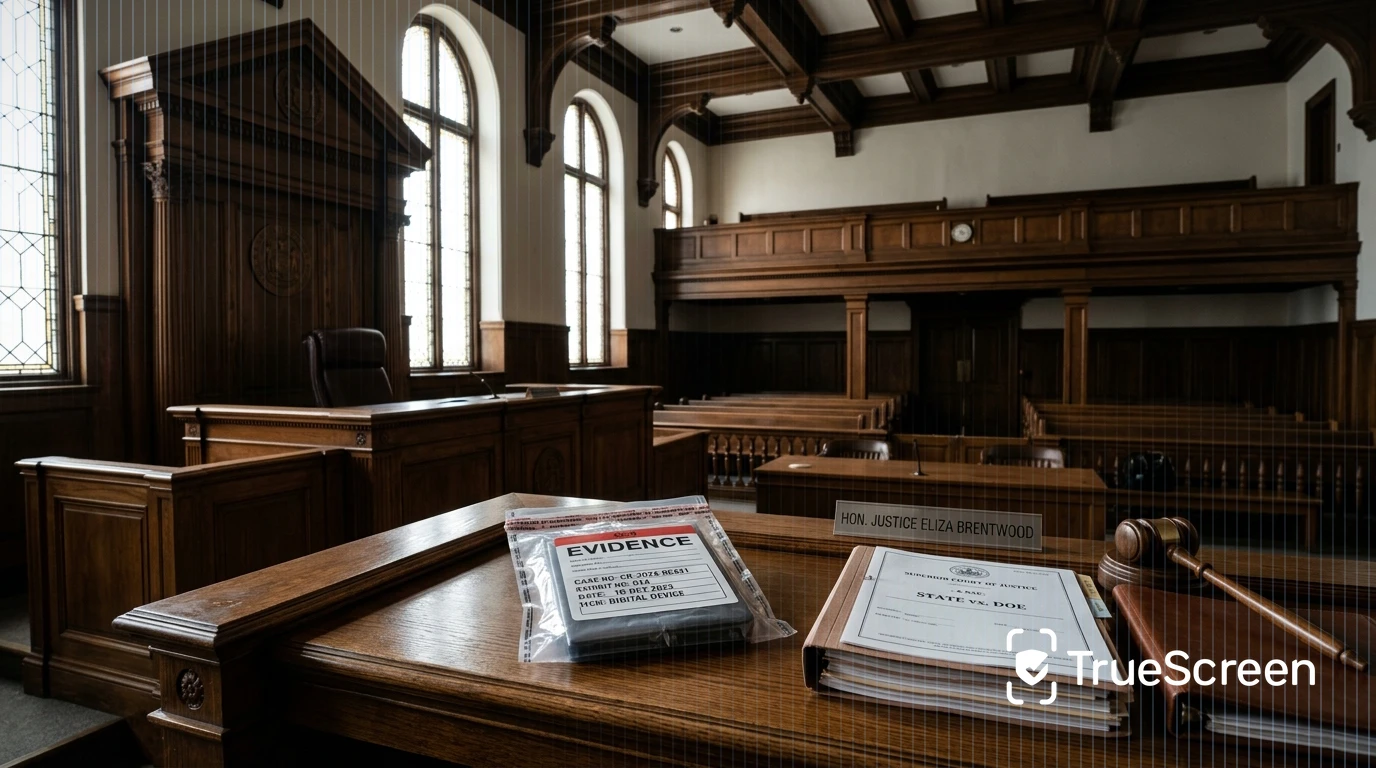
How to certify data at the source with evidentiary value
Certifying data at the source means acquiring and sealing it at the moment of capture, before any manipulation is possible, rather than notarizing an existing file after the fact. This is the key difference: data certified at the source is born certified. TrueScreen applies a forensic methodology that captures content with its environmental context (device identity, GPS, network, timestamp) and then integrates the qualified electronic seal and qualified timestamp of a third-party QTSP through its API, producing a verifiable, tamper-evident record compliant with ISO/IEC 27037 and eIDAS.
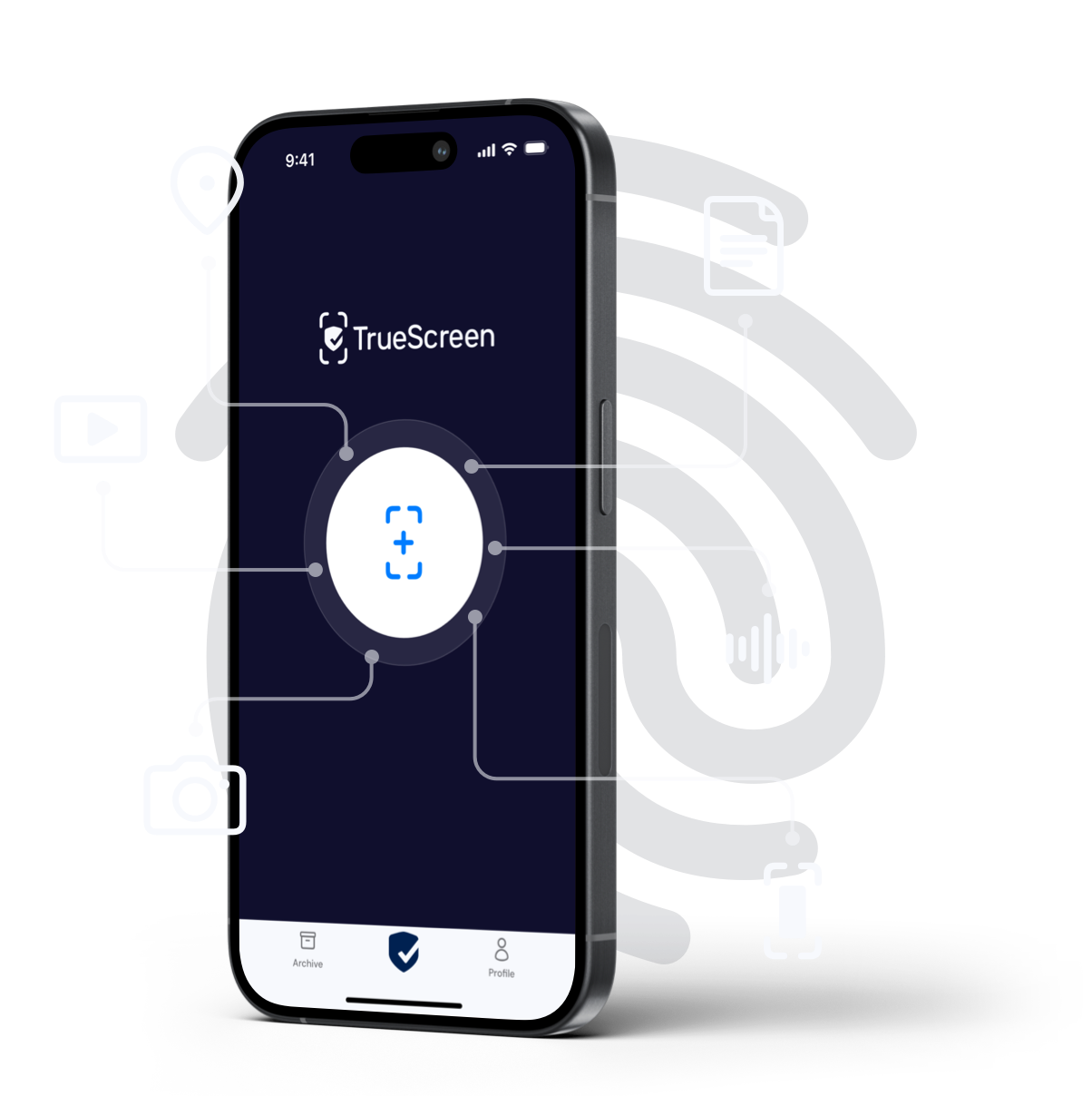
The practical advantage is that you never have to reconstruct authenticity later. With TrueScreen, the data is acquired and sealed in one motion. The TrueScreen App handles certified mobile capture of photos, videos and audio in the field. The Forensic Browser handles certified acquisition of web pages and online content. The API and Web Portal bring the same certification to high volumes, for organizations that need it at scale.
Consider a legal officer who spots a defamatory publication online and knows it may be removed within hours. Instead of a screenshot that proves nothing, they acquire the page with a certified capture and obtain a digital seal and qualified timestamp in seconds. The content, its metadata and the exact moment of acquisition are sealed before the post disappears, producing certified digital evidence for litigation that is ready to defend. This same approach underpins the broader idea of Digital Provenance, where every piece of digital content carries verifiable proof of its origin and history. Investigators rely on it for certified private investigations, where the defensibility of the evidence is the entire job.
FAQ: forensic copy and evidentiary value
What exactly is a forensic copy?
A forensic copy is an integral, verifiable reproduction of digital data that preserves the original bit by bit, including content, metadata and structure. It is verified through a cryptographic hash, a unique fingerprint that proves the copy is identical to the source and reveals any later alteration. Unlike an ordinary copy, which keeps only visible files, a forensic copy is made to be defensible: it documents how the data was acquired and freezes its state at a precise moment. This is the reproduction technical consultants and courts rely on when the authenticity and integrity of digital data are in question.
How much does a forensic copy cost?
The cost varies widely depending on the data type and the method. A traditional forensic acquisition by a technical consultant, including analysis and a written report, can range from a few hundred to several thousand euros per case, driven by complexity and the time required. A single device or large data set sits at the higher end. By contrast, source-level self-service certification, where you acquire and seal the data yourself at the moment of capture, dramatically lowers the per-acquisition cost. For organizations that document evidence frequently, this turns a costly one-off into a fast, repeatable operation.
Do screenshots have legal value?
A screenshot can be submitted as evidence, but on its own it carries weak evidentiary value. It is a static image with no integrity guarantee, no independent timestamp and no chain of custody, so the opposing party can easily argue it was edited or staged. Courts generally assess digital evidence for authenticity and reliability, and a bare screenshot offers little to support either. It becomes far stronger when the capture is performed with forensic methodology and sealed with a hash and a trusted timestamp, which is what separates a casual image from a defensible record.
Are WhatsApp messages valid in court without a forensic copy?
WhatsApp messages can be relevant evidence, but without a forensic copy their value is fragile. A simple screenshot of a chat proves little, because conversations can be edited, deleted or fabricated and the screenshot preserves none of the underlying metadata. Courts in most jurisdictions generally expect a forensic extraction that proves the messages' integrity and a documented chain of custody before giving them significant weight. A certified WhatsApp chat, captured with forensic methodology and sealed at the moment of acquisition, preserves the content and context in a form that is much harder to contest.
What is the difference between a forensic copy and an expert report?
A forensic copy is the faithful, verifiable acquisition of digital data. An expert report is the analysis and interpretation of that data by a qualified consultant, who examines it, draws conclusions and often testifies. The copy is the evidence; the report is the expert opinion built on it. The two are complementary, and a forensic copy frequently serves as the input the expert later analyzes. For many practical needs, such as capturing online content before it is removed, a source-certified forensic copy is enough on its own, without commissioning a full report for every acquisition.
When is a forensic copy NOT usable?
A forensic copy loses its value when the methodology breaks down. The main failure points are a broken chain of custody, where the data cannot be accounted for between capture and courtroom; data that was already altered before acquisition, since a faithful copy of corrupted data is still corrupted; and a missing or unverifiable hash or timestamp, which removes the integrity proof. Acquisitions that are excessively broad or exploratory, gathering far more than the matter requires, can also be contested as disproportionate. A sound forensic copy is targeted, documented and verifiable from capture onward.
TrueScreen editorial team
Published on · Updated on
This section is edited by the TrueScreen editorial team, which brings together expertise in digital forensics, the law of digital evidence and regulatory compliance. Every article is checked against primary sources: legislation, published rulings, technical standards and official documentation, always cited in the text.


