
Ephemeral content as evidence: certifying Instagram Stories and WhatsApp Status before they disappear
A threat lands inside an Instagram Story. An insult shows up in a WhatsApp Status. An improper proposal arrives as a view-once message that erases itself the moment it is opened. The person on the receiving end knows exactly what they saw. The trouble starts afterward: that ephemeral content lives for twenty-four hours, sometimes for a few seconds, then deletes itself. And the proof goes with it.
A screenshot looks like the obvious fix. Tap, save, done. Except a manual screenshot is just an image like any other, and it can be cropped, recomposed, edited. In a dispute the other side can challenge it, and a photo of a screen then carries little weight. The real problem is not capturing timed content fast enough. It is proving the content was authentic, intact, and tied to a reliable date and time when Instagram story evidence is at stake.
This is where certified acquisition at the source changes the outcome. TrueScreen captures and certifies ephemeral content while it is still visible, applying an integrity hash, a qualified timestamp issued by an integrated QTSP, and a documented chain of custody. The result is evidence with legal value, enforceable against third parties, that does not depend on the good faith of whoever took the screenshot.
What ephemeral content is and why it is hard to use as evidence
Ephemeral content is digital content built to disappear after a set time or after the first view. Instagram Stories, WhatsApp Status updates, and view-once messages are designed to leave no trace: that is a product feature, not a flaw. That programmed volatility is exactly what makes them hard to use as evidence, because the window to collect them is short and does not come back. When the content disappears, it disappears for everyone, including the person who had every reason to keep it.
The contrast with an ordinary chat is sharp. A persistent WhatsApp conversation stays in the phone's memory and can be recovered months later, as we cover in the guide on certifying a WhatsApp chat with legal value. Ephemeral content does not. Once it expires, there is no original left to start from, and someone facing harassment or defamation inside a Story often realises this too late.
Instagram Stories, WhatsApp Status and timed messages: how they work and how long they last
Instagram Stories stay visible for 24 hours, then they vanish from feed, profile, and direct messages unless the author saves them as a highlight, according to Instagram's own help documentation. The model is simple: after a day, the content is gone for the people who saw it.
WhatsApp Status follows the same 24-hour logic, though WhatsApp has added adjustable timers that let a status disappear after anything from a few hours up to a month. Disappearing messages add another layer, with read-based timers as short as a few minutes.
View-once messages are the extreme case. They open a single time and then become inaccessible, even to the sender. Here the window is not measured in hours but in seconds. Once the screen is tapped, the content is already lost.
The extremely narrow window to capture the proof
The practical consequence is that collecting the proof has to happen now, not tomorrow. With ephemeral content the window is exactly as long as the content is visible. If the defamation sits inside a Story seen at 10 p.m., by 10 p.m. the next day there is nothing left to capture.
This reframes how collection has to work. You do not need a tool to use calmly after speaking to a lawyer. You need one already on the phone the moment the content appears. Speed is not an operational detail here. It is the condition that decides whether proof can exist at all.
The evidentiary value of a screenshot of ephemeral content
A screenshot of ephemeral content is, in evidentiary terms, a weak form of electronically stored information (ESI). It is a truncated image of the original post, not an exact copy of the native file. United States courts applying the Best Evidence Rule have held that screenshots can fail to satisfy it precisely because the metadata and full context of the native file are missing, so the image does not accurately reflect the substance of the source. For digital evidence to hold, three conditions generally need to align at once: authenticity, meaning the item is tied to a verified source and not fabricated; integrity, confirmed by a cryptographic hash showing no change since capture; and a documented chain of custody accounting for every access and transfer. A raw screenshot of disappearing content offers none of the three.
Why a manual screenshot is easy to challenge
A manually captured image carries no technical guarantee of its own authenticity. It shows what appeared on the screen, but it does not prove when it was taken, whether it was edited afterward, or where the content truly came from. The date and time visible in the image belong to the device, and a device clock is easy to alter.
When the original content has already expired, this weakness becomes decisive. To dispute a screenshot, the opposing party needs only to question whether it faithfully reflects reality, and with no original left to compare against, the party producing the proof is defending an image of something that no longer exists. We go deeper into this in the analysis of how digital evidence is admitted in court, and on the legal risks of editing a screenshot instead of certifying the source.
What makes evidence hold up: integrity, reliable date, provenance
The strength of digital evidence rests on the ability to prove three things: integrity, a reliable date, and provenance. Integrity confirms the content was not altered after collection, and it is established with cryptographic hash functions that make any later change detectable. A reliable date fixes the moment of acquisition, and a qualified electronic timestamp does this in a way that is hard to contest. Under eIDAS Articles 41 and 42, a qualified electronic timestamp carries a legal presumption of the accuracy of its date and time and of the integrity of the data bound to it, shifting the burden onto whoever wants to dispute it. Provenance documents the source the content came from.
On top of these sits the chain of custody. ISO/IEC 27037, the international standard for handling digital evidence, treats the chain of custody record as a document that should begin at the moment of collection or acquisition. Any gap in it can make the evidence contestable, and we map this out in the guide on chain of custody for digital evidence.
When the content disappears, the evidence vanishes with it
The concrete risk with ephemeral content is the irreversible loss of proof. A persistent chat gives you a second chance: if you did not document it today, you can do it tomorrow. Timed content does not. After it expires, there is no platform archive a private individual can access to recover what they saw.
Take a workplace harassment case. A manager sends a colleague demeaning messages through WhatsApp Status updates that erase after 24 hours. The colleague sees them every morning, but by the time they consult a lawyer, weeks later, nothing remains. The same holds for a threat in a view-once message, or the online behaviour an HR manager has to document before acting on it. The difference between having proof and not having it is measured in hours, which is why capturing at the source matters so much, and why it ties into protecting your online reputation with legal evidence.
How to certify ephemeral content that holds up
Certifying ephemeral content means capturing it at the source while it is still visible and sealing it with technical guarantees of integrity, a reliable date, and provenance. It differs from a manual screenshot not in image quality but in what travels with the image: the hash that locks the content, the qualified timestamp that dates it, and the documentation that traces its origin. The table below sets the two approaches side by side.
| Aspect | Manual screenshot of ephemeral content | Certified acquisition at the source |
|---|---|---|
| Content integrity | No guarantee: the image can be edited after capture | Cryptographic hash that detects any later alteration |
| Date and time | The device's, which is alterable | Qualified timestamp issued by a QTSP, with a legal presumption of accuracy |
| Provenance | Not documented | Source and acquisition context recorded |
| Chain of custody | Absent | Documented from collection to presentation |
| Resistance to challenge | Weak: easy to dispute as an inexact copy | Strong: conformity is technically provable |
| Useful window | Depends on manual speed | Immediate capture while the content is visible |
Acquisition at the source while the content is still visible
Acquiring at the source means capturing the content directly from where it appears, in the moment it is visible, rather than relying on a plain photo of the screen to be processed later. It is the only approach compatible with the nature of timed content: since no recoverable original exists after expiry, the only defensible original is the one collected during visibility. Instead of chasing the content, you seal it the instant it appears, before the platform makes it vanish.
Digital seal, qualified timestamp and chain of custody
Once acquired, the content has to be sealed. A digital seal certifies the integrity and authenticity of the captured material, ensuring it is not altered after collection. This is different from a digital signature, which concerns a person signing a document: here the goal is to attest the integrity of a piece of content, so the right instrument is an electronic seal paired with a timestamp.
The qualified timestamp adds the reliable date, placing the acquisition at a precise, presumptively accurate moment, issued by a qualified QTSP. The chain of custody then documents every step the material goes through, building the continuous, verifiable path that forensic standards require for the proof to survive scrutiny.

How does TrueScreen certify Stories, Status updates and timed messages?
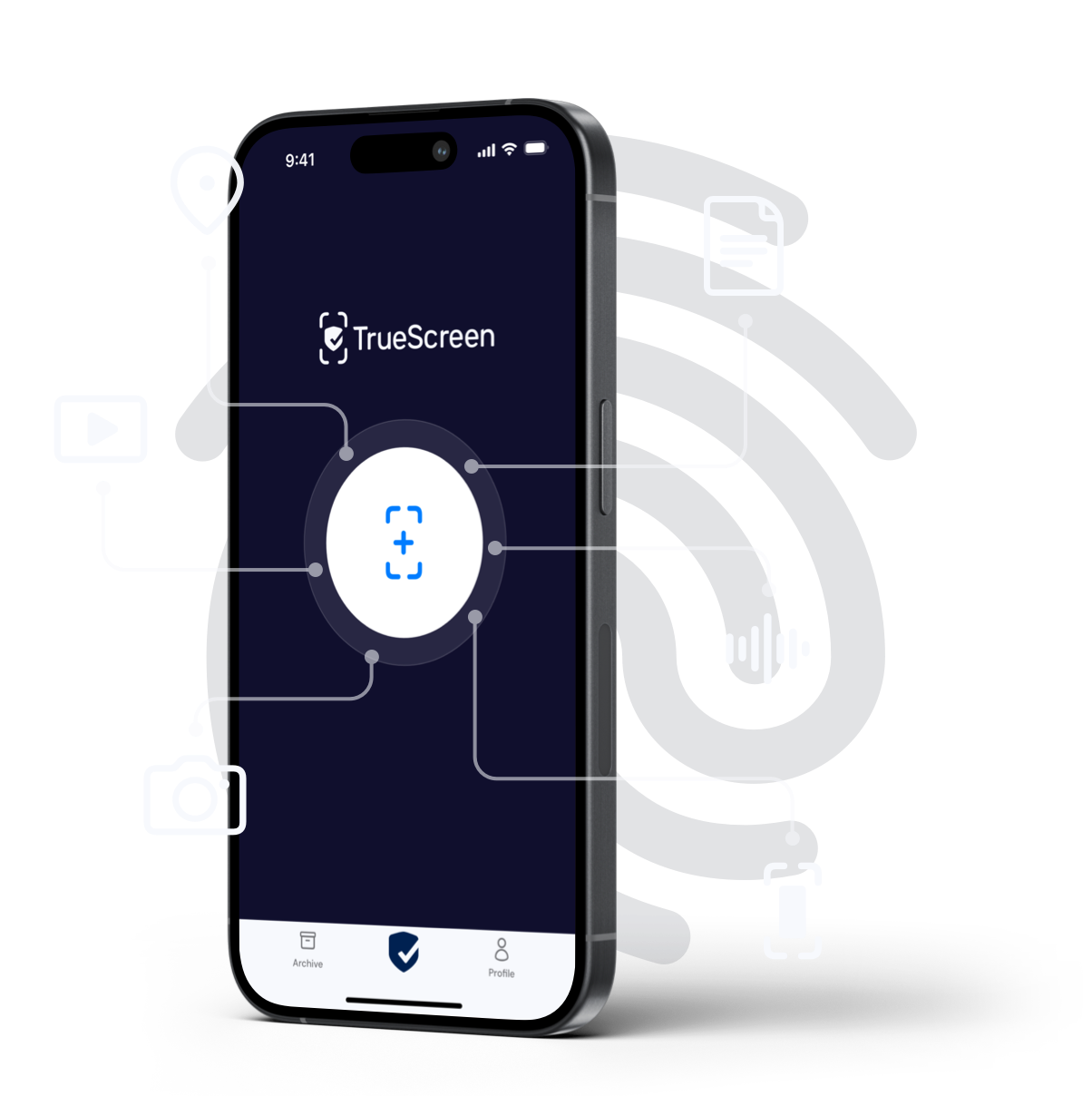
TrueScreen is the data authenticity platform that captures and certifies digital content at the source with legal value. For ephemeral content it works like this: the user acquires the Story, the Status, or the timed message straight from the smartphone while it is visible, and TrueScreen automatically applies an integrity hash, an electronic seal, and a qualified timestamp issued by a qualified QTSP integrated into the platform via API. TrueScreen does not issue certificates and does not act as a certificate authority: it integrates the seal of qualified third-party QTSPs inside its own forensic methodology. The output is an evidentiary package with a reliable date, verifiable integrity, and a documented chain of custody, enforceable against third parties and built to hold up in a dispute. The difference from a manual screenshot is not how fast you tap, but the certification that travels with every acquisition.
Three complementary solutions cover the acquisition, depending on the device at hand. The main solution on desktop is the TrueScreen Forensic Browser, an application for macOS and Windows that acquires Stories and ephemeral content visible in the browser (Instagram and Facebook web) while recording the entire browsing session in a controlled forensic environment. The Web Notarization extension for Chrome and Edge lets you quickly certify any content during normal browsing, while the TrueScreen app for iOS and Android certifies the conversation directly from the smartphone. All of them feed the same certification workflow, with SHA-256 hashing, qualified timestamping and electronic seal.
Acquisition happens through the TrueScreen mobile app, already on the smartphone the moment the content appears, so collection stays possible even inside a window of a few seconds. A short example shows how this plays out. A self-employed professional receives a defamatory accusation inside an Instagram Story. They open the app, capture the Story while it is still online, and certify it. The next day the Story no longer exists, but they hold a record with a qualified timestamp and an integrity hash attesting what was published, when, and from where. That proof holds even if the other side tries to deny it.
FAQ: ephemeral content and digital evidence
Does a screenshot of an Instagram Story count as evidence in court?
Can I certify a view-once message before it deletes itself?
What is the difference between certifying a normal chat and ephemeral content?
What makes digital evidence enforceable against third parties?
TrueScreen editorial team
Published on · Updated on
This section is edited by the TrueScreen editorial team, which brings together expertise in digital forensics, the law of digital evidence and regulatory compliance. Every article is checked against primary sources: legislation, published rulings, technical standards and official documentation, always cited in the text.


