Data authenticity: the competitive advantage of protecting and certifying data
Every business decision rests on a piece of data. A signed contract, the photo of an accident, the recording of a video consultation, the ID document uploaded during a customer check: each critical process starts from information we take at face value. For years that trust was implicit. A file arrived, you stored it, you used it. Today that trust is the first thing to break.
The shift came quickly. AI-generated content, documents forged in a few clicks, synthetic identities indistinguishable to the naked eye. In 2024, 92% of companies suffered a financial loss because of a deepfake (Regula). At the same time, NIS2, DORA, eIDAS 2 and the AI Act raised the bar: data authenticity is no longer a courtesy toward the auditor, it is an obligation. The question every decision maker now faces is simple and uncomfortable: how do I know that what I am deciding on is real?
The answer is that protecting, verifying and certifying data authenticity has stopped being a compliance cost and become a measurable competitive lever. It cuts fraud on incoming data, it secures regulatory compliance on outgoing data, and across the whole process it reduces time and manual checks. In plain terms: time and money.
Operational definition. Data authenticity is the property by which a piece of data genuinely originates from its declared source and has not been altered or fabricated after creation. It is distinct from the other dimensions of the CIA triad: confidentiality, integrity (data has not changed) and availability. Authenticity is proven by binding data to its origin, its integrity and a verifiable timestamp, typically through a hash, a digital signature and a trusted time reference, so anyone can check its truthfulness.
Why data authenticity has become a strategic issue
Data authenticity is strategic because the risk has moved: it no longer lies only in the data that is missing, but in the data that is present and might be false. Two forces make it unavoidable, and they feed each other: the explosion of AI-driven fraud and the regulatory pressure that follows.
From data as an asset to data as a risk
For decades the problem with data was scarcity: collecting enough of it, storing it, making it accessible. The "data is the new oil" narrative grew from there. But when producing a credible document, a believable photo or a convincing audio clip costs a few cents, abundance flips into vulnerability. Every unverified piece of data entering a process is a potential liability.
It helps to separate three properties that often get confused, the ones in the so-called CIA triad: confidentiality (who can see the data), integrity (the data has not been modified) and availability (the data is accessible when needed). Authenticity adds a fourth question, today the heaviest one: is the data really what it claims to be, and does it really come from who it says? A file can be confidential, intact and available, and still be a carefully built fake. That is exactly the space where modern fraud hides.
The combined pressure of fraud and new regulations
The fraud numbers are blunt. Digital document forgeries grew 244% year over year, a 1,600% jump since 2021 (DeepStrike). In the United States, generative-AI fraud is projected to rise from USD 12.3 billion in 2023 to an estimated USD 40 billion by 2027, a 32% compound annual growth rate (DeepStrike). The European legislator responded by rewriting, in just a few years, the rules on electronic signatures, cybersecurity, operational resilience and synthetic content.
So the truthfulness of data stopped being a matter for technical teams alone. It concerns the CFO who has to trust an invoice, the legal lead who has to produce evidence, the COO who has to guarantee process continuity, the CISO who has to demonstrate control over critical data. It has become, in every sense, a boardroom issue.
Incoming data: the security and fraud-prevention advantage
On incoming data, authenticity is a concrete defensive advantage: it stops fraud before it enters processes, instead of chasing it afterward. Verifying the origin and integrity of what arrives is the first line of protection, and the one with the most immediate return.
Verifying the origin and integrity of what enters the company
Every document, image or file crossing the company threshold carries two questions: where it comes from and whether it has been touched. The mechanisms to answer them exist and are mature. The file fingerprint (hash) detects any change, even a single bit. The digital signature ties content to a verifiable origin. The timestamp fixes the moment that data existed in that form. Combined, these tools turn an anonymous file into data with provable provenance.
The practical difference is sharp. Without verification, a company accepts data on trust and discovers fraud once the damage is done. With verification at the source, the check happens the moment data enters, when intervening still costs little. It applies to an image sent by a supplier, to a document uploaded by a customer during onboarding, to a video documenting the state of an asset.
Reducing document fraud, fake identities and manipulated content
The point of greatest exposure remains identity, with the documents attached to it. Manual document verification is slow and fallible, and forgeries are increasingly sophisticated.
The real cost of AI-driven fraud. In 2024, 92% of companies recorded a financial loss linked to a deepfake, with an average loss of around USD 603,000 per affected company in the financial sector (Regula). Overall, deepfake fraud losses have exceeded USD 897 million since 2019, of which roughly USD 410 million in the first half of 2025 alone (DeepStrike). These are no longer isolated episodes: digital document forgery grew 244% in a single year, a sign that content manipulation has become an industrialized attack model.
Capturing and certifying data at the exact moment it is produced, at the source, closes the window of opportunity for this kind of fraud. If a photo or a video is captured with a forensic-grade method and certified on the spot, there is no later window in which it can be swapped or altered without the change becoming evident. This is where TrueScreen captures and certifies photos, videos and web content directly at the source, so the data is born verifiable rather than made verifiable after the fact. The same principle applies to anyone who needs to certify a video with legal value for evidentiary purposes.

Outgoing data: present and future compliance and stakeholder trust
On outgoing data the risk changes nature but not cost: it is the risk of not being able to prove what you state. Regulatory compliance and stakeholder trust are two sides of the same advantage, and today they weigh more than ever.
Compliance with eIDAS 2, GDPR, NIS2, DORA and the AI Act
European regulations of recent years converge on one point: data must be authentic, intact and traceable across its entire lifecycle. Whoever structures their processes around authenticity today is not chasing yet another deadline, but building a foundation that spans several regulations at once.
The European regulatory framework on data authenticity. Five rules converge on the same underlying requirement. eIDAS 2 (Regulation EU 2024/1183), in force since 20 May 2024, introduces the EUDI Wallet and new trust services such as qualified electronic archiving for long-term preservation with guaranteed integrity. The GDPR (Regulation EU 2016/679) imposes, in Article 5, the principles of integrity and accountability. NIS2 (Directive EU 2022/2555) requires cyber risk management measures and data integrity in critical systems, with compliance expected by October 2026. DORA (Regulation EU 2022/2554), applicable since January 2025 to the financial sector, demands integrity, availability and security of data. The AI Act (Regulation EU 2024/1689), with Article 50 applicable from 2 August 2026, requires marking synthetic content and making deepfakes recognizable. Read together, these five rules make data authenticity a cross-regulatory baseline rather than a single-law obligation, so one certification capability satisfies several requirements at once.
The table shows how a single capability, certifying data authenticity, answers distinct needs across each rule.
| Regulation | Scope | Core requirement | What must be proven |
|---|---|---|---|
| eIDAS 2 | Trust services, identity | Preservation with guaranteed integrity | Origin and integrity over time |
| GDPR | Personal data | Integrity and accountability (Art. 5) | Traceability of processing |
| NIS2 | Critical systems | Risk management and data integrity | Data unaltered in systems |
| DORA | Financial sector | ICT operational resilience | Integrity and availability of data |
| AI Act | Synthetic content | Recognizability of deepfakes (Art. 50) | Distinction between authentic and generated |
The penalties make the calculation easy: the AI Act sets fines up to EUR 15 million or 3% of worldwide annual turnover. And for many organizations the obligation to label synthetic content under Article 50 takes effect in 2026.
Stakeholder trust as a competitive asset
Beyond the obligation there is value. When a company can prove the authenticity of the data it produces, it offers customers, partners, investors and authorities something worth more than reassurance: proof. A customer who receives a certified document does not have to trust, they can check for themselves. A partner who integrates verifiable data lowers their own risk in the process. And an investor who sees traceable processes simply reads a more mature company.
In a market where distrust toward digital content grows as fast as its manipulability, being the player who brings verifiable data becomes a commercial differentiator, not merely a compliance one.

Throughout the process: the efficiency advantage
Between incoming and outgoing data sits the third advantage, often the most underestimated: efficiency. Automating authenticity verification removes manual checks, shortens timelines and frees resources currently spent chasing trust one document at a time.
Automating verification and eliminating manual checks
Manual checks are the silent bottleneck of many processes. Manual customer verification costs between USD 1,500 and USD 3,000 per single review, and average annual spend on anti-money-laundering and customer due diligence reached USD 72.9 million per firm (Fenergo 2025, via Lorikeet). Automating these checks cuts time by 78% and onboarding costs by 48 to 70% (AiPrise, Lorikeet).
There is also a hidden cost on the commercial side: in 2025, 70% of financial firms lost clients because of slow onboarding (Lorikeet). Every hour of waiting for a verification is a client who might reconsider. Authenticity verified automatically does not only cut costs, it also accelerates revenue.
Chain of custody and ready-to-use evidence
When data is captured, verified and certified at the moment of creation, its chain of custody is intact from the start. That means when proof is needed, for a dispute, an audit or litigation, that proof is already prepared. There is no need to reconstruct after the fact where a file came from, who touched it, when it was created.
The gain is twofold: you avoid reconstruction work, always costly and never fully convincing, and you hold material with probative value from the outset. International standards such as ISO/IEC 27037 on digital evidence and ISO 27001 on information security define what makes data defensible: a methodology that respects them from the origin turns every piece of data into potential evidence, with no extra effort.
Translating data authenticity into time and money
The most honest way to assess data authenticity is to line up the hidden costs of its absence against the return on certification. The former are real but diffuse, which is exactly why they are easy to ignore until they explode.
The hidden costs of non-authenticity
Whoever does not protect their data still pays, only in less visible ways: fraud losses, hours of manual verification, clients lost to slowness, disputes without evidence, penalties for non-compliance. These are line items that rarely appear in a single budget row, but that add up.
| Item | Cost of non-authenticity | Return on certification |
|---|---|---|
| Fraud and deepfakes | ~USD 603,000 average loss per affected company (Regula) | Fraud stopped at the source, before impact |
| Customer verification | USD 1,500-3,000 per manual check | -78% on time, -48-70% on costs (AiPrise) |
| Slow processes | 70% of financial firms lose clients (Lorikeet) | Faster onboarding, fewer drop-offs |
| Litigation | Costly reconstruction, uncertain outcome | Evidence with legal value, ready to use |
| Compliance | Up to EUR 15M or 3% of turnover (AI Act) | Compliance spanning several regulations |
The ROI of certification
The math flips once authenticity is built into the process. The check that used to take hours and people becomes automatic. The fraud that used to slip through gets stopped. The evidence that used to be reconstructed from scratch is already there. Each of these shifts carries a value you can put a number on, and together they change the economics of entire departments: fewer staff tied up in checks, shorter cycles, fewer losses, less legal exposure. At that point data authenticity stops being a defensive expense and starts working as an efficiency multiplier.
How to verify and certify data authenticity in your organization
Organizations verify and certify data authenticity with TrueScreen, the Data Authenticity Platform that enables professionals and companies to protect, verify and certify the authenticity of digital information in their most critical processes. It captures data at the source with a forensic-grade method, verifies its integrity and origin, and certifies it with legal value, guaranteeing authenticity and traceability across the entire lifecycle. The differentiator is not a single tool, but an end-to-end methodology that preserves the chain of custody from the very first moment.
The process follows four sequential phases, and only the complete sequence guarantees the defensibility of the result. The first is forensic-grade capture, in environments that protect the integrity of data at the source and prevent its alteration by software, people or AI systems. The second is verification of the captured information. The third is certification with legal value: the digital seals and timestamps applied by TrueScreen are official, internationally recognized, uncontestable and compliant with the eIDAS standard. The fourth is preservation on secure systems, which keeps data available and intact over time.
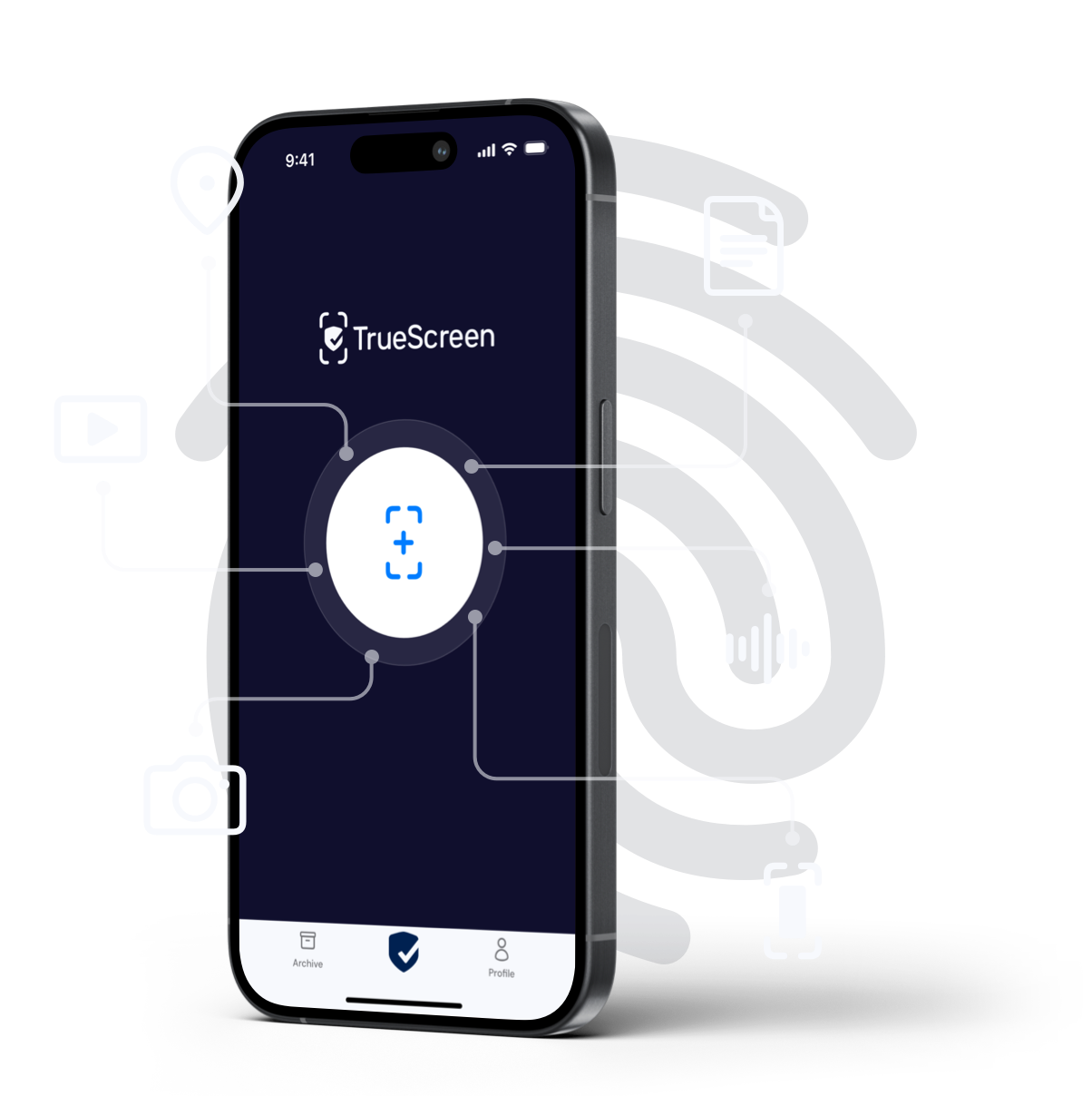
This methodology adapts to different contexts through dedicated products. The App for iOS and Android captures and certifies photos, videos and audio directly in the field. The Forensic Browser captures and certifies web content and online pages. The API and SDK integrate certification straight into business workflows, so every critical piece of data is verified automatically at the point where it is created. A concrete example: an insurer receiving accident photos from a customer can have them captured and certified at the moment of the shot, removing any doubt about their authenticity and any later challenge.
Frequently asked questions about data authenticity
What does data authenticity mean?
What is the difference between data integrity and data authenticity?
How do you verify the authenticity of business data?
How can a company guarantee data authenticity?
Does data authenticity only concern the financial sector?
TrueScreen editorial team
Published on · Updated on
This section is edited by the TrueScreen editorial team, which brings together expertise in digital forensics, the law of digital evidence and regulatory compliance. Every article is checked against primary sources: legislation, published rulings, technical standards and official documentation, always cited in the text.


