AI disinformation in 2026: when fake outpaces real and why certifying the authentic wins
For years, disinformation was a problem of manageable volume: doctored text, retouched photos, invented quotes that travelled slower than newsrooms could correct them. In 2026 that ratio broke. During this year's crises and major media events, AI-generated fake content began to outpace traditional disinformation by sheer volume, to the point that, according to BBC Verify, the 2026 Iran conflict may have already broken the record for the amount of AI-generated content going viral during a war.
The trap is that chasing the fake is a reactive race, and a losing one. By the time a synthetic video has racked up a hundred million views, the debunk arrives after the damage is done. So the question every exposed organization should be asking has shifted: not "how do I spot the fakes that target me", but "how do I prove that my own content and data are authentic". The governing answer of this article is that 2026 marks a turning point at which it pays to flip the perspective: instead of running after AI disinformation one clip at a time, certify the authentic at the source, so that what is true stays demonstrably true.
Why 2026 is the turning point for AI disinformation
2026 is the year fake AI content stopped being the exception and became the constant background noise of the information space. This is not a perception, it is a measurement. During the Iran conflict, fact-checkers tracked fake videos drawing tens of millions of views in a matter of days, alongside campaigns that imitated real news outlets and inserted synthetic footage precisely when actual strikes were under way and verification was hardest.
The same pattern repeated far from any war zone. As the 2026 World Cup opened on 11 June, synthetic images and video of every kind went viral: fabricated opening-ceremony shots, manipulated photos of crowds in the stands, clips built from real footage but recomposed to depict events that never happened. The mechanism is always the same: generative tools have become cheap and fast enough to put credible fakes within reach of anyone, while platforms have thinned out their verification teams and AI authenticity checkers like Grok and Gemini have repeatedly mislabelled synthetic media as genuine.
So the disinformation of 2026 carries three new traits that set it apart from earlier years. Volume, because producing a fake now costs almost nothing. Speed, because a synthetic clip travels faster than its correction. And plausibility, because the quality of synthetic images, video and audio has crossed the threshold beyond which the human eye no longer tells the difference. It is a terrain structurally hostile to anyone chasing the fake, and structurally favourable to anyone who can vouch for the real, much as we argued when looking at how war and disinformation reshape data authenticity.
Why chasing deepfakes is a battle already lost
Relying on detection alone means accepting a permanent disadvantage. Whoever generates synthetic content always holds a timing and technology lead over whoever tries to expose it: every new generative model degrades the detection tools built against the previous one. The logic is that of a chase where the pursued sets the pace, which is exactly why detection tools keep proving unreliable at scale.
The problem is not only technical, it is a shift of paradigm. For decades we treated digital content as authentic unless proven otherwise. Today the opposite holds: any image, video or document is potentially untrustworthy until it is vouched for as authentic. In this new equilibrium the useful question is no longer "is this content fake?", but "is this content demonstrably true?". It is a distinction that changes an organization's whole defensive posture, as we explored in comparing deepfake detection against source certification.
For a company or a newsroom the stakes are concrete. A doctored product photo, a fake statement attributed to management, an altered video showing an executive saying things they never said: in each case the reputational damage lands in the hours before any correction reaches the same audience as the fake. And even when the correction arrives, the burden of proof remains. Saying "that wasn't me" is not enough: you need to be able to demonstrate what, instead, is authentic. This is where the cost of disinformation for businesses becomes measurable in lost trust, litigation and time pulled away from work.

What certifying the authentic at the source means
Certifying the authentic at the source means acquiring a piece of content at the moment it is produced or captured and binding it immutably to its origin, its date and its integrity, before it can ever be called into question. It is the opposite of detection: you do not analyse a suspect file to decide whether it is fake, you certify a genuine one so it stays verifiable over time. The value of this approach is that it moves the burden of proof to the right side: whoever holds certified content does not have to chase whoever disputes it, the proof is already in hand.
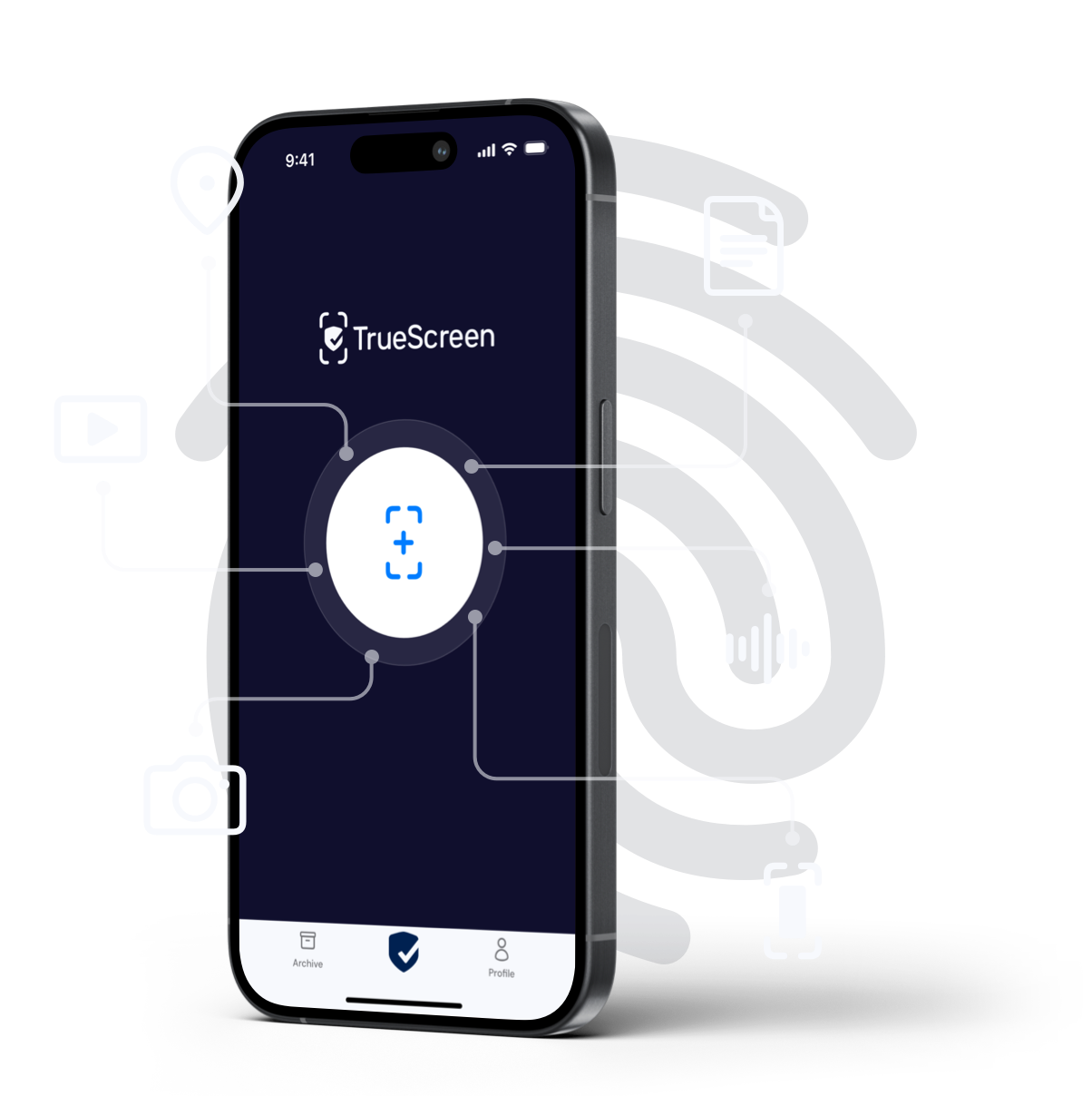
TrueScreen is the Data Authenticity Platform that enables this change of perspective. It acquires content and data with forensic methodology at the source, verifies their integrity and authenticity, and applies an electronic seal and a qualified timestamp issued by a qualified QTSP integrated via API. The result is authentic content that stays demonstrably authentic, defensible and enforceable against third parties, without the organization depending on detection tools that are always one step behind the generators. This principle of traceable origin is what we call Digital Provenance: the verifiable history of a piece of content from the moment it is born.
Acquisition with forensic methodology
Forensic acquisition captures the content and its technical context at the exact moment of creation, fixing the data that proves its origin. It is not an ordinary screenshot: it is a procedure that records, in a structured way, what was acquired, when and under which conditions, so the certified object remains reconstructable and verifiable long afterwards. The difference from a file saved by hand is the same as the difference between a personal note and an official record.
Electronic seal and qualified timestamp
An electronic seal and a qualified timestamp are then applied to the acquired content. Both are issued by a qualified QTSP integrated into TrueScreen via API: the platform does not replace the trust service provider, it integrates its guarantees into its own process. The qualified timestamp proves a certain date in an enforceable way, while the seal proves the content was not altered after certification. Together they make any later tampering detectable and demonstrable.
Defensible evidence and legal value
Certified content becomes evidence with legal value, built according to a methodology that preserves its chain of custody. For those operating in regulated environments this means being able to bring, before a court, an authority or a stakeholder, not an assertion but a record whose authenticity can be verified independently. That is the difference between defending yourself and proving your case.
What the rules already ask: eIDAS and the AI Act
The European regulatory framework is moving in the same direction as the paradigm shift. The eIDAS Regulation governs electronic seals and qualified timestamps and defines their evidentiary weight: certifying content with these instruments means leaning on a standard recognized across the Union, not on a proprietary guarantee.
On synthetic content, the EU AI Act introduces transparency obligations in Article 50 that become applicable on 2 August 2026. The rule requires that content generated or manipulated by AI be marked in a machine-readable format and that deepfakes be disclosed as artificially generated. It is an institutional acknowledgement of the problem: if lawmakers compel the labelling of the synthetic, the other side of the same coin is being able to reliably demonstrate what is not synthetic. The two reinforce each other, as we described when analysing the AI Act transparency obligations for companies. The Code of Practice on transparency of AI-generated content, published by the European Commission on 10 June 2026, sketches how that marking should work in practice.
For a compliance lead, the convergence of eIDAS and the AI Act is an operational signal: the guarantee of authenticity is no longer just a sound defensive habit, it is becoming part of the language with which both regulation and the market expect digital content to be handled. Coordinated influence operations such as the Storm-1516 campaign show how far adversaries will go, and building a corporate disinformation defence now, one that pairs source certification with regulatory compliance, is the most solid way to arrive prepared.
Turning point, not a losing chase
2026 has made plain what had been signalled for some time: in the contest between real and fake, the fake has gained volume, speed and credibility. Defending yourself by chasing every synthetic clip is a strategy that starts out behind. The lever still in organizations' hands is the opposite one, and the stronger one: certify the authentic at the source, turning your own content and data into defensible evidence that holds up before clients, authorities and courts. It is not a defence against deepfakes: it is the way to make them irrelevant.
FAQ: AI disinformation and content certification
Is AI-generated fake content really outpacing real content in 2026?
Why is detecting deepfakes a losing strategy?
How does certifying content at the source protect a company's reputation?
What do eIDAS and the EU AI Act require for synthetic content?
TrueScreen editorial team
Published on · Updated on
This section is edited by the TrueScreen editorial team, which brings together expertise in digital forensics, the law of digital evidence and regulatory compliance. Every article is checked against primary sources: legislation, published rulings, technical standards and official documentation, always cited in the text.


