
Spoliation of evidence: what courts do when digital evidence disappears
When the duty to preserve begins, how far a preservation letter really reaches, and how federal courts respond when posts, chats and web pages are lost.
Updated on
Spoliation of evidence is, in the Second Circuit’s words in West v. Goodyear Tire & Rubber Co. (1999), “the destruction or significant alteration of evidence, or the failure to preserve property for another’s use as evidence in pending or reasonably foreseeable litigation.” For lost electronically stored information (ESI) in federal court, Rule 37(e) allows curative measures for prejudice and reserves an adverse inference, dismissal or default for intent to deprive.
Key takeaways
- The duty to preserve arises when litigation is reasonably foreseeable; the 2015 Committee Note says Rule 37(e) does not create a new duty (FRCP 37, Committee Note 2015).
- A spoliation letter puts the recipient on notice and dates its knowledge, but it does not create the duty, bind a platform or capture any content (18 U.S.C. § 2703(f)).
- Under Rule 37(e)(1), prejudice allows measures no greater than necessary; under Rule 37(e)(2), an adverse inference, dismissal or default requires intent to deprive (FRCP 37(e)).
- Deleted Facebook photos, Signal auto-delete and 24-hour chat deletion have led to adverse inferences and default (Allied Concrete v. Lester, FTC v. Noland, Epic v. Google, WeRide v. Huang).
- Platforms generally refuse civil requests for content under the Stored Communications Act, so a public post you need is best captured yourself, at once (Crispin v. Christian Audigier, 2010).
25%
of webpages that existed between 2013 and 2023 were no longer accessible by October 2023
Nearly 1 in 5
tweets were no longer publicly visible within months of posting
Today spoliation of evidence is more often a deleted Facebook photo, a Signal thread on auto-delete or an edited web page than a shredded file. Online content is fragile anyway: the Pew Research Center found that 25% of webpages that existed between 2013 and 2023 were gone by October 2023, including 38% of pages from 2013, and that nearly 1 in 5 tweets stopped being publicly visible within months.
Most of the risk sits in timing: the duty to preserve often starts earlier than people assume, Rule 37(e) punishes intent far harder than carelessness, and posts you need are safest captured before any notice goes out. This piece expands one part of preserving digital evidence for litigation.
This insight is part of our guide: How to Preserve Digital Evidence for Court: The Complete Guide
What spoliation of evidence is and when the duty to preserve starts
Spoliation of evidence happens when relevant evidence is destroyed, altered or not preserved after the duty to preserve has arisen. Courts generally hold that the duty starts when litigation is reasonably foreseeable, often before any complaint is filed.
The duty to preserve comes from the anticipation of litigation, not from a letter or a filed lawsuit.
The trigger: reasonable anticipation of litigation
The 2015 Committee Note to Federal Rule of Civil Procedure 37 asks judges to consider “the extent to which a party was on notice that litigation was likely and that the information would be relevant.” It adds that Rule 37(e) “does not attempt to create a new duty to preserve”: the rule rests on the common-law duty, does not reach information lost before it arises, and asks for reasonable steps, not perfection.
What a spoliation letter does, and what it cannot do
A spoliation letter, also called a preservation letter or spoliation notice, puts the recipient on notice that litigation is expected and asks them to keep specific evidence. Its practical value is a date: after it arrives, the recipient can hardly claim ignorance.
A letter does not create the duty to preserve, and it does not bind a platform. Non-parties generally have no duty to preserve without a subpoena, a contract or a court order, and the provider preservation request in 18 U.S.C. § 2703(f) belongs to governmental entities. Nor does a letter capture anything: if the post is gone tomorrow, it proves you asked, not what the post said. The sender is rarely off the hook either: a party ready to write one usually anticipates litigation, so its own duty has normally started.
What federal courts do when electronically stored information is lost
Under FRCP 37(e), a court acts on lost electronically stored information only when four conditions are met: the information should have been preserved in the anticipation or conduct of litigation, it was lost, the loss happened because a party failed to take reasonable steps to preserve it, and it cannot be restored or replaced through additional discovery.
Rule 37(e) separates prejudice from intent, and the harshest spoliation sanctions require intent to deprive.
Rule 37(e) covers ESI in federal court; for state courts and tangible evidence, the rules may differ.
Prejudice: measures no greater than necessary
Under Rule 37(e)(1), a court that finds prejudice to another party “may order measures no greater than necessary to cure the prejudice.” No intent is required, so careless loss still has consequences. The Committee Note’s example: letting the parties present evidence and argument to the jury about the loss.
Intent to deprive: adverse inference, dismissal, default
Under Rule 37(e)(2), the court needs a finding that a party acted with intent to deprive another party of the information’s use in the litigation. Only then may it presume the information was unfavorable, instruct the jury that it may or must presume so, or dismiss the action or enter a default judgment. In federal court, for lost ESI, an adverse-inference presumption or instruction requires a finding of intent to deprive. The 2015 Committee Note rejects cases that allowed it for negligence or gross negligence.
| Question | Rule 37(e)(1) | Rule 37(e)(2) |
|---|---|---|
| Required finding | Prejudice to another party | Intent to deprive another party of the information’s use |
| Prejudice required? | Yes | No (2015 Committee Note) |
| Available measures | No greater than necessary to cure the prejudice | Unfavorable presumption, adverse inference instruction, dismissal or default |
Deleted posts and disappearing chats in recent cases
The same facts keep showing up in social media and messaging cases: auto-delete left on, an app removed, a profile “cleaned up.”
In Allied Concrete Co. v. Lester (Supreme Court of Virginia, 2013), the plaintiff deleted 16 Facebook photos after his lawyer’s office told him to “clean up” his profile. The trial court sanctioned the lawyer $542,000 and the client $180,000 and gave an adverse-inference instruction, in a state case outside Rule 37(e).
In FTC v. Noland (D. Ariz., Aug. 30, 2021), executives used Signal, apparently with auto-delete on, and deleted the app before their phones were imaged. The court found intent to deprive under Rule 37(e)(2) and ordered an adverse inference.
In Epic Games v. Google (N.D. Cal.), Judge James Donato found on March 28, 2023 that Google had not suspended 24-hour deletion of internal chats after the case began. The jury instruction said jurors “may infer” the deleted chats were unfavorable to Google.
WeRide v. Huang (N.D. Cal. 2020) is the bluntest: ephemeral DingTalk messages, emails deleted after 90 days and wiped laptops ended in terminating sanctions and default under Rule 37(b), Rule 37(e) and inherent power.
Platforms rarely fill the gap. They generally refuse to give content to private parties in civil cases, citing the Stored Communications Act, and Crispin v. Christian Audigier (C.D. Cal. 2010) quashed civil subpoenas for private messages. The SCA’s reach against private litigants is contested, but if you need a public post, capture the social media evidence yourself, now.
How do you capture a certified record of web pages, social posts and chats before they disappear?
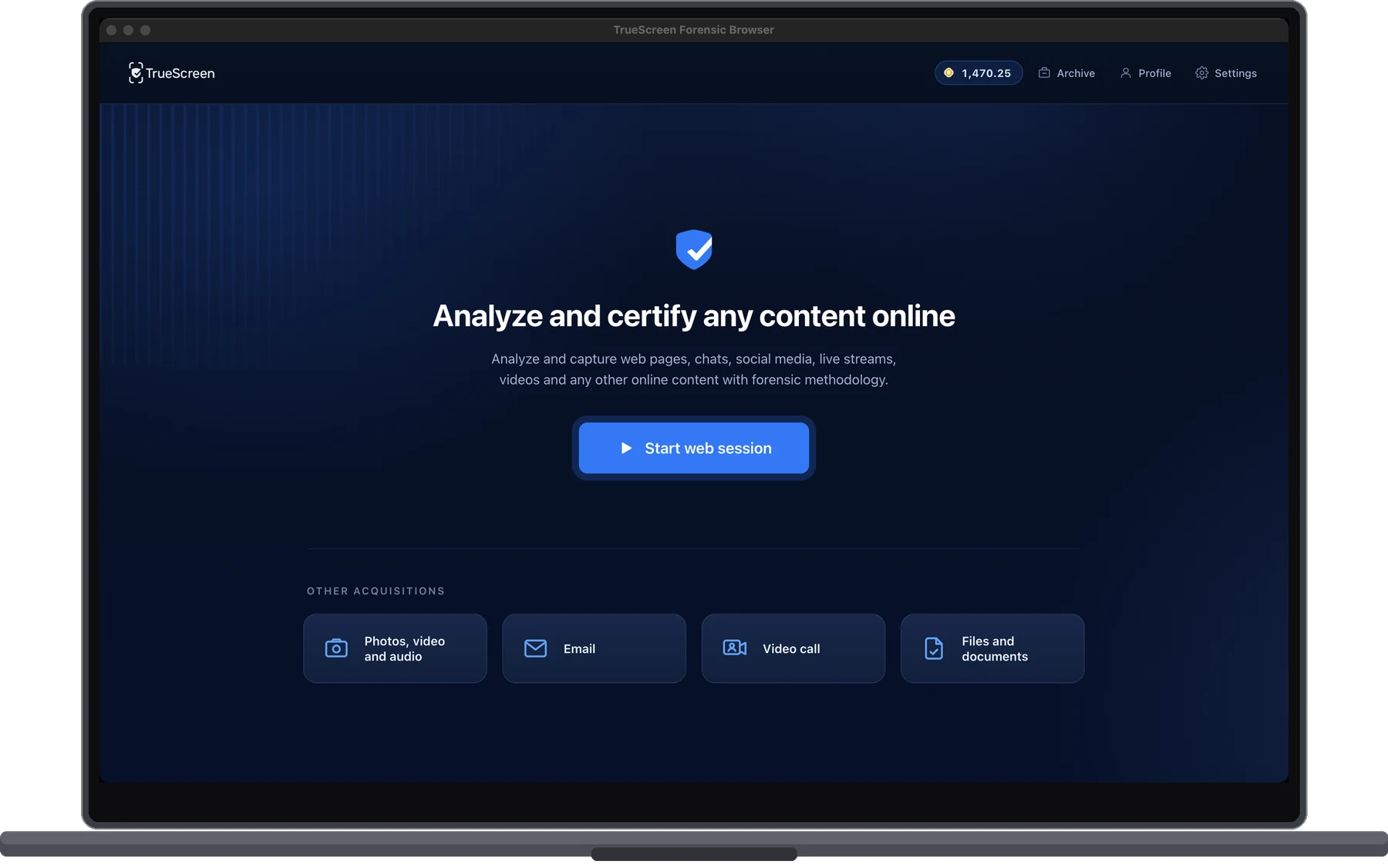
TrueScreen, the Data Authenticity Platform, certifies what a web page, social profile or chat showed at the moment of acquisition, sealing it with a qualified electronic seal and a qualified timestamp. TrueScreen is not a continuous web archive: it certifies a page, profile or chat as it was acquired. The record shows what was visible then; the original can still be deleted.
Capture what you need at the source while it is still visible, and let the preservation letter do its separate job.
Why a screenshot is a weak record
A screenshot taken without TrueScreen shows pixels but not how, when or where they were acquired, and the other side can question each point (see screenshot evidence in court). Certifying an existing screenshot fixes the file from that day, not the moment it was taken.
Picture a lawyer whose client sends screenshots of a former partner’s public posts: before sending a preservation letter, the lawyer certifies the live pages. This is a scenario, not legal advice, for content that is public or reachable with your own account.
-
List what can disappear first
Start with content you do not control: public posts, profiles, comments, web pages and chats on a client’s phone. Rank them by how fast they could go, then certify what is at risk with the tool you already have.
-
Acquire it at the source
The TrueScreen Forensic Browser acquires public posts and web pages in a controlled browsing session, with a technical report of how each page was captured. Each acquisition starts with browsing data cleared and saves the server source, an MHTML archive, a PNG image, a navigation video and chained SHA-256 fingerprints. Use it when the other side could contest how a page was acquired.
The Browser Extension for Chrome and Edge works in sessions you already have open, logged-in pages included, recording a screenshot or tab video with hashes of the rendered page and server source. When content matters and speed counts, it does the job.
A chat that exists only on a phone is certified with screen recording in the TrueScreen App while the conversation is scrolled. That recording does not replace native preservation of the messages and their metadata, which discovery may require.
-
Seal the record and hand it to counsel
Every certification carries an official digital seal and a qualified timestamp, recognized internationally. Alteration is prevented during the acquisition and detectable afterwards. The public verifier checks the seal and timestamp and recomputes SHA-256 fingerprints in the browser; it does not validate the seal certificate against EU trusted lists or revocation. A certification attests how and when content was acquired, not whether it is true. TrueScreen cites Federal Rule of Evidence 901, including 901(b)(9) on evidence about a process or system, as context for authenticating certified content in the United States. Admissibility is decided by the court. Then hand the package to counsel.
Conclusion
Spoliation disputes are usually decided on dates: when litigation became foreseeable, when the information disappeared, and what each party knew at that moment. A preservation letter fixes one of those dates, Rule 37(e) decides how much the loss costs, and a certified acquisition made while the content is still online gives counsel a record of what was visible, even if the original is deleted later. This article is general information, not legal advice; rules vary by jurisdiction.
FAQ: spoliation of evidence
What is a spoliation letter, and who can send one?
A spoliation letter, also called a preservation letter, is a written notice asking a person or company to keep specific evidence because litigation is expected. It is usually sent by a lawyer for a party expecting to sue or be sued, and it puts the recipient on notice from the date it arrives. It does not create the duty to preserve, which courts generally tie to reasonably foreseeable litigation, and it does not capture any content.
What are the sanctions for spoliation of evidence?
For lost electronically stored information in federal court, Rule 37(e)(1) allows measures no greater than necessary to cure the prejudice to the other party. Under Rule 37(e)(2), a finding of intent to deprive can lead to a presumption that the information was unfavorable, an adverse inference instruction, dismissal or default judgment. State courts and tangible evidence may follow different rules.
How do you prove spoliation of evidence?
Under Federal Rule of Civil Procedure 37(e), the moving party shows that the ESI should have been preserved, that it was lost because the other party failed to take reasonable steps, and that it cannot be restored or replaced through additional discovery. The court then looks for prejudice under Rule 37(e)(1) or intent to deprive under Rule 37(e)(2). Dates carry weight: when the duty arose, when the data was lost and what the party knew at the time.
Is deleting social media posts spoliation?
It can be, if the duty to preserve has arisen and the posts are relevant to the case. In Allied Concrete Co. v. Lester (Supreme Court of Virginia, 2013), the trial court sanctioned a lawyer $542,000 and his client $180,000 after the client deleted 16 Facebook photos following advice to “clean up” his profile.
What is an adverse inference instruction?
An adverse inference instruction tells the jury it may, or must, presume that lost evidence was unfavorable to the party that lost it. In federal court, for lost ESI, an adverse-inference presumption or instruction requires a finding of intent to deprive under Rule 37(e)(2). In Epic Games v. Google, jurors were told they “may infer” that deleted Google Chat messages held evidence unfavorable to Google.
Sources and verification
Every figure and principle cited here links to its source, listed with type and date. Links checked on the publication date.
| Source | Type | Date | What it supports |
|---|---|---|---|
| Federal Rule of Civil Procedure 37(e) and 2015 Committee Note | Law | 01/12/2015 | Four conditions for lost ESI, the two tiers of measures and the Committee Note on the duty, notice and negligence |
| Federal Rule of Evidence 901 | Law | 2011 | Authentication, including 901(b)(9) evidence about a process or system |
| 18 U.S.C. § 2703(f) | Law | 1986 | Provider preservation requests available to governmental entities |
| West v. Goodyear Tire & Rubber Co., 167 F.3d 776 (2d Cir.) | Case law | 12/02/1999 | Definition of spoliation used by the Second Circuit |
| Allied Concrete Co. v. Lester, 285 Va. 295 (Supreme Court of Virginia) | Case law | 10/01/2013 | Deleted Facebook photos, trial court sanctions of $542,000 and $180,000 and adverse-inference instruction |
| FTC v. Noland, No. CV-20-00047-PHX-DWL (D. Ariz.) | Case law | 30/08/2021 | Signal auto-delete, intent to deprive under Rule 37(e)(2) and adverse inference |
| In re Google Play Store Antitrust Litigation (Epic Games v. Google), findings on chat preservation (N.D. Cal.) | Case law | 28/03/2023 | 24-hour chat deletion not suspended after the case began |
| Epic Games v. Google, final jury instructions, Instruction No. 13 (N.D. Cal.) | Document | 06/12/2023 | Permissive inference: jurors may infer deleted chats were unfavorable to Google |
| WeRide Corp. v. Kun Huang, No. 5:18-cv-07233-EJD (N.D. Cal.) | Case law | 24/04/2020 | Ephemeral DingTalk messages, email deletion and wiped laptops leading to terminating sanctions and default |
| Crispin v. Christian Audigier, Inc., 717 F. Supp. 2d 965 (C.D. Cal.) | Case law | 26/05/2010 | Civil subpoenas to social platforms for private messages quashed under the Stored Communications Act |
| Pew Research Center, When Online Content Disappears | Survey | 17/05/2024 | Share of webpages and tweets that are no longer accessible |
Certify web pages, posts and chats while they are still online
Acquire the content at the source with the Forensic Browser, the Browser Extension or the App, and receive a certification with a qualified electronic seal, a qualified timestamp and a technical report to share with counsel.



TrueScreen editorial team
This section is edited by the TrueScreen editorial team, which brings together expertise in digital forensics, the law of digital evidence and regulatory compliance. Every article is checked against primary sources: legislation, published rulings, technical standards and official documentation, always cited in the text.
