
Possession of site: what to record in a pre-construction survey before works begin
What to write into the possession record on day zero, which site evidence to gather before excavation starts and how to keep the photos verifiable months later.
Updated on
A pre-construction survey records the condition of the site, its access routes and the neighboring buildings on the day the employer gives the contractor possession of site, before any excavation starts. Signed by both parties and backed by photos whose date and location can be verified, it becomes the baseline for every later claim about cracks, utilities or unavailable areas.
Key takeaways
- Under Sub-Clause 2.1 of the FIDIC 2017 Red Book, the employer must give access to and possession of the site within the time stated in the Contract Data.
- The Commencement Date is notified at least 14 days in advance and falls within 42 days after the Letter of Acceptance (FIDIC 2017, Sub-Clause 8.1), while possession can be given in stages.
- A reservation in the possession record does not replace a Notice of Claim, which FIDIC 2017 Sub-Clause 20.2.1 requires within 28 days of awareness.
- HKA’s eighth CRUX Insight report, on more than 2,200 projects, found that sums in dispute averaged 33.4% of contract budgets.
- Under Article 41(2) of the eIDAS Regulation, a qualified electronic timestamp enjoys a presumption of accuracy of its date and time and of the integrity of the bound data.
Every construction contract has a day zero. On the day the employer gives the contractor possession of site, someone walks the site and signs a possession record, and that record is where the pre-construction survey belongs.
The trouble is that the record is often a few lines of text and a batch of phone photos in a shared folder, so when a neighbor later points at a crack, each party reads that record its own way. That ambiguity is expensive: the Arcadis 2026 Construction Disputes Report puts the average dispute at US$56 million and 12.16 months, with differing site conditions among the causes respondents cite most often.
So what should you record, and how do you make it hold up? Document the site item by item, attach evidence to every statement, and bind photos and videos to the signed record so nobody can later dispute when they were taken.
What possession of site means and why it sets day zero of the contract
Possession of site is the act by which the employer gives the contractor access to, and control of, the land where the works will be built; under Sub-Clause 2.1 of the FIDIC 2017 Red Book it must happen within the time stated in the Contract Data. The date of possession, and the condition recorded on that date, become the reference point for time, cost and liability on everything that follows.
If the employer is late and the contractor suffers delay or cost as a result, Sub-Clause 2.1 entitles the contractor, through the claims procedure of Sub-Clause 20.2, to an extension of time and Cost Plus Profit. US public contracts usually work through a notice to proceed, yet the principle holds: both parties accept a date, an area and its condition.
Possession of site vs Commencement Date (FIDIC 2.1 and 8.1)
The two dates often coincide, though they answer different questions. Under Sub-Clause 8.1 of the 2017 Red Book, the engineer notifies the Commencement Date at least 14 days in advance, within 42 days after the Letter of Acceptance unless the Particular Conditions say otherwise, and the Time for Completion runs from it. Possession concerns physical access and can be given in stages, so the commencement of works can come before the contractor holds every part of the site, and that gap is where delay claims tend to grow.
Who signs the possession record
The 2017 Red Book sets no standard form for the possession record, so in practice the engineer or contract administrator signs for the employer and the contractor’s representative for the contractor. On public contracts the contracting authority’s representative signs, and the record joins a procurement file where certified evidence in digital public procurement carries more weight than loose attachments. If one side refuses to sign, write the refusal and its reasons into the record.
What a possession record and pre-construction survey should contain
A possession record should state what is handed over, in what condition, with which reference points and what is not yet available. Each line needs evidence behind it, because a statement with no photo, measurement or reference point is an opinion the other party can reject later.
The essential items
You can use this table as a template for the record, filling in each row and attaching the evidence listed next to it.
| Item | Why it matters | Evidence to attach |
|---|---|---|
| Date, time and attendees | Fixes day zero and who confirmed it | Signed record with names and roles |
| Boundaries of the area | Defines where the contractor’s responsibility starts | Marked plan, geolocated photos of corners and fences |
| Items of reference | Every setting-out operation depends on them | Survey sheet, close-up of each benchmark |
| Existing structures | Separates existing defects from new damage | Photos and video, cracks shot next to a ruler |
| Neighboring buildings | Most frequent source of third-party claims | Condition survey of each building |
| Access routes and roads | Road damage is often claimed at the end | Video of each route, photos of surfaces |
| Utilities and buried obstructions | Unknown utilities drive cost and delay | Photos of manholes and markers, drawings received |
| Areas not yet available | Basis for partial possession and extension of time | Marked plan, photos of the obstruction |
| Reservation of rights | Preserves the contractor’s rights | Written statement, reference to the formal notice |
When site conditions differ from the design
If the site does not match the drawings, photograph the difference and notify it on the day, because the pre-construction survey is often the earliest evidence of what was visible. Under the 2017 Red Book, Sub-Clause 2.5 requires the employer to make its site data available and to specify the items of reference (original survey control points, lines and levels), and Sub-Clause 4.7 asks the contractor to verify them before use, so a missing benchmark belongs in the record as well.
Partial and early possession
Sub-Clause 2.1 speaks of the time or times stated in the Contract Data, so possession can be given area by area when a building is still occupied or a utility diversion is pending. If the contractor receives the northern half of a site while a substation on the southern half awaits relocation, geolocated, time-stamped images of the fenced substation show what could not be worked on, the factual basis of any later extension of time.
Notices and claims raised at possession
A reservation of rights in the possession record does not replace the contractual notice. Under Sub-Clause 20.2.1 of FIDIC 2017, a Notice of Claim is due no later than 28 days after the claiming party became aware, or should have become aware, of the event, so describe the facts in the record and send the formal notice in parallel, quoting the record.
Where disputes start when the record relies on words
Most site disputes turn on what was there before the works, and a record made only of words leaves that question open. When nobody can prove the starting condition, every crack and every unexpected pipe turns into a negotiation, and those negotiations run long and cost money.
The HKA CRUX Insight eighth annual report, covering more than 2,200 projects in 114 countries, found that sums in dispute averaged 33.4% of contract budgets and that contractors sought time extensions equal to 65.8% of planned schedules. The trend is not easing either: in the Arcadis 2026 survey, 57.9% of respondents saw more disputes in 2025 than in the previous year.
The crack in the neighboring building
Four months into a basement excavation, the owner next door blames the vibrations for a crack in the stairwell, and the record says only “adjacent buildings in fair condition”. If the pre-construction survey captured that wall with a certified date and location, a side-by-side comparison shows whether the crack was already there, at the same width against the same ruler, or is new. Should the case reach a court-appointed expert, chain of custody is the first thing they will check.
Utilities, buried obstructions and additional costs
Under Sub-Clause 4.12 of the FIDIC 2017 Red Book, the contractor can claim for physical conditions that an experienced contractor could not reasonably have foreseen. Whether a pipe was foreseeable often depends on what showed at the surface on day zero, such as manhole covers, valve boxes or a patched trench, so photographing those signs protects the contractor and the employer alike.
Photos without a reliable date
EXIF metadata can be edited with free software, and a file in a shared folder can be replaced without a trace. A qualified electronic timestamp changes that: under Article 41(2) of the eIDAS Regulation (EU) No 910/2014, it enjoys a presumption of accuracy of date and time and of integrity of the data it is bound to. Certified geolocation in photo evidence settles the place, and courts already look hard at work progress photos as evidence when their origin is unclear.
Which evidence to collect before breaking ground
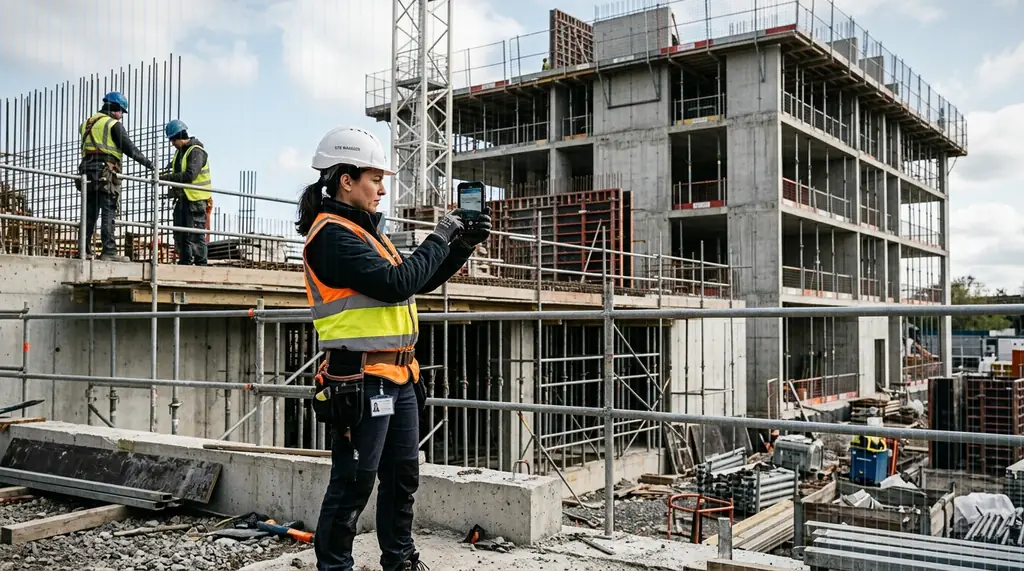
Evidence must be collected before the first excavator arrives, because once ground is broken the original condition is gone. Plan the pre-construction survey as a joint walk-through on the day of possession and capture each item at the source, following the identify, collect, acquire and preserve sequence of ISO/IEC 27037.
Areas handed over and existing works
Start the pre-construction survey by walking the perimeter on video, then photograph each corner, gate and structure to be retained, with a wide frame for context and a close-up with a ruler or crack gauge for every existing defect and benchmark.
Neighboring buildings: the condition (dilapidation) survey
The pre-construction survey of adjoining properties, called a dilapidation report in Australia and often a schedule of condition in the UK, records facades, cracks, damp patches and, where owners agree, interiors. The usual practice is to write to each owner, offer the survey free of charge and share a copy afterwards. If an owner refuses, note it and document what can be seen from public areas.
Access, roads and utilities
Record the haul route, curbs and sidewalks, storm drains, manholes, overhead lines and utility markers, and read the meters of any supply the employer provides, so that later arguments about who damaged the road have a clear starting point.
-
Capture the evidence during the walk-through
Capture photos and videos in real time with an app that certifies them at acquisition, while both parties are present, instead of importing images from the camera roll afterwards, which carry less evidential weight.
-
Generate a certified report
Group the captures by item and generate a report listing each file with its date, time and location, then have it signed and attach it to the possession record as the photographic annex of the pre-construction survey.
-
Quote the report’s hash in the possession record
Write the report’s identifier and its hash, a digital fingerprint that changes if a single bit changes, into the possession record, so anyone can check that the annex has not been swapped.
-
Store the package with the contract records
Keep the certified package with the contract documents and give each party a copy. Progress inspections can follow the same method, so that possession, the works and the final handover of the site form one comparable record.
How can site conditions at possession be documented with evidential value?
With TrueScreen, the Data Authenticity Platform, the engineer and the contractor capture photos and video of the site at possession using a forensic methodology, with geolocation, a digital seal and a qualified timestamp, and then quote the hash of the certified report in the possession record. The record stays the document the parties sign, while TrueScreen certifies at the source the images it refers to, so when and where they were taken no longer rests on anyone’s word.
Forensic acquisition on site, even offline
The TrueScreen app captures photos and videos through a patented forensic acquisition process that prevents alteration while the capture is in progress, and it keeps working offline in basements or remote sites. Photos received from third parties can be checked with AI content analysis when they were not certified at the source.
Verification, report and certification
Each capture is then verified, described in a technical report and finally certified with a digital seal and a qualified timestamp, recognized internationally with eIDAS as the legal basis. From that point any alteration of the certified photos and videos is detectable through the seal and cryptographic hashing. The report can be signed through report and document signing. Certification proves how and when an image was captured, not whether the scene was complete, so the walk-through still needs someone who knows what to look for.
A package anyone can verify
Each certification produces a ZIP package with the original files, a PDF report, a JSON report and an XML file with seal and timestamp, and the package can be verified independently, even without TrueScreen. On a typical job, the engineer and the site manager capture neighboring facades, manholes and the access road, sign the report and quote its hash in the record; six months later, when an adjoining owner reports a crack, the comparison takes minutes. You can see the workflow in certified construction site inspections.
Conclusion
The possession record is the one document both parties sign before the site changes for good, and a pre-construction survey turns it from a set of statements into a baseline you can check. Record each item with its evidence, bind certified photos and videos to the record through the report’s hash, and keep the same method through progress inspections up to the end of the works: when a neighbor reports a crack or a pipe appears where no drawing showed one, the answer will already be in the file.
FAQ: possession of site and pre-construction surveys
What does possession of site mean in construction?
Possession of site is the moment the employer gives the contractor access to and control of the site so that works can start. Under Sub-Clause 2.1 of the FIDIC 2017 Red Book, it must be given within the time stated in the Contract Data; late possession can entitle the contractor to an extension of time and Cost Plus Profit.
What is a pre-construction survey?
A pre-construction survey is a documented inspection of the site and its surroundings before works begin, covering existing structures, neighboring buildings, access roads and visible utilities. It records existing cracks and defects so later damage can be compared with them. ISO/IEC 27037 offers guidance on acquiring and preserving the digital evidence it produces.
What is the difference between the commencement date and the date of possession?
The Commencement Date starts the contract clock, while the date of possession marks when the contractor physically receives the site. Under Sub-Clause 8.1 of the FIDIC 2017 Red Book, the engineer gives at least 14 days’ notice of the Commencement Date, which falls within 42 days after the Letter of Acceptance. Possession under Sub-Clause 2.1 can be given in stages, so the two dates may differ.
Who signs the possession record?
The FIDIC 2017 Red Book sets no standard form for it. Usually the engineer or contract administrator signs for the employer and the contractor’s representative for the contractor; on public contracts, the contracting authority’s representative signs. A reservation of rights in the record does not replace a Notice of Claim, which under Sub-Clause 20.2.1 of FIDIC 2017 is due within 28 days of awareness.
Do neighboring owners have to allow a pre-construction survey?
Access to a neighbor’s property usually rests on consent, and any obligation depends on the contract, local rules and the jurisdiction. In practice contractors offer the survey free of charge and share a copy, since a dated record protects the neighbor too; if access is refused, the facade can still be documented from public areas.
How can you prove when construction site photos were taken?
EXIF data alone is weak because common software can edit it. A stronger approach is to certify photos at capture: with TrueScreen, images taken in the app receive geolocation, a digital seal and a qualified timestamp, and the report’s hash goes into the possession record. Under Article 41(2) of the eIDAS Regulation, a qualified electronic timestamp enjoys a presumption of accuracy of its date and time.
Sources and verification
Every figure and principle cited here links to its source, listed with type and date. Links checked on the publication date.
| Source | Type | Date | What it supports |
|---|---|---|---|
| FIDIC Conditions of Contract for Construction (Red Book), 2nd edition 2017, Sub-Clauses 2.1, 2.5, 4.7, 4.12, 8.1 and 20.2.1 | Document | 2017 | Possession of site, items of reference, unforeseeable physical conditions, Commencement Date and notice of claim |
| Regulation (EU) No 910/2014 (eIDAS), Art. 41(2) | Law | 23/07/2014 | Presumption of accuracy of date and time and of data integrity for qualified electronic timestamps |
| ISO/IEC 27037:2012 | Standard | 2012 | Guidelines for identification, collection, acquisition and preservation of digital evidence |
| Arcadis, 2026 Construction Disputes Report | Survey | 2026 | Average dispute value (US$56 million) and duration (12.16 months), share of respondents seeing more disputes (57.9%), differing site conditions among common causes |
| HKA, CRUX Insight eighth annual report “From Insight to Foresight” | Survey | 2025 | More than 2,200 projects in 114 countries: sums in dispute 33.4% of budgets, time extensions sought 65.8% of schedules |
Certify the site before you break ground
Whether you are a contractor, an employer or a public contracting authority, try a certified pre-construction survey on your next site, or book a demo to see how certified photos and videos link to your possession record.




TrueScreen editorial team
This section is edited by the TrueScreen editorial team, which brings together expertise in digital forensics, the law of digital evidence and regulatory compliance. Every article is checked against primary sources: legislation, published rulings, technical standards and official documentation, always cited in the text.


