
Updated on
Digital Identity Theft and Cloned Accounts: How to Certify Evidence for a Complaint
So much of our life now runs through a digital identity: a social profile, an email address, an account that carries personal relationships, professional reputation, and sometimes banking operations. That profile is not just a business card. It is how other people recognize us online, and it is the thing they trust when a message arrives with our name on it.
The trouble starts when someone takes it over. Digital identity theft and account cloning keep rising year after year, and victims discover a cruel twist: the evidence of impersonation is fragile. The fake profile asking your contacts for money, the messages sent in your name, the urgent payment requests fired off to people who trust you, all of it can vanish within hours, often at the very moment you report the abuse and the platform removes the content. Show up to file a complaint with a few screenshots on your phone, and you may be holding far less than you think.
So how do you prove you were impersonated with evidence that survives a complaint or holds up in court? The answer is to change when and how you gather it. Do not photograph the screen afterward. Instead, capture and certify the cloned profile, the conversations, and the screens at the source, sealing content, URL, and date with a digital seal. That is the difference between an image anyone can dispute and evidence that stands.
What digital identity theft and account cloning are
Digital identity theft is the unauthorized use of a person's data or online identity to act in their name: opening accounts, contacting third parties, or extracting money and information. Account cloning is one specific form of it: a copy profile is built with the victim's name, photo, and bio to deceive their contacts. The two overlap often, but they are not the same.
It helps to separate three situations that everyday language tends to blur together. In identity theft proper, the attacker gets hold of personal data (an ID document, credentials, photos) and reuses it to pose as the victim, perhaps registering new accounts or requesting services. In a cloned account there is usually no technical breach at all: the original profile stays untouched, but a parallel copy appears, a fake profile that reposts the same public images and starts messaging the victim's followers. Impersonation is the broader conduct of taking on someone else's identity to gain an advantage or cause harm, and it is treated as a form of fraud in most jurisdictions.
Knowing which scenario you are in matters, because it shapes both your evidence-gathering strategy and the legal angle you can pursue. The common denominator stays the same: in a case of digital identity theft, without solid proof of what happened and when, the complaint starts on the back foot. It is a close cousin of the problem behind synthetic identity fraud and identity checks, where the core challenge is also telling an authentic identity apart from one built to deceive.
Why impersonation evidence disappears and a plain screenshot is not enough
Impersonation evidence is volatile by nature, and a phone screenshot on its own carries weak evidentiary weight. A fake profile can be deleted by its author, suspended by the platform after your report, or edited within minutes. The instant the content disappears, so does any chance to reproduce it, and the image you saved stays a file that anyone can question.
Here sits the paradox almost no one explains to the victim. The instinctive move, reporting the fake profile to the platform so it gets taken down, is also the move that destroys the evidence. Once the profile is gone, that fake account with its URL, its creation date, and its messages is no longer available to anyone, not even to investigators. Meanwhile whoever cloned the account carries on undisturbed elsewhere, and you are left describing in words something you can no longer show to anyone.
Then there is the evidentiary problem with the screenshot itself. A screen capture is a digital reproduction, and under general principles of evidence admissibility its value depends on integrity and non-repudiation. If the other side can plausibly claim "that image does not match what actually happened, it could have been altered," its weight collapses. A manually captured image carries no guarantee about integrity, provenance, or date. It has no hash attesting that it was not tampered with, it does not record the page URL in a verifiable way, and it fixes no defensible point in time. Standards for handling digital evidence, such as ISO/IEC 27037 on the identification, collection, and preservation of digital evidence, exist precisely because those weak points are where repudiation is won or lost.
What evidence to collect and certify before reporting
Before you report or file a complaint, collect and certify everything that documents the digital identity theft: the fake profile in full, the conversations, the money requests sent to your contacts, and the technical data that ties that profile to a specific page online at a specific moment. Order matters here. Secure the proof first, report second.
Here is what to capture in practice, in this sequence:
- The complete fake profile, not a single detail. You need the full page URL, the username, the profile photo, the bio, and the profile ID: the numeric identifier the platform assigns to the account, which stays stable even if the attacker changes the display name. It is the value that anchors the fake to a precise entity.
- The suspicious conversations: direct messages where someone poses as you, or the ones you received yourself while uncovering the scam. Capture the whole exchange, with names, dates, and times visible, not isolated fragments.
- The money requests to your contacts: the screenshots your followers or colleagues forward when they get the classic urgent ask ("I need a top-up," "send me a transfer"). These are valuable because they show concrete harm and the method of operation.
- The technical and time data: full URL, date and time of capture, any available metadata such as EXIF where it applies. These are the elements that turn an image into a verifiable document.
- The public context: posts published by the fake profile, comments left under other people's content, tags. Anything that demonstrates impersonation activity aimed at third parties.
The most common mistake is squeezing everything into a handful of screen photos and then rushing to report. That produces weak images of something that will no longer exist in a few hours. Flip the logic: capture in a certified way first, locking the URL and the date, then move on to reporting and the complaint with your evidence already sealed. With TrueScreen you can crystallize proof of the fake profile, the chats, and the money requests before you report, while the content is still online. The same approach applies to other relational scams, as in the case of certifying romance scam evidence before filing a report, where the window to fix the proof is even narrower.
How to certify impersonation evidence with TrueScreen
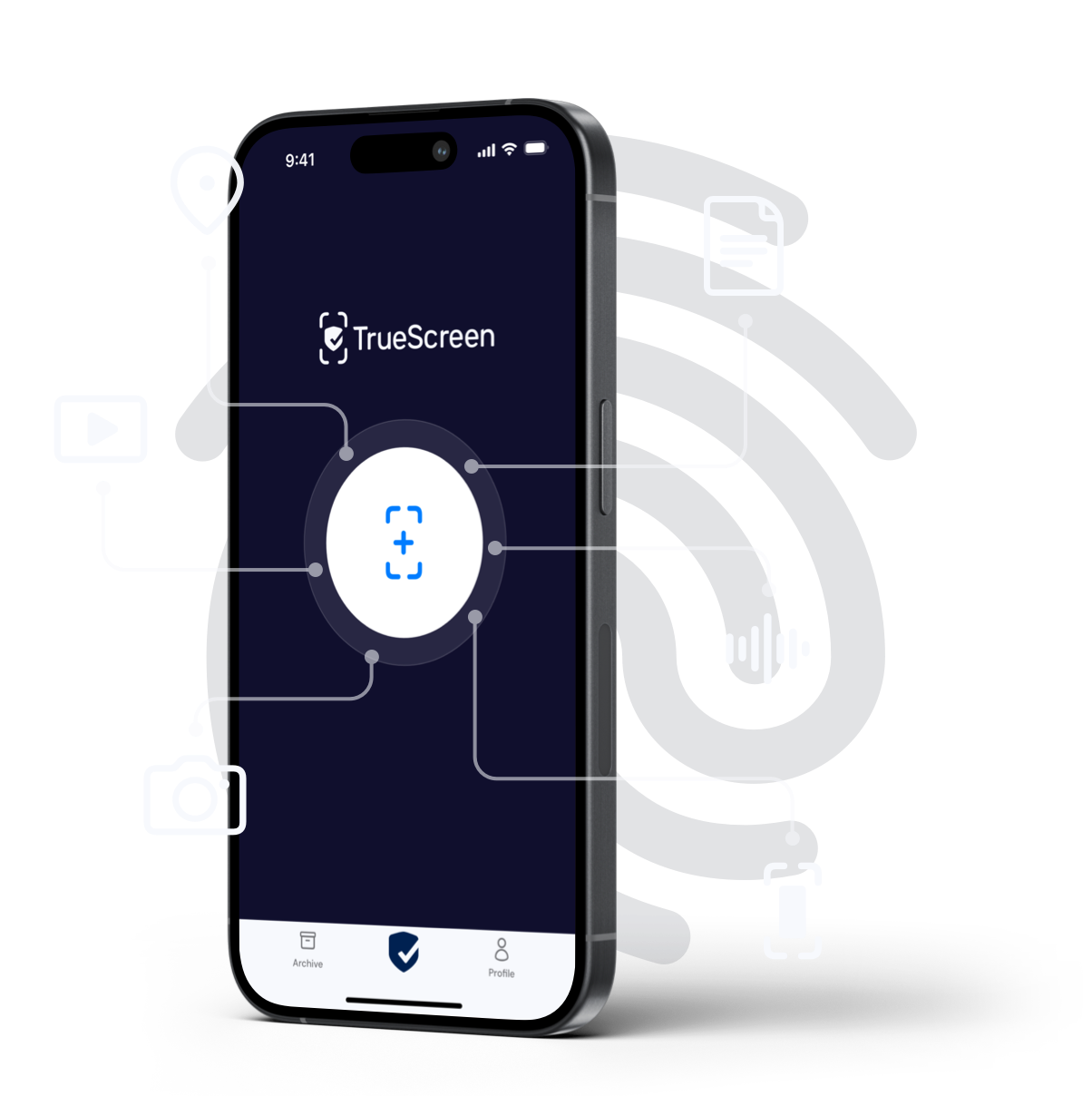
Faced with digital identity theft, TrueScreen is the platform that captures and certifies digital content with legal value directly at the source, before it can be removed or altered. For a cloned profile that means capturing the social page, the conversations, and the screens with a forensic methodology that seals content, URL, and date, integrating the electronic seal and qualified timestamp of a third-party QTSP. The result is evidence that holds up under challenge, where a bare image would not.
The starting point is the volatility described above: the proof you need today may not exist tomorrow. That is why TrueScreen works on capture at the source, recording what is actually published at that moment at that URL, rather than a file already sitting on the user's device. The distinction is substantial, because it is the genuineness of the capture moment that holds up against a challenge.
Forensic capture of web pages, social profiles, and chats
Forensic capture is the acquisition of online content through a documented, repeatable technical process that faithfully records content, URL, date, and time. With TrueScreen you can capture a cloned social profile, a single conversation, a public page, or a screen, obtaining a coherent evidentiary package. The tool built for capturing pages and profiles is the TrueScreen forensic browser, designed to fix what you see online exactly as you see it.
Electronic seal and qualified timestamp
Certification rests on qualified elements delivered by third parties. TrueScreen integrates the electronic seal and qualified timestamp of a qualified QTSP, so the capture receives a defensible time reference and an integrity guarantee. The digital seal attests that the captured content was not modified after acquisition; the qualified timestamp fixes with certainty the moment the capture took place. These are the two pieces that answer directly the weaknesses of a plain screenshot.
Sealing content, URL, and date, plus chain of custody
Every capture produces evidence with a hash certifying it was not altered, the exact page URL, and a reliable time reference, all tracked in a verifiable chain of custody. That lets whoever receives the proof, a lawyer, a magistrate, a cybercrime unit, check its genuineness independently. In concrete terms: the victim of a cloned Instagram account asking followers for top-ups captures the fake profile with its profile ID, saves the incriminating conversations, and gets a file documenting what was there, where, and when, before ever pressing "report."
How to use certified evidence: complaint, cease-and-desist, and takedown request
After digital identity theft, certified evidence supports three distinct actions: a criminal complaint, a cease-and-desist against whoever spreads the impersonation, and a takedown request to the platform. A sealed capture makes each of these moves stronger, because you start from a documented, non-disputable fact rather than a story.
The first path is the complaint. Digital identity theft and impersonation are reported to law enforcement, and reputable resources such as the U.S. Federal Trade Commission's IdentityTheft.gov recovery portal walk victims through the steps and paperwork. Attaching the certified capture of the fake profile, with URL, profile ID, and date, puts investigators in a position to work on a verifiable element from the very first moment, even if the profile has since been removed.
The second is the cease-and-desist, useful above all when a fake profile spreads communications in the name of a company or a professional. A profile posing as a brand's official channel and messaging its customers causes immediate reputational damage: a formal cease-and-desist, backed by certified proof of what the fake published, is much harder to ignore.
The third is the takedown request to the platform and, where relevant, the exercise of data-subject rights under the General Data Protection Regulation (EU 2016/679). Unauthorized use of a person's name and image involves unlawful processing of their personal data, which opens rights to erasure and objection. Here too, showing exactly what was published and when strengthens the request. It is the same logic that applies whenever solid proof has to come before the action.
Plain screenshot vs certified capture
| Aspect | Plain screenshot | TrueScreen certified capture |
|---|---|---|
| Content integrity (hash) | Absent, file is editable | Hash certifying no alteration |
| Certified date and time | Not verifiable, depends on the device | Qualified timestamp via QTSP |
| URL and profile ID | Not recorded reliably | Recorded and sealed in the capture |
| Court admissibility | Weak, easily disputed | Reliable and verifiable evidence |
| Chain of custody | Nonexistent | Tracked and verifiable |
| Repudiation risk | High: conformity is easy to contest | Reduced: integrity and date are attested |
The legal and standards landscape: identity fraud, GDPR, and eIDAS
Digital identity theft and account cloning sit at the intersection of several international frameworks: identity fraud as a recognized offense across jurisdictions, data-protection rights under the GDPR, the trust services regime under eIDAS, and standards for handling digital evidence. Together they define both what the victim can claim and what makes a piece of proof credible.
Impersonation is broadly treated as a form of fraud: inducing someone into error by taking on another person's identity to obtain an advantage or cause harm. This is the typical conduct of a cloned profile deceiving the victim's contacts, and while the exact statute varies by country, the underlying principle of prohibiting fraudulent misrepresentation is common across legal systems. On the evidentiary side, admissibility generally turns on integrity, authenticity, and a reliable chain of custody, the very properties a certified capture is built to demonstrate and a plain screenshot cannot.
Two European regulations matter most for this kind of proof. The GDPR (EU 2016/679) gives the data subject actionable rights when their personal data is misused, including rights to erasure and objection that support a takedown. The eIDAS Regulation (EU 910/2014) sets the framework for qualified electronic seals and qualified timestamps issued by QTSPs, the qualified elements TrueScreen integrates to give a capture its integrity guarantee and defensible time reference. For the handling of the digital evidence itself, ISO/IEC 27037 provides internationally recognized guidance on identifying, collecting, and preserving it: the technical reason a certified capture, hard to repudiate, is worth more than a screenshot.
FAQ: Digital identity theft and account cloning
Does a screenshot of a cloned profile count as evidence?
How do I report digital identity theft?
Can authorities trace a fake account?
What should I attach to an impersonation complaint?
What is the difference between identity theft and impersonation?
TrueScreen editorial team
This section is edited by the TrueScreen editorial team, which brings together expertise in digital forensics, the law of digital evidence and regulatory compliance. Every article is checked against primary sources: legislation, published rulings, technical standards and official documentation, always cited in the text.


