All content
Browse all articles and insights from the TrueScreen blog
Articles

The limits of the EU AI Act: what transparency cannot guarantee
The EU AI Act limits stop at the perimeter: who is bound, why markers break, and what it takes to prove content is authentic.
Data Authenticity Clauses: What B2B Contracts Now Require
Data authenticity clauses now appear in tenders and supply agreements: what they require, where they come from and which evidence must be verifiable.

Test report and acceptance records: proving the provenance of measurement data
How a test report holds up in a quality audit or a supply dispute: ISO/IEC 17025 records, FAT and SAT evidence, measurement data provenance.
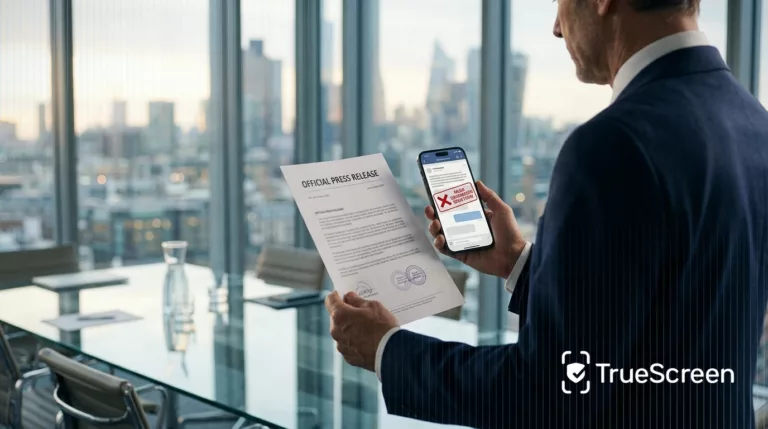
Fake corporate announcements: proving what the issuer published
A fake corporate announcement moves the price before the denial. How the Market Abuse Regulation frames financial disinformation and why proof matters.

Escrow: what it is, how it works and which tools it takes
Escrow is a conditional deposit held by a neutral third party: how it works, who acts as agent, and what it takes to prove what...

Invoice fraud and the IBAN swap: how to prove which email is the original
Business email compromise and the IBAN swap are settled on proof: what a bank, an insurer and a supplier argue, and how the original email...

Audit evidence for publicly funded projects: proving the work was done
Public funding audits check whether work was actually done. Site photos, inspection reports and attendance logs need verifiable time and place.
Cargo damage in transit: how to document the condition of a shipment
Cargo damage in transit: how to document the condition of a shipment so CMR reservations, the seven-day window and dock photographs actually hold.

Labelling AI content is not enough: the case for proof of authenticity
From 2 August 2026 the AI Act requires labelling synthetic content, but flagging the fake doesn't prove the true. Certification at the source completes it.

EU AI Act countdown to 2 August 2026: what businesses must do
The EU AI Act August 2026 deadline switches on Article 50 transparency and penalties. What businesses must do: label AI content, map systems, keep records.

Proving the integrity of archived electronic invoices when they are challenged
Archiving e-invoices is not enough: in an audit or dispute you must prove their integrity with a hash and a qualified timestamp. Here is how.
Food Traceability: Certifying Provenance Evidence Against Fake Made in Italy
Food traceability holds only when supply chain evidence is verifiable: certifying photos, documents and inspections against fake Made in Italy.
Sextortion: What to Do First and How to Preserve Evidence of Online Blackmail
Sextortion: what to do first and how to preserve evidence of online blackmail with legal value, so it holds up when you report it to...
Telegram Messages as Evidence: How to Certify Chats, Groups and Channels With Legal Value
Telegram messages as evidence: why a screenshot is contestable and how to certify a Telegram chat with a hash and a qualified eIDAS timestamp.
Digital Identity Theft and Cloned Accounts: How to Certify Evidence for a Complaint
Digital identity theft and cloned accounts: capture and certify evidence of the fake profile, chats, and money requests before you report.
Online trading scams and fake brokers: how to certify evidence for your report
Hit by an online trading scam or fake broker? Which evidence to collect and how to certify it so your report holds up and is...

Electronic health record integrity: keeping clinical reports and data authentic
Why electronic health record integrity underpins its legal value, and how to keep clinical reports and diagnostic images authentic and tamper-proof.
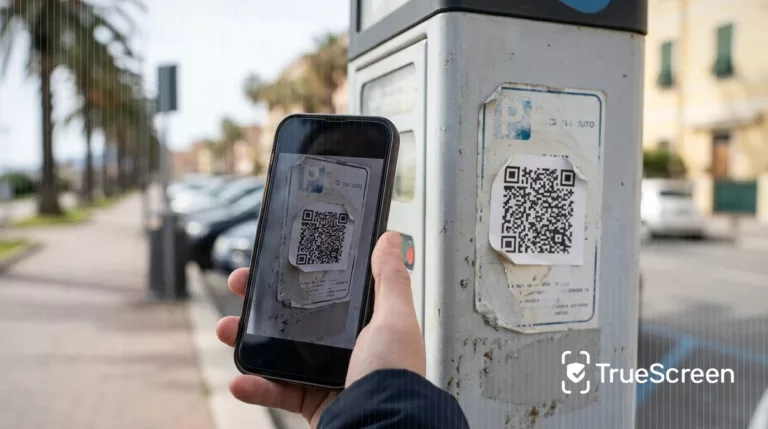
Quishing and QR code scams: how they work and how to collect certified evidence
Quishing and QR code scams: how they work, what to do after the fraud, and how to collect certified evidence that stands up when you...
Romance scams: how to certify the evidence before you report it
Romance scam evidence: which chats, profiles and receipts to collect and how to certify them at the source so they hold up when you report...
European Accident Statement: what it proves and when your insurer can challenge it
A European Accident Statement signed by both drivers is not conclusive proof: the insurer can rebut it. What makes the accident photos hold up.
Insights
Spoliation of evidence: what courts do when digital evidence disappears

How to fake a screenshot: date, place and messages that were never there
How to remove C2PA Content Credentials from an image, a video or a PDF, and what you actually gain

How to change a photo’s date, location and camera in the metadata, and why it proves nothing
How to edit (or wipe) the metadata of an MP4 or a PDF, and what a forensic reader still sees
FRE 902(13) and 902(14): When an Electronic Record Authenticates Itself
APP Fraud Evidence: What to Secure When a Hacked Account Asks You for Money
Challenging the authenticity of an electronic document: what actually shifts the burden
Education Verification in Hiring: What a Registry Check Cannot Prove
Move-out inspection report: how to prove rental damage
Vacation rental scams: certify the listing, chat and payments before they vanish
Unauthorized account access: what to document before you reset credentials
Forensic Capture of Password-Protected Web Pages: Portals and Private Areas
Submitting video evidence to police: what to hand over and in what format
WhatsApp voice notes as court evidence: legal value and how to certify audio messages
Advanced electronic signature with national eID: legal value for businesses and professionals
Certified email formal demand: evidentiary value and common challenges
AI liability insurance: why data certification is a prerequisite for coverage
eIDAS 2.0 Timestamp Requirements: What Changes for QTSPs and Businesses