Video Evidence in Private Investigations: Admissibility in Civil and Criminal Proceedings (2026)
A surveillance file sits on a smartphone for 72 hours before counsel sees it. By then the question is no longer what it shows but whether a judge will let the jury see it. Video evidence in private investigation work used to be a craft of stakeouts and zoom lenses. Now it is a discipline governed by procedural codes, privacy law, and whether the file itself can be trusted. Defense lawyers move to exclude footage on grounds that seemed exotic a decade ago: missing timestamps, broken chain of custody, ambiguous geolocation. A recording is admissible only when it passes four cumulative tests, and most smartphone footage fails on the technical ones long before the privacy debate even starts.
Video evidence in private investigations refers to footage recorded by a licensed investigator during surveillance and submitted as proof in civil or criminal proceedings. According to the New York Unified Court System Rule 9.14, a video is admissible at the trial judge's discretion when it is relevant to a fact in dispute and properly authenticated. For investigative footage specifically, courts apply four cumulative tests: legitimacy, usability, integrity, authenticity. Failure on any single test is enough for exclusion. The American Bar Association's 2025 trial-tactics guidance confirms three accepted authentication methods: pictorial testimony, silent witness theory, and circumstantial authentication. Chain of custody is non-negotiable across all three.
For TrueScreen's certified private investigations workflow, see the dedicated page: certified private investigations.
The Four Tests Courts Apply to Investigative Video Evidence
Investigative footage gets treated differently from incidental video. A private investigator records with a purpose tied to litigation, and that intent raises the bar for admission. The four tests are cumulative. Pass three of them and you can still get an exclusion order.
Legitimacy: who is allowed to record and in what context
Legitimacy is the gateway question: did the operator behind the camera have a lawful basis to record the subject in that place at that moment. For a licensed PI, the answer comes from three documents read together: the state license, the written mandate from the client, and the scope permitted under local law. Record outside the mandate, after it has expired, or someone not named in the brief, and legitimacy tends to collapse.
Usability: balancing privacy with the right of defense
A recording can be lawful at capture and still get excluded if showing it in court would harm the subject's privacy more than it serves the right to a fair defense. European courts run a proportionality test rooted in Article 8 of the European Convention on Human Rights. U.S. courts work through a tort-and-evidence hybrid that weighs reasonable expectation, public interest, and what other means the litigant could have used.
Surveillance and Privacy: Public, Semi-Public, and Private Locations
Where the recording happened tends to matter more than how, and it shapes admissibility before any technical question gets asked. Courts work with three layers: open public space, semi-public space (workplaces, lobbies, shared parking lots), and private space (homes, hotel rooms, fenced gardens). The further the lens travels from open public space, the higher the admissibility burden on the party offering the footage.
Court rulings on private locations
U.S. courts use the "reasonable expectation of privacy" doctrine that Katz v. United States set down in 1967. A subject in their own backyard with a privacy fence has a high expectation. The same subject in a public park has almost none. EU courts get to similar outcomes through different language, asking whether the data subject could reasonably expect not to be recorded in that context.
GDPR Article 6 and legitimate interest
GDPR Article 6 is the operative text for EU-facing work. Paragraph 1(f) treats legitimate interest as a lawful basis for processing personal data, identifiable video included. The clause demands a balancing exercise: the controller's interest against the rights of the data subject. The European Data Protection Board's 2024 guidelines insisted on a point that gets ignored often in practice: the test has to be documented before recording starts, not reconstructed afterwards.
Recording in private locations triggers exclusion under U.S. evidence rules and EU privacy regulation alike. Brandon J. Broderick litigation guidance (April 2026) confirms that footage captured where a subject has a "reasonable expectation of privacy" is presumptively inadmissible regardless of investigative purpose. In the EU, GDPR Article 6(1)(f) permits processing only when the legitimate interest of the controller is not overridden by the rights of the data subject, a balancing test reaffirmed by the European Data Protection Board in 2024 video-processing guidelines. The practical rule for licensed investigators: public and semi-public spaces are generally permissible; expectation-of-privacy zones require consent, judicial authorization, or right-of-defense exception under national procedural codes.
Integrity and Chain of Custody: the Smartphone Video Problem
Integrity asks one mechanical question: are the bytes shown in court the bytes recorded in the field. A raw .mov or .mp4 from iOS or Android is a container, and containers are editable. Metadata can be rewritten with consumer tools. Frames can be re-encoded. The original timestamp can be swapped for anything plausible. None of this needs forensic skill. Defense counsel knows it.
Qualified timestamps, cryptographic hash, geolocation
Three controls do most of the work, and they make it possible to admit a file without leaning on the investigator's word alone. A qualified electronic timestamp issued by a trust service provider ties the file to a specific moment. A SHA-256 hash sealed at capture lets any verifier confirm the file has not changed by a single bit. Geolocation metadata signed at the source pins the recording to a place. The chain of custody for digital evidence holds these elements together from capture to courtroom.
From raw footage to court-ready evidence
U.S. authentication doctrine recognises three routes under the Federal Rules of Evidence: pictorial testimony, silent witness theory, and circumstantial authentication. The American Bar Association's spring 2025 guidance flagged a quiet shift: silent witness theory is increasingly the preferred route in commercial and insurance disputes, because it takes the investigator's credibility off the witness stand. The preference only works if the system itself can be verified.
Smartphone footage fails admissibility most often on integrity, not legitimacy. A raw video file produced by iOS or Android does not carry a qualified timestamp, a cryptographic hash binding the file to its original byte sequence, or a tamper-evident geolocation record. Courts have excluded otherwise relevant footage when defense counsel demonstrated that file metadata could have been edited post-capture. The 2026 Blank Rome analysis of "Matter of M.S." underscored this point for New York practice. Source-level certification captures these elements at the moment of recording. The investigator's chain of custody no longer depends on testimony alone but on a verifiable digital seal issued by a qualified third party.
Civil vs criminal admissibility at a glance
| Dimension | Civil proceedings | Criminal proceedings |
|---|---|---|
| Standard of proof | Preponderance of the evidence | Beyond a reasonable doubt |
| Privacy threshold | Balancing resolved at trial | Higher scrutiny, suppression pre-trial |
| Authentication burden | Reasonable juror could find authentic | More demanding, often expert needed |
| Typical exclusion ground | Privacy outweighs probative value | Chain of custody break or unlawful capture |
| Effect of integrity proof | Streamlines admission | Often decisive against suppression |
How TrueScreen Makes Investigative Video Admissible at the Source
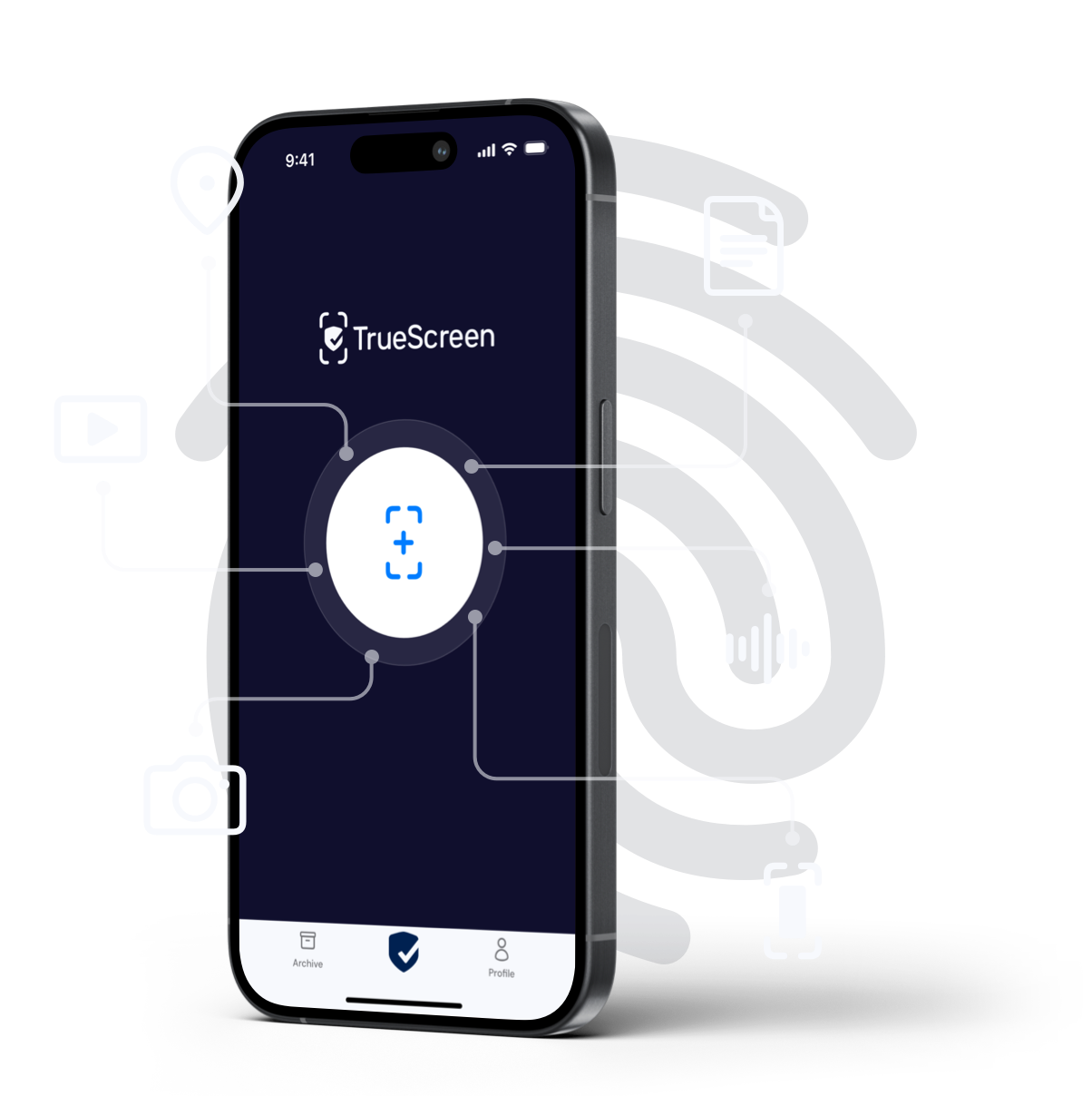
TrueScreen is the data authenticity platform investigators and litigation attorneys use to convert smartphone surveillance footage into court-ready evidence. The TrueScreen Mobile App records video while binding each frame to a qualified electronic timestamp issued through an integrated qualified trust service provider, a SHA-256 cryptographic hash sealed at capture, and verified geolocation metadata that cannot be retroactively edited. The result is a file whose integrity and authenticity are mathematically demonstrable in court without relying on the investigator's personal testimony as the sole foundation. Organizations use TrueScreen to satisfy all four admissibility tests in a single workflow: lawful capture, privacy-respecting collection, integrity preservation, and source authentication. The Forensic Browser and Web Notarization Chrome Extension extend the same methodology to remote-source content (social media, OSINT, public records). Each certified output ships with a verifiable evidence package admissible in civil and criminal proceedings across the EU and equivalent jurisdictions.
Investigators working in the legal sector plug TrueScreen into the case-management tools they already use. The TrueScreen platform keeps a centralised attestation database that opposing counsel and the court can query for independent verification. For a deeper look at the workflow, the certified private investigations page walks through the full pipeline, and the broader guide to digital evidence admissibility sets out the cross-jurisdictional picture.
FAQ: video evidence in private investigations
What makes video evidence from a private investigator admissible in court?
Admissibility comes down to four cumulative tests: legitimacy of the recording (lawful basis, valid mandate, licensed operator), usability under the proportionality balance between privacy and the right of defense, integrity of the file (no post-capture modification), and authenticity of the source (the file is what it claims to be). Courts apply all four, and a failure on any single test produces exclusion. TrueScreen's source-level certification handles integrity and authenticity at capture, which leaves counsel free to argue legitimacy and usability on substantive grounds rather than technical ones.
Can a private investigator legally record someone without their consent?
In most U.S. states and EU jurisdictions, licensed investigators may record subjects without consent in public and semi-public locations where there is no reasonable expectation of privacy. Recording in private locations (homes, fenced yards, hotel rooms, restrooms) is generally prohibited regardless of investigative purpose. Two-party consent states impose stricter rules on audio recording specifically. The mandate from the client must align with the recording activity; off-mandate recording exposes the investigator to license suspension and the footage to exclusion.
What makes video evidence inadmissible?
Five grounds dominate the case law: capture in violation of privacy rights, broken chain of custody, missing or unreliable metadata (timestamp, location, device identifier), proof of post-capture modification, and inability to authenticate under any of the three accepted methods. The 2026 Blank Rome analysis of "Matter of M.S." showed how integrity failures alone were enough to defeat otherwise relevant footage. Defense counsel routinely combines two or more of these grounds in a single motion to exclude.
Is smartphone video from a PI admissible in court?
It can be, but raw smartphone files struggle on integrity. iOS and Android produce video containers whose metadata can be edited after capture without leaving forensic traces. Courts have excluded relevant footage when defense counsel showed this possibility, even with no proof of actual tampering. To clear the integrity test, smartphone video needs source-level certification: a qualified timestamp, a cryptographic hash sealed at capture, and tamper-evident geolocation. Without these, the investigator becomes the only authentication witness, and the recording is only as strong as their testimony.
What is the difference between civil and criminal admissibility for video evidence?
Both forums apply the same four tests, but the thresholds differ. Civil courts admit on a preponderance standard and resolve most privacy challenges at trial through balancing. Criminal courts apply heightened scrutiny, often through pre-trial suppression motions, and demand stronger authentication, frequently expert testimony. Integrity proof matters in both, but its absence tends to be decisive in criminal cases because the consequences of admitting unreliable evidence are graver. A file certified at source carries equally well into either forum.
How does the silent witness theory apply to PI footage?
Silent witness theory lets a recording authenticate itself when the system that produced it can be shown to be reliable. The investigator does not have to testify that the video accurately depicts what they saw. The system speaks for itself through verifiable technical proof. For PI footage, this matters because it takes the investigator's credibility out of the central question. The theory only works when the recording system produces verifiable output: qualified timestamp, sealed hash, signed geolocation. Source-level certification is what makes silent witness theory practically usable for surveillance video.
TrueScreen editorial team
Published on · Updated on
This section is edited by the TrueScreen editorial team, which brings together expertise in digital forensics, the law of digital evidence and regulatory compliance. Every article is checked against primary sources: legislation, published rulings, technical standards and official documentation, always cited in the text.


