
Certified Web Evidence vs Wayback Machine: Three Evidentiary Scenarios
An IP lawyer opens archive.org, pulls up a competitor's landing page from March 2023, saves the snapshot, and drops it into the complaint as Exhibit A. Public archive, free, used for two decades. What could go wrong? Opposing counsel's motion in limine brings the answer: the snapshot gets challenged on authentication, and the court wants to know who captured the page, when, and with what integrity controls. This is the real question around Wayback Machine evidence court admissibility: not whether archive.org is useful, but whether it survives contest. The Internet Archive was built as a historical library, never designed for courtroom use. It does not seal captures with a qualified timestamp, does not produce a reconstructable chain of custody, and US and EU case law have already excluded Wayback snapshots when authenticity was contested. The working question is simpler than it sounds: when is archive.org enough, and when does the file need an ISO/IEC 27037 forensic capture? For the full doctrinal framework see our Wayback Machine evidence legal limits guide.
This insight is part of our guide: Wayback Machine as Legal Evidence: Limits and Alternatives
What Wayback Machine actually certifies (and what it does not)
Wayback Machine evidence court admissibility starts from a category mistake. Archive.org is a library, never a forensic platform. Its automated crawlers produce none of the elements a judge needs to authenticate a page under FRE 901(b) once the other side pushes back. For the requirements that make a captured page stand as evidence, see our guide to certifying web pages with legal value.
How the Internet Archive crawler works
Internet Archive sends crawlers out to visit public URLs and save static copies. The method scales well for historical research, though it has obvious limits for anyone trying to authenticate web evidence in litigation. Snapshots are rarely complete: dynamic JavaScript, API-driven content, and pages behind login usually come back partial. Crawl frequency swings from weeks to months. At capture no cryptographic seal is applied: no SHA-256 hash, no qualified timestamp, no operator signature. A snapshot can also vanish retroactively once a domain owner updates robots.txt. An archive that empties on request is not what a court has in mind when it asks for an immutable record.
Evidentiary gaps: no chain of custody, no qualified timestamp
The problem shows up once authenticity is challenged. Without chain of custody and without a qualified timestamp under Article 42 of the eIDAS Regulation (EU 910/2014), a Wayback snapshot cannot carry the legal presumption of time accuracy EU trust services provide. ISO/IEC 27037:2012 requires things archive.org does not supply: operator identification, documented capture device, content hash, and a report linking each step to the next. ISO/IEC 27041 adds assurance for the acquisition process itself. In common law systems the debate also runs into the hearsay doctrine: an archived snapshot is an out-of-court statement offered for the truth of the matter, inadmissible absent an exception under FRE 902(11) for self-authenticating business records or FRE 902(14) for records certified through digital identification. Some courts accept judicial notice under FRE 201 for the existence of an archived URL, though not for its content.
Weinhoffer v. Davie Shoring, Inc. (5th Cir. 2022): the Fifth Circuit excluded Wayback Machine screenshots because the proponent failed to lay proper foundation under FRE 901. The court treated the snapshots as unauthenticated and refused to take judicial notice of their content. See Norton Rose Fulbright's analysis on using screenshots from the Wayback Machine in court proceedings.
US and EU case law that excluded Wayback snapshots
Case law tracks the ceiling of Wayback Machine evidence court use fairly clearly. Beyond Weinhoffer, the Federal Circuit in Valve Corp. v. Ironburg Inventions (Fed. Cir. 2021) showed that even in inter partes review, where archive.org is the traditional route to prove prior art, validation hinges on formal affidavits and rarely stands alone. The EUIPO in a 2023 decision put archive.org extracts in the same bracket: corroborating indication, not autonomous proof of publication date. In Italy, a Wayback screenshot falls under the general rule on electronic reproductions (article 2712 of the Civil Code): if the other party challenges its conformity, further authentication is needed.
Wayback Machine evidence court: three evidentiary scenarios
Probative weight depends on the proceeding type and the likelihood of contest. Three scenarios cover most practical decisions.
Scenario 1: Pre-litigation discovery and monitoring
For due diligence, trademark monitoring, and prior art search, archive.org is usually enough. The goal is understanding what was published and when, not preparing a court exhibit. No adversary, nothing to contest, and a forensic capture is hard to justify. Typical case: a firm reconstructing the history of a site suspected of trademark infringement starts with Wayback, identifies the critical dates, and then decides where to spend forensic budget on the live site.
Scenario 2: Civil litigation and cease-and-desist
In civil proceedings Wayback Machine evidence turns from informational tool into object of contest. A snapshot paired with an Internet Archive affidavit still remains open to authenticity challenges: opposing counsel will raise doubts about the crawler, the absent content hash, the possibility of retroactive removal. In trademark, unfair competition, or defamation cases, the difference between evidence admitted without objection and evidence argued for months can tip the outcome. This is why many lawyers preserve the content with a forensic capture already at the first demand letter, even when a Wayback snapshot exists. The forensic copy becomes primary evidence, and Wayback stays on file as supplementary context, in line with what the Florida Bar recommends for authenticating web pages under FRE 901/902.
Scenario 3: Criminal proceedings and international arbitration
In criminal proceedings the standard rises to beyond reasonable doubt, and a Wayback snapshot without chain of custody rarely holds. International arbitration works the same way. The IBA Rules on the Taking of Evidence applied in ICC and LCIA proceedings require authentication elements archive.org does not deliver, and tribunals consistently ask for evidence of origin, integrity, and continuity. The decision here is less about Wayback versus forensic capture and more about whether the evidence survives scrutiny at all.
Decision table: when archive.org is enough, when forensic capture is needed
| Scenario | Wayback enough? | Forensic capture needed? |
|---|---|---|
| Discovery / due diligence | Yes | No |
| Pre-litigation cease-and-desist | With IA affidavit | Recommended |
| Contested civil litigation | Insufficient | Required (ISO 27037) |
| ICC / LCIA arbitration | Insufficient | Required |
| Criminal / IPR prior art | Risky (Weinhoffer, Valve v. Ironburg) | Required |
Forensic web capture requirements under ISO/IEC 27037
When the context calls for evidence that survives contest, four technical and procedural elements have to work together. In combination they are the minimum admissibility bar for web evidence acquisition under ISO 27037 that most jurisdictions now apply.
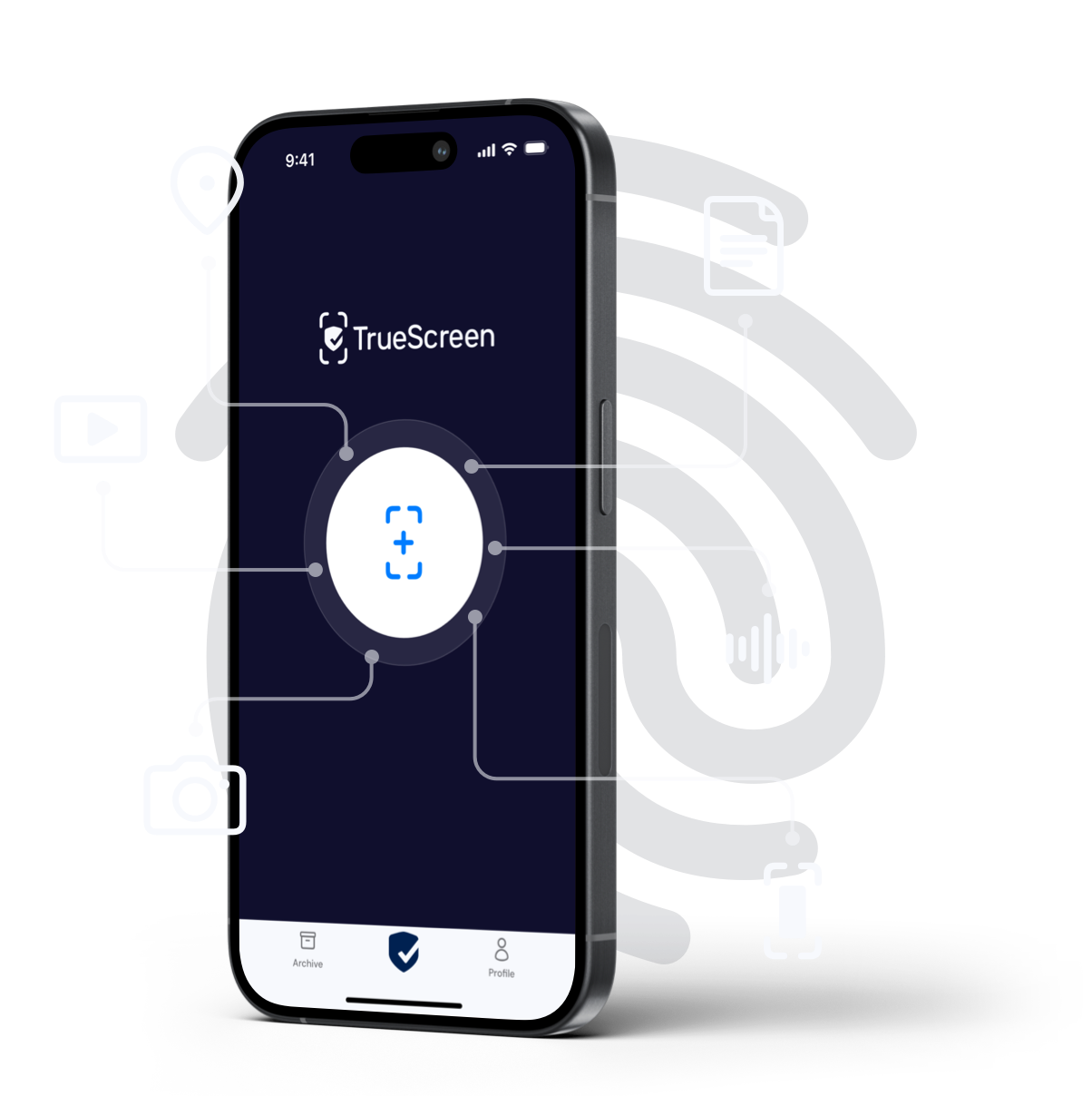
With TrueScreen, a web page can be acquired with three complementary solutions, depending on the device at hand. The main solution is the TrueScreen Forensic Browser, an application for macOS and Windows that records the entire browsing session in a controlled forensic environment, with hashes, metadata and network traffic. The Web Notarization extension for Chrome and Edge lets you quickly certify any content during normal browsing, while the TrueScreen app for iOS and Android acquires content directly from a smartphone. All of them feed the same certification workflow, with SHA-256 hashing, qualified timestamping and electronic seal.
SHA-256 hash and eIDAS qualified timestamp
A SHA-256 hash of the captured content protects integrity. Any byte-level change afterwards shifts the hash value and the alteration becomes detectable. A qualified timestamp issued by a Trust Service Provider under Article 42 of the eIDAS Regulation gives the time reference the legal presumption of accuracy that EU jurisdictions recognize. This is the slot where Wayback snapshots fall short: without a qualified timestamp, the capture date is a statement by the archive, not a legally certified fact.
Chain of custody and certification report
Chain of custody documents every step from capture to filing: device identifier, operating system, browser, geolocation, timestamp, operator. ISO/IEC 27037:2012 asks that every element be reconstructable and verifiable by a third party. ISO/IEC 27041 adds assurance that the acquisition method has been tested. As Page Vault notes, the gap between a browser screenshot and a forensically sound capture is procedural as much as technical.
Wayback as supplementary source, not substitute
Wayback and forensic capture are complementary, not alternatives. Archive.org reconstructs what was published over time; forensic capture seals the current state with full probative weight. The pattern we see across IP litigation teams: Wayback to document the persistence of infringing content over years, forensic capture at the cease-and-desist moment to lock down the page today. This is also the approach outlined in the PageFreezer vs TrueScreen comparison for teams evaluating archiving platforms against forensic certification.

What makes a web page capture legally admissible?
Legally admissible web capture requires four elements: cryptographic hash (SHA-256), qualified timestamp under eIDAS Article 42, reconstructible chain of custody, and ISO/IEC 27037 compliance. TrueScreen, the Data Authenticity Platform, captures web pages directly at the source with these four elements produced in a single act. Hash, qualified timestamp, chain of custody, and certification report are generated in the same operation, not stitched together afterwards. This is where a Wayback Machine evidence court exhibit falls short: cryptographic sealing at origin is missing. A concrete case: a company has to prove a false claim published by a competitor on March 12, 2026. Wayback holds later snapshots, but the team uses the Forensic Browser to acquire the page the same day they find it. The forensic capture becomes primary evidence in the cease-and-desist; Wayback sits behind it as secondary proof of persistence. The workflow to certify a web page combines both when it makes sense. For a deep dive on Wayback Machine admissibility, the parent guide covers the full framework.
FAQ: Wayback Machine as evidence
Is Wayback Machine admissible as evidence in court?
Do I need a forensic expert to use archive.org in litigation?
Can I combine archive.org with a certified screenshot?
What is the difference between a qualified timestamp and forensic certification?
How much does an Internet Archive affidavit cost?
TrueScreen editorial team
Published on · Updated on
This section is edited by the TrueScreen editorial team, which brings together expertise in digital forensics, the law of digital evidence and regulatory compliance. Every article is checked against primary sources: legislation, published rulings, technical standards and official documentation, always cited in the text.


