Electronic Seal: What It Is, How It Works, and Differences from Digital Signature
Updated on
An electronic seal (eSeal) is the instrument a legal entity, meaning a company, public body, or organisation, uses to guarantee the origin and integrity of a digital document or file under the eIDAS Regulation (EU 910/2014). Unlike a digital signature, which binds a natural person to the signing of a document as the equivalent of a handwritten signature, the seal does not identify a signatory: it certifies that the content originates from that organisation and has not been altered after sealing.
Many organisations treat the electronic seal and the digital signature as interchangeable, exposing themselves to compliance errors and challenges to the legal validity of their documents. The distinction is not merely terminological: it concerns who applies the instrument, what guarantee it produces, and in which contexts each is appropriate.
European businesses and public institutions generate millions of documents, photos, videos, and digital files every day that require verifiable guarantees of authenticity and integrity. Understanding the difference between the electronic seal and the digital signature is the first step toward selecting the correct instrument for every business scenario.
What is an electronic seal under the eIDAS Regulation
The electronic seal is an instrument reserved for legal entities to guarantee the origin and integrity of digital data. Unlike the digital signature, it does not identify an individual but an organisation: a company, a public body, an association. The eIDAS Regulation introduced it specifically to address the need for organisational authentication in European electronic transactions.
Regulatory definition and security levels
Article 3(25) of the eIDAS Regulation defines an electronic seal as “data in electronic form, which is attached to or logically associated with other data in electronic form to ensure the latter’s origin and integrity.” The regulation establishes three progressive security levels:
- Simple electronic seal: basic level with limited guarantees regarding the creator’s identity
- Advanced electronic seal: uniquely linked to the creator, created using data under the creator’s sole control, capable of detecting any subsequent alteration
- Qualified electronic seal: created using a qualified seal creation device and based on a qualified certificate issued by a Qualified Trust Service Provider (QTSP)
Only the qualified level benefits from the legal presumption of data integrity and correctness of origin, under Article 35 of the eIDAS Regulation. This presumption applies across all EU Member States without the need for additional recognition procedures.
Qualified electronic seal: the highest level of assurance
The qualified electronic seal represents the highest standard of reliability established by the European regulatory framework for certifying data origin. According to Article 35(2), a qualified electronic seal enjoys the presumption of integrity of the data and of correctness of the origin of the data to which it is linked. In practical terms, this means the burden of proof is reversed in legal proceedings: it is not the party presenting the sealed data that must prove authenticity, but the party challenging it that must demonstrate alteration.
To achieve this level of assurance, the seal must be created with a qualified device conforming to Annex II of the eIDAS Regulation and based on a qualified certificate issued under Annex III. The certificate is issued by a QTSP listed on the EU Trusted List, subject to periodic audits by national supervisory authorities.
How the electronic seal works: technical architecture
The qualified electronic seal relies on established cryptographic mechanisms that guarantee both the association between data and the creating organisation and the detectability of any subsequent modification. The technical process involves two principal components: asymmetric cryptography with digital certificates and qualified timestamps.
Asymmetric cryptography and X.509 certificates
At the foundation of the electronic seal is a public-key cryptography system. The organisation holds a pair of cryptographic keys: a private key, stored in a secure device (HSM, Hardware Security Module), and a public key, contained in the qualified X.509 certificate issued by the QTSP.
When the organisation applies the seal to digital content, the system computes a cryptographic hash of the file (a unique digital fingerprint) and encrypts it with the private key. The result is the electronic seal. Anyone receiving the data can verify the seal using the public key in the certificate: if the hash matches, the data is intact and originates from the organisation holding the certificate.
The X.509 certificate contains identifying information about the legal entity (name, registration number, Member State), the validity period, and reference to the issuing QTSP. This scheme complies with ETSI EN 319 412 standards for qualified certificates.
Qualified timestamp and integrity chain
The qualified electronic seal is typically paired with a qualified timestamp, which attests the exact moment the seal was applied. The timestamp is also regulated by the eIDAS Regulation (Articles 41-42) and, at the qualified level, enjoys the presumption of accuracy of the date and time indicated, as well as the integrity of the data to which it is linked.
The combination of a qualified electronic seal and a qualified timestamp creates a verifiable integrity chain: it can be demonstrated not only that the data originates from a specific organisation and has not been modified, but also the precise moment this guarantee was generated. This chain is fundamental in legal and forensic contexts, where the temporal dimension of evidence is often decisive.
Electronic seal vs digital signature: operational and legal differences
The confusion between electronic seals and digital signatures arises because both use asymmetric cryptography and digital certificates. The technical similarities, however, mask substantial differences in subject, purpose, and legal effect.
Subject, purpose, and automation
The digital signature is the instrument through which a natural person signs a digital document, expressing consent and assuming personal responsibility. Under the eIDAS Regulation (Article 25), a digital signature has the legal effect equivalent to a handwritten signature.
The electronic seal, by contrast, is reserved for legal entities. It does not express an intent to sign but certifies the origin and integrity of the data. A crucial operational difference concerns automation: while the digital signature requires the conscious action of the signer for each individual act, the electronic seal can be applied automatically by the organisation’s information systems, without human intervention for each operation. This capability makes it suitable for certifying large volumes of data.
Legal effects compared
In terms of legal effects, the eIDAS Regulation assigns the qualified electronic seal a presumption of data integrity and correctness of origin (Art. 35(2)). The digital signature, in its qualified configuration, has the legal effect equivalent to a handwritten signature (Art. 25(2)).
This distinction has direct practical implications: a contract requires the digital signatures of the contracting parties (natural persons expressing consent); an inspection report certified by the producing organisation requires an electronic seal.
Summary comparison: electronic seal vs digital signature
| Criterion | Electronic seal | Digital signature |
|---|---|---|
| Subject | Legal entity (company, public body, association) | Natural person |
| Purpose | Guarantee origin and integrity of data | Sign a document (expression of consent) |
| Automation | Can be applied automatically by IT systems | Requires conscious action by the signer |
| Legal effect (qualified) | Presumption of integrity and correctness of origin | Equivalent to handwritten signature |
| Regulatory reference | eIDAS Art. 35-40 | eIDAS Art. 25-34 |
| Certificate | Issued to the legal entity | Issued to the natural person |
| Typical use | Document certification, invoices, multimedia content | Contracts, declarations, formal acts |
When the qualified electronic seal becomes essential for businesses
The qualified electronic seal becomes the necessary instrument whenever an organisation must guarantee, in a verifiable and legally enforceable manner, that digital data is authentic and has not been altered. This is not an optional choice in many regulated scenarios: European regulatory evolution is making the seal an operational requirement.
Practical application scenarios
EU Implementing Regulation 2024/994 introduced the requirement for a qualified electronic seal for companies registering products in the EPREL database (European Product Registry for Energy Labelling), demonstrating how the seal is becoming a concrete operational requirement at the European level.
Beyond the EPREL context, scenarios where the qualified electronic seal proves critical include:
- Insurance sector: certifying claim photographs at the moment of collection ensures images have not been manipulated, accelerating settlement and reducing fraud
- Construction and infrastructure: a construction site inspection video sealed at the time of acquisition becomes enforceable evidence of the state of works
- Litigation: a screenshot, email, or digital document certified with a qualified seal has probative value in legal proceedings without requiring additional expert assessment
- Compliance and audit: compliance documentation sealed by the producing organisation is verifiable by any third party at any time
- Electronic invoicing: the seal guarantees the origin and integrity of invoices issued by the organisation
Regulation (EU) 2024/1183, known as eIDAS 2.0, entered into force on 20 May 2024 and requires every Member State to offer at least one European Digital Identity Wallet to citizens and businesses by the end of 2026 (Regulation (EU) 2024/1183, Official Journal). With that rollout, the qualified electronic seal is set to become a standard component of enterprise digital infrastructure.
How digital content certification works with the electronic seal
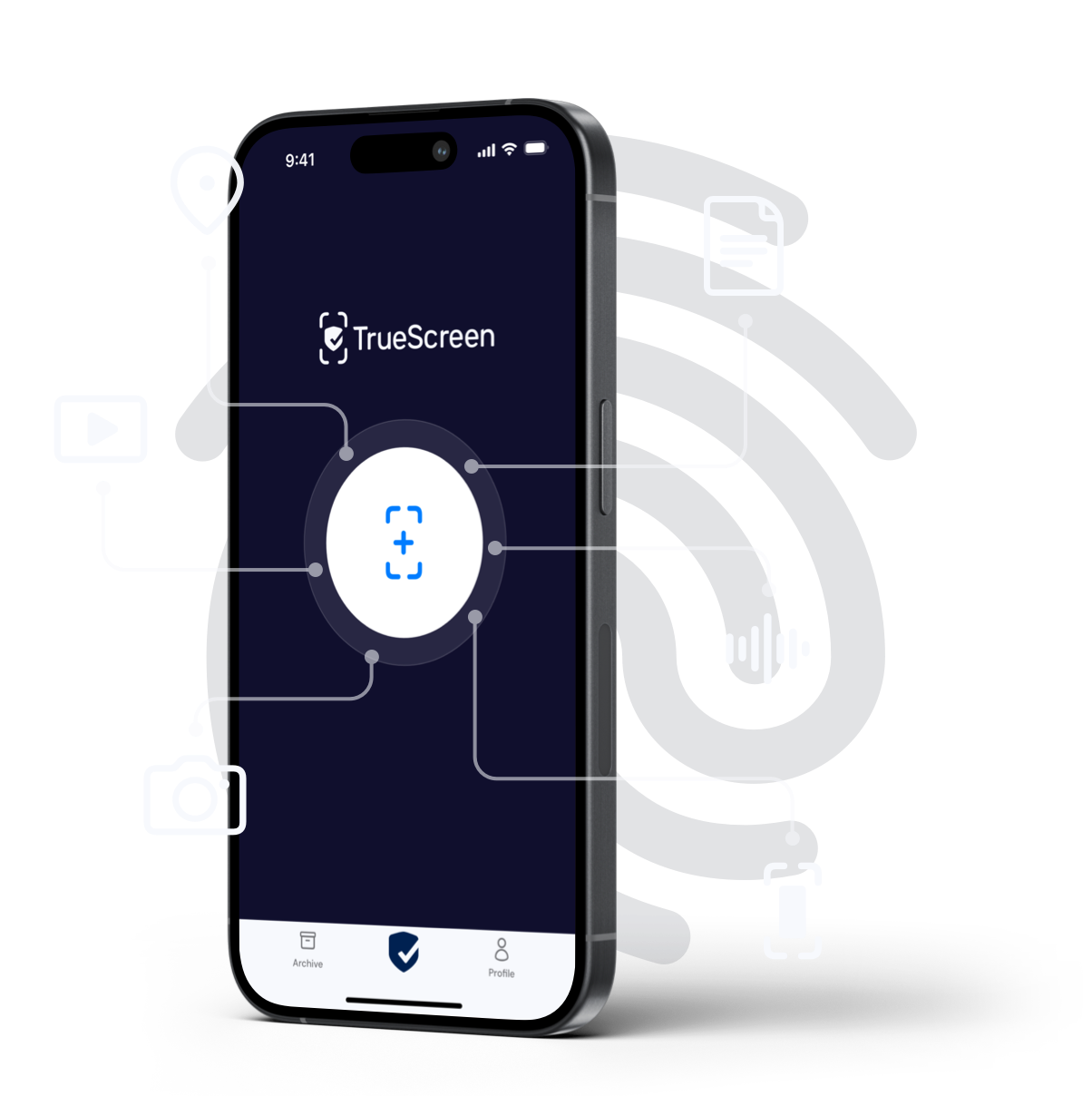
The qualified electronic seal finds its most complete application when integrated into a structured process for acquiring and certifying digital content. TrueScreen represents a concrete example of this integration: the platform combines forensic data acquisition at the source and sealing with a qualified electronic seal issued by an international QTSP, creating a verifiable and legally valid digital chain of custody.
Forensic acquisition and QTSP sealing
The TrueScreen methodology comprises two inseparable phases. The first is forensic acquisition: every piece of content (photo, video, screenshot, document, email) is captured using a methodology compliant with the ISO/IEC 27037 standard for identification, collection, and preservation of digital evidence. Environmental metadata (GPS coordinates, timestamp, device parameters) are recorded to contextualise the content.
The second phase is certification: a qualified electronic seal and a qualified timestamp, issued by an accredited QTSP, are applied to the acquired content. The file’s cryptographic hash is computed and sealed, making any subsequent modification immediately detectable. The result is a complete evidentiary package: original content, metadata, seal, timestamp, and certification report.
This combination of forensic acquisition and qualified seal distinguishes Digital Provenance from the mere application of a seal to pre-existing data. Probative value arises from the guarantee that the data was correctly acquired at the source, not merely sealed after the fact.
Concrete use cases
An insurance surveyor documenting a claim with the TrueScreen app captures photos and videos with certified metadata: the qualified electronic seal guarantees that those images have not been modified after capture and that they originate from the surveyor’s device, at that location and at that time. The result is documentation the insurer can use directly in the settlement process, reducing timelines and disputes.
A site director inspecting a construction project can certify progress videos. A lawyer needing to submit a screenshot of a conversation or web page in court can certify it with probative value without resorting to a notary or separate expert assessment.
FAQ: electronic seal and digital signature
What is the difference between an electronic seal and a digital signature?
Does a qualified electronic seal have legal validity across Europe?
Who can apply a qualified electronic seal?
What types of content can be protected by an electronic seal?
What changes does eIDAS 2.0 bring for electronic seals?
TrueScreen editorial team
This section is edited by the TrueScreen editorial team, which brings together expertise in digital forensics, the law of digital evidence and regulatory compliance. Every article is checked against primary sources: legislation, published rulings, technical standards and official documentation, always cited in the text.


