Certifying audio recordings as court evidence: chain of custody and qualified timestamp
Audio recordings are among the most contested forms of digital evidence in court. Without technical certification of the source and integrity, an audio file can be challenged as unreliable in civil proceedings and ruled inadmissible in criminal trials. Most mp3 files captured today on smartphones reach the judge with no metadata, no cryptographic hash and no qualified timestamp: when the opposing party objects, the court orders a forensic audio examination, and proceedings stall.
European law gives parties a way to neutralise this risk. Under the eIDAS regulation 910/2014 (and its 2024 amendment, eIDAS 2.0), a qualified electronic timestamp issued by a Qualified Trust Service Provider has full legal value across the EU, and a qualified electronic seal has the same evidentiary weight as a handwritten signature on paper. When applied at the moment of recording, these instruments transform an ordinary mp3 into self-verifying evidence. This insight covers the rules that govern audio admissibility in court, the typologies of recording (telephone, ambient, interview), the cost of forensic examinations, and the end-to-end flow that produces an audio file already certified at source.
For a wider view on multimedia evidence in court and the chain of custody requirements for video files, see our companion insight on video evidence in private investigations.
When an audio recording carries evidentiary value in court
The probative value of an audio recording depends on three elements: the lawfulness of the capture, the attribution of the voice to its author, and the integrity of the file from the moment of recording to deposit at trial. Rules and burdens of proof differ across jurisdictions, but the common thread is unchanged: whoever produces the audio must be able to demonstrate that the file has not been altered.
Civil proceedings: integrity and the burden of disclaiming
In most European civil systems, a multimedia file can be admitted as documentary evidence as long as it represents a fact, a person, or a thing. The opposing party retains the right to challenge its authenticity, but the challenge must be specific and articulated: a generic objection rarely succeeds. The Council of Europe's Committee on Legal Co-operation has repeatedly stressed that digital evidence requires technical safeguards proportionate to the contested value.
The practical issue is that, without a technical certification of source, the opposing party can articulate an objection sophisticated enough to force the producing party to commission a forensic audio examination. A qualified timestamp, a SHA-256 hash and a qualified electronic seal applied from the moment of recording neutralise this risk: the file becomes self-referential as to time and content, and a generic challenge collapses.
Criminal proceedings: documentary evidence and free evaluation
Most European criminal codes treat audio recordings as documentary evidence subject to free judicial evaluation. The court considers provenance, integrity and chain of custody when deciding admissibility. The European Court of Human Rights, in its case law, has consistently recognised that a recording of a conversation made by one of its participants does not amount to interception and does not breach Article 8 of the Convention, provided the capture is lawful and the integrity of the file is preserved.
Here too the difference comes down to integrity: a file without a qualified timestamp and without a cryptographic fingerprint is more exposed to challenge, and challenges in criminal proceedings can lead to partial or total exclusion.
Recording among present parties: the consolidated principle
A recording made by one of the participants in a conversation, even without informing the others, is generally lawful and admissible. This principle has been confirmed across European jurisdictions: a participant who records their own dialogue is not a third party intercepting a communication, but one of its protagonists. The eIDAS framework and the e-Evidence Regulation (Regulation EU 2023/1543) reinforce the requirement of technical reliability without revisiting the substantive lawfulness of participant recordings.
Outside this perimeter, recordings made in private spaces by an outsider, or with concealed devices when the author is not part of the conversation, fall under privacy and unlawful interference rules. In all other cases, the file is admissible: the real risk is not the lawfulness of capture but the technical demonstration of integrity.
Audio recording typologies and technical risks
Not every audio file is the same, and a court treats a recorded phone call, an ambient capture and a structured interview differently. Technically, the differences come down to background noise, signal quality and the ease with which a forensic expert can identify the speakers. From an evidentiary perspective, what counts is the qualified timestamp, the hash and the ability to reconstruct the chain of custody from the recording device through to deposit at trial.
Telephone, ambient, interview
A telephone recording is captured by one of the parties to the call. It is the most common form in employment, family and commercial disputes. The file is typically an mp3 or m4a saved by the smartphone's native recorder. Without certification, the risk of alteration (cuts, overdubs, montage) is high and judges tend to order a forensic examination.
An ambient recording captures conversations occurring in a place such as an office, room or vehicle. When the author of the recording is part of the conversation, the participant principle applies. When the author is not present, the recording falls under privacy and unauthorised surveillance rules, with full inadmissibility.
An interview is a structured recording in which the author conducts a conversation with the declarant. It is the typical format of defence investigations and journalistic activity. Here the risk is not lawfulness but attribution: without a digital signature on the transcript and a qualified timestamp on the file, the declarant can later contest both the content and the temporal sequence of the exchanges.
Forensic audio examination: when and why it costs
A forensic audio examination is the technical assessment ordered by the court or commissioned by the parties to verify authenticity, identify speakers, exclude alterations and reconstruct any cuts or overdubs. In civil proceedings it is typically a court-appointed expert opinion or a party expert opinion; in criminal proceedings it is an expert opinion ordered by the judge.
Costs are significant: a basic spectrographic analysis by a party expert starts at several thousand euros, while a complex court-ordered analysis with comparative speaker identification can exceed twenty thousand euros, according to forensic association tariff guidance. Time is added on top: an examination requires weeks or months and freezes the case during the evidentiary phase.
| Type of examination | When ordered | What it verifies |
|---|---|---|
| Party expert opinion | In support of one's own case | Basic authenticity, signal quality |
| Court-appointed expert (civil) | Following an objection by the opposing party | Integrity, speaker identification, possible cuts |
| Forensic examination (criminal) | Ordered by the judge or investigating magistrate | Integrity, attribution, overall authenticity |
An audio file already certified at source, with a qualified timestamp and a SHA-256 fingerprint, drastically reduces the need for a preliminary examination: the court already has the technical proof of integrity in front of it.
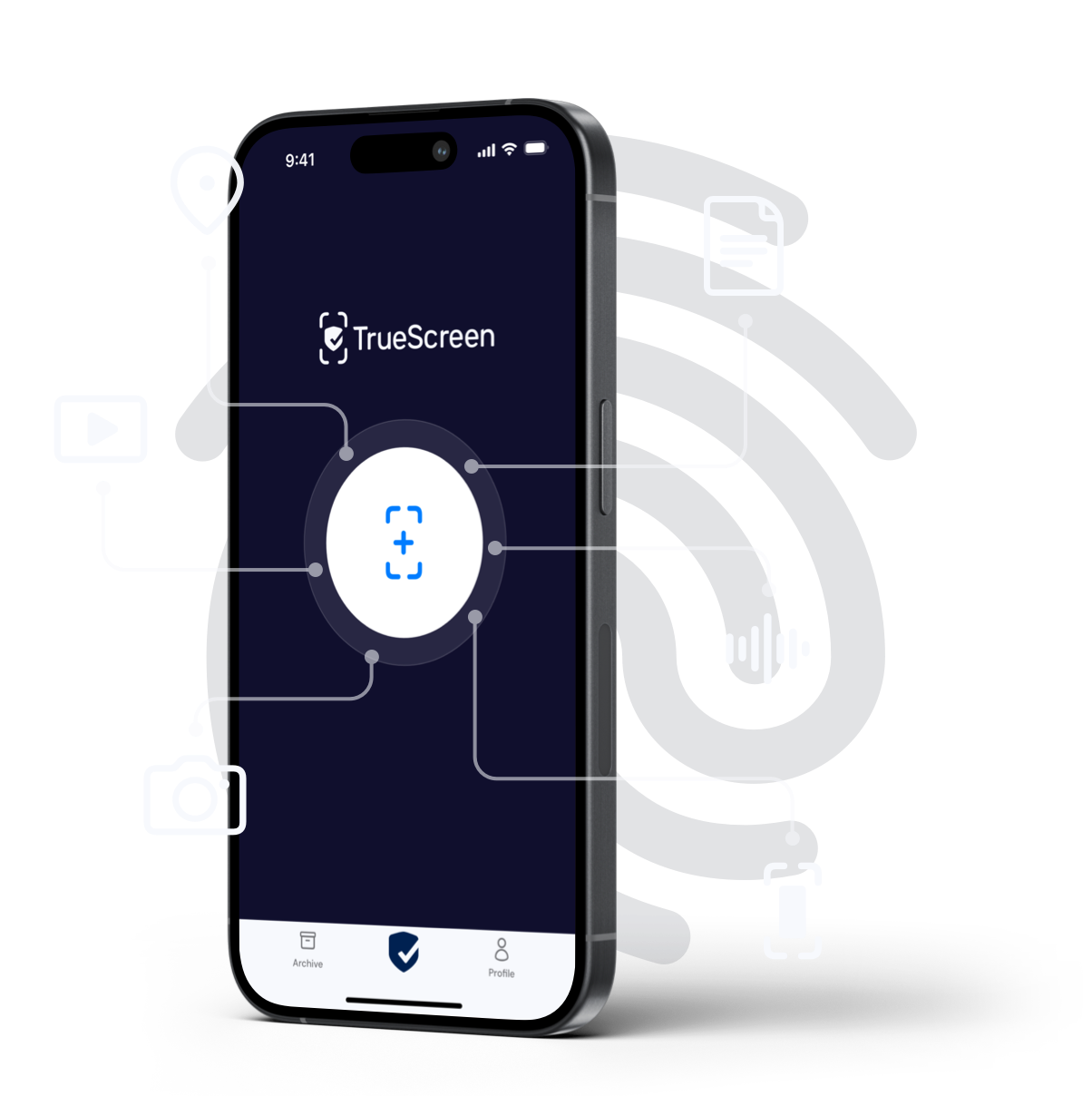
How to certify audio recordings with TrueScreen
TrueScreen integrates the seal of qualified third-party QTSPs and qualified timestamps directly into the acquisition process. There is no after-the-fact seal applied to an existing file: the audio is captured through the mobile app or the web portal, and the resulting file leaves the system with a documented chain of custody, a cryptographic hash and an eIDAS qualified timestamp already applied. The principle is immutability at source: evidence is born already defensible.
For an end-to-end view of the certification model applied to video calls, see our companion insight on how to certify video calls on Zoom, Teams and Meet, which applies the same methodology to videoconferencing.
Acquisition, SHA-256 hash and qualified timestamp
The process unfolds in three technical steps. First: the TrueScreen app starts the recording and computes the SHA-256 fingerprint of the audio stream in real time. Every byte of the file is tracked and the final hash is generated at the end of the recording. Second: the hash is sent to a qualified QTSP (a Trust Service Provider under Regulation EU 910/2014) which applies a qualified timestamp and returns the TSA token. Third: the audio file, the hash and the token are wrapped in a sealed bundle with a qualified electronic seal, also issued by an integrated QTSP.
The result is a data bundle the court can verify with standard tools: the hash certifies that not a single bit of the file has changed, the qualified timestamp proves the moment of recording with legal value erga omnes, and the seal binds everything to the TrueScreen system as the technical author of the acquisition.
Chain of custody documented from origin
The difference compared to a non-certified mp3 is substantial. The chain of custody starts at the recording device (smartphone or web portal), continues with encrypted transmission to the TrueScreen infrastructure, and concludes with the issuance of the sealed bundle. Every step is logged, every log is itself signed.
When the file is filed in court, counsel can produce:
- the original audio file, identical bit-for-bit to the moment of recording
- the qualified timestamp certificate issued by the QTSP
- the chain of custody report with timestamped logs
- the qualified electronic seal attestation
Three concrete benefits for litigators: stronger admissibility without a preliminary forensic examination, protection against alteration challenges on the merits, and a complete technical record the court can verify autonomously using standard EU-grade tools.
For practitioners managing significant volumes of recordings, including law firms specialised in employment law, criminal defenders and licensed private investigators, the difference between a certified and a non-certified audio file is measured in case duration and in the probability of clearing the first instance without court-ordered technical assessments.