
Criminal defense investigations: how chain of custody keeps defense evidence admissible
Updated on
Criminal defense investigations are the inquiries that defense counsel, or investigators and experts acting on counsel's behalf, carry out to gather statements, documents and digital material that support the accused. In most systems their fate is decided by rules of form: who may take a statement, which warnings must be given before it, and how the material is documented and kept. Evidence collected in breach of those rules can be excluded however strong its content. For material gathered by the defense, TrueScreen certifies photos, videos and recordings with an official digital seal and a qualified timestamp: content captured in real time with the TrueScreen App is certified as a forensic acquisition, while an existing file has a certain date from the moment of certification. Integrity and date become verifiable, while the weight of the evidence is still assessed by the court case by case.
In adversarial and mixed criminal-justice systems, the defense is no longer a passive party waiting for the prosecution to move. Defense counsel can run their own inquiry, gather material that supports the accused, and bring it before the court as evidence formed with equal standing. This is a fairness principle: a fair trial assumes that prosecution and defense can both present proof the judge will weigh on its merits.
The complication sits in the form, not the substance. Most systems attach strict rules to how a defense party may take a statement, film a place, or capture a digital file, and a piece of evidence collected in breach of those rules can be challenged and thrown out, sometimes long after it was gathered. A statement taken by the wrong person, a photograph with no traceable origin, a video whose integrity cannot be proven: each of these hands the prosecutor a ready-made objection.
The governing answer of this insight is easy to state and hard to practice. In criminal defense investigations, the line between usable evidence and excluded evidence almost never depends on the content, and almost always depends on the form of acquisition and on a traceable chain of custody for criminal evidence. Source-level certification, where defense evidence admissibility hinges on proving a file was never altered, is where the defense closes the gap before the prosecutor can open it.
This insight is part of our guide: Chain of custody of digital evidence: operational guide for lawyers and law firms
Who may lawfully gather and document defense evidence
The first error that produces an exclusion is confusion over roles. In most adversarial systems the right to take a formal, documented statement is reserved to specific actors, and treating a private investigator's note as if it carried the same weight as counsel's record is a fast route to inadmissibility.
Defense counsel, and the lawyers working under their authority, can normally run the full range of acts: an informal conversation that is not recorded, the receipt of a written statement, and the taking of a documented account under whatever formality the jurisdiction prescribes. A licensed private investigator with criminal accreditation occupies a narrower lane. In many systems the investigator may speak with people who hold relevant information and report back, but the formal, documented statement that goes into the case file remains the lawyer's responsibility. Where that boundary is crossed, the resulting record is vulnerable to challenge even when its content is accurate.
When defense counsel can delegate to a private investigator
Delegating to an accredited private investigator is valuable for the material side of an inquiry: site visits, locating witnesses, gathering documents, and filming places. The work has to stay inside the investigator's powers. A sound practice is to record the instruction in writing, stating the scope and limits of the delegated task, so it can later be shown that every act was performed by the person entitled to perform it. This matters because private investigator evidence is the first thing a prosecutor probes for a procedural flaw.
Cautions and warnings before taking a statement
Before receiving an account, whoever conducts the act usually has to identify their role, state the purpose, and tell the person of their right not to answer and of the consequences of a false statement. In many jurisdictions, omitting these warnings is itself a ground for exclusion: a statement that is substantially true but taken without the required cautions may simply not enter the proceeding.
Filming places and people, and documenting informant statements
Defense investigations move on two delicate fronts: the photographic or video record of places and people, and the documentation of what informants say. On both, counsel protects the client only by anticipating the objection rather than answering it after the fact.
Privacy and proportionality limits when filming
Defense counsel can document the state of a location with photographs and video, but the power is not unlimited. Filming private places, homes, and individuals runs into the General Data Protection Regulation (GDPR) and the protection of private and family life recognised across European and international human-rights frameworks. Recording in public or publicly accessible spaces is generally accepted when it serves the exercise of the right to defense, which can provide a lawful basis for processing; filming that intrudes into the home or the intimate sphere risks exclusion and, in the worst cases, separate liability. The guiding test is proportionality: film only what the defense needs, in the least intrusive way, and keep a record of when, where, and how the footage was taken.
Written record versus certified audio or video
An informant's account can be fixed in a written record drawn up by counsel, or documented with an audio or video recording. The recording has an evidential advantage: it faithfully reproduces tone, context, and the spontaneity of the speaker. It also introduces the real weak point of modern defense work: how do you prove that this audio or video file was not cut, edited, or altered between the recording and the moment it reached the case file? A recording with no guarantee of its own integrity is an open invitation to a challenge. The same is true for screenshots of conversations, photos taken on a smartphone, and content downloaded from the web. We covered how to fix footage in a defensible way in our analysis of video evidence in private investigation and its admissibility, while the probative value of the data hidden behind an image is explored in our piece on EXIF metadata, photo date, and court evidence.
How defense material enters the case file, and why courts exclude it
Acts of the defense inquiry flow into the defense file, which counsel may present to the court at the times and in the manner the law allows. The contest over usability is decided in the move from raw material to filed exhibit.
Courts in adversarial and mixed systems have repeatedly excluded defense evidence not for what it said, but for defects of form and origin: statements taken by an actor without authority, acts missing a required caution, and digital documents whose authenticity could not be demonstrated. A flaw in the acquisition does not heal with the passage of time. This is why the chain of custody behind criminal evidence has to be set before filing, not after. For digital content, the prudent defense measures itself against forensic standards, starting with ISO/IEC 27037 on the handling of digital evidence, which calls for documented identification, collection, acquisition, and preservation by a qualified first responder. The parent guide on the chain of custody for criminal evidence handled by lawyers sets out the four pillars that any defense file has to satisfy, and a defense exhibit that fails authenticity rarely survives the prosecutor's first objection.
How TrueScreen narrows the prosecutor's room to challenge
The defense lawyer's concrete question is this: how do you make a digital file hard for the prosecution to attack? The answer is not to prove that the fake is fake, but to guarantee at the source that the genuine is authentic. It is the shift in paradigm that TrueScreen enables: instead of chasing the objection after the fact, you fix the authenticity of the content the moment it is captured.
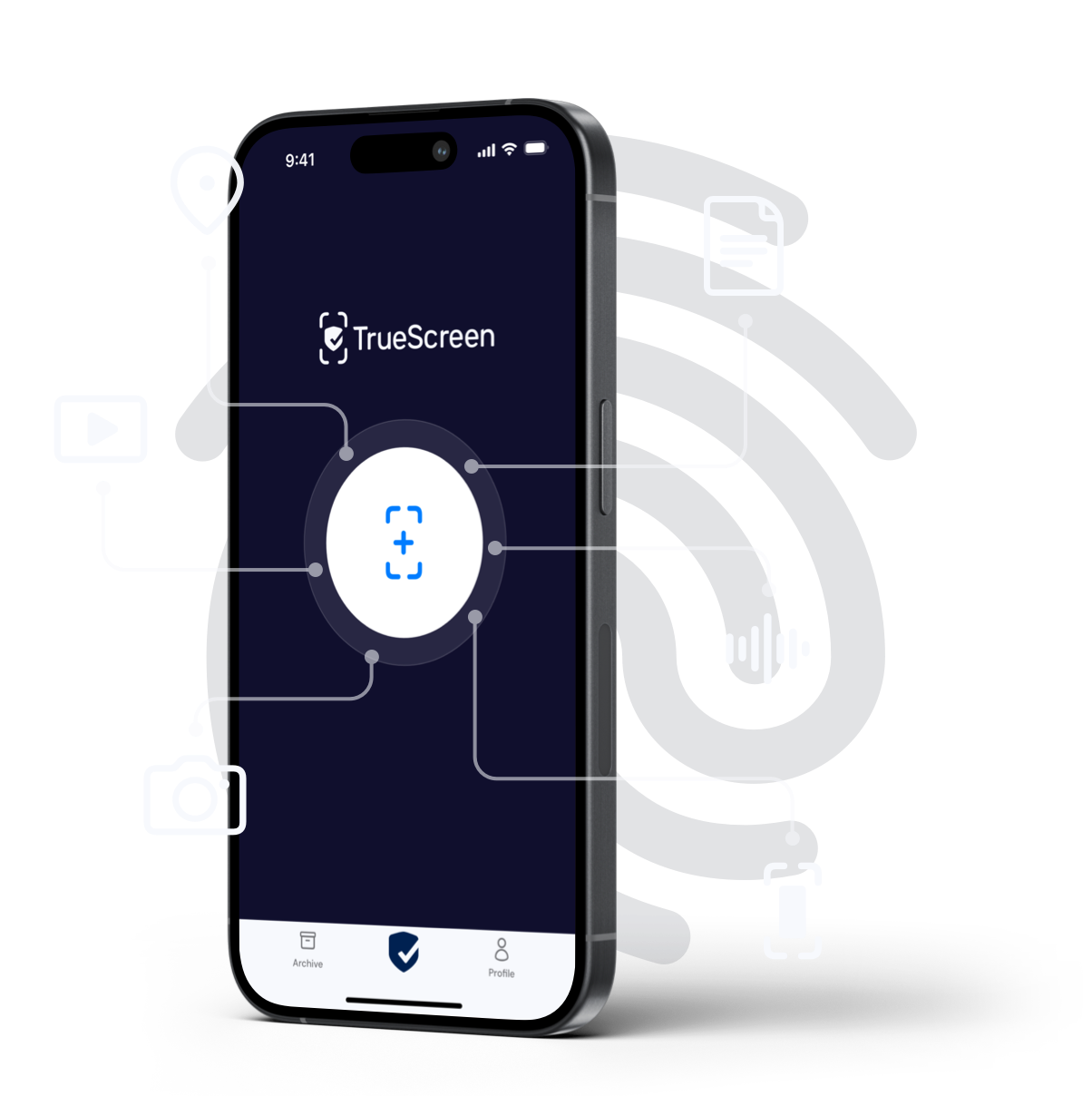
TrueScreen is the Data Authenticity Platform that acquires and certifies photos, videos, screenshots, email, and web pages with a forensic methodology. Acquisition happens at the source, the integrity of the content is verified and locked, and on that fingerprint a qualified timestamp and an electronic seal are applied through a qualified QTSP integrated into TrueScreen via API. TrueScreen is not a QTSP and does not issue certificates of its own: it integrates the seal of qualified third-party providers, building a traceable, documented chain of custody around the content.
For the defense this means two things. First, when a defense investigator certifies footage, a screenshot, or a photograph at the source, the file carries proof of when it was captured and that it was not changed afterward. Second, a prosecutor's objection to the authenticity of the digital material runs into a verifiable trail rather than a one-sided assertion. Certification does not guarantee admissibility in every jurisdiction and procedural context, which remains a matter for the court, but it sharply reduces the room to challenge the genuineness of the content. When source-level certification underpins private investigator evidence, the prosecutor is left arguing relevance, not authenticity. Where the inquiry borders on protecting confidential company material, the same logic carries over to digital evidence in corporate espionage cases.
The principle holds across the whole law of evidence: in defense investigations the winner is not the party that gathers the most, but the one that gathers in the right form and can prove it.
FAQ: criminal defense investigations and admissibility
Can a private investigator take written statements in a criminal defense investigation?
When does defense evidence become inadmissible?
How do you prove that defense-gathered video was not altered?
TrueScreen editorial team
This section is edited by the TrueScreen editorial team, which brings together expertise in digital forensics, the law of digital evidence and regulatory compliance. Every article is checked against primary sources: legislation, published rulings, technical standards and official documentation, always cited in the text.


