Certified Data Room: how forensic audit trails turn a data room into admissible evidence
Global M&A deal value hit USD 4.8 trillion in 2025, the second-highest total ever recorded according to Bain & Company. Every one of those deals runs through a data room, and the question of whether it is a certified data room or a standard virtual data room decides what kind of evidence survives a later dispute. The same question applies to public tenders, IP disputes, escrow arrangements and R&W underwriting files that hinge on sensitive digital documentation. The virtual data room market itself is at USD 3.34 billion in 2025 and is projected to reach USD 5.21 billion by 2030 at a 10.31% CAGR (Mordor Intelligence).
Then the moment comes when the evidence actually has to hold up, and most of those data rooms do not. The 2024 SRS Acquiom M&A Deal Terms Study reports that 28% of earnouts are disputed in part or in whole (SRS Acquiom). R&W insurance carriers see claim activity on roughly one policy in six, and 7% of those claims pay more than USD 10 million (Woodruff Sawyer). The friction is rarely about who got inside the data room. It is about whether the contents, and the log itself, can survive a court challenge.
Traditional virtual data rooms certify who accesses documents. They do not certify that the documents are authentic, nor that the audit trail itself is admissible in court. A certified data room closes both gaps by applying forensic methodology on two layers: every document sealed at ingestion, and every action (upload, download, view, share) cryptographically certified. The dual layer of trust that results is what lets a party prove, in front of a judge, a regulator or an R&W carrier, both that a file is unaltered and that the record of who saw it and when is beyond dispute.
Why traditional data rooms fail when evidence actually matters
A traditional VDR does three things well: encryption, access control, activity logging. What it does not do, and what matters most in a dispute, is prove forensic integrity of content and register. Federal Rule of Evidence 902(14), in force since December 2017, allows self-authentication of data copied from an electronic device, storage medium or file through “a process of digital identification” (typically a cryptographic hash) plus certification by a qualified person, as codified by Cornell Law School.
In the European Union, eIDAS Regulation 910/2014 Article 35 grants a qualified electronic seal the legal presumption of integrity and origin correctness. None of the dominant VDR providers (Datasite, Intralinks, iDeals, Drooms, Firmex, SecureDocs) seal documents at source with an independent qualified timestamp.
Their architecture is built around perimeter security, but post-closing litigation is decided on authenticity and forensic traceability, which is a different plane entirely.
The audit trail illusion: what standard VDR logs actually track
A standard VDR audit trail records user activities in a database the platform controls. Every event is a row: who, what, when. That row lives inside a system the provider can modify, so there is no legal presumption the log has not been edited after the fact. If opposing counsel challenges the trail, the provider has to produce technical testimony to defend it. In court, that is the line between self-authenticating evidence and evidence that needs a foundation witness.
Uncertified content: pre-upload tampering goes undetected
A traditional VDR starts tracking a document the moment it is uploaded. Anything that happens before is invisible, including a seller editing the file. If a buyer discovers after closing that a material contract was altered before being placed in the data room, the seller can always argue that was the version in existence on day X. Without a cryptographic hash and qualified timestamp applied at source, proving pre-upload manipulation is a slow forensic exercise with uncertain results. The Woodruff Sawyer R&W Claims Study found that financial statement claims on audited targets show an average payout of 41.4% of the policy limit, well above the overall average. Having auditors on the target is not enough when the documentation handed to those auditors carries no forensic integrity that a third party can independently verify.
Unsealed audit log: the registry itself is contestable
An audit log that is not sealed with a qualified timestamp at creation becomes contestable along with the content it describes. Opposing counsel will argue the log could have been edited after the dispute arose. The self-authentication shortcut in FRE 902(14) only works if the log was sealed at source. Otherwise the court takes the long road: testimony, expert analysis, reconstruction. Meanwhile the cost of the dispute climbs and the economic value of the evidence erodes.
The cost of a non-certified data room: where evidentiary value breaks down
When an audit trail cannot hold, a measurable cascade follows. The 2024 SRS Acquiom M&A Deal Terms Study reports that 28% of earnouts are disputed and that earnouts pay, on average, 21 cents per dollar outside of life sciences. Of those deals, 68% include multiple metrics, so every friction point is also a documentary proof point (SRS Acquiom).
On the insurance side, Woodruff Sawyer tracks claim activity on roughly one in six R&W policies, with 7% of claims paying more than USD 10 million and financial statement claims on audited targets reaching average payouts of 41.4% of the policy limit. R&W claim categories break down as financial statements 18%, tax 16%, compliance with laws 15%, material contracts 14%.
Survival periods run 12 to 24 months for general reps and up to six years for fundamental and tax matters. That is 12, 18, 24 months in which the data room remains at the center of negotiation, and a contestable audit trail turns every disclosure into negotiable material.
M&A post-closing disputes: breach of warranty, earn-out, misrepresentation
Post-closing disputes cluster into four recurring archetypes: breach of representations and warranties, earn-out claims, misrepresentation and working capital adjustments. All of them hinge on what the seller did or did not disclose. In Shareholder Representative Services LLC v. Alexion Pharmaceuticals (Del. Ch. Sept. 5, 2024), the court found Alexion had breached a merger agreement by failing to use commercially reasonable efforts on eight milestones. Damages were calculated by multiplying expected earnout value by the probability of milestone achievement, producing exposures above USD 1 billion in comparable cases (Skadden). When evidence of what was communicated during the earnout period is contestable, damages become negotiable rather than forensically demonstrable.
R&W insurance gap: what the policy requires and what the data room fails to provide
R&W insurance is now standard on mid-market and large-cap deals, with policy limits typically around 10% of enterprise value (ABA Business Law Today). When a claim is triggered, the carrier wants access to data room materials, disclosure schedules and the Q&A log to reconstruct what the buyer saw. A certified data room lets the carrier verify what was disclosed and when without relying on testimony from the VDR provider. Without forensic integrity, every disclosure becomes disputable. Standard policies carve out only intentional fraud by the seller, leaving constructive fraud, negligent misrepresentation and recklessness inside the subrogation waiver. That asymmetry makes evidentiary quality the pivot on which recovery turns.
Public tender and procurement disputes
The CJEU Kolin ruling (C-652/22, 22 October 2024) confirmed that any post-award documentary integration must be traceable within the correct procedural stage (How to Crack a Nut). A rejected bidder can challenge the timing of an integration, and the contracting authority must be able to show cryptographically who did what and when. Without a sealed trail, defending the procedure degrades into the word of the operator against the word of the challenger.
IP priority disputes: when timestampability is the difference
In patent, trade secret and software authorship cases, priority depends on proving that a specific document existed in its exact form at a specific moment. Informal timestamps from email or commercial cloud storage carry thin weight in court. A qualified electronic timestamp under eIDAS Regulation (EU) 910/2014 has presumption of accuracy regarding date, time and data integrity across all EU Member States (EUR-Lex). On the U.S. side, FRE 902(14) enables self-authentication via hash plus qualified-person certification. A data room that applies both at ingestion builds a priority register that resists disclaimer.
The four requirements of a data room with admissible evidence
Unlike a standard VDR audit trail, which records who accessed a document but cannot prove the document itself is authentic, a certified audit trail builds a dual layer of trust: content sealed at source with a cryptographic hash and a qualified eIDAS timestamp, and every interaction sealed in a hash-chained tamper-evident log. ISO/IEC 27037:2012 defines the processes of identification, collection, acquisition and preservation of digital evidence (ISO).
SEC Rule 17a-4, amended October 2022 and effective January 2023, obliges U.S. broker-dealers to preserve records with a “complete time-stamped audit trail” covering all modifications, dates, times and creator or modifier identity (Cornell LII).
A data room that produces evidence fit for M&A post-closing disputes, R&W claims, public tenders or IP litigation has to satisfy four non-negotiable technical requirements. Each one closes a door the traditional VDR leaves open.
Document integrity at ingestion (hash + qualified eIDAS timestamp)
Every upload is hashed with a robust algorithm (SHA-256 or stronger), and the combination of hash, identifier and qualified timestamp is sealed by a trusted third party. Any later comparison between original and current hash proves, in binary fashion, whether the file has been altered. Article 41 of eIDAS grants qualified timestamps legal presumption of accuracy regarding date, time and data integrity. The cryptographic hash satisfies FRE 902(14) self-authentication. Challenging that combination in court would require demonstrating a cryptographic collision, practically out of reach with standard algorithms.
Cryptographically sealed audit trail
Every user action (upload, download, view, share, comment, delete) receives an independent qualified timestamp and is cryptographically chained to the previous ones using hash-chain logic. The log becomes tamper-evident: any attempt to modify a prior entry breaks the chain in a detectable way. FINRA Rule 4511 sets a six-year minimum retention for books and records, with formats that must comply with Exchange Act Rule 17a-4. Without a sealed trail, a regulated broker-dealer cannot demonstrate compliance through the standard audit route.
End-to-end chain of custody: the dual layer of trust
Content integrity is certified, and interactions with that content are certified too. The two dimensions are cryptographically linked yet independently verifiable: a third party (judge, expert, R&W carrier, opposing counsel) can reconstruct the state of documents at any point without trusting the platform. Datasite, Intralinks, Drooms, iDeals and the other leading players deliver encryption, granular permissions, watermarking and session logging, but those are perimeter-security features, not forensic integrity. The dual layer of trust breaks the circularity the traditional VDR leaves in place, in which you have to trust the platform in order to believe the platform.
International legal value: eIDAS, ISO 27037, FRE 901 and 902(14)
A cross-border deal cannot afford an audit trail that holds in one jurisdiction and fails in another. A certified data room combines multiple standards: eIDAS for the EU-wide presumption of integrity and origin, ISO/IEC 27037 for forensic acquisition and preservation, NIST SP 800-86 for U.S. forensic techniques, FRE 901 and 902(14) for admissibility in federal courts, RFC 3161 for the Time Stamp Token. Taken together, they produce evidence that holds up in every jurisdiction where the deal might be contested. TrueScreen applies all of these standards inside one ingestion pipeline, so the Certified Data Room produces the same admissibility profile on both sides of the Atlantic.
What is TrueScreen’s Certified Data Room
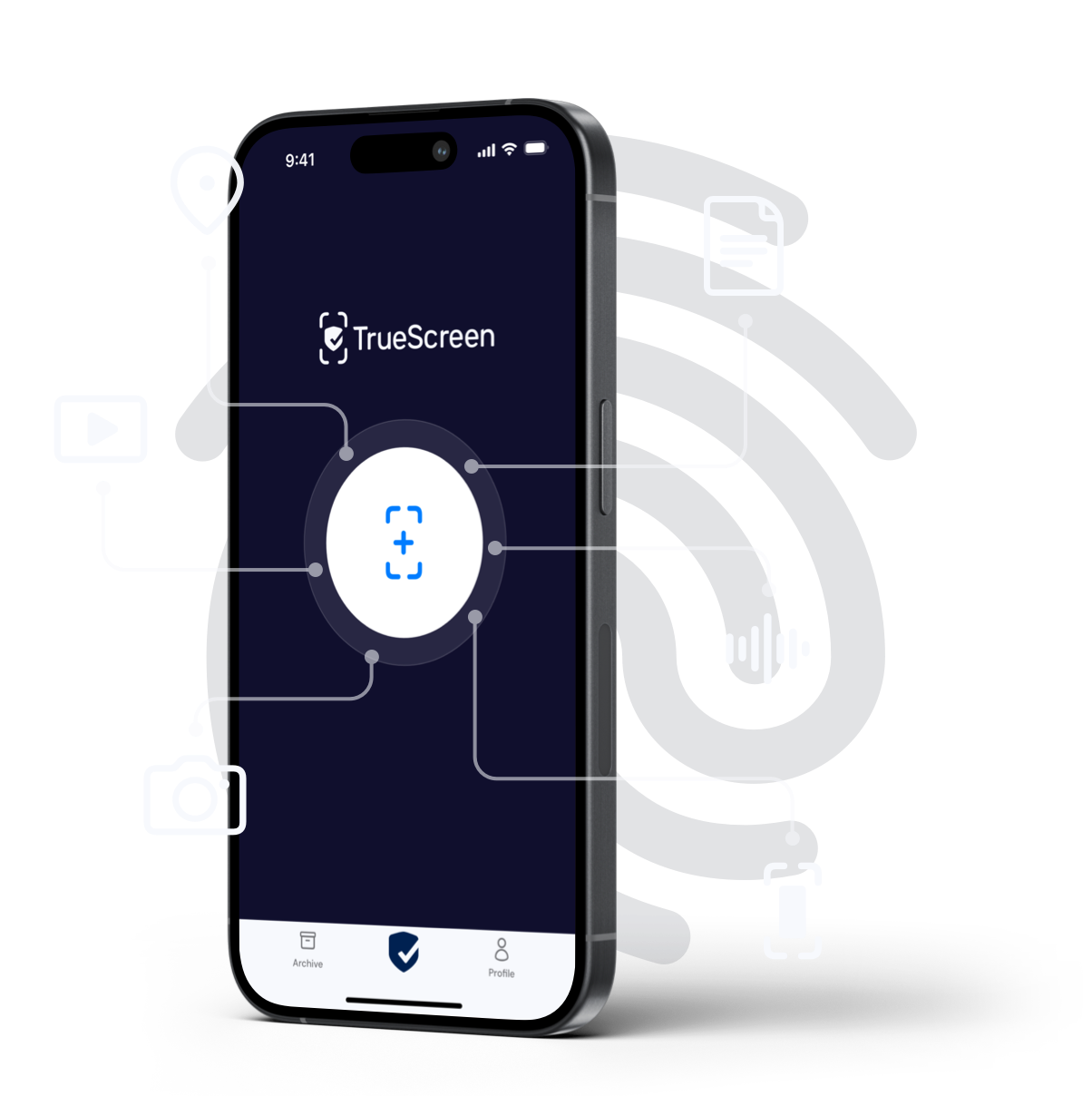
TrueScreen’s Certified Data Room, built on the TrueScreen Data Authenticity Platform, is a secure, tamper-evident environment for storing, managing and sharing sensitive documents with full legal value at an international level. Every document and every action (upload, download, view, share) is sealed, which creates a dual layer of trust: content and process. Instead of stopping at perimeter security and internal logging, the platform applies forensic methodology at ingestion and on every subsequent action. The evidence it produces is usable in civil, commercial, regulatory and arbitral proceedings across the European Union, the United States and beyond. Organizations use it to defend against post-closing M&A disputes, contested public tenders and IP priority challenges with cryptographically sealed proof of what was disclosed and when.
Forensic methodology applied at ingestion
A document uploaded into the Certified Data Room is not merely stored. It is acquired using forensic methodology: the ingestion environment protects data integrity at source and prevents alteration during transfer. The content is verified, then sealed with a digital seal and a qualified electronic timestamp. From that moment any modification becomes cryptographically detectable. The same principle underpins TrueScreen’s forensic acquisition of web content and other digital assets.
Cryptographically sealed audit trail on every interaction
Every authorized action is written to a tamper-evident log. Each entry receives an independent qualified timestamp and is cryptographically chained to the previous ones, so a third party can reconstruct the full timeline without relying on the platform operator. In litigation the log self-authenticates under FRE 902(14) in the United States and under comparable civil-procedure rules across the EU, which means the audit trail can be admitted without a foundation witness.
Access controls that live inside the certified log
The platform includes the operational controls expected in any serious VDR: role-based access with granular permissions, multi-factor authentication, dynamic watermarking, deadline tracking, real-time revocation. Every event touching these controls (permission assignment, revocation, watermark application, expiration) is written into the certified audit trail and sealed with a qualified timestamp, so permission changes themselves become admissible evidence. Those same controls answer the data-protection questions regulated industries raise before they open a data room. GDPR accountability obligations sit on the same access logs. Healthcare M&A in the U.S. reads the permission history as a HIPAA-equivalent confidentiality trail. SOC 2 Type II and ISO 27001 auditors treat the certified log as evidence of operating effectiveness rather than configuration on paper.
A concrete scenario
In a cross-border M&A between a European private equity fund and a U.S. tech company, buyer-side counsel has to prove, 14 months post-closing, that a specific undisclosed litigation memo was never shared by the seller before signing. A traditional VDR audit log cannot rule out that the log itself was edited after the dispute arose. The certified audit trail, cryptographically sealed at every event, is admitted as self-authenticating evidence under FRE 902(14). The breach-of-warranty claim settles in six weeks instead of the 18-month median survival common in comparable matters.
Where the dual layer of trust makes the difference: official use cases
According to Mordor Intelligence, the global virtual data room market reached USD 3.34 billion in 2025 and is projected to hit USD 5.21 billion by 2030 at a 10.31% CAGR. The legal and compliance segment accounts for 38% of the 2024 market, while the BFSI vertical leads at 31% of 2024 revenue share.
Intellectual property management is the fastest-moving segment at 16.9% CAGR, driven by monetization of patents and digital assets in M&A and carve-out transactions. Asia-Pacific is the region with the highest CAGR (14.4%) and Europe is expected to see double-digit M&A growth in 2025.
Those numbers clarify why the probative quality of a data room is not a commodity feature but an economic variable: as deal volumes rise, the probability of disputes over data room contents scales alongside them, and the cost of contesting weak evidence rises with deal size.
M&A due diligence: buyer side vs seller side
On the buyer side, the Certified Data Room produces verifiable evidence of what was made available, when and in which version. If an R&W claim is triggered, the carrier reconstructs exposure without depending on platform testimony. On the seller side, the seal at source proves that what the buyer saw was exactly what the seller shared, with no contestable pre-upload alterations. Earnouts, disputed in 28% of cases (SRS Acquiom), pay on average 21 cents per dollar and require granular evidence of milestone performance, which makes the certified audit trail directly relevant to valuation outcomes.
Public tenders and procurement: audit trail transparency
A certified data room lets a contracting authority prove, if a challenge is filed, that every document was uploaded at the declared time and has not been altered afterward. On the bidder side, the same infrastructure proves that the offer was complete and compliant at submission. Evidence becomes bidirectional and symmetric, which is the implicit requirement of any fair procurement procedure.
Escrow arrangements: verifiable neutral custody
The SRS Acquiom 2025 Deal Terms Study reports that more than 75% of deals from 2019-2024 include a separate escrow for purchase price adjustment, with median size at 1% of deal value. In the digital sphere, escrow requires the custodian to prove material integrity and access transparency. A certified data room offers native escrow infrastructure: the seal at source proves the documents are the ones deposited, and the certified audit trail proves nobody accessed them outside the defined conditions.
Intellectual property management: priority and provenance
For startups, research centers and spinoffs, demonstrating priority over inventions, code, design models and know-how is the foundation of every future negotiation. A certified data room applies a qualified timestamp to every IP asset at deposit, building priority evidence usable in patent prosecution, investment-round due diligence and IP infringement litigation. The IP management segment grows at 16.9% CAGR, the highest in the sector, because disputes over AI-generated code authorship make digital provenance a first-order economic problem, which also informs certified IP protection workflows.
Legal proceedings and law firm workflows
Law firms, litigation-support providers and in-house legal teams use data rooms to manage complex disputes, advise on M&A counsel-side and archive evidentiary documentation for clients. The Certified Data Room exposes APIs that connect it to existing case management or document management systems while preserving the forensic chain of custody end to end. Every document imported via API receives the same seal and qualified timestamp as a manual upload, which matters in digital-evidence-centric litigation and in the work of law firms producing evidence that must survive authentication challenges.
Legal framework: when an audit trail becomes evidence
Admissibility of an audit trail in court depends on two simultaneous conditions: the procedural rule that defines what counts as evidence and the technical standard that produces the integrity. In the European Union, Article 35 of eIDAS Regulation 910/2014, in the consolidated text of 18 October 2024 published on EUR-Lex, grants a qualified electronic seal legal presumption of integrity and correctness of origin in every Member State.
In the United States, FRE 902(14), effective December 2017, allows self-authentication of data copied from a device via a hash-based process plus qualified-person certification.
Without a rule that admits self-authenticating digital evidence no technique is enough; without a technical standard that produces verifiable integrity no rule can compensate for contestability. The two halves have to be used together, which is why cross-border transactions increasingly require both by design.
Europe: eIDAS 910/2014, ISO 27037, the eIDAS 2 context
eIDAS Regulation 910/2014, directly applicable in every Member State, grants qualified electronic seals (Art. 35) presumption of integrity and origin correctness, and qualified timestamps (Arts. 41-42) presumption of accuracy of date and time and of data integrity. ISO/IEC 27037:2012 provides guidelines for identification, collection, acquisition and preservation of digital evidence. eIDAS 2 Regulation (EU) 2024/1183, in force since 20 May 2024, extends the framework with the EU Digital Identity Wallet. Each Member State has to make an EUDI Wallet available by December 2026.
United States: FRE 901, FRE 902(14), SEC Rule 17a-4, FINRA 4511
FRE 901 requires that authenticity be demonstrated before admission. FRE 902(13) allows authentication of electronic records generated by a reliable process through qualified-person certification, eliminating live testimony. FRE 902(14), effective December 2017, allows self-authentication of data copied from a device, storage medium or file through a process of digital identification (typically a hash) plus qualified-person certification. SEC Rule 17a-4, amended October 2022, obliges broker-dealers to preserve records with a complete time-stamped audit trail covering all modifications, dates, times and creator or modifier identity (Cornell LII). FINRA Rule 4511 sets a minimum retention of six years.
Reference table: EU vs US standards
| Dimension | European Union | United States |
|---|---|---|
| Document authenticity | eIDAS Art. 35 (qualified seal, presumption of integrity and origin) | FRE 902(14) (hash + qualified-person certification) |
| Verifiable timestamp | eIDAS Arts. 41-42 (qualified electronic timestamp) | FRE 902(13) + RFC 3161 Time Stamp Token |
| Chain-of-custody standard | ISO/IEC 27037:2012 | NIST SP 800-86 |
| Digital documentary evidence | National civil-procedure frameworks recognizing qualified-sealed records | FRE 901 |
| Regulatory record-keeping | eIDAS 2 (EU 2024/1183), AI Act provenance obligations | SEC Rule 17a-4, FINRA Rule 4511, SOX 404 |
| Cross-border enforceability | Automatic recognition in every EU Member State | Recognition via certified process + qualified person |
A data room that does not rest on a combination of these standards risks being opposable in one legal system and not the other. Cross-border transactions cannot afford evidentiary asymmetries.
FAQ: Certified Data Rooms and Forensic Audit Trails
What is a certified data room and how is it different from a traditional VDR
Are VDR audit trails admissible evidence in court
How does a qualified timestamp protect M&A documents
What is FRE 902(14) and how does it affect data room evidence
How do R&W insurance claims relate to data room integrity
Can a seller tamper with documents before uploading them to a VDR
What happens to the data room after closing in an M&A transaction
Do earnout disputes rely on data room evidence
TrueScreen editorial team
Published on · Updated on
This section is edited by the TrueScreen editorial team, which brings together expertise in digital forensics, the law of digital evidence and regulatory compliance. Every article is checked against primary sources: legislation, published rulings, technical standards and official documentation, always cited in the text.


