
Updated on
WhatsApp screenshots in court: three steps to real probative value
A client walks into your office holding a phone and a conviction: "I have screenshots of the whole conversation, that is enough." It is a phrase every civil, criminal and employment lawyer hears more and more often. WhatsApp chats now hold agreements, threats, notices of termination, acknowledgments of debt. Yet in front of a judge, a screenshot on its own is worth far less than the client imagines.
The reason is simple: a WhatsApp screenshot is not a self-sufficient documentary record. It is a digital reproduction that the opposing party can challenge, and once that challenge is well founded and opposing counsel is prepared, the image loses most of its force. Across jurisdictions the pattern is consistent: a screenshot captured with the phone's native button, then forwarded across chats, carries no reliable link to the source and no fixed date. The legal value of a WhatsApp screenshot depends on how it was acquired, not on the picture itself.
The argument of this insight is operational: to bring a WhatsApp screenshot to court with real probative value, you need three steps, and it is the lawyer's job (not the client's) to make sure they are met before a dispute even ignites.
This insight is part of our guide: Lawyers and law firms: certified digital evidence and digital signature
Why a WhatsApp screenshot alone is not reliable evidence in court
A screenshot does not carry the full evidentiary weight of a signed document. It is a digital reproduction whose contents are presumed accurate only until the opposing party disputes their conformity to the original. Under the US Federal Rules of Evidence, the same image must clear an authentication hurdle (Rule 901) and survive the best evidence rule (Rule 1002): the proponent has to show the item is what they claim it is. Disputing authenticity is the most ordinary defensive move: counsel argues the image was cropped, taken out of context or altered, shifting the burden back onto the party that produced it.
The practical consequence is that admissibility is not the same as evidentiary weight. A judge may let a screenshot into the record and still give it little or no weight if its origin, integrity and timing cannot be demonstrated. Counting on the other side "not to object" is a gamble, not a strategy, especially when the screenshot is the central piece of the case.
There is also a technical mistake that voids the entire legal discussion: photographing a phone screen with a second smartphone. That photo strips the original file's metadata, carries no link to the source device, and to a forensic examiner it is just an image with no anchor to the real conversation. The same fragility applies to native screenshots saved and then re-shared: every hop adds a weak link to the chain.
The three steps that give a WhatsApp screenshot probative value
Probative value does not come from the image, it comes from the way the image is acquired. Three elements turn a contestable screenshot into a defensible package: an identifiable source, the hash of the file, and a timestamp that crystallises the date of acquisition. These are the same requirements that authentication standards expect when a digital record is challenged.
1. Identifiable source: device, account and conversation context
The first question any judge asks is "where does this screenshot come from?". The acquisition must tie the image to the source device and the WhatsApp account: phone number, contact name, the full screen with no cropping, date and time visible in the interface. Never extract a single message out of context. At the moment of capture it is worth documenting the source device, because identifying the origin is the first barrier against any suspicion of tampering.
2. File hash: the fingerprint that proves integrity
A hash is a cryptographic function that generates a unique fingerprint of a file. Change a single pixel and the fingerprint changes. Calculating a SHA-256 hash at the moment of acquisition and preserving it means you can demonstrate, at any later point, that the file produced in court is identical to the one acquired. It is the direct technical answer to a claim of alteration: integrity becomes verifiable by anyone, not left to one party's word.
3. Qualified timestamp: crystallising the date of acquisition
The date shown in the screenshot is the one from the phone's interface, editable and therefore unreliable. A qualified timestamp, issued by a qualified trust service provider (QTSP) under the eIDAS Regulation, binds the file to a date that is opposable to third parties. It does not prove what was written in the chat, but it proves beyond dispute when that content was captured and frozen: a temporal anchor that neither party can move.
How TrueScreen certifies a WhatsApp screenshot at the source
TrueScreen is the platform that acquires and certifies digital content with legal value, applying the three steps in a single guided action rather than leaving them to the client's improvisation. It is not a tool for detecting fakes: the challenge today is not chasing forgeries, it is guaranteeing the authenticity of content the moment it is captured. Instead of a reactive defence that runs after manipulation, TrueScreen moves protection upstream and certifies the conversation at the source. It is the same approach described in the guide on certified digital evidence for lawyers and law firms, applied to the specific case of a chat screenshot.
Three complementary solutions cover the acquisition, depending on the device at hand. The main solution on desktop is the TrueScreen Forensic Browser, an application for macOS and Windows that acquires WhatsApp Web while recording the entire browsing session in a controlled forensic environment. The Web Notarization extension for Chrome and Edge lets you quickly certify any content during normal browsing, while the TrueScreen app for iOS and Android certifies the conversation directly from the smartphone. All of them feed the same certification workflow, with SHA-256 hashing, qualified timestamping and electronic seal.
In practice, the acquisition of a WhatsApp screenshot follows a forensic methodology: capture of the full screen with the device and account traceable, calculation of the file hash, and application of the digital seal and qualified timestamp issued by a QTSP integrated into the platform. The result is an evidentiary package with a documented chain of custody, ready to be filed. The certified acquisition of WhatsApp chats was built for exactly this scenario.
Practical case: a notice of termination sent over WhatsApp in an employment dispute
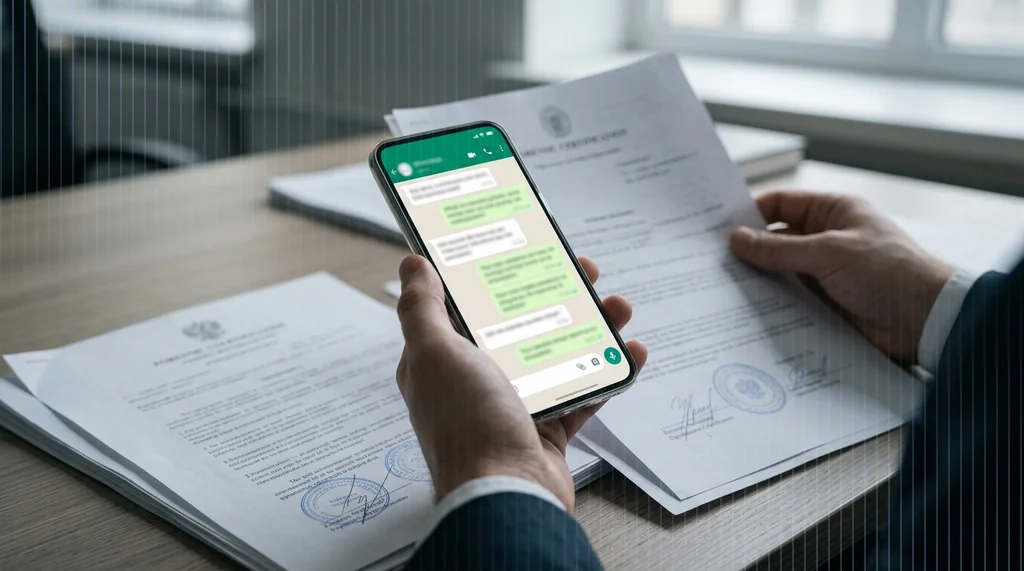
An employer sends notice of termination to a worker through a WhatsApp message. Months later a dispute arises: the worker claims they never received anything. In most jurisdictions the communication can be valid even outside traditional channels, provided the written form and the recipient's knowledge of it can be proven. This is where the screenshot makes the difference: without certified acquisition, the employer holds a contestable image; with a screenshot acquired with an identifiable source, a hash and a qualified timestamp, they hold opposable proof that the message, with that content, was sent and frozen at a certain date. The same logic applies in reverse to the worker who needs to prove a resignation or a complaint. For broader disputes, where screenshots sit alongside emails and other documents, it pays to structure the whole digital file: that is the focus of certified digital evidence for litigation.
To frame the objections opposing counsel can raise at the hearing and how to answer them, it is worth reading the analysis on screenshot evidence in court and the objections to its legal value, while the broader question of when screenshots, SMS and emails truly count is covered in the insight on when screenshots and messages count as evidence.
FAQ: WhatsApp screenshots as court evidence
Is a WhatsApp screenshot enough as evidence in court?
Can I photograph the phone screen with another smartphone?
What makes a WhatsApp screenshot defensible against a challenge?
TrueScreen editorial team
This section is edited by the TrueScreen editorial team, which brings together expertise in digital forensics, the law of digital evidence and regulatory compliance. Every article is checked against primary sources: legislation, published rulings, technical standards and official documentation, always cited in the text.


