Updated on
Enterprise digital provenance: integrating data certification into business processes
Enterprise organizations manage thousands of digital data points across their daily operations: field inspection photographs, contractual documents, audit reports, supplier communications. Until recently, the integrity of this data was taken for granted. With the proliferation of artificial intelligence tools capable of generating and manipulating content indistinguishably from the original, that implicit trust no longer holds. Gartner included digital provenance among the top strategic technology trends for 2026, estimating that by 2029, organizations that have not adequately invested in this area will face sanction risks potentially in the billions of dollars.
The answer does not lie in trying to detect fake content after it has been produced. It lies in guaranteeing the authenticity of data at the source, at the exact moment it is captured. For enterprise organizations, this means integrating a certification infrastructure into existing workflows without overhauling processes, but making them inherently trustworthy. As explored in our guide on digital provenance as a strategic technology trend, the shift from detection to source-level authenticity is now an operational necessity, not a technology choice.
This insight is part of our guide: Digital provenance: why Gartner considers it a strategic technology trend
Why enterprise organizations need digital provenance
The operational risk of uncertified data
When a manufacturing company documents a quality control inspection with photographs taken by an operator, that data passes through multiple systems before reaching decision-makers: transferred from a smartphone to a management system, shared via email, archived in a document management platform. At each step, the integrity of the original data is at risk. Sophisticated attacks are not needed: an accidental metadata change, a compression that alters the file, a download and re-upload that breaks the chain of custody.
The problem is amplified in regulated environments. A Sprinto report on ISO 27001 highlights how collecting and preserving digital evidence requires structured procedures for identification, acquisition, and preservation, with a chain of custody log documenting every interaction with the data. Without a system that certifies authenticity at the source, organizations must prove after the fact that data has not been altered: a costly burden of proof that is often impossible to meet.
Compliance and audit-readiness as a permanent requirement
ISO 27001, eIDAS 2.0, GDPR, AI Act: the European regulatory framework is converging on a common principle, namely that organizations must be able to demonstrate the integrity and provenance of the data they use in decision-making processes. Storing data is no longer sufficient: organizations must prove it has not been modified since its creation.
For a CTO or compliance officer, this translates into a concrete operational requirement: every relevant data point must be traceable, verifiable, and legally defensible at any time and without notice. Permanent audit-readiness is not an aspirational goal. It is the new minimum standard for operating in regulated sectors such as manufacturing, insurance, energy, and critical infrastructure.
How to integrate certification into enterprise workflows
APIs and SDKs: embedded certification in existing systems
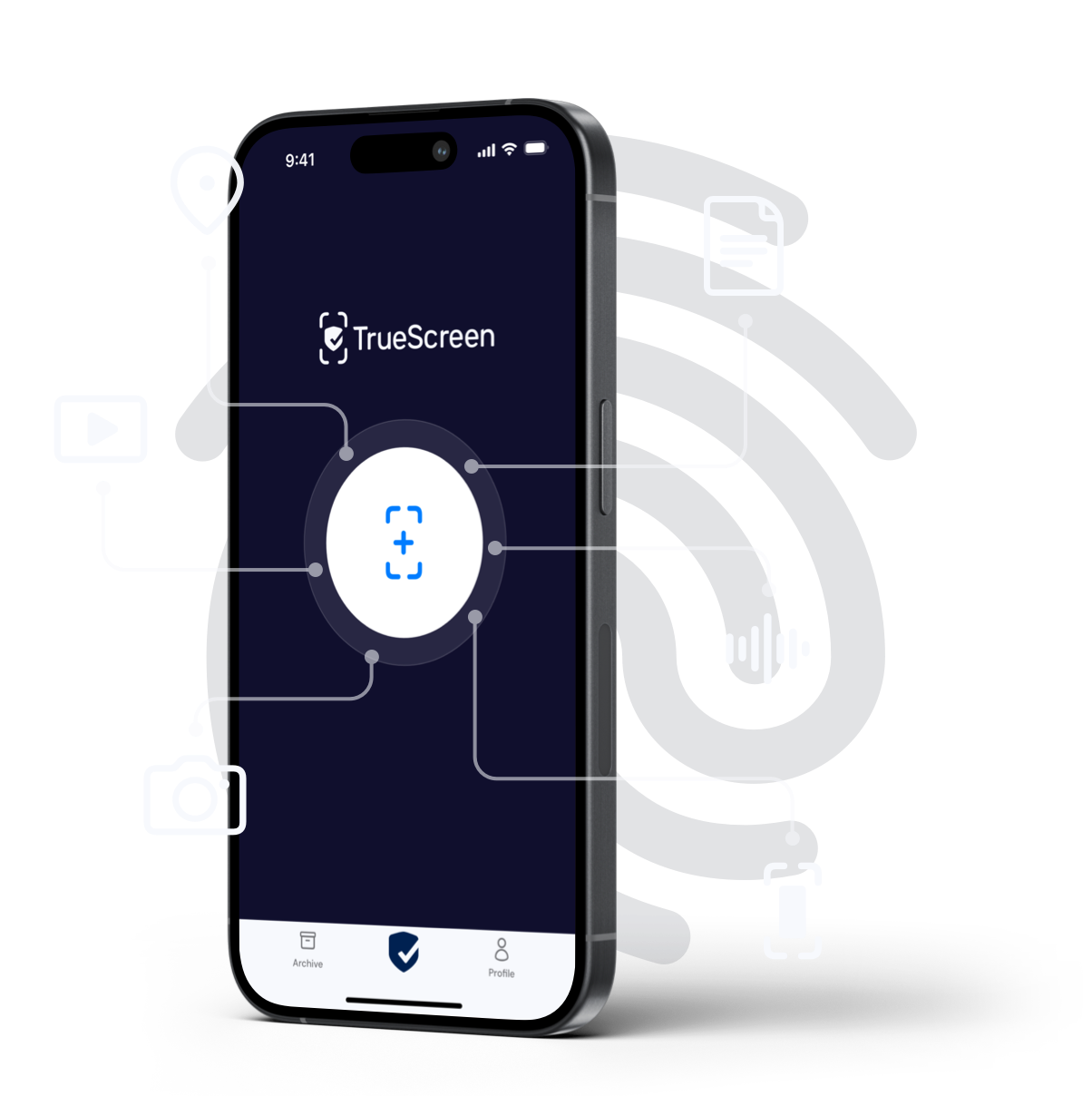
Integrating digital provenance in an enterprise context does not require replacing existing systems. TrueScreen provides REST APIs and native SDKs for iOS, Android, and web applications that allow organizations to embed certification directly within existing processes. An ERP system managing construction documentation, a CRM archiving client communications, a quality management platform collecting inspection photographs: each of these systems can call TrueScreen's APIs to certify data at the exact moment it is captured.
The process works in three steps. Data is captured through the TrueScreen module integrated into the application, which applies anti-tampering controls and secure capture mechanisms. The system verifies the content's integrity at the source, collecting forensic metadata (GPS, timestamp, device information). The certified data receives a digital seal and a qualified timestamp issued by an international Qualified Trust Service Provider, guaranteeing its immutability and legal value.
Operational scenarios: from supply chain to quality control
A manufacturing company operating across multiple facilities needs to document field inspections so that every photograph, every measurement, every finding is legally defensible. With TrueScreen integrated into the quality control management system, the operator takes a photo from the company device and the system automatically certifies the content: the original image, GPS coordinates, precise time, all sealed and unalterable.
The same principle applies to supply chain documentation. When a supplier delivers materials and the receiver documents the condition of goods, that certified photographic documentation becomes legally opposable evidence in case of disputes. For document management, the certified data room adds a further layer: not only are documents certified, but every action performed by users (uploads, downloads, views, shares) is recorded in an audit trail that is itself certified and verifiable.
TrueScreen as enterprise digital provenance infrastructure
Forensic acquisition and automatic certification
The value TrueScreen brings to enterprise organizations does not simply lie in applying a seal to an existing file. It lies in the complete process that begins with data acquisition using international forensic methodology. Data is captured in a controlled environment, verified at the source for integrity and authenticity, and only then certified with a digital seal, qualified timestamp, and where required, digital signature. These are two inseparable components: forensic acquisition and subsequent certification.
This approach solves a structural problem that traditional solutions do not address. A document management system can ensure that a file has not been modified after archiving, but it cannot say anything about what happened before. TrueScreen intervenes at the moment of data creation, eliminating the time gap during which content could have been altered.
Certified data room and verifiable audit trail
For enterprise operations requiring maximum transparency (M&A due diligence, public tenders, intellectual property management), the certified data room represents a qualitative leap over traditional virtual data rooms. Every uploaded document is certified using forensic methodology. Every user interaction is recorded, timestamped, and cryptographically sealed. The result is a dual layer of assurance: the content is authentic and the chain of human interactions with that content is independently verifiable.
In a context where compliance with eIDAS 2.0 and ISO 27001 is not optional, having an infrastructure that certifies both data and the processes around data means transforming compliance from a recurring cost into a structural organizational capability.
FAQ: digital provenance for enterprise organizations
How does TrueScreen integrate with existing enterprise systems?
Which compliance standards does enterprise certification support?
What is the difference between TrueScreen and a traditional document management system?
TrueScreen editorial team
This section is edited by the TrueScreen editorial team, which brings together expertise in digital forensics, the law of digital evidence and regulatory compliance. Every article is checked against primary sources: legislation, published rulings, technical standards and official documentation, always cited in the text.


