
Insurance fraud in the generative AI era: why certifying evidence is the only structural defense
Insurance companies process millions of claims every year based on an assumption that no longer holds: that the photos, videos, and documents submitted as supporting evidence are authentic. For decades this assumption worked, because creating convincing fraudulent documentation required technical skills and time. Generative AI has eliminated both barriers.
Today anyone can produce professional-quality receipts, photographs, videos, and audio recordings with a few clicks. According to the Coalition Against Insurance Fraud, insurance fraud costs US consumers and businesses over $308 billion a year, and generative AI is accelerating the problem dramatically. The response cannot be limited to detection: the defense needs to shift from identifying fakes after the fact to certifying evidence at the point of acquisition.
$308 billion: the scale of insurance fraud
The explosion of AI-generated fraud in the insurance sector
42% of North American carriers report that AI and digital tools are being exploited for fraudulent activities. Nearly half flag suspicious claims linked to AI-generated documentation. In Europe the picture is similar: a survey of British claims handlers found that 19% estimate that one in four claims contains documents fabricated or altered with AI tools.
From cottage industry to industrial scale
Before generative AI, insurance fraud was a cottage industry. Faking a photographic appraisal required photo editing skills; altering a medical document meant access to templates and specialized knowledge. Cost and complexity kept the phenomenon limited to organized groups or isolated opportunistic attempts.
AI removed those constraints. Allianz reported a 300% increase in cases where AI applications were used to distort real images, videos, and documents submitted in support of claims. The marginal cost of fraud has dropped to near zero, while the quality of fraudulent material has reached levels indistinguishable to the human eye. Medical receipts generated by language models, property damage photos created with image generators, accident videos synthesized from a few prompts. What used to take weeks of manual work now takes minutes.
Why fraud detection is no longer enough
The structural gap between generation and detection
The dominant response from the insurance sector has been to invest in detection. 67% of carriers use AI for fraud detection, a 16-point increase from the previous year. Yet losses keep growing.
The reason is straightforward: detection is reactive and always operates behind generation techniques. Every improvement in generative models makes previous detection systems obsolete. A detector trained on Stable Diffusion 2.0 artifacts cannot identify images produced by subsequent generation models. The gap widens with every update cycle. Carriers find themselves chasing a technology that evolves faster than their ability to adapt.
The limits of traditional anti-fraud systems
Traditional anti-fraud systems rely on pattern matching, statistical anomaly analysis, and comparison with historical databases. These approaches work well against conventional fraud, where repetitive patterns are identifiable. But generative AI changes patterns continuously, and fraudulent documents do not exhibit the statistical anomalies typical of manual forgery.
There is a deeper legal problem. Even when a detection system flags a document as suspicious, the insurer must prove it is fake. Under the Federal Rules of Evidence (Rule 901), the party introducing evidence bears the burden of authenticating it, but challenging digital evidence requires expensive forensic analysis. Under eIDAS in the EU, electronic documents are not to be denied legal effect solely because they are in electronic form. The burden of proof falls on whoever contests, not on whoever submits.
Certifying evidence at the source: a different approach
What it means to certify data at the moment of acquisition
Source certification reverses the logic. Instead of analyzing a document after receiving it to determine whether it is authentic, the data is certified at the very moment it is created or acquired. Every photo taken, every video recorded, every document acquired goes through a forensic process that fixes its digital identity: cryptographic hash, digital signature, qualified timestamp, verified metadata (GPS, device, time), complete chain of custody.
The resulting evidence package cannot be altered without the modification becoming immediately detectable. The question changes: no longer "is this document fake?" but "is this document certified at source?". If it is, verification is instant. If it is not, it should be treated with appropriate caution.
At the core is the concept of digital provenance: the ability to trace and verify the origin, history, and integrity of any digital content from the moment of its creation. Guaranteeing the authentic rather than chasing the fake.
From post-hoc verification to preventive assurance
A detection system analyzes thousands of received documents and flags a percentage as suspicious. False positives that slow down the investigation, false negatives that let sophisticated fraud through. A source certification system eliminates the problem upstream: certified documents are verifiable instantly and automatically, while uncertified ones go through additional verification procedures.
For insurance companies this means moving from a reactive model to a preventive one. No longer receive and then try to figure out what is fake, but acquire certified and verify automatically.
The operational workflow: claims with certified evidence
Field evidence collection with forensic certification
An adjuster conducting a survey for a property damage claim uses a certification application to acquire evidence. Every photo is taken through the certified process, which automatically records verified GPS coordinates, qualified timestamp, and device identity. The appraisal video follows the same process. Paper documents are scanned and certified on site.
In pre-risk appraisals the advantage is even more tangible: documentation of the condition of assets before insurance coverage acquires immediate evidentiary value, eliminating subsequent disputes over pre-existing conditions.
The policyholder can participate too. For minor claims, the client documents the damage via a certified app on their smartphone. The insurer receives evidence with authenticity guarantees without needing to send an adjuster on site for every case.
Investigation and settlement with verifiable chain of custody
Every certified document carries verifiable metadata: who acquired it, when, where, with which device, and whether it was modified after acquisition. The claims handler no longer needs to subjectively assess the reliability of evidence. Verification is objective and automatable.
In the complete claims certification process, from notification to settlement, every documentary step maintains the chain of custody. If the claim goes to litigation, certified evidence meets the admissibility requirements for digital evidence under applicable regulations: eIDAS compliance, adherence to ISO/IEC 27037 for forensic acquisition, and qualified timestamp issued by a Qualified Trust Service Provider.
The return on investment is measurable across multiple dimensions: reduced fraud exposure because fake evidence does not pass verification; faster settlement times because authentic evidence is processed automatically; lower litigation costs because certified evidence holds up in court.
TrueScreen in claims management: certification with legal value
Photos, videos, and documents certified at source
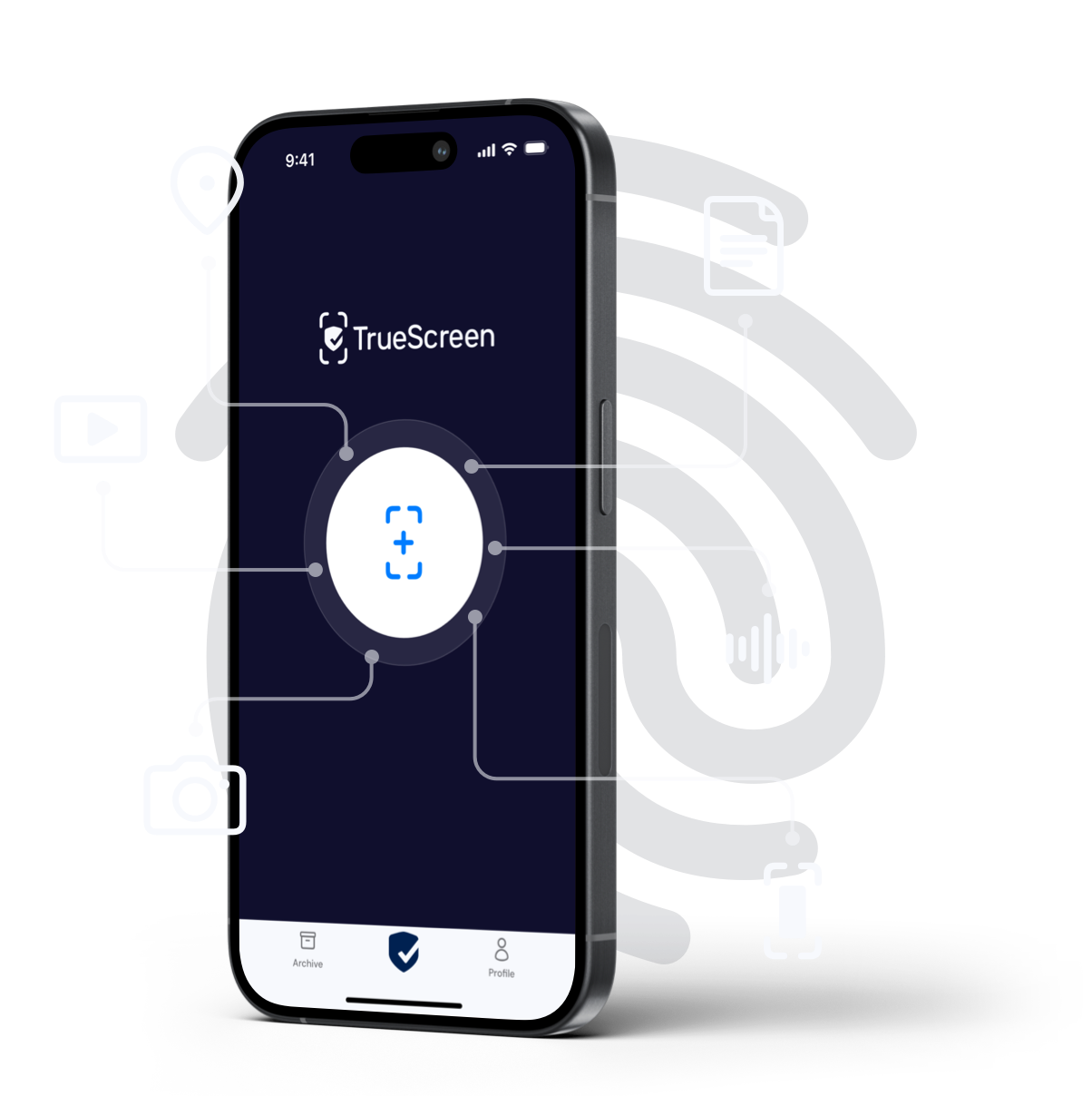
TrueScreen is the data authenticity platform that enables insurance companies and adjusters to certify any digital content at the moment of acquisition. Every photo, video, audio, document, and geolocation acquired through TrueScreen receives a digital signature, qualified timestamp issued by an international QTSP, and cryptographic hash that makes any subsequent modification detectable.
The process complies with ISO/IEC 27037 for the acquisition and preservation of digital evidence, ISO/IEC 27001 for information security management, the eIDAS regulation, and GDPR. The output is a complete evidence package: PDF report, JSON report, and qualified electronic seal, directly usable in court proceedings.
For the insurance sector this means having evidence with legal value from the moment of collection, without depending on subsequent assessments of document authenticity.
Enterprise integration via API and SDK
TrueScreen is available via mobile app for field collection, desktop platform for centralized management, and API/SDK for direct integration into claims management systems. An insurance company can integrate certification into its existing digital workflow without changing existing processes: certified acquisition becomes a transparent step within the operational flow.
Certification takes seconds, with no operational overhead perceptible to the adjuster or policyholder.
FAQ: insurance fraud and evidence certification
How much does insurance fraud cost globally?
Has generative AI really changed the scale of insurance fraud?
Why is fraud detection not enough?
What does certifying evidence at source mean?
Does certified evidence have legal value in court?
TrueScreen editorial team
This section is edited by the TrueScreen editorial team, which brings together expertise in digital forensics, the law of digital evidence and regulatory compliance. Every article is checked against primary sources: legislation, published rulings, technical standards and official documentation, always cited in the text.
Published on · Updated on · Technical review: digital forensics


