Updated on
Online meeting certification: legal value and real-world use cases
Online meetings have become the default format for a growing share of high-stakes business interactions. Board meetings, arbitration hearings, contract negotiations, disciplinary proceedings: activities that once required physical presence now take place on platforms like Zoom, Microsoft Teams, or Google Meet. And organizations record them, assuming that a recording equals proof.
The problem is that it does not. A video conference recording, on its own, offers no guarantee of integrity. Any participant with access to the file can cut, edit, or delete portions of the session without leaving visible traces. In a dispute, opposing counsel can challenge the authenticity of any uncertified recording, and without a verifiable chain of custody, the evidentiary value of the recording depends entirely on the good faith of whoever stored it.
Online meeting certification closes this gap. Certifying a recording at the source, with a digital signature, qualified timestamp, and immutable metadata, transforms a vulnerable file into evidence with full legal standing. This article examines five concrete scenarios where certifying online meeting recordings makes the difference between admissible evidence and a contested file.
Online meeting recordings: a false sense of security
Video conferencing platforms include native recording features. Zoom generates MP4 files saved locally or in the cloud, Teams stores recordings in OneDrive or SharePoint, Google Meet deposits them in Google Drive. This has created the habit of recording every sensitive meeting, from sales calls to board sessions.
Native recordings, however, are not designed to ensure forensic integrity. The files they produce contain no cryptographic hashes, no qualified timestamps, and no digital signatures. Anyone with access to the storage can modify them using ordinary video editing software. No internal metadata flags the alteration.
The regulatory framework is clear on this point. The eIDAS regulation (EU 910/2014) establishes that electronic documents bearing a qualified seal and timestamp from a Qualified Trust Service Provider enjoy a legal presumption of integrity and authenticity. Uncertified recordings fall outside this protective framework.
The ISO/IEC 27037 standard, which governs the identification, collection, acquisition, and preservation of digital evidence, requires that every piece of evidence maintain a documented and verifiable chain of custody. A recording downloaded from a cloud platform and saved to a local drive satisfies none of these requirements.
Board meetings and shareholder assemblies
European corporate governance codes increasingly require detailed documentation of board deliberations. The OECD Corporate Governance Factbook 2025 reports that transparency in board decision-making is a growing requirement across jurisdictions, and recording sessions is recommended as a complement to written minutes.
When a board of directors meets via video conference, a certified recording solves multiple problems at once.
The first concerns proof of deliberations and quorum. If a board resolution is challenged, a certified recording demonstrates who was present, when they spoke, and how they voted. The qualified timestamp attests the exact timing of the session, making quorum verification incontestable.
Then there is director protection. Board members who cast dissenting votes or raise reservations during a session have every reason to document their position in an unimpeachable way. A certified recording constitutes autonomous evidence, independent of the minutes.
Finally, regulatory compliance. For listed companies and public entities, Directive (EU) 2025/25 on digital tools in company law pushes toward native digital documentation. A certified board recording fits into this trajectory as a proactive compliance instrument.
Remote depositions and arbitration hearings
Civil litigation and international commercial arbitration have embraced remote hearings as standard practice. The International Chamber of Commerce (ICC) recorded 841 new cases in 2024, a record year, and a growing share of proceedings takes place entirely via video conference. The UNCITRAL arbitration rules explicitly provide for remote hearings. In the United States, Federal Rule of Civil Procedure 30(b)(4) has been recently amended in several states to authorize depositions via video conference without requiring a prior stipulation.
The critical issue remains the certification of the recording. In an ICC arbitration, the recording of oral testimony is part of the evidentiary file. If its integrity is challenged, the arbitrator must decide whether to admit or exclude it, with potential consequences for the outcome of the proceedings.
Certifying at the source removes the problem entirely. A recording acquired with a cryptographic hash, qualified timestamp, and digital signature during the session satisfies the requirements of ISO/IEC 27037 and enjoys the presumption of integrity under eIDAS. The arbitral tribunal or judge receives a complete forensic package: PDF report, JSON metadata, and XML seal from the QTSP. Not a simple video file.
For lawyers and law firms managing international proceedings, certifying remote depositions is also a risk management measure. It reduces the risk of procedural objections and strengthens the client’s evidentiary position.
Disciplinary proceedings and internal HR investigations
Workplace disciplinary proceedings are among the contexts most exposed to recording disputes. The employee contests the statements attributed to them; the employer maintains that the employee admitted certain facts during the hearing. Without a recording whose integrity is verifiable, the dispute reduces to one party’s word against another’s.
Employment tribunals across jurisdictions have increasingly addressed the admissibility of meeting recordings in disciplinary cases. The general principle is that a recording made by a participant present at the conversation may be admissible as evidence when created for the purpose of establishing facts. The key requirement is that the recording party was actually present during the conversation.
Certification adds a layer of assurance that protects both sides. The employer obtains unimpeachable documentation of the disciplinary proceeding, the allegations made, and the responses received. The employee, in turn, is protected against partial or distorted reconstructions of the meeting.
In organizations with complex workplace safety procedures, meeting certification takes on additional significance. Training sessions, operational briefings, and safety-related disputes produce recordings whose evidentiary value can be decisive in the event of an accident or inspection.
Contract negotiations and verbal agreements
Statements made during negotiations carry legal significance even before a formal contract is signed. In common law jurisdictions, oral agreements have full contractual value in many circumstances, and a recording of a call in which parties agree to terms can be decisive in subsequent litigation.
Certifying these recordings transforms otherwise contestable statements into digital evidence for litigation with a verified date and provable integrity.
Consider M&A negotiations or investment rounds: parties frequently reach preliminary agreements via video conference before formalizing them in writing. A certified recording documents what was agreed, by whom, and when. The same applies when confidential information is shared during a call based on a verbal non-disclosure agreement: the certified recording proves the existence of the agreement and the terms of the disclosure. In complex B2B sales, statements made by the seller during an online presentation can constitute contractual representations. Forensic certification of the recording crystallizes those statements.
Online meeting certification: how the process works
Certifying an online meeting requires a process that operates during the session, not after. The distinction is far from academic: certifying a file downloaded from a cloud platform after the fact does not guarantee that the file remained intact between the moment of recording and the moment of certification. The chain of custody must be continuous, without interruptions.
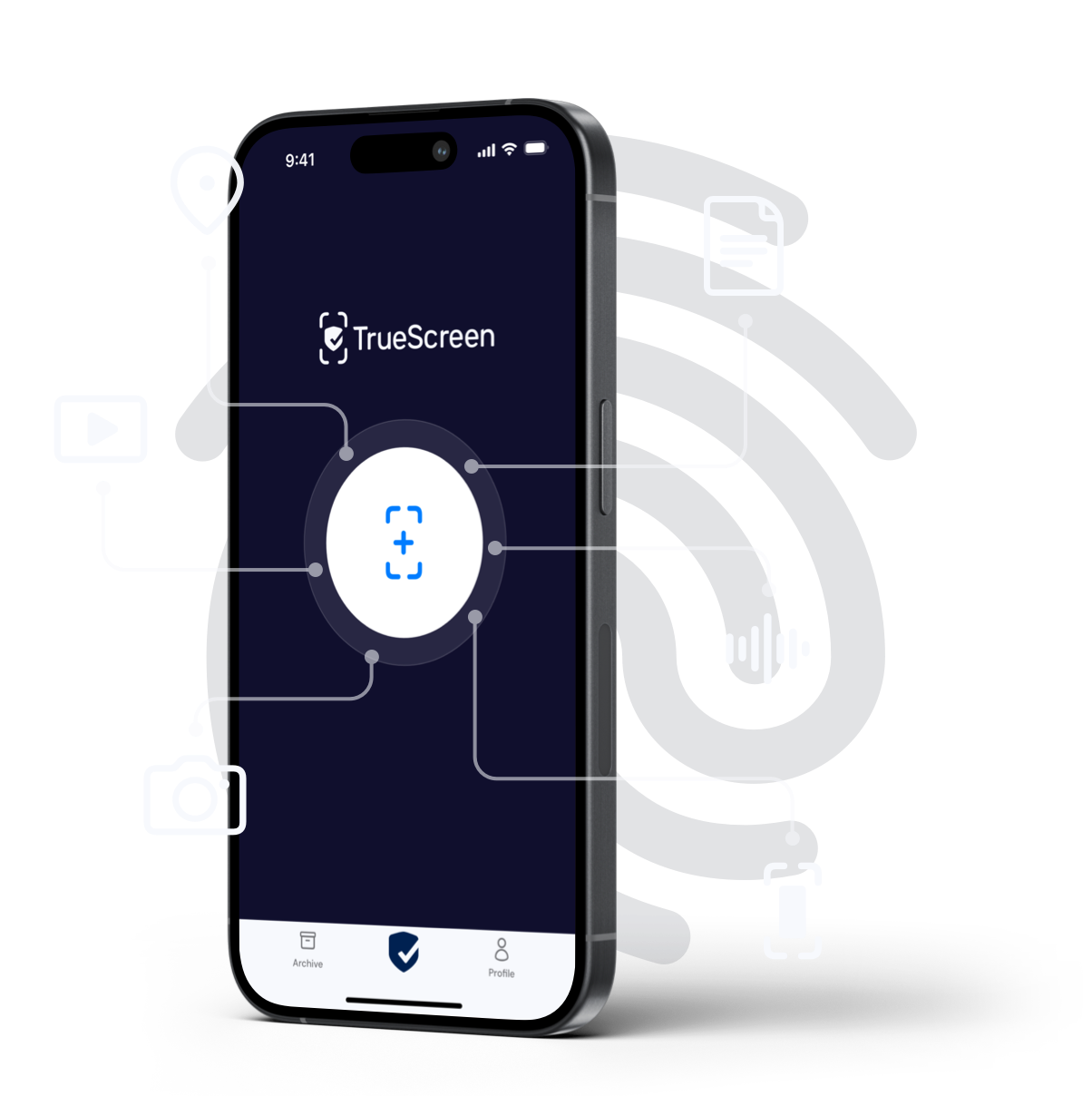
TrueScreen addresses this problem with a certification-at-source approach. The process works through certified screen recording: the user starts recording the screen within TrueScreen’s controlled environment before joining the video conference. Throughout the entire session, the platform captures video, audio, shared content, and metadata (timestamps, duration, platform identifiers) in a protected environment that prevents any manipulation of the data stream.
At the end of the session, TrueScreen generates a complete certified package. The original files are preserved exactly as captured, with no alterations to data or metadata. The package includes a PDF report with the forensic details of the acquisition, a JSON file for integration into enterprise information systems, and an XML file with the electronic seal and qualified timestamp from the QTSP. The cryptographic hash of the content ensures that any modification, even of a single frame, is immediately detectable.
This output satisfies the requirements of ISO/IEC 27037 for digital evidence chain of custody and the eIDAS regulation for the legal presumption of integrity. The result is a meeting recording with full evidentiary value, usable in civil, arbitral, employment, and administrative proceedings.
The certification works with any video conferencing platform: Zoom, Microsoft Teams, Google Meet, Slack, Webex, or any other tool that produces a session visible on the device screen.
Related insights
This guide is accompanied by eight dedicated insights, each focusing on a specific aspect of online meeting certification:
- Evidentiary Value of Online Meeting Recordings: Digital Certification and Legal Proof
- Recording a Meeting Without Consent: Legality, Limits and GDPR
- Certified Screen Recording: How the Digital Chain of Custody Works
- Zoom, Teams, Meet: Certify Video Calls on Any Platform
- Online Corporate Assemblies: How to Certify Remote Resolutions
- Due Diligence and Remote Negotiations: Certifying Commercial Discussions
- Certified Remote Training: Compliance Obligations and Regulatory Requirements
- Employment Disputes and Certified Meetings: Dismissals, Disciplinary Actions, Whistleblowing
FAQ: Online meeting certification and legal value
What is the legal value of a certified online meeting recording?
Can an uncertified video conference recording be challenged in court?
Does the certification work with all video conferencing platforms?
Is it legal to record a work meeting without everyone’s consent?
Which international standards does TrueScreen certification meet?
TrueScreen editorial team
This section is edited by the TrueScreen editorial team, which brings together expertise in digital forensics, the law of digital evidence and regulatory compliance. Every article is checked against primary sources: legislation, published rulings, technical standards and official documentation, always cited in the text.


