How to certify digital files: a complete guide to forensic certification
Every day, professionals and organizations make decisions based on digital files: photographs taken during site inspections, videos recorded in the field, emails exchanged with clients or suppliers, documents shared across departments. The need to certify files is operational, not theoretical. Yet most of this content is created and transmitted without any guarantee of integrity or provenance.
The problem is structural. Editing tools available to anyone and generative AI capable of creating or modifying content almost invisibly have overturned an assumption that held for decades: that a digital file was reliable until proven otherwise. Today the opposite is true. A digital file is potentially unreliable unless it has been certified through a structured method.
Forensic certification addresses this gap. It transforms any file into defensible evidence, documents its integrity, authenticity and timestamp, and aligns it with internationally recognized standards such as ISO/IEC 27037. Adding a stamp is not enough: what is needed is a process that makes every piece of digital content verifiable and legally sustainable.
Why certifying digital files has become essential
Manipulable files and generative AI: the current landscape
Professional activities generate growing volumes of digital evidence: photos of incidents, inspection videos, chat conversations, technical reports, email communications. Any one of these files can determine the outcome of a dispute, an audit or an internal investigation.
The issue is that these same files are fragile. An image can be modified in seconds with any editor. A video can be trimmed and reassembled on a smartphone. A chat can be exported partially, selecting only the messages that suit a particular narrative. And with generative AI, creating photorealistic content or altering existing documents is within anyone’s reach, no technical skills required.
The EU AI Act (Regulation 2024/1689) now requires transparency obligations for AI-generated content and prohibits manipulative AI practices. It is a signal that regulators recognize the scale of the problem.
What happens without certification: real-world risks
When a digital file is presented in litigation or a regulatory inspection, the opposing party can challenge its authenticity. “Was that photo modified?”, “Is the video complete?”, “Was the email altered after it was sent?”. Legitimate questions. And without a certification methodology, answering them becomes difficult.
Under eIDAS (EU Regulation 910/2014), electronic documents bearing qualified timestamps and electronic seals carry a legal presumption of integrity. Files that lack these safeguards are far easier to contest. Post-hoc reconstruction requires time, resources and often costly expert analysis.
What forensic file certification actually means
Forensic certification of a digital file covers four dimensions, each necessary to build a solid piece of evidence.
Integrity: the file has not been altered
The file that exists today is identical to the original. It has not been cut, repeatedly compressed, modified or recombined. Verification relies on cryptographic hashes that make any change, however small, immediately detectable.
Authenticity: provenance is documented
It is not enough for a file to be intact. You need to demonstrate where it came from: which device acquired it, under what circumstances, with what technical parameters. This documentation of provenance, known in technical terms as digital provenance, tells the complete story of the file from its origin.
Certified timestamp: verifiable date and time
Linking a file to a precise moment in time is often decisive. “Probably last year” or “sometime in March” creates confusion in proceedings. A certified timestamp issued by a Qualified Trust Service Provider under eIDAS gives the file a legally certain date.
Probative value: compliance with recognized standards
Following a methodology aligned with internationally recognized forensic standards such as ISO/IEC 27037 for the handling of digital evidence increases the probative robustness of the file and facilitates the admissibility of evidence across different legal contexts.
What forensic certification is not: common misconceptions
Screenshots, cloud storage, and digital signatures: why they fall short
Some approaches are widespread but insufficient.
Saving files to network folders or cloud services does not document provenance or guarantee integrity over time. A screenshot of a screenshot is easily manipulated and preserves no useful metadata. Digital signatures authenticate the signer of a document, but they are not designed to certify forensic evidence such as photographs, video recordings or web content acquisitions.
Something different is needed: a structured process of acquisition, analysis and documentation that preserves the chain of custody of digital content from origin to presentation.
How to certify photos, videos, emails and other content
Certifying photos: acquisition and metadata
In cases of insurance claims, site inspections or audits, images often make the difference. A photo taken without method and sent via chat loses metadata, passes through compressions, becomes easily contestable.
Forensic certification documents the acquisition context: date, time, device, GPS coordinates. It preserves technical metadata and applies integrity controls. What was “just a photo” becomes technically verifiable evidence.
Certifying videos: continuity and integrity
Videos present specific challenges. Invisible cuts, speed changes, imperceptible edits. Modifications that alter perception without leaving traces visible to the naked eye. With generative AI, producing convincing synthetic videos is already possible.
A forensic certification workflow ensures recording continuity and documents the entire acquisition process. The video becomes defensible even in the most technical contexts.
Certifying emails: headers, attachments and timestamps
Emails are sensitive professional communications. Disputes, agreements, reports, operational instructions: the content of a message can be altered, attachments replaced, timestamps manipulated.
To certify an email means freezing the entire package: message body, technical headers, attachments, temporal metadata. Complete documentation that makes retroactive revision very difficult.
Certifying documents, chats, web pages and audio
The scope does not stop at photos, videos and emails. Contracts, WhatsApp and Telegram chats, web pages, audio recordings, screen recordings: any digital content that has been created, copied or potentially manipulated may require structured certification.
Certifying chats and acquiring web pages with legal value are among the operations that a forensic methodology makes possible and repeatable.
How TrueScreen makes forensic certification accessible
Real-time acquisition and certification of existing files
TrueScreen operates through the Data Authenticity Platform with two modes.
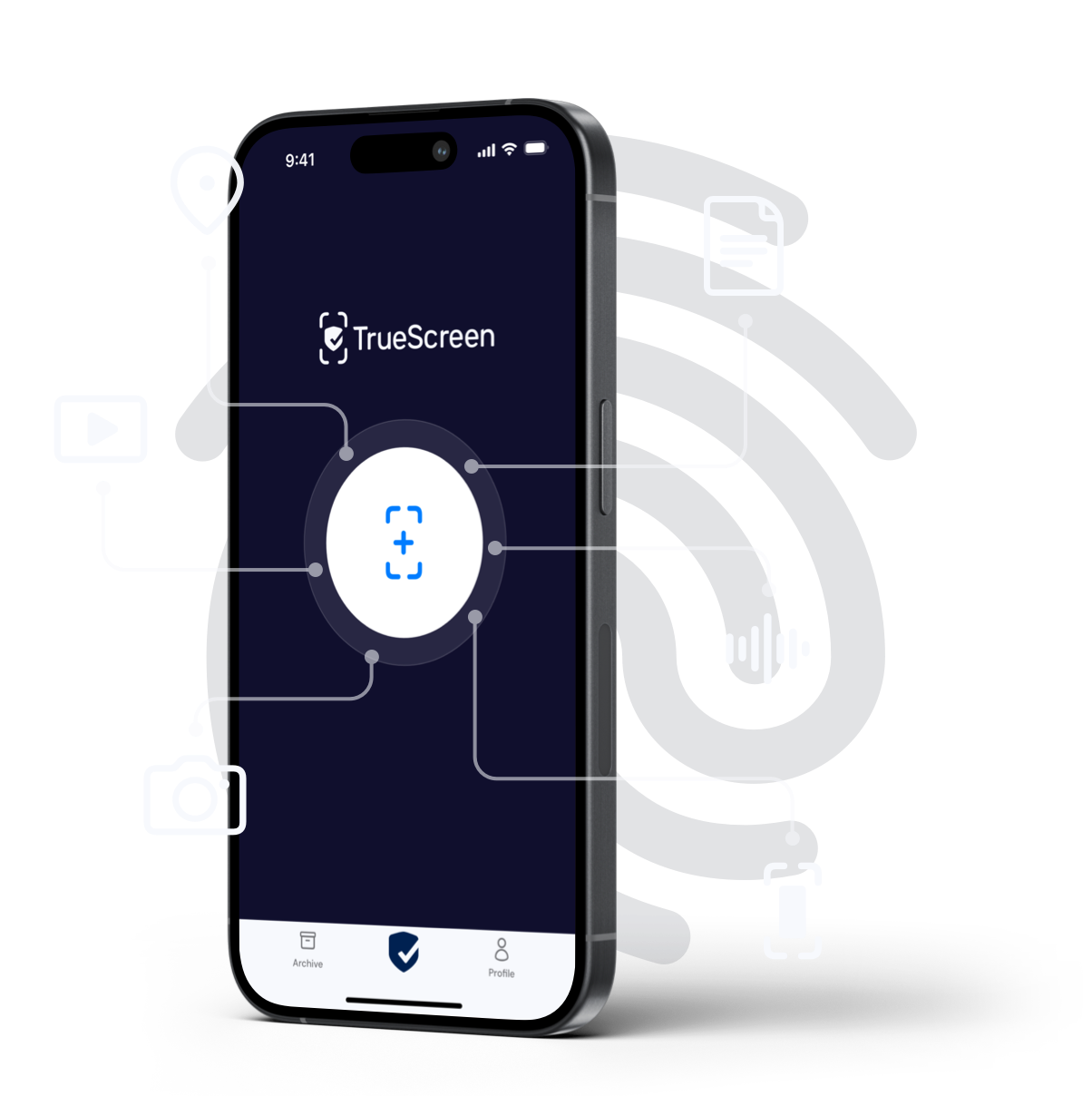
The first is real-time acquisition. Content is captured directly through the TrueScreen mobile app or desktop platform. A technician photographing during a site visit, a surveyor documenting damage, an inspector recording field conditions: the entire acquisition phase remains controlled, with context metadata, technical parameters and certified timestamps.
The second is the certification of files that already exist. Documents, photos, videos, emails already in the organization’s archives. A law firm receiving evidentiary material, an HR department managing communications accumulated over time, a fraud team analyzing reports. TrueScreen analyzes available metadata, performs integrity checks and produces forensic reports.
Forensic reports aligned with ISO/IEC 27037
In both cases the process is the same: collection of essential information, integrity sealing with cryptographic hashes and digital signature, generation of readable reports.
The methodology is aligned with ISO/IEC 27037 for digital evidence handling, ISO/IEC 27001 for information security and eIDAS for the legal recognition of electronic seals and qualified timestamps. Each certified file is sealed by a Qualified Trust Service Provider, with a legal presumption of integrity and authenticity.
The reports work for anyone who needs to evaluate them: from judges and arbitrators to lawyers, technical consultants, fraud investigators and auditors. No specialized IT expertise is required to read them. For a comparison of the available options, see our guide to the platforms to present and certify legal case documents.
Practical benefits for professionals and organizations
Legal, insurance, HR, audit: everyday use cases
For professionals in the legal sector, certifying files means building case folders where every photo, video, chat or email includes documentation explaining its origin and integrity. Courtroom surprises decrease. Challenges become more manageable because you start from certified digital evidence, not generic files.
In the insurance sector, uniform documentation methods for claims, complaints and fraud reports make the process faster and less exposed to disputes. Damage images, videos, supporting documents: all managed with a consistent approach.
For HR and employment relations, certifying critical communications protects both employer and employee. Relevant communications are no longer left to memory or unclear printouts but become structured digital archives.
For audit, quality and inspection teams, certified field reports simplify demonstrating what was actually observed or verified. If a challenge arises, you do not start from scratch: you return to the certified evidence.
FAQ: common questions about forensic file certification
Is certification mandatory to use a file in court?
How simple is it to certify a file?
Why certify digital files?
What happens if a file is not certified?
TrueScreen editorial team
Published on · Updated on
This section is edited by the TrueScreen editorial team, which brings together expertise in digital forensics, the law of digital evidence and regulatory compliance. Every article is checked against primary sources: legislation, published rulings, technical standards and official documentation, always cited in the text.


