Voice cloning CEO defense: stopping BEC 2.0 with source-certified corporate audio
Voice-cloned executive fraud is no longer a lab scenario: it is the fastest-growing category of corporate crime in the United States. In 2025 the FBI logged more than 22,000 complaints linked to AI-enabled fraud, with losses exceeding 893 million dollars, and Deloitte projects cumulative impact reaching 40 billion dollars by 2027 in the US alone. Almost every case starts with the same primitive: a phone call in which the attacker impersonates a senior executive and authorises a wire transfer, changes an IBAN, or unlocks a security policy.
The complication is that three seconds of public audio are enough to clone an executive's voice with quality indistinguishable from the original. A quarterly earnings call, an industry podcast, a conference keynote: all of it lives online, and attackers harvest the samples in minutes. Traditional defenses (callback to a known number, dual-control, verbal passwords) do not scale beyond a small perimeter and create operational friction that management routinely bypasses.
The structural answer to voice cloning CEO defense is not to recognise the fake downstream, but to authenticate the real upstream: capture a reference of the executive's authentic voice at source, seal it with a qualified electronic seal issued by a third-party QTSP and a qualified timestamp, and store it in a forensic chain of custody that any recipient of a sensitive audio communication can verify in real time.
This insight is part of our guide: Voice cloning corporate fraud: the verifiable defense for CFOs after the Arup case
Anatomy of voice-cloned fraud: why three seconds of public audio are enough
BEC 2.0 (Business Email Compromise evolved with synthetic voice) follows a precise script. The attacker collects public voice samples of the executive, trains a voice-synthesis model, identifies the operational recipient (CFO, payments officer, strategic supplier), and constructs a credible urgency scenario. A thirty-second call, a new IBAN to enter into the treasury system, a verbal authorisation: the wire goes out, and the anomaly only surfaces days later when bank reconciliation reveals the loss.
The numbers of BEC 2.0 fraud in the US and Europe
The annual FBI Internet Crime Complaint Center report attributes more than 2.9 billion dollars of direct losses to BEC fraud in 2024, with marked acceleration in cases that include a synthetic voice component. The Deloitte analysis on deepfake banking fraud projects cumulative losses of 40 billion dollars by 2027 in the United States alone.
Europe follows the same trend with a 12 to 18-month lag. The 2024 Arup case, in which a Hong Kong employee transferred 25 million dollars after a video call with a synthetic CFO, demonstrated that the vector works regardless of geography. ENISA, in the Threat Landscape 2024, classifies AI-enabled social engineering as a structurally growing threat for large European enterprises.
Why traditional defenses (callback, dual-control, verbal passwords) do not scale
The three defenses every fraud-prevention manual recommends each have an operational limit:
- Callback to a known number: works if the number is verified and the executive is reachable, but gets skipped under urgency pressure (quarter close, M&A, liquidity crunch);
- Dual-control or four-eyes principle: effective on scheduled payments, but many organisations keep individual delegation thresholds for large amounts and for urgent payments to key suppliers;
- Verbal passwords or code-words: hard to manage across wide perimeters (a CFO who talks to a hundred operational counterparts cannot remember a hundred passphrases), they travel through insecure channels, and they decay after weeks of use.
The net effect is that prevention rests on the diligence of the individual operator receiving the call. BEC 2.0 fraud targets exactly that point: a credible voice, a pressing deadline, a plausible motivation. Without a real-time verifiable authenticity reference, even an experienced operator gives in.
Source-certified corporate audio: the preventive paradigm for executive communications
The principle is simple: do not try to detect the fake when it arrives, but make the real recognisable when it is emitted. Relevant audio communications from management (formal announcements, operational authorisations, statements to strategic suppliers) are captured with a forensic methodology at source, sealed with a qualified electronic seal issued by a third-party QTSP and a qualified timestamp, and stored in a chain of custody that preserves their integrity and authenticity over time.
When a recipient receives a sensitive audio communication, verification becomes a technical procedure: the received file is compared against the certified reference, or the executive confirms the authorisation through a channel that produces a certified record of the confirmation itself. In both cases, the operator does not rely on timbre recognition: they rely on a chain of technical evidence.
How the authentic voice reference with a qualified seal issued by a third-party QTSP works
The authentic voice reference is an audio sample of the executive captured under controlled conditions, with cryptographic hashes computed before the file leaves the capture device. The resulting package (audio plus metadata plus hashes) is sealed with a qualified electronic seal from a third-party QTSP and a qualified timestamp: both seals carry full probative value across the European Union under the eIDAS Regulation.
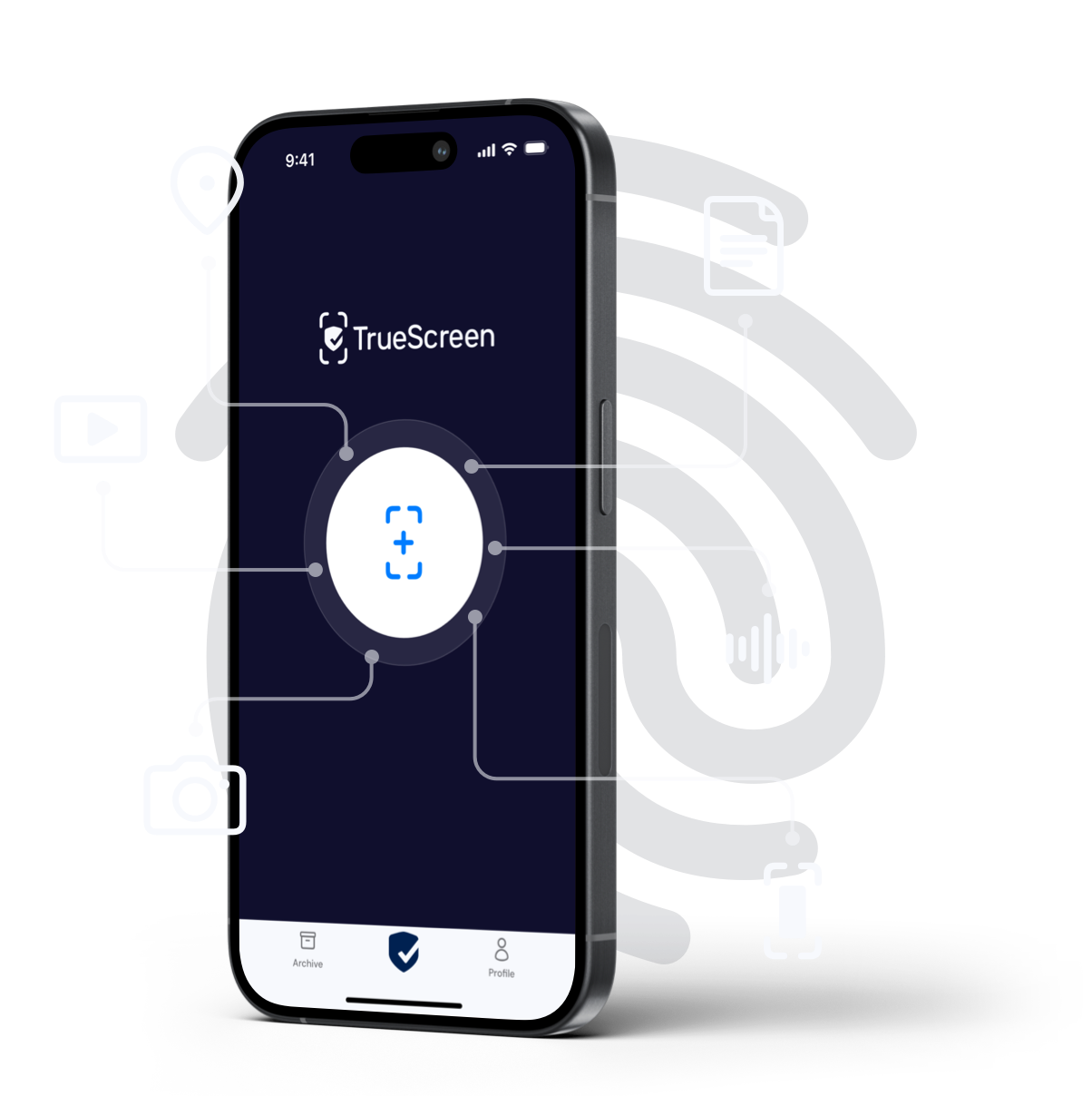
TrueScreen integrates the qualified QTSP seal directly into the capture flow: the executive does not manually sign the file, the forensic methodology itself produces the certified package. The reference is then preserved in a chain of custody that logs every access and protects integrity over time. The same logic underpins Digital Provenance applied to sensitive audio communications.
Comparison table: traditional defenses vs source-certified corporate audio
| Defense | Scalability across wide perimeter | Probative value in court | Resistance to voice-cloning fraud | Operational friction |
|---|---|---|---|---|
| Callback to a known number | Low | None | Medium | High |
| Dual-control on payments | Medium | None | High on monitored amounts | Medium |
| Verbal passwords or code-words | Low | None | Low over time | High |
| Source-certified audio with QTSP seal | High | Full (eIDAS Regulation) | Structurally high | Low |

How TrueScreen helps CFOs and fraud prevention managers stop BEC 2.0
TrueScreen is the Data Authenticity Platform that combines forensic capture of audio communications, the application of a qualified electronic seal issued by a third-party QTSP, and storage in a chain of custody into a single operational flow. For the CFO or fraud prevention manager, this means that every relevant audio communication from management can be turned into a verifiable piece of evidence, without requiring an in-house sealing infrastructure or specialist forensic skills from the executive.
Operational flow and integration with payment approval workflows
The typical adoption pattern runs through three engagement points. First, the executive records authorisation audio messages through the certified capture environment: every message is born sealed. Second, the treasury or supplier-management system receives the identifier of the certified message and verifies its chain of custody before releasing the operation. Third, in the event of a dispute or a detected fraud attempt, the certified message becomes evidence in court with full probative value across the EU.
For organisations subject to MiFID II obligations on certified client communications, the integration produces a positive side effect: the same infrastructure addresses both fraud prevention and compliance requirements on client communications. One flow, two returns.
Progressive adoption pattern for mid-large enterprise
Adoption does not require a big-bang project. The pattern observed across mid-large enterprises moves in concentric rings:
- Ring 1 (4 to 8 weeks): C-level executives only (CEO, CFO, COO), payment authorisations above a defined threshold;
- Ring 2 (3 to 6 months): extension to function heads who sign contracts with strategic suppliers, integration with the supplier-management system;
- Ring 3 (12 to 18 months): extension to sensitive external communications (investor announcements, press statements, regulatory communications) to cover reputational and market risk.
The fraud prevention lead typically starts from a specific event: a thwarted fraud attempt, an internal audit that flags a gap, a new regulatory requirement (for example the AI Act for organisations operating high-risk systems). The most effective organisational lever is the operational return from ring one: in 4 to 8 weeks, the company moves from informal callback to a documented procedure that holds up in audit.