Data provenance vs data lineage: differences, standards, and why governance needs both
Two terms keep getting swapped in data governance conversations, and the confusion costs organizations more than they realize. Data provenance and data lineage sound interchangeable, yet they answer different questions about a dataset. When a team says it has "full lineage" and assumes that settles authenticity, it has quietly skipped the harder problem. Understanding data provenance vs data lineage is not a vocabulary exercise: it decides whether you can actually trust the numbers feeding your decisions, your models, and your compliance reports. The short version of the thesis is this: lineage tells you where data went, provenance tells you where it truly came from, and serious governance needs both.
The reason the distinction matters now is that data is no longer trustworthy by default. Synthetic media, AI-generated records, and edited source files can move through a pipeline cleanly, gaining a flawless transformation history while carrying no real origin. Lineage will faithfully document the journey of something that was fabricated at step zero. Provenance is the discipline that addresses that blind spot by certifying the origin and authenticity of data at the moment it is created.
This insight is part of our guide: Digital provenance. Where that guide maps the broader landscape of digital provenance and data authenticity, this piece zooms in on one specific source of confusion that undermines governance programs.
What data lineage tracks: the journey of your data
Data lineage maps how data flows and transforms across its lifecycle: where it originates inside your systems, which pipelines process it, how it is joined, aggregated, and reshaped, and where it eventually lands. It answers an operational question: what happened to this value between the table I am looking at and the systems upstream of it. Lineage is the chain of transformations, rendered as a map you can walk backward and forward.
This makes lineage indispensable for day-to-day data work. When a dashboard shows an impossible figure, lineage lets engineers trace the value back through each transformation to find where it broke. When a column needs to change, impact analysis built on lineage reveals every downstream report and model that depends on it. For compliance, lineage demonstrates that personal data flowed only through approved systems, supporting obligations such as the GDPR accuracy principle, which requires that personal data be kept correct and up to date across its processing.
The DAMA DMBOK, the Data Management Body of Knowledge published by DAMA International, treats this kind of traceability as a core metadata management practice, alongside classification and business context. Lineage is the operational backbone of mature governance: without it, debugging, impact analysis, and audit readiness all become guesswork. What lineage does not do, by design, is question whether the data was authentic when it first entered the system.
What data provenance certifies: origin and authenticity at the source
Data provenance answers a different and more fundamental question: where did this data genuinely come from, who or what created it, and has it remained intact since that first instant. Provenance is closer to a chain of custody than to a flow diagram. It establishes the origin, the author, and the integrity of data starting from the moment of creation, before any pipeline has touched it.
This is precisely the blind spot of lineage. A pipeline can have immaculate lineage for a record that was invented, manipulated, or generated by a model. Every transformation is logged, every system is mapped, and none of it tells you the record was real to begin with. Provenance closes that gap by binding the data to a verifiable origin and an integrity guarantee at the source. Once data carries that proof, downstream lineage describes the history of something whose authenticity is already established rather than assumed.
International standards increasingly treat provenance as a first-class requirement. ISO 8000, the international standard series for data quality and master data developed under ISO Technical Committee 184, dedicates an entire part to it: ISO 8000-120 specifies how to represent and exchange information about the provenance of master data, so that quality claims become auditable and traceable rather than asserted. The EU AI Act points in the same direction. Article 10 requires providers of high-risk AI systems to document the provenance of training, validation, and testing datasets and to maintain traceability between datasets and model versions. In other words, regulators now ask not only where data flowed but where it originated, and whether that origin can be proven.
Why governance needs both, and the role of TrueScreen
The two disciplines are complementary, not competing. Lineage without provenance is a meticulous chain of custody for an exhibit that might be a forgery: you can prove every step of handling and still have no proof the object was authentic when it entered the room. Provenance without lineage gives you a trustworthy origin but no visibility into what happened afterward. Complete governance needs provenance at the point of creation and lineage across the lifecycle, working together.
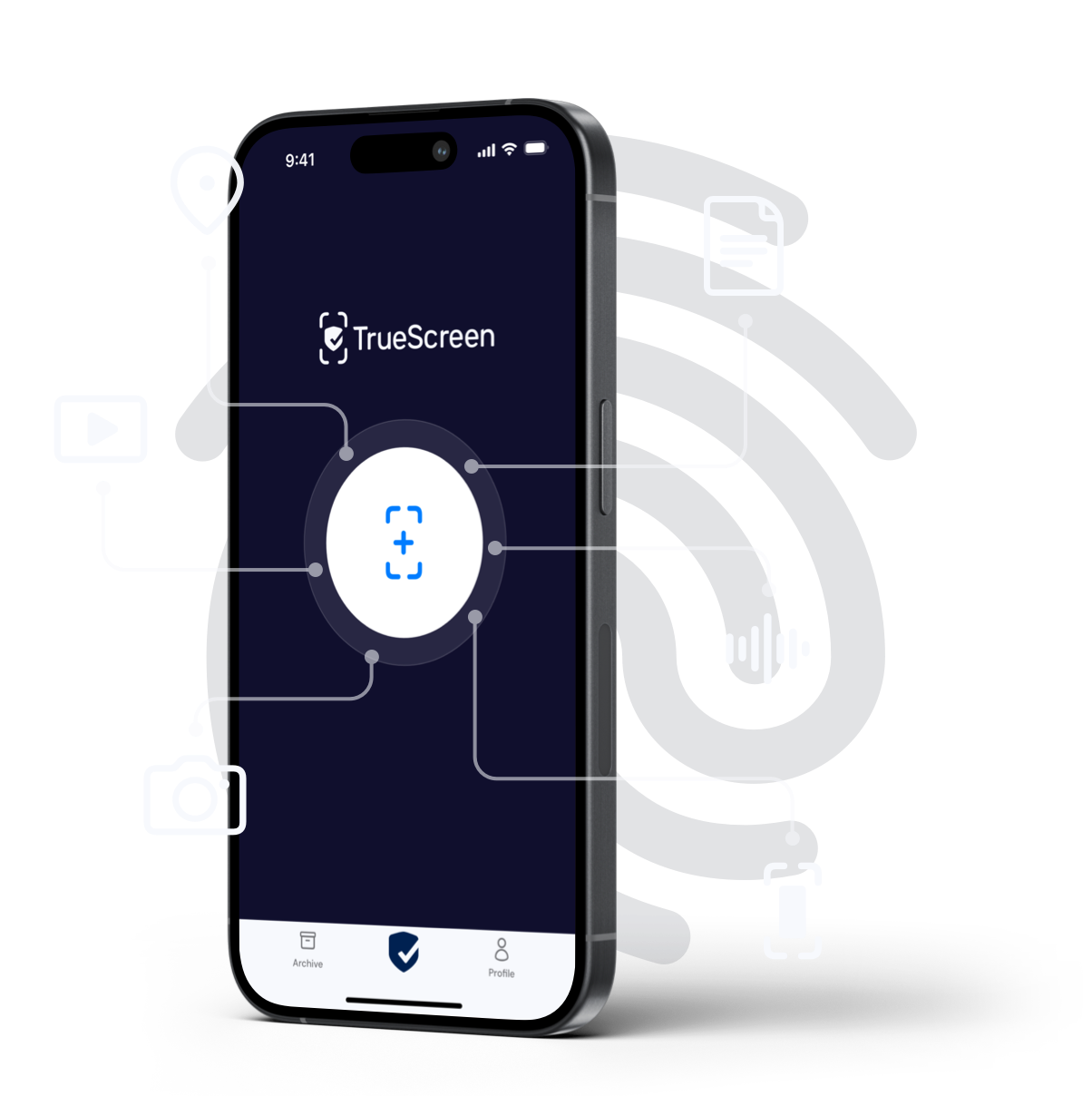
TrueScreen addresses the provenance side of that architecture. It captures and certifies data at the source, fixing its origin and integrity from the first instant. To give that certification legal weight, TrueScreen integrates the qualified electronic seal and qualified timestamp of a third-party QTSP via API: the seal attests to the integrity and authenticity of the captured data, and the RFC 3161 timestamp anchors it to a verifiable point in time, in line with the eIDAS framework and ETSI standards. TrueScreen does not issue qualified certificates itself; it certifies data origin by integrating a qualified third-party QTSP's seal, so the proof rests on established trust infrastructure.
In a complete data governance setup, the division of labor is clean. TrueScreen certifies origin and authenticity at the source, and your data lineage systems track the downstream path through transformations and systems. The table below summarizes how the two compare.
| Dimension | Data provenance | Data lineage |
|---|---|---|
| Question answered | Where did the data truly come from, and is it authentic? | Where did the data go, and how was it transformed? |
| Moment of focus | The instant of creation, at the source | The full lifecycle, after creation |
| What it guarantees | Verifiable origin and integrity from the first instant | A complete map of flows and transformations |
| Reference standards | ISO 8000-120, eIDAS, RFC 3161, EU AI Act Art. 10 | DAMA DMBOK metadata management, GDPR accuracy |
The result aligns with what the major frameworks already ask for. DAMA DMBOK wants provenance captured as metadata. ISO 8000 wants provenance exchanged and auditable. The EU AI Act wants dataset origin documented and traceable to model versions. Pairing provenance at the source with lineage across the lifecycle is how an organization satisfies all three at once, and how it stops mistaking a well-documented history for a trustworthy one.