
Court-appointed property expert: a site-inspection chain of custody that holds up in court
A court-appointed property expert does not simply describe a building: they answer, under the court's mandate, a question that can decide who wins a dispute. When a judge appoints a surveyor or forensic engineer to inspect a property, that expert becomes personally accountable for the reliability of everything they report. The site visit, the measurements, the photographs, the conclusions: all of it is attributable to one professional whose findings the court is expected to trust.
The complication is that the inspection itself is the weakest link. A report can be technically flawless in its reasoning and still collapse if the documentation behind it is contestable. Photos with no trusted date, a site record nobody countersigned, a folder of loose images with no link to where and when they were taken: each gap is an opening for opposing counsel to argue that the inspection cannot be verified, and therefore the report cannot be relied upon.
This is the governing point: the evidentiary weight of a court-appointed property expert's report is determined, more than by the analysis, by the quality and immutability of the inspection's photographic documentation. An inspection that can be reconstructed and proven holds up. One that rests on the expert's word alone does not. The same principle underpins certified property appraisals for business lending, where a valuation is only as defensible as the evidence that supports it.
This insight is part of our guide: Certified property appraisals for business lending.
Appointment and expert operations: the scope of the surveyor's accountability
When a court appoints a technical expert, that professional acts as the court's auxiliary: a neutral party whose duty runs to the court, not to either side. The mandate is specific. The expert receives the questions to answer, the deadline, and the obligation to conduct operations in a way that all parties can observe and challenge in real time.
Expert operations typically unfold in a fixed sequence. The expert notifies the parties (and their own technical consultants) of the date, time, and place of the site inspection. They examine the documentary record already in the case file: deeds, prior surveys, permits, plans. They carry out the site inspection itself, gathering measurements, observations, and visual evidence. Finally, they draft the report, attaching the exhibits that substantiate every finding: photographs, plans, measurement tables, and the inspection record.
Personal accountability is non-delegable
The expert signs the report in their own name and answers for it. If a conclusion is challenged, the expert must be able to show how they reached it: which photograph documents which defect, when the image was captured, who was present, and that nothing was altered after the fact. This is where many surveys quietly fail. The analysis is defensible, but the underlying documentation cannot withstand cross-examination because it was never built to be verified. Accountability without verifiable evidence is exposure, not authority.
A site inspection that holds up in court: documentation that cannot be challenged
An inspection holds up when every element of it can be independently verified: who was present, when each photograph was taken, where, and that the images have not been touched since. Under general principles of evidence admissibility, the three properties that matter are authenticity (the evidence is what it claims to be), integrity (it has not been altered), and reliability (the process that produced it can be trusted). A forensic property survey is built to satisfy all three.
The international reference point for handling digital evidence is ISO/IEC 27037, which sets out how to identify, collect, and preserve digital material so the chain of custody is unbroken from capture to courtroom. Applied to a site inspection, it means each photograph carries a verifiable record of how and when it was acquired. The eIDAS Regulation (EU 910/2014) adds the trust layer: a qualified timestamp and a qualified electronic seal, delivered by a qualified third-party Trust Service Provider (QTSP), fix the date and integrity of the captured files in a way that is recognized across jurisdictions.
The practical difference between a fragile inspection and one that holds up is concrete:
| Element | Fragile documentation | Documentation that holds up |
|---|---|---|
| Date of photos | Editable file metadata, no trusted source | Qualified timestamp from a third-party QTSP |
| Integrity | No proof the image is unaltered | Qualified seal fixing the file's integrity |
| Site record | Verbal, or unsigned | Signed record acknowledged by the parties present |
| Photo context | Loose images, no location reference | Context-tagged photos per room and orientation, with GPS |
| Chain of custody | Broken or undocumented | Continuous, per ISO/IEC 27037 |
| Verifiability | Rests on the expert's word | Independently reconstructable by anyone |
The errors that sink a survey
Most contested inspections fail on the same predictable points: photographs whose date can be edited, no signed record proving the parties were notified and present, and images that cannot be tied to a specific room or facade. A defect photographed in perfect detail proves little if opposing counsel can credibly ask when it was taken, or whether it belongs to the property at all. The lesson mirrors what defensible certified property appraisals require: the evidence must speak for itself, without depending on the professional's recollection. The related case of a mortgage property appraisal shows the same dynamic when a lender's decision rests on the survey.
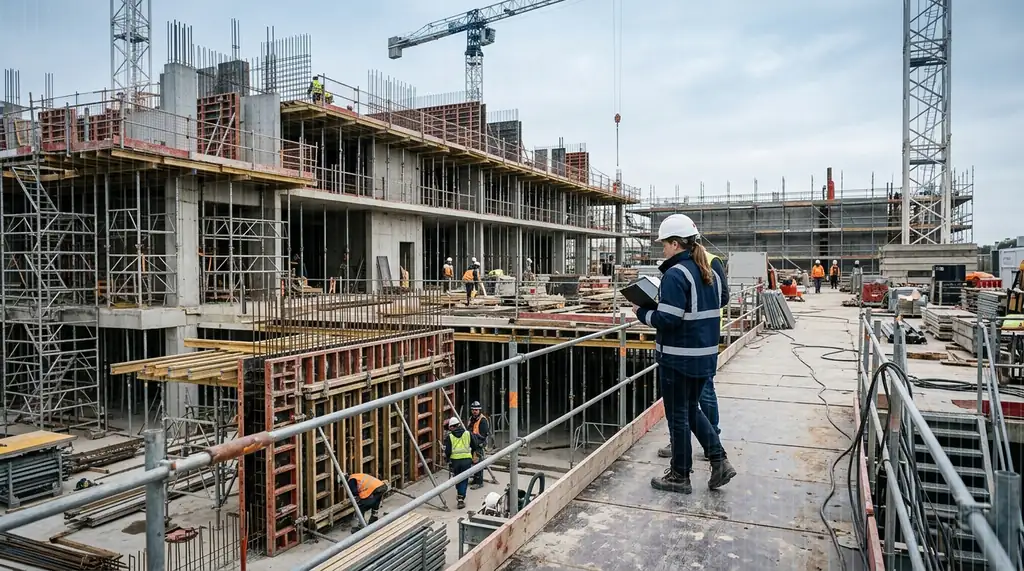
An operational flow for the surveyor: how TrueScreen makes the site inspection challenge-proof
The way to make a site inspection unchallengeable is to certify the documentation at the moment of capture, not afterward. TrueScreen, the Data Authenticity Platform, gives the court-appointed property expert an operational flow that turns each step of the inspection into verifiable evidence. The expert opens the inspection from the mobile app, capturing photos and video on site with a qualified timestamp and GPS coordinates applied at the source, so the date and place are fixed before the file ever leaves the device.
From there, the flow is built around how an expert actually works a property. Photographs can be context-tagged per room and orientation, so every image is tied to where it belongs and nothing arrives in court as a loose, unattributable file. The inspection can close with multi-party signatures, producing a signed record that the parties present acknowledged the operations. TrueScreen captures and certifies in a single forensic process: it integrates a qualified third-party QTSP's seal and qualified timestamp via API, so the resulting documentation carries authenticity and integrity recognized under eIDAS, with a chain of custody aligned to ISO/IEC 27037.
The distinction worth keeping clear is between the seal and the signature. The seal certifies the photos, video, and documents the expert captures: it attests that those files are authentic and unaltered. The signature is the personal subscription of the people involved, the acknowledgment that they took part in the operations. A robust inspection uses both: certified evidence of the property, and a signed record of who was there. Captured this way, the expert's report stops depending on being believed and starts being provable, which is exactly what gives it weight when a judge has to decide.