WhatsApp evidence in court: 2026 guide to chats, screenshots and voice messages with legal value
WhatsApp evidence court cases have multiplied across Europe, the UK and the US, yet judges still treat raw screenshots with growing suspicion. The app counts over two billion users worldwide and dominates communication in more than one hundred countries (WhatsApp Business 2025), so most disputes involve at least one chat, voice note or shared file. The complication: what you exhibit at trial is rarely what you saw on the phone. A screenshot can be cropped, a message can be deleted, a voice note can be re-encoded. How do you turn a WhatsApp conversation into evidence that survives a challenge on authenticity? The answer is a forensic acquisition with documented chain of custody, cryptographic integrity and a qualified timestamp.
WhatsApp as digital evidence: the 2026 landscape
WhatsApp content is admissible in most jurisdictions, but admissibility is not the same as probative weight. In a WhatsApp evidence court setting, judges now distinguish between a message that exists on a device and a message collected with a method capable of proving its integrity. That distinction decides cases.
Why WhatsApp content is admissible but contestable
WhatsApp messages, voice notes and shared files are generally accepted as electronic evidence under EU and common law frameworks. Recommendation Rec(2019)1 of the Council of Europe encourages courts to admit digital materials when authenticity and integrity can be assessed. The problem is the assessment itself: opposing counsel will ask how the content was acquired, whether the device was tampered with, whether timestamps match server logs. Without a documented method, those questions are hard to answer.
The two challenges: integrity and source authenticity
Every WhatsApp evidence court exhibit faces two attacks. Integrity: was the message altered between the moment it appeared on screen and the moment it reached the courtroom? Source authenticity: can the exhibit be tied to a specific account, device and time? A cropped phone-gallery screenshot answers neither. A forensic acquisition that captures the visible chat with metadata, network context and a cryptographic fingerprint addresses both.
International standards for digital evidence (FRE 901, ISO 27037)
Two frameworks govern how chats, voice notes and screenshots should be handled before they reach a judge. ISO/IEC 27037:2012 is the international standard for identification, collection, acquisition and preservation of digital evidence, defining the principles every forensic examiner follows: relevance, reliability, sufficiency, auditability. In the US, Federal Rule of Evidence 901 requires the proponent to produce evidence sufficient to support a finding that the item is what its proponent claims. A cryptographic hash at acquisition plus a qualified timestamp is the most direct way to satisfy both in 2026 practice.
Types of WhatsApp evidence and technical acquisition requirements
Each type of WhatsApp content has its own failure mode. Chats can be edited, screenshots lose context, voice messages get re-encoded, shared files replaced. Treating every type with the same method is the most common reason WhatsApp evidence court exhibits get excluded.
Text chats and group conversations
A text chat is a sequence, not a single artefact. Probative value comes from message order, sender identity, timestamps and unbroken thread. Capturing only a few messages invites a selective-disclosure objection. Best practice is to acquire the full visible conversation, scroll-by-scroll, with each frame timestamped and hashed. For group conversations, the membership list at the moment of capture matters as much as the content.
Screenshots: completeness and readability
A standalone screenshot is the weakest form of WhatsApp evidence and the most frequently contested. Without device, account, app version and time, a screenshot is just an image file. Counsel relying on screenshot evidence admissibility in 2026 should acquire the visible screen with device fingerprints and a cryptographic hash, then preserve the original capture. A forensic screenshot retains EXIF-equivalent metadata and a verifiable acquisition log; a phone-gallery screenshot does not.
Voice messages: file integrity and metadata
Voice notes are fragile. WhatsApp re-encodes audio when it is forwarded, exported or backed up, which changes the file hash even when the content is identical. Acquiring a voice message means capturing the original .opus file as it sits on the device, computing a SHA-256 hash at acquisition, and recording metadata such as duration, sender ID and reception time. A voice message court evidence package should include a transcription whose accuracy can be measured and disclosed.
Shared files, photos and videos
Files shared through WhatsApp travel through the platform's servers and are stored locally in compressed form, rarely identical to the original. When the file is the disputed item (a contract PDF, a photo, a video), acquisition must capture the file with its hash, filename, the conversation context that delivered it, and the time of receipt.
Video calls and Status: limits
Some WhatsApp content cannot be acquired after the fact. Video calls leave no recording on the device. Status updates disappear after 24 hours. The only viable approach is real-time forensic capture during the event itself, which requires the user to know in advance that the content will matter. Where prospective capture is not possible, supporting evidence (call logs, contemporaneous notes, server records via lawful request) is necessary.
| Evidence type | Technical requirement | Admissibility risk if missing |
|---|---|---|
| Text chat | Full thread capture, hash per frame, timestamps | Selective disclosure objection |
| Screenshot | Device fingerprint, hash, acquisition log | Authenticity challenge |
| Voice note | Original .opus file, SHA-256, metadata, transcript | Re-encoding objection |
| Shared file | File hash, conversation context, receipt time | Origin dispute |
| Photo or video | Hash, metadata, conversation thread | Provenance challenge |
| Video call | Real-time capture only | No artefact, inadmissible |
| Status update | Real-time capture within 24h | Content unrecoverable |
Chain of custody, SHA-256 hashing and qualified timestamp
Three pillars decide whether WhatsApp evidence court submissions hold up under cross-examination: a documented chain of custody, a cryptographic hash bound to each artefact, and a qualified timestamp issued by a recognised trust service provider. Without these, the WhatsApp messages legal proof rarely persuades.
Chain of custody for digital evidence in 3 steps
A defensible digital chain of custody for WhatsApp content follows three steps. First, identification: device, account, conversation, time window. Second, acquisition: the content is collected with a method that preserves integrity and produces an immediate cryptographic fingerprint. Third, preservation: the material is stored in a way that prevents modification and logs every later access. ISO/IEC 27037:2012 codifies these phases and is the reference for examiners across Europe and most common law jurisdictions, including the chain of custody UK practice.
SHA-256 hash and integrity protection
SHA-256 is a cryptographic function that produces a unique 256-bit fingerprint of any file or data block. If a single bit changes, the output hash changes completely. Applied to a WhatsApp acquisition, SHA-256 binds the content to a value that can be recomputed at any later moment to verify nothing has been altered. Courts and examiners treat SHA-256 as the de facto standard for integrity protection in WhatsApp evidence court proceedings in 2026.
Qualified timestamp under eIDAS and opposability
A qualified electronic timestamp under eIDAS Regulation (EU) 910/2014 is a legally binding date and time issued by a Qualified Trust Service Provider listed in the EU Trusted List. It anchors a digital artefact to a precise moment with a presumption of accuracy that opposing parties cannot dismiss without specific proof. Regulation (EU) 2024/1183 (eIDAS 2.0) extends the framework with remote qualified seals and the EUDI Wallet. For WhatsApp evidence, the qualified timestamp proves the acquisition happened when it claims to have happened, which is decisive when a defendant argues the content was created after the fact.
How TrueScreen certifies WhatsApp chats, voice and screenshots
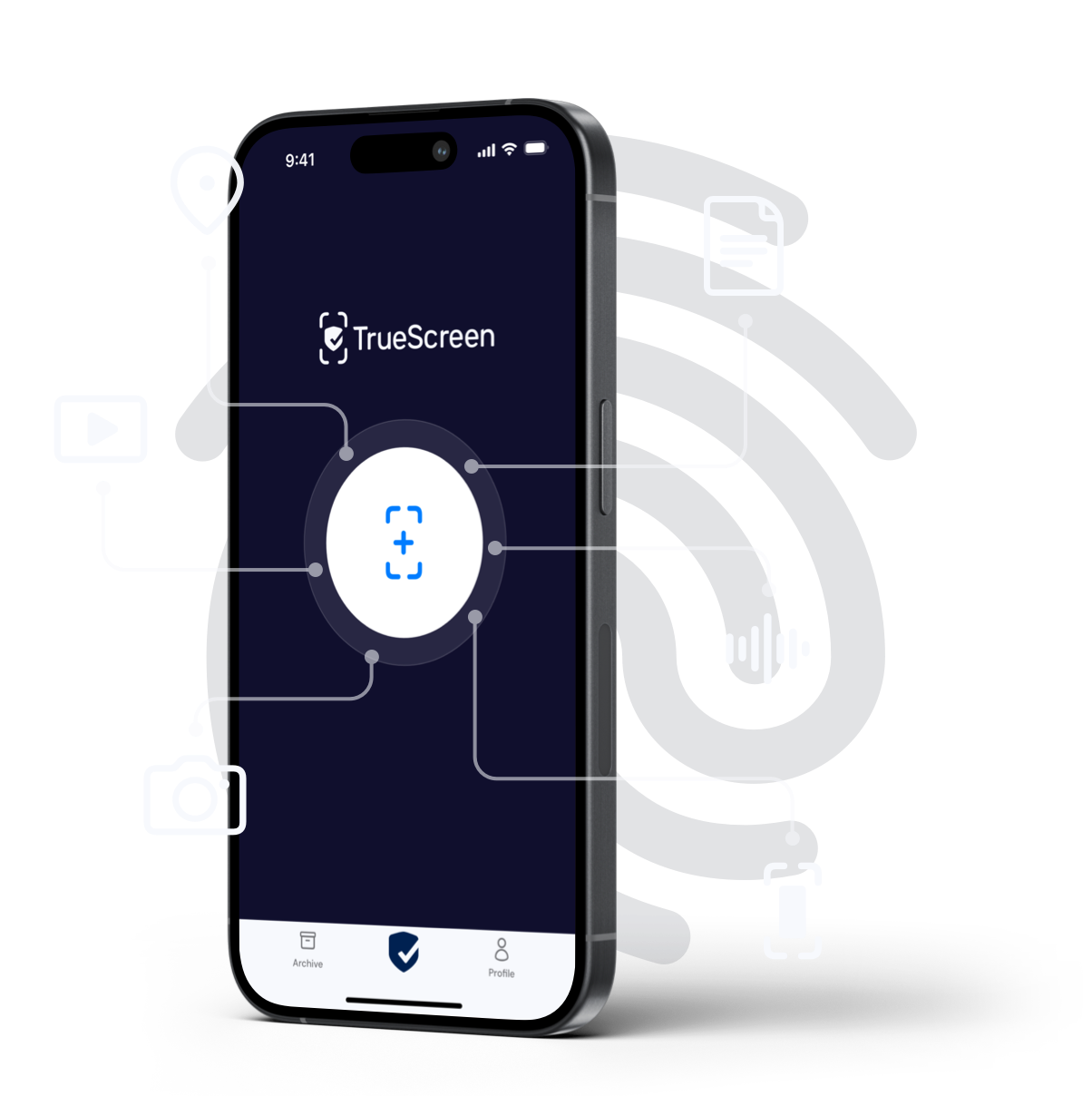
TrueScreen is the Data Authenticity Platform that captures and certifies WhatsApp content with a forensic methodology designed for WhatsApp evidence court use. The process integrates acquisition at the source, cryptographic integrity, qualified timestamping through an integrated QTSP, and a forensic report consolidating everything into a court-ready package. TrueScreen is not a Trust Service Provider itself: the qualified electronic seal and qualified timestamp are applied by a third-party QTSP via TrueScreen API, so the chain of trust rests on entities listed in the EU Trusted List under eIDAS.
Mobile app and browser extension capture
TrueScreen offers two complementary capture paths for WhatsApp. The App mobile acquires chats, voice notes and shared files from the phone with forensic methodology, including device fingerprints, network context and per-frame hashes. The Chrome extension does the same for WhatsApp Web sessions. Both feed into the same certification workflow and meet ISO/IEC 27037:2012 acquisition principles.
Forensic report with qualified electronic seal from integrated QTSP
Every TrueScreen acquisition produces a forensic report that consolidates the captured content, SHA-256 hashes, acquisition metadata and chain of custody log. The report is sealed with a qualified electronic seal applied by a third-party QTSP via TrueScreen API and bound to a qualified timestamp delivered by the integrated QTSP. The result is a self-contained PDF any examiner can verify independently. See the TrueScreen guide on forensic certification for more.
Who uses TrueScreen for WhatsApp evidence court cases (lawyers, investigators, HR)
Litigators use TrueScreen to preserve client WhatsApp content before disclosure deadlines. Forensic investigators rely on it for compliant acquisition in fraud, harassment and IP cases. HR and compliance teams document workplace incidents on company-issued devices. The common need is digital evidence that meets the digital evidence admissibility bar without requiring the user to be a forensic expert.
When a screenshot is enough and when forensic acquisition is needed
Not every WhatsApp exchange ends up as WhatsApp evidence court material, and not every case demands forensic-grade acquisition. A workable rule separates low-stakes documentation from material facing an adversarial challenge.
Decision framework for legal proceedings
A casual screenshot is acceptable when the content will never be contested. As soon as it may become WhatsApp evidence court material in a proceeding, used to support a disciplinary action, or relied upon to enforce a contractual right, forensic acquisition becomes prudent. The cost of certifying at acquisition is always lower than the cost of losing a case because the evidence was inadmissible. If the opposing party has any incentive to challenge authenticity, the screenshot route is rarely defensible.
| Scenario | Recommended certification level |
|---|---|
| Internal note, no dispute expected | Plain screenshot |
| Customer complaint, low value | Screenshot with metadata |
| Pre-litigation documentation | Forensic acquisition with hash |
| Civil proceeding | Forensic acquisition with qualified timestamp |
| Criminal proceeding | Forensic acquisition with chain of custody report |
| Cross-border litigation | Forensic acquisition with QTSP seal |
For deeper views on screenshot evidence admissibility, certifying WhatsApp chats, digital chain of custody, digital provenance and eIDAS 2.0 implications, see the dedicated TrueScreen guides.