Capturing online content as evidence before it disappears: a practical guide to forensic acquisition
A defamatory post, a fraudulent listing, a fake review that damages your name. You see it, and a quiet thought forms: "this could matter one day." Online, that day often never comes. Whoever published the content can delete it in seconds, and the only proof of the wrong vanishes with it. The instinctive reaction is to take a screenshot or use "save as," but that file on its own rarely holds up when it is challenged.
To save a web page as evidence does not mean keeping a picture of it. It means capturing the content at the source, at the exact moment it is still visible, recording what was published, where, and when, with technical guarantees that make it defensible. That is the difference between a contestable file and defensible, dated evidence with a documented chain of custody. This guide is operational: no doctrine, just what to do when content is about to disappear and you need to preserve it with legal value.
One thing to settle right away, because the confusion here is expensive: this is not about "saving something to read later," and it is not about recovering a page that has already been deleted through the Wayback Machine. It is about an action you take while the content is still online, freezing it as evidence before the person who posted it decides to make it gone.
Why a screenshot or "save as" is not enough as evidence
A screenshot or a printout of a web page, on its own, is weak evidence: it is an image that is easy to alter and carries no guarantee of when or where it was captured. Anyone can edit a screenshot in thirty seconds, and nothing in the file proves that the page actually existed at that address at that moment.
Courts evaluate digital evidence on its authenticity, and a bare screenshot struggles on exactly that point. Under the Federal Rules of Evidence, a screenshot must be authenticated under FRE 901 before it is admitted, meaning the party offering it has to show the item is what they claim it is. That burden falls on metadata, witness testimony, or technical signals that a plain image simply does not carry. The picture is admissible in principle, but its weight collapses the moment the other side raises a credible doubt about how it was made. We cover this in detail in our piece on the admissibility of a screenshot as evidence in court.
The browser's "save as" does not change the picture. It produces an HTML or PDF file that proves only one thing: that you, on your machine, saved something resembling that page. Everything that makes a capture defensible is missing: the hash that certifies integrity, the qualified timestamp that fixes the date against third parties, the network data that ties the content to its real address. Without those elements you are left with an image, not evidence.
What forensic acquisition of online content actually is
Forensic acquisition of online content is the process that captures and freezes a page with four technical elements that guarantee its authenticity and integrity: a hash, a qualified timestamp, an electronic seal, and context data. The combination is what turns a simple capture into defensible evidence, not the capture itself.
Each element answers a question someone will raise in a dispute. The hash is a unique code calculated on the acquired content: if even a single pixel or character changes after acquisition, the hash changes too, which is how you prove the file is still identical to the original. The qualified timestamp fixes a certain date and time, valid against third parties under the eIDAS regulation, recording exactly when the capture happened. The electronic seal attests to integrity and origin, which answers anyone who claims the content might have been tampered with. Context data covers the rest: URL, date and time, HTTP headers, network data, and process logs that describe where the content was published and under what conditions it was acquired.
Unlike a screenshot, every element here is independently verifiable. It is the same logic described in the international guidance on web evidence acquisition under ISO 27037, applied to the single ephemeral item that could disappear at any moment.
Ephemeral content: when time is the critical variable
When content is destined to disappear, time becomes the deciding variable: once it is deleted, in most cases you cannot recover it as evidence, and no later analysis can reconstruct what was never acquired while it was online.
Online content is ephemeral by nature. A post, a listing, or a review can vanish at any time, by the choice of whoever published it or through the automatic mechanisms of the platforms themselves. Stories last 24 hours. Marketplace listings come down the moment a seller closes a deal or senses a report. Reviews get edited or deleted by their authors. Sponsored posts have an expiry. In all these cases the useful window for acquiring the proof is measured in minutes, not days.
The table below is built to help you decide fast: for each type of content, what you risk if it disappears, and the acquisition method worth adopting right away.
| Content type | Disappearance risk | Recommended acquisition method |
|---|---|---|
| Defamatory social media post | Author deletes it or makes the profile private: proof lost for a complaint or lawsuit | Real-time forensic acquisition with hash, qualified timestamp and context data |
| Fraudulent marketplace listing | Seller removes the listing after the scam: no trace of the offer | Immediate acquisition of the listing at the source before removal |
| Fake or defamatory review | Author edits or deletes it: the original text is lost | Forensic acquisition of the review text and surrounding context |
| Story or expiring content (24h) | Disappears automatically by platform design | Acquisition within the visibility window, from app or browser |
| Corporate web page or landing | Updated or taken offline: the disputed content changes or vanishes | Full-page acquisition including HTTP headers and logs |
| Email or online message | Deleted from the inbox or retracted | Certified acquisition of the message and its metadata |
The practical rule is a single one: if content can disappear and might serve you as evidence, acquire it now. There is no better moment than the one in which the content is still online in front of you.
The limits of the Wayback Machine as a source of evidence
The Wayback Machine is valuable for research and the historical memory of the web, but as a source of evidence it has structural limits: it archives retroactively and incompletely, it does not guarantee it saved the exact page you need at the moment you need it, and it offers no documented chain of custody.
Unlike real-time forensic acquisition, the Wayback Machine archives after the fact: it saves snapshots of pages when its crawlers happen to visit them, not when the wrong occurs. Many pages are never archived at all, others survive only in partial versions or with missing elements, and content behind a login or generated dynamically almost always escapes capture. Above all, you do not control the moment of archiving: if the defamatory post was online for two hours and then deleted, the odds are the Wayback Machine never saw it. Courts have accepted Wayback Machine captures in some matters, typically when paired with a declaration from the Internet Archive, but that is a far cry from evidence whose date and integrity you fixed yourself.
This makes the retroactive archive unsuited to documenting ephemeral content or to providing proof with a certain date and guaranteed integrity. We analyzed the question in our article on the legal limits of the Wayback Machine as evidence. The operational point stays simple: forensic acquisition solves the problem at the root, capturing the content at the moment it is online instead of hoping someone else archived it first.
The legal framework: ISO/IEC 27037 chain of custody and FRE 901 authentication
The evidentiary weight of acquired online content rests on two pillars: the authentication rules that decide whether a court will even consider it, and the acquisition standards that document the chain of custody, starting with ISO/IEC 27037.
Authentication comes first. Under FRE 901, evidence is admissible once the proponent shows it is what they claim it to be, and FRE 902(13) and 902(14) go further, treating certified records generated by an electronic process, and data verified by a hash, as self-authenticating. A well-documented forensic acquisition speaks directly to that standard: the hash, the qualified timestamp, and the logs demonstrate on technical grounds that the content has not been altered, which is exactly what an authentication challenge attacks. Our guide to FRE 901 authentication of digital evidence goes deeper for anyone who needs it.
The other decisive element is the chain of custody. ISO/IEC 27037 provides the international guidelines for identifying, collecting, and preserving digital evidence so that every step is traceable and reconstructable. The Budapest Convention on Cybercrime pushed many jurisdictions to adopt technical measures capable of preserving the integrity of acquired data and preventing its alteration. A documented digital chain of custody is what separates solid evidence from contestable evidence: without it, even a technically correct acquisition stays exposed to doubts about authenticity.
How to capture online content with legal value using TrueScreen
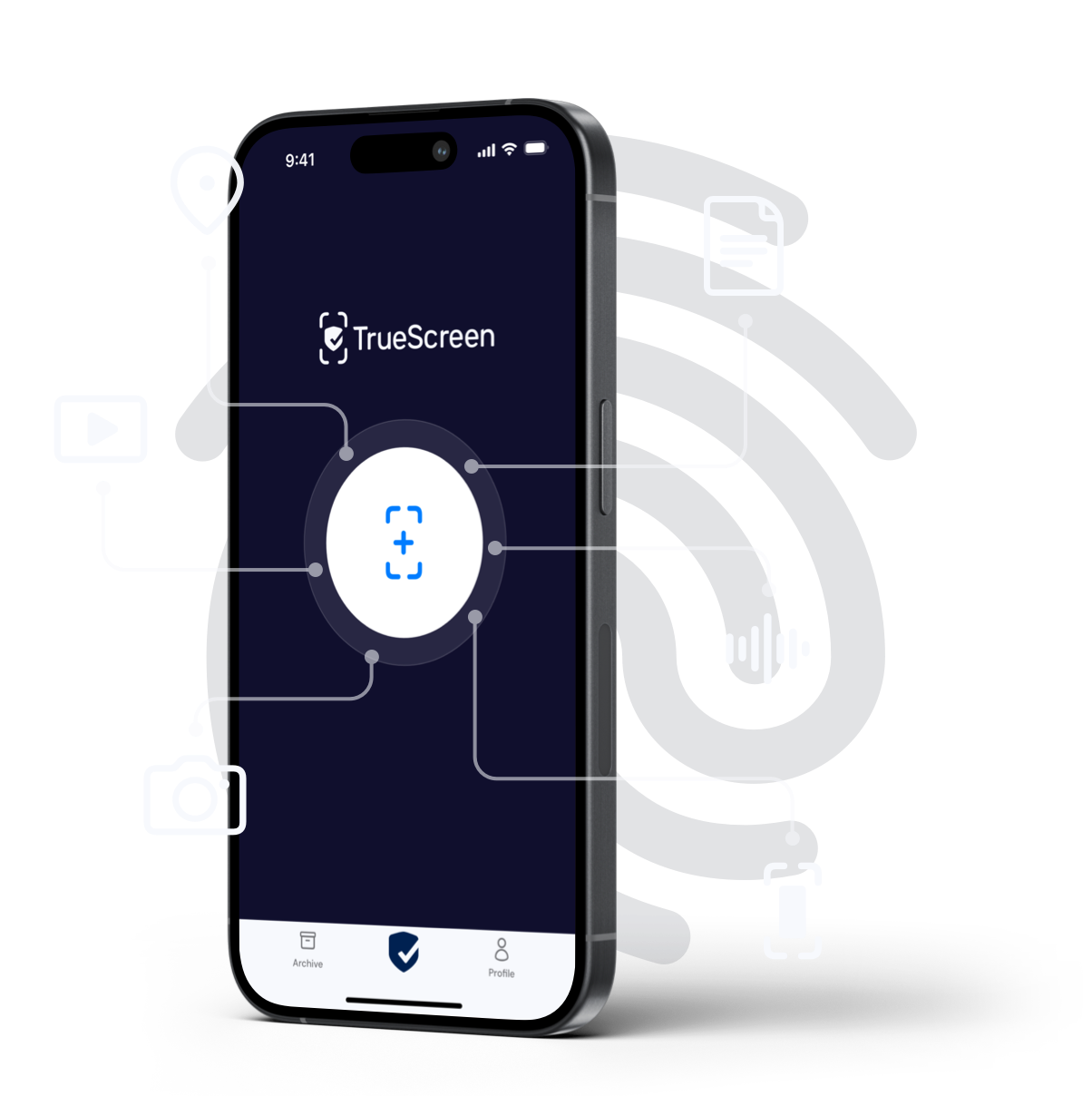
To save a web page as evidence with legal value, TrueScreen captures the page directly at the source and, at the moment of acquisition, applies every element that makes it defensible: it records the content, calculates the hash, applies a qualified timestamp and an electronic seal, and collects the context data (URL, date and time, network data) that prove what was published, where, and when. The result is defensible, dated evidence with a documented chain of custody.
TrueScreen acquires and certifies online content directly at the source, and it does so with tools built for different situations. From the Forensic Browser and the Web Portal you acquire full web pages, HTTP headers and process logs included. With the Chrome Extension you capture content while you are looking at it in your browser, with no intermediate steps. With the App you acquire content viewed on mobile, including Stories and social posts that are hard to capture from a desktop. And for those running brand protection at scale, API and SDK let you embed acquisition into your own workflows and automated monitoring.
One point deserves to be stated plainly: the qualified timestamp and the electronic seal are not issued by TrueScreen, which is not a certificate authority. TrueScreen integrates the seal of a qualified third-party QTSP via API, applying to the capture a qualified timestamp issued by the QTSP integrated into the platform. That architecture is what gives the evidence its legal weight, because it keeps the party that acquires separate from the party that certifies. For other scenarios you can read how to certify a web page with legal value across contexts, from defamation to copyright protection.
A concrete example. A brand protection manager spots a marketplace listing selling counterfeit goods under the company's trademark. She already knows the seller will pull the listing at the first sign of trouble. Instead of taking an easily contestable screenshot, she acquires the listing from the marketplace in about thirty seconds, before it disappears: she gets the page with its hash, qualified timestamp, seal, and context data. When the seller removes the listing a few hours later, the evidence is already frozen and ready for a cease-and-desist or a lawsuit.
Practical cases: fraudulent listing and defamatory post
The scenarios where capturing content before it disappears truly makes the difference are two above all: the fraudulent listing, which gets removed fast, and the defamatory post headed for a legal complaint. In both, the evidence exists only as long as the content is online.
The fraudulent listing. A consumer finds a deal on a marketplace that is too good to be true, pays, and never receives the product. By the time he returns to the page to document the scam, the seller has already deleted the listing. Had he acquired the listing at the moment of purchase, with a certain date and context data, he would have defensible evidence to attach to a complaint or a refund request. Without it, it is his word against nothing. The rule: acquire the listing the moment you complete a suspect transaction, not afterward.
The defamatory post. A person or a company is publicly attacked with false statements on social media. To proceed with a complaint or a civil suit, you need to show what was written, by whom, and when. But the author, aware of having gone too far, can delete the post or make the profile private within a few hours. Acquiring the post forensically while it is still visible, with the author's identifier and the qualified timestamp, guards against that escape. The same approach applies to the broader category of social media evidence you need to capture and authenticate before it is taken down.
The common thread is speed. The best evidence is the one collected while the content is still online: every hour that passes is an hour in which someone can make it vanish.