AI fake news: when content provenance becomes the proof
AI fake news no longer looks like clumsy, misspelled text that anyone can spot. It now arrives as images and video that hold up at first glance, indistinguishable from a real recording: a frame from a conflict zone, a familiar face saying things never said, a newspaper page that never went to print. Generated in seconds, ready to spread before anyone can react.
The trouble is that the fake travels faster than the people debunking it. In recent conflicts, synthetic content topped a billion views before any verification caught up with it. By the time the correction lands, the image has already shaped an opinion and worked its way through group chats. Recognizing the fake after it goes viral does not bring back the trust it cost.
That is why a purely defensive approach has stopped working. Chasing every fake to expose it is a race you lose from the start. The stronger move is to flip the logic: instead of proving that something is false, certify what is authentic at the source. TrueScreen works on exactly this principle, turning the provenance of a piece of content into its proof. When the origin is certified at the moment of capture, there is no need to chase the fake anymore: the authentic content speaks for itself.
Why visual disinformation became structural in 2026
AI-generated visual disinformation is the spread of synthetic images, videos and screenshots built to deceive, now so realistic that they pass the test of the human eye. It is no longer a fringe phenomenon. It became structural for a simple reason: producing a convincing fake costs a few seconds, while verifying one takes hours and specialized skill.
The imbalance is stark. Anyone generating disinformation has fast, free tools within easy reach. Anyone who has to verify works downstream, with limited resources and long turnaround times. The result is an ecosystem where synthetic media spread faster than defenses can respond.
The scale of the problem shows up in the numbers. According to NewsGuard, 35% of responses from leading chatbots contained false claims in August 2025, nearly double the 18% recorded in August 2024. The same technology meant to help people stay informed ends up amplifying online disinformation when it is trained on polluted sources, often mass-produced by content farms that churn out false material automatically.
When a fake tops a billion views before the correction
Speed of spread is the real critical factor. In the conflicts of 2026, several disinformation campaigns built on AI war images and synthetic video topped a billion views before any independent verification could debunk them. By the time fact checking arrives, the damage is done: audiences have seen, shared and mentally filed that content as true.
This is where every reactive approach shows its weakness. The correction reaches only a fraction of the audience touched by the original fake. AI-generated false news rides the same social infrastructure that rewards emotion and speed, not accuracy. Verification, however accurate, always comes second.
The fabricated context that amplifies credibility
The most effective fakes are not just images: they are images wrapped in fabricated context. A synthetic photo becomes far more believable when paired with a fake newspaper page, a plausible date, a quote attributed to a real outlet. This is the logic of the shallow fake: you do not need a sophisticated deepfake if the surrounding frame looks authentic.
That mechanism shifts the problem. Analyzing the pixels of an image is not enough to decide whether it was generated, because even real content can be reused inside a false frame, with misleading captions or invented attributions. Media manipulation today works as much on the content as on the frame around it, and it is the frame that makes it so hard to dismantle.
Why recognizing the fake is not enough
Recognizing the fake is not enough because it always comes too late, and once content goes viral, trust does not return. Detection is a reactive defense: it estimates the probability that content has been manipulated, but it does so once that content has already circulated. Chasing every fake is a strategy that starts at a disadvantage by definition.
There is also a deeper technical limit. Automated detection systems learn to recognize known generation techniques, but generative models evolve faster than the models built to defend against them. Every advance in producing AI images makes the previous detector obsolete. It is a permanent chase, and the side playing defense always stays one step behind.
Unlike detectors that estimate the probability that content is fake, TrueScreen proves when and how authentic content was captured. The shift in perspective is substantial: the point is not to demonstrate that something is bogus, but to certify that something is genuine, at the exact moment it exists.
Detection chases manipulation that moves faster than defenses
Automated detection has a structural problem: it runs after a manipulation that changes constantly. A detector trained on yesterday's fakes struggles with today's, and tomorrow it will already be outdated. The challenge is not building a better detector but stepping out of a race that, by design, cannot be won.
This asymmetry explains why many organizations are looking at the limits of automated detection and searching for another path. When the problem is structural, the answer cannot be a single, ever more sophisticated tool: it takes a change of paradigm. Certifying the authentic at the source drains value from the fake, because it puts a verifiable reference on the table to measure doubtful content against.
Lost trust does not return with a correction
The damage from disinformation is not only informational. It is reputational, and it lasts. When a fake attributed to a person or an organization goes viral, the later correction reaches fewer people and convinces even fewer. The doubt, once planted, stays.
This holds for anyone who produces or holds their own content: a newsroom, a company, an institution. Debunking someone else's fake is exhausting and rarely effective. Being able to prove the authenticity of your own content, with verifiable evidence of its origin, is an entirely different position. It moves the weight from "what they say is not true" to "here is the proof of what actually happened."
How to certify content authenticity at the source
TrueScreen certifies the authenticity of photos, videos and screenshots at the exact moment they are captured, recording their provenance with legal value. Instead of analyzing content after the fact to figure out whether it is fake, it acts at the origin: it captures the data, verifies its integrity and certifies it before it can be altered or pulled out of its real context.
At the core is a forensic methodology that captures, verifies, and certifies digital content at the source, before it can be altered, guaranteeing authenticity, traceability, and legal validity throughout its entire lifecycle. The chain of custody starts at capture, not at publication: that is the difference that turns provenance into proof rather than a mere clue. The whole idea of digital provenance rests on this.
Every photo or video captured with TrueScreen receives a digital seal and a qualified timestamp, attesting to its authenticity, integrity, and date with full international legal value. The seal applied is officially recognized, legally valid, and aligned with the European eIDAS framework for electronic seals and qualified timestamps. With TrueScreen, provenance is not an indicator: it is the proof.
Certified capture from a mobile device
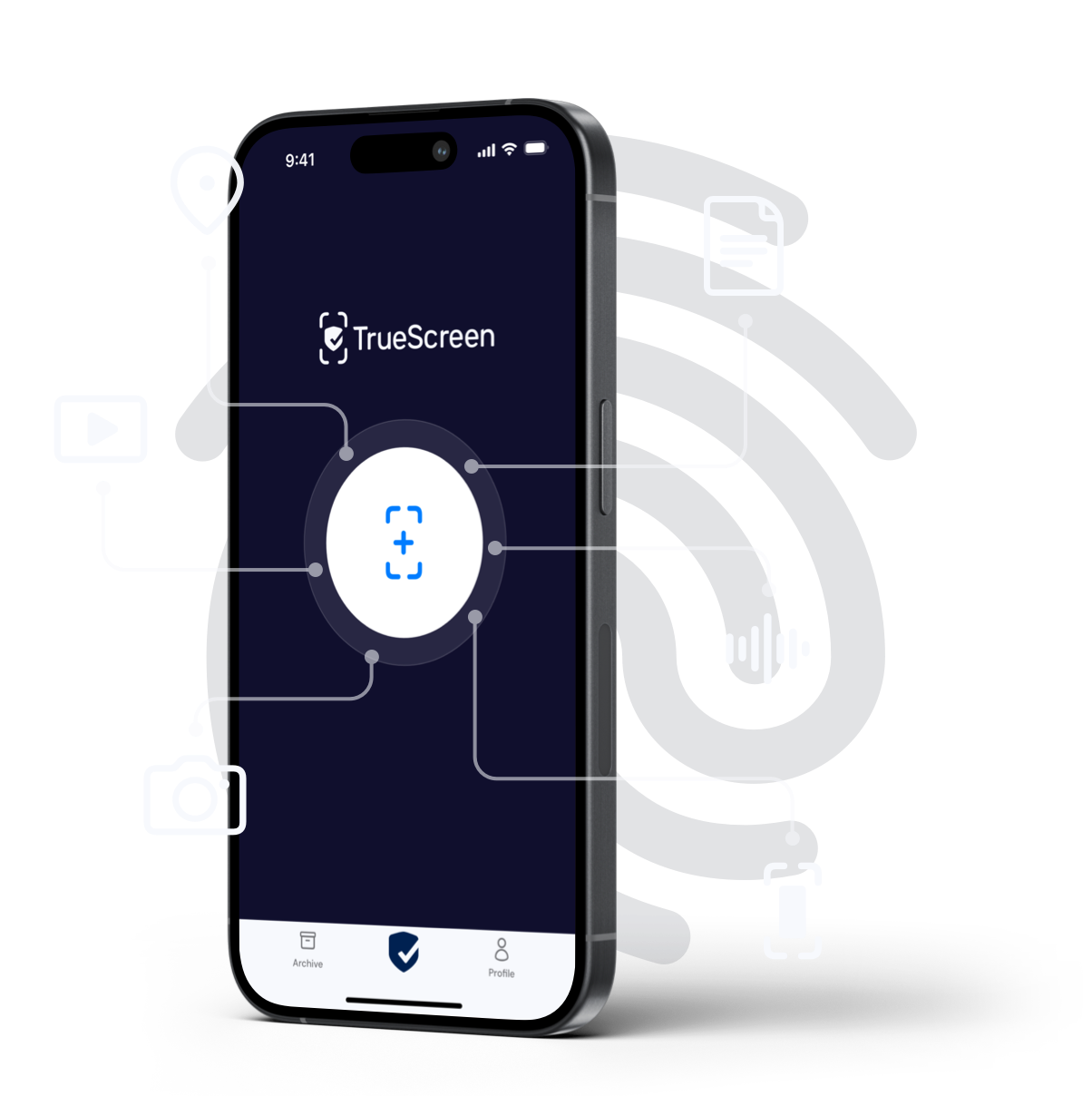
The TrueScreen App lets you capture photos and videos directly from your smartphone with a forensic methodology. At the moment of capture, the content is certified with a digital seal and a qualified timestamp, together with its context metadata. A reporter in the field, an insurance adjuster, a technician documenting a site inspection: all of them can produce evidence with a certified origin, not just contestable photos.
Certified capture of web content
The Forensic Browser captures web pages, social posts and online content with full legal value. When a news item or an image circulates online, capturing it with TrueScreen fixes its exact state in that moment, with a trusted date and complete traceability. It is the tool for documenting what exists online before it gets edited or removed, with everything flowing back into the Web Portal and available through the API and SDK for integration.

What AI Act labeling covers and what it does not
AI Act labeling certifies that content was generated by AI, but it does not say what authentic content represents or where it comes from. These are two different planes: the label declares the synthetic nature, source certification attests to the real origin. One does not replace the other.
The AI Act introduces new obligations for traceability and transparency of AI-generated content. TrueScreen addresses these requirements by certifying digital data authenticity at the source, ensuring provenance and legal validity. The AI Act synthetic content labeling obligations become applicable from 2 August 2026 and concern transparency about synthetic content. But the label covers only what is declared, and it depends on whoever generates the content choosing to disclose it.
That is where the limit sits. Provenance certified at the source, by contrast, does not rely on a voluntary declaration: it is a technical fact written into the content at the moment of capture. It covers what the label cannot see, namely the positive authenticity of real content.
| What the AI Act label certifies | What source provenance certifies |
|---|---|
| That content was generated by AI | That content is authentic and when it was captured |
| Depends on the generator's declaration | Does not depend on declarations: it is technical and automatic |
| Applies to synthetic content | Applies to the real content you need to protect |
| Transparency about the nature of the content | Legal proof of origin and integrity |
| Obligation applicable from 2 August 2026 | Available at the source, before publication |
Authenticity is not verified after the fact: it is guaranteed at the source, before the data can be disputed. Label and certification work on complementary problems, but only the second answers the question that really matters: this real content, where does it come from?
Practical examples: newsrooms, companies, institutions
Source certification changes the position of anyone who has to defend the authenticity of their own content, because it moves the weight from the correction to the proof. Three profiles show this clearly: newsrooms, companies, and public institutions.
Newsrooms can use TrueScreen to capture content directly at the source and prove its origin, instead of chasing the correction. When a reporter receives a video from a source or documents an event in person, capturing it with a forensic methodology means being able to prove its authenticity if it is ever disputed. Certified provenance becomes part of the editorial record, rather than a check carried out after the fact.
For companies the risk wears a different face: being attributed content they never produced. A fake press release, a manipulated video of an executive, a fabricated screenshot of a conversation that never happened. Certifying their official content at the source lets companies set a verifiable proof against any imitation. The gap between absorbing disinformation and dismantling it with evidence of origin is enormous.
Public institutions face the same challenge, only wider. A synthetic image attributed to a public body can feed disinformation across an entire population. Being able to prove which content is authentic, with a trusted date and traceability, becomes a safeguard of transparency toward citizens. Content provenance then turns into an infrastructure of trust, not a one-off defense good for a single occasion.